It happened about once every couple of months. I’d get an email in my Microsoft mailbox saying something like,
I just wanted to send you an email and say hi. . .Hi!
Huh?
Eventually it became obvious that these emails were the result of meetings my brother was giving. We both left WordPerfect at the same time. We left under somewhat different circumstances (I Was A Pawn in the War With Microsoft. . .(He Got To Be A Knight.))
At WordPerfect my email address had been RODNEYB. When I got to Microsoft, I checked and that name was already taken. The system assigned me RODBL. I don’t go by Rod at work and RODBL isn’t even pronounceable. So, I picked RBLISS. My email was [email protected].
My brother Richard also left to go to a new company. Eagle Systems, I think it was. He decided to also pick RBLISS. So, his email address was [email protected].
Aside from the confusion this was our mother, it wasn’t too bad. Richard is a brilliant marketer. He quickly rose to senior marketing positions with various companies. Each company he went to he kept the email address RBLISS. As a marketing person he gave lots of public presentations; to customers, and to the press mostly.
He would end each presentation by inviting people to email him with further questions.
If you can’t remember my email just send it to [email protected]. It’ll get to me.
That was his laugh line. Since he was normally speaking to groups who were using competing products to Microsoft, it went over pretty well. Unfortunately, some people just had to try it out.
When I left Microsoft I started doing private consulting and used the email rbliss at msn dot com. This is still my primary email address. I remember the first tradeshow that we both attended.
This RBLISS thing is going to cause a problem.
Not for me! You’ve been telling that joke for 10 years. Besides, I had it first!
Tell your friends about this!


(photo credit mastermadefeeds.wordpress.com)
He meant me.
I’d been at Microsoft for about 3 years and I was transitioning into a new position. . .and Mark was transitioning out of it.
Mark had been writing courseware for Microsoft for years. He wasn’t moving far. In fact, his office would stay on the fourth floor of the Microsoft Exchange development building, and he was going to start writing Microsoft Official Curriculum: same content, different audience.
Also, Mark was brilliant. Most of what I knew about Microsoft Exchange I had learned from him. Most of what ANYONE knew about Exchange they had learned from him.

My new customers in Support LOVED Mark. They didn’t even know me.
Rodney who?
Are you sure Mark can’t stay?
Because our offices were on the same floor and we would both be writing curriculum, Mark did more than the usual, “I’m leaving. . .call me if you have any questions. . .but I hope you don’t” that I was used to when taking over for someone.
My first day we discussed how we would handle the transition.
I’ll keep fielding the questions for a while and I’ll add you to the distribution. That way I can introduce you to the customers and when you feel comfortable just let me know and I’ll drop out.
That was the plan. It ran up against two technical issues. It started fine. Mark got a question from our group of customers and decided to introduce me. He added me to the email thread. Then he answered the question and at the end put
. . .What do you think, Rodney?
Early versions of Outlook spellchecker didn’t include the name “Rodney” as a correctly spelled word. It showed up with that squiggly red line under it. Outlook offered alternatives. The first was, you guessed it, “Rodent.” It even kept the capitalization. The second problem was that Exchange did not have the ability to recall a message. So, Mark’s attempt at introducing me to the group was by asking me “What do you think, Rodent?”
He felt terrible, of course. I try not to hold grudges. So, I renamed our shared printer. For the next two years whenever Mark printed a document, Windows would tell him,
Now printing to the Rodent.
(We remain friends and laugh about it now.)
Rodney Bliss is an author, blogger and IT manager. He’s been in the IT field longer than he can remember. He lives in Pleasant Grove, UT with his lovely wife and their 13 children.
Tell your friends about this!


With any new system there are bound to be glitches. This one turned out to be mild. . .and tasty.
We had recently setup Cisco MeetingPlace as our conference call system. Being part of the messaging team, we went out of our way to use it as often as possible, so that we could become familiar with the features.
One of the nice features was that the system would actually call your phone number at the start of a meeting. This was handy for people who were traveling for example, or on a cell phone. You just had to press a key to join the meeting. Assuming you entered the correct phone number.
I remember one meeting about a week after we’d set up the system, where we were discussing the performance of the email system. Between those in the conference room and those on the call we probably had about a dozen people. Ten minutes into the meeting someone on the phone spoke up.
Ah. . .could you guys tell me why I’m here?
Who is this?
This is Jake Smith.
I didn’t know a Jake Smith, but I was new to the company. Looking around the conference room I got back blank stares and shrugged shoulders.
Ah. . where are you Jake?
I’m at Subway in Orem.
What are you doing at Subway, Jake?
I work here.
The looks in the conference room turned to confusion.
How did you get on this call, Jake?
Well, the phone rang and when I picked it up, it said to press “1” to join the meeting, so I pressed “1.”
Jake, I don’t think you need to be here. Sorry about that.
Oh, okay. I wasn’t sure.
Jake, why didn’t you say anything before now?
Well, I didn’t want to interrupt.
Sometimes the tools are part of the problem.
I was planning to post a book review of “The 4 Hour Work Week.” Look for that sometime next week. It’s taking me longer than I expected to wade through it.
Rodney Bliss is an author, blogger and IT manager. He’s been in the IT field longer than he can remember. He lives in Pleasant Grove, UT with his lovely wife and their 13 children.
Tell your friends about this!

How many of you like to read network traces?
No hands
How many of you hate to read network traces?
Every hand went up.
The speaker was Krista Anders a trainer for Microsoft Corporation. And, while this class of 25 Microsoft Exchange support engineers was being taught at Microsoft’s training facilities in Las Colinas, TX, Krista told me that she started every class the exact same way. And always got the exact same reaction.
By the end of this three day course, you will LOVE to read network traces.
It was clear from their faces that no one believed her. That was okay. She didn’t expect them to. She’d been through this enough to know how it was going to turn out. And the more skeptical the students were at the beginning the more exciting the transformation was by the end.
Chances are you didn’t come to this blog to find out how to read network traces. Don’t worry, while they can be extremely interesting, I won’t take you through them. I want to talk about this course and this experience for two reasons.
First, I think it illustrates why we hate certain things and what we need to do to overcome that hatred.
Second, I wrote the course and it was one of the most amazing things I ever created.
Let me give a little background on network traces, so that you can understand what Krista was up against. Most people understand that computers “talk” to each other. If you’ve ever sat waiting for a web page to refresh, you know that sometimes computers talk v.e.r.y s.l.o.w.l.y. When that slowness happens for corporate customers, they call Microsoft for help.
Just as it’s possible to record a conversation between two people speaking, or texting, it’s possible to record a conversation between two computers talking. The results are called a network trace. . . and if you’ve ever seen one, it looks like someone threw a bomb into a dictionary. There are letters, but no words. If you look closely, you’ll notice the letters are all A, B, C, D, E and F. The reasons have to do with binary to hexadecimal conversions. (That’s the last we’ll talk about that topic here.) 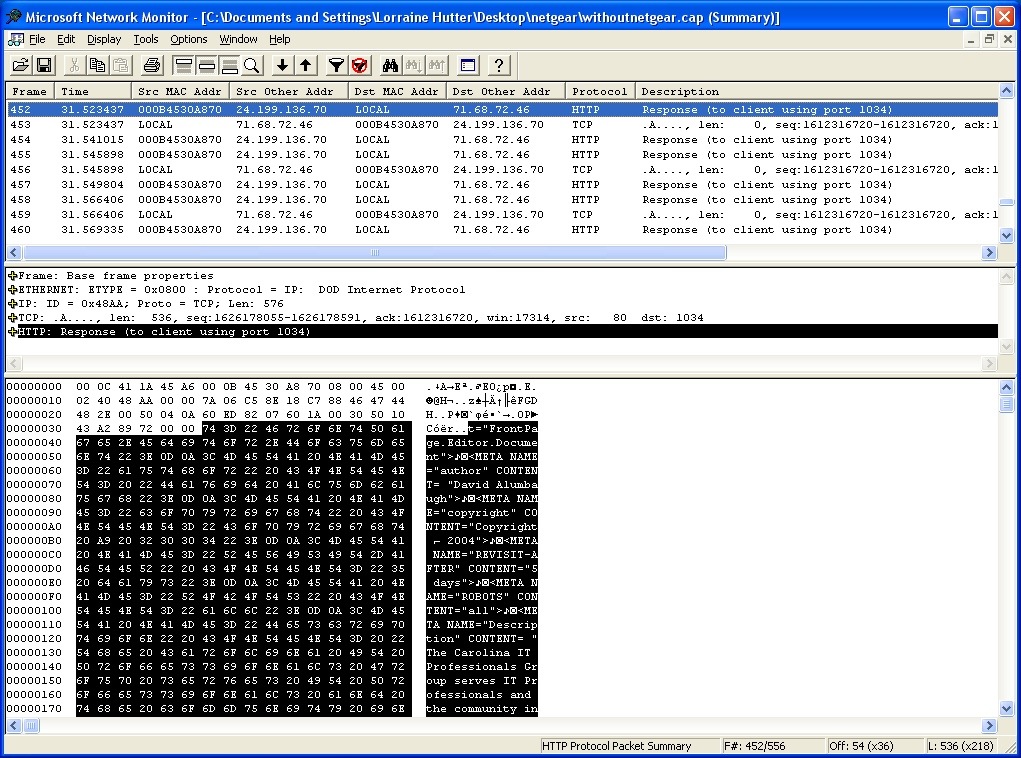 (Image courtesy of net-analyst.com)
If you don’t know what you are looking at, it can be confusing. If you are trying to help a customer and you don’t know what you are looking at, it can be very frustrating. Everyone in the class had been in support for at least 6 months and that meant they had looked at plenty of network traces.
You might as well try to translate Greek to English without ever having studied Greek.
The course was three days long, but it was really the same 20-30 minute lesson repeated over and over. In the first half hour we took people through a prerecorded network conversation between a Microsoft Outlook client and a Microsoft Exchange server. There are only about 8 things those two systems can say to each other. Once we covered those 8 commands it was simply a matter showing how to recognize each command in the network trace.
So, far this is no better than any lecture where the professor explained amino acids and how to recognize the different acids. (I have no idea how many amino acids exist.)
But, in the afternoon of the first day we started into the labs. Students worked in groups of two and they started making their own network traces. And then deciphering them.
The first time I taught this course, I got really nervous in the afternoon of the first day.
Ah. . .does anyone have any ques. . .
Quiet! I’m getting it.
It was amazing to watch the light of understanding dawn on each student’s face. A student would look at his lab partner.
Let’s try Calendar!
Yeah!
And at that point, it was simply a matter of practice, and testing different scenarios.
All of our instructors loved to teach this class. Krista told me about one class where a student approached her after the course was over.
When I got here and saw that we were going to be studying network traces, I decided there was no way I was going to subject myself to that torture for three days. But, then you issued that challenge that we’d learn to love traces. I stuck around just so that I could prove you wrong.
And?
I can’t. I loved this class. I can’t wait to get back to my desk and start trying new combinations.
What does this have to do with business development?
A lot, I think. I want to talk about people and processes.
People
Part of the reason EPA was such a challenging account for WordPerfect (How I saved the EPA) was the EPA’s chief email administrator was a very demanding person. She would question our answers. She would call with one question and then add another, and another and another. NO ONE wanted to talk to Bridget.
When I was assigned to work with the EPA, it meant, of course that I had to work with Bridget. Right around this time we had an email conference in Utah and Bridget attended. After meeting her and spending some time with her team an interesting thing happened. I no longer dreaded the phone ringing. I understood why she was asking such detailed questions. And I started to look forward to talking to her. I once figured out how to solve a particularly tricky problem and could hardly wait to call her and explain it.
Once I learned enough about her and her personality our relationship improved dramatically.
Processes
While working for a large non-profit in Utah, I managed the monthly maintenance for our 5 datacenters. Before I took over monthly maintenance, the Monday after the maintenance weekend was plagued with unexpected down time. They were called P1 incidents. And you did not want to be the manager who was associated with causing them. During a P1, pretty much everything stopped until the system was restored.
I took a different approach. If we had a P1 on Mondays, I constantly pestered the Major Incident Managers to know if I caused it during our maintenance over the weekend. P1s were often my only metric to know if something went wrong. If we missed a process, I wanted to know so that I could fix it and not miss that same process next month.
By understanding the value of the P1 designation, I could stop fearing it and start learning from it.
That was my intention anyway. I never really got to test that theory since my engineers did outstanding work and after taking over the monthly maintenance we never again caused a Monday morning P1.
So, from what I could see, the difference between hating a task and liking it was often a matter of education. Once the students understood network traces, they loved getting them from their customers since it was the quickest way to pinpoint the problem.
Even though I wasn’t reading network traces anymore, I found the same process applies to other scenarios as well.
(Rodney Bliss is an author, blogger, and IT manager. He’s been in the computer business for longer than he can remember. He lives in Pleasant Grove, UT with his wife and 13 children.)
Tell your friends about this!

Hey Sandra, I think I’ll take up doodling as a hobby.
– Howard Tayler circa 2000
My friend Howard Tayler lives about 3 miles from me. We worked together briefly at WordPerfect. He’s got a wonderful wife and three beautiful children. He drives a green Volkswagen beetle and he has a completely insane business plan. Howard draws comics. He’s the genius behind the popular and award winning webcomic “Schlock Mercenary.”
Howard’s business model is to draw a comic and give it away for free on the internet every day. Schlock Mercenary launched on June 12, 2000. That makes the strip 13 years old today. And it really is free. You can go back and read every Schlock Mercenary strip from that day in June 13 years ago to today, all 4,748 of them, for free. There are two amazing things about Schlock Mercenary.
First is that in all that time, 678 weeks (and two days) Howard has never once failed to update his comic. That includes the day that the datacenter hosting his servers blew up.
Second, and to me more impressive is that all 4,748 days are available for free. Try it. Go to www.schlockmercenary.com and look at the navigation bar on the right. Click the “GO TO FIRST” arrow and you’ll see the first strip. I’ve put it here as well.
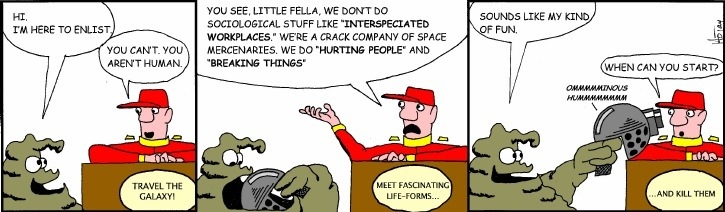
((c) HyperNode Press and Howard Tayler. Used by permission.)
Here’s an updated version of that first strip that he did as part of a bonus story a couple years ago.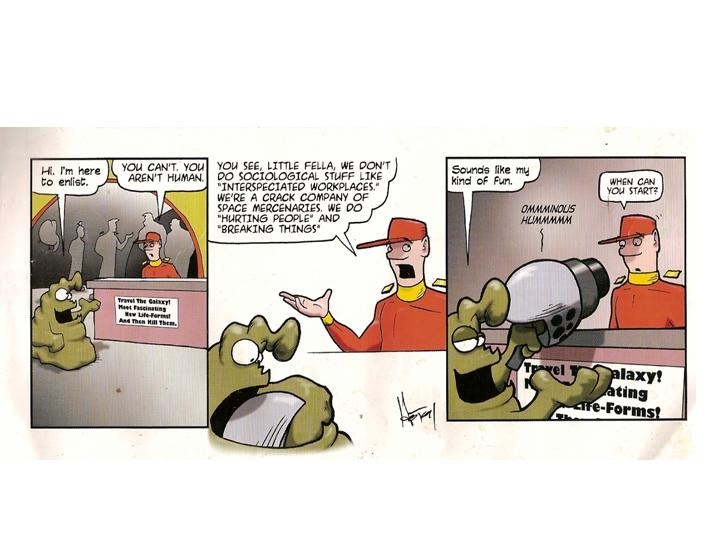 ((c) HyperNode Press and Howard Tayler. Used by permission.)
And here’s the strip from today. As you can see, Howard’s drawing improved. . .a lot.
 ((c) HyperNode Press and Howard Tayler. Used by permission.)
When the strip launched back around the turn of the century, Howard was working for a big computer software company. About 6 years ago, he opted to ditch the cubicle and become a full-time cartoonist. . .by drawing a comic and giving it away for free on the internet every day.
How does that even work?
It works by creating a brand and a fan base and then providing added value to those fans.
1. Create free content
2. Attract a following
3. Repackage your content into books with some added bonuses
4. Keep creating free content
5. Find new and interesting things that your fans will want to buy based on your content
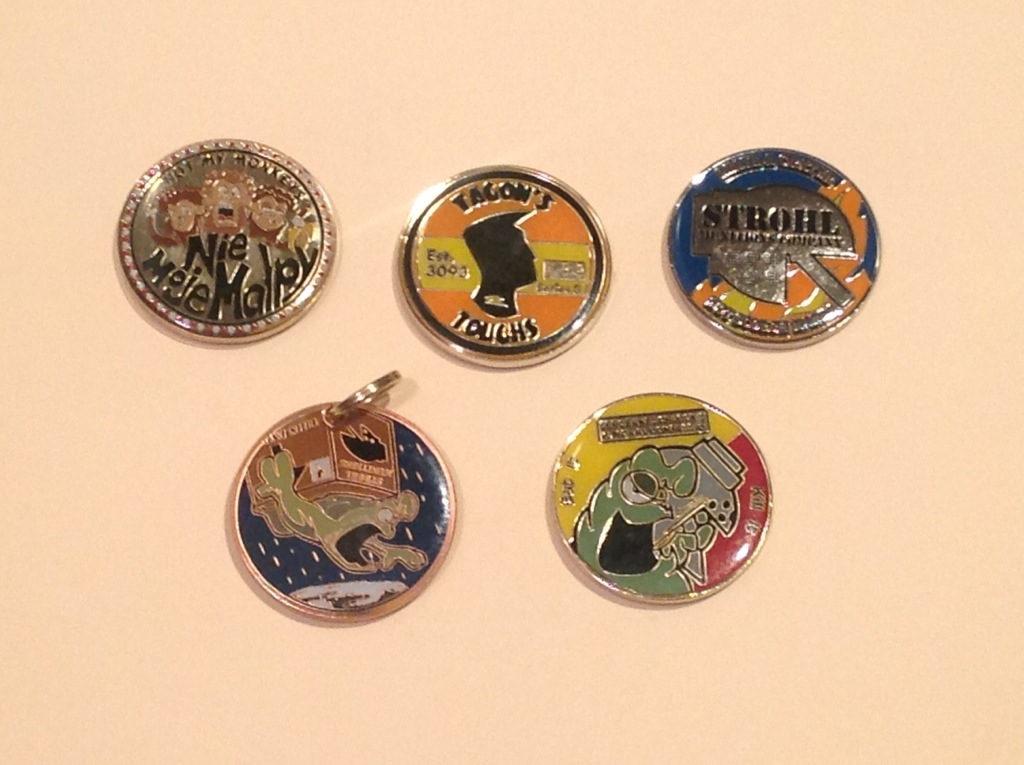
The genius of his business plan is that he gets you hooked on the story. You want to go and play in his universe. His added content gives you that opportunity. His most recent project is Challenge Coins. Howard introduced them both in his comic and to his fans this year. He ran a Kickstarter campaign to launch the coins.
The success was more than anyone expected. Howard asked his fans for a modest $1,800 to create a few coins. Thirty days later thousands of his fans had pledged over $154,000. What makes it interesting is that the coins, the physical coins, are not an integral part of the story. You don’t have to have ever seen a challenge coin to enjoy reading his comic.
Here are a few of mine.
The last piece of Howard’s business plan that amazes me is this.
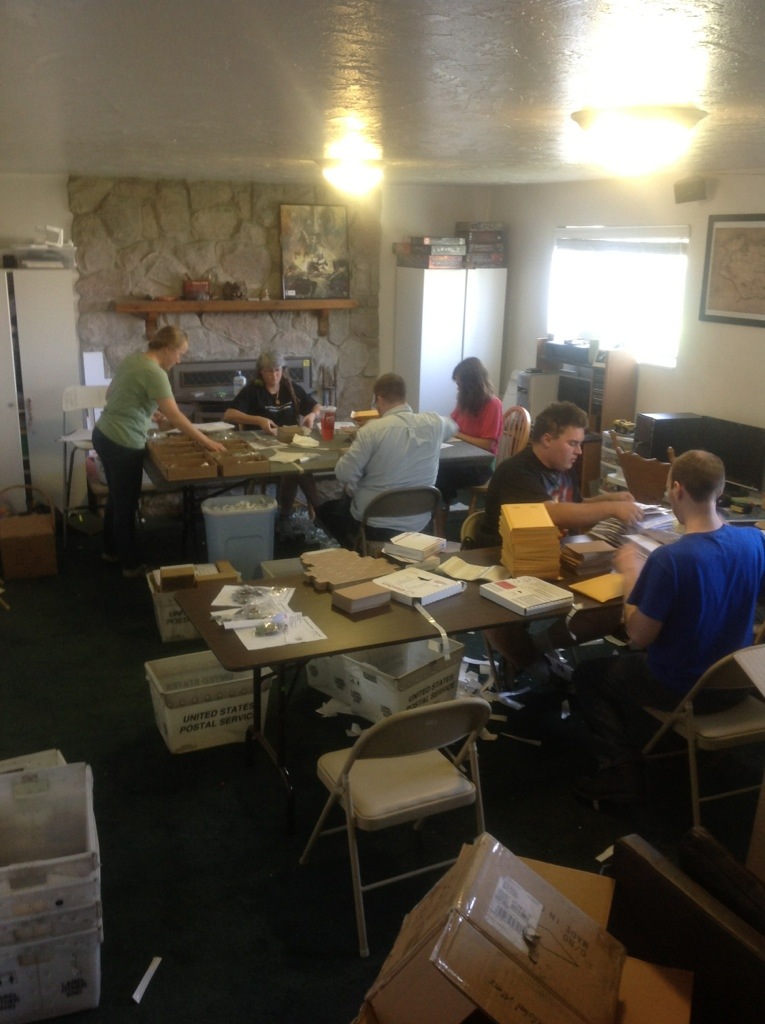
That’s a group of volunteers who showed up last month to help Sandra, Howard’s business manager and wife ship the challenge coins. They shipped a lot of coins all over the world.


Not only were they able to get fans to come and help ship product, the competition to be one of “Sandra’s Minions” is fierce. Sandra will post a call for help to the Schlock Facebook group and within minutes all the volunteer slots will be filled.
So, how do you create a successful business plan by giving your product away for free? You don’t focus on selling product. You focus on building a community. A community who enjoys your work and enjoys the world you’ve created. Then, you give that community the opportunity to participate. If you do it right and do it well, the fans will jump at the chance.
Happy 13th birthday, Schlock. Congratulations Howard, and thank you for all the free Schlock.
(Rodney Bliss is an author, blogger, and IT manager. He’s been in the computer business for longer than he can remember. He lives in Pleasant Grove, UT with his wife and 13 children.)
Tell your friends about this!
I need help
What’s the problem?
I just realized that when we ship in September I’m going to disappoint 100% of my customers.
I was president of RESMARK and we were building a reservation system for the rafting industry. It was only May but I can read a spreadsheet. It’s One of The Things I Did There. And my spreadsheet said that at our current velocity I was going to run out of summer before I ran out of features for the team to implement. Okay, the team was never going to run out of features, but the ones that I’d promised would be in RESMARK version 1.0 were now below the line. That meant unless something changed, every one of my customers was going to be disappointed with what we shipped on September 1st.
The problem of over-promising and under-delivering exists in all industries, of course, but in the software industry we’d turned it into nearly a given. There are three inputs that go into software development.
– Schedule
– Features
– Resources
As a project manager, you get to modify any two. My schedule was set. I HAD to ship on September 1st or I’d miss the the most important trade show of the year and ultimately the entire next season. My resources were already stretched to the limit. I was running the company on investment money and my investors, while supportive, naturally expected me to operate with the budget we had agreed. Plus, in software development there’s a paradox called The Mythical Man Month. It shows that at a certain point, adding more people to a project actually slows the project down. You have to bring people up to speed, and train them. That process takes people away from building new features. The Mythical Man Month is summed up in the analogy, one woman can have a baby in 9 months. Nine women cannot have a baby in one month.
The only option I had was to cut features. But, I had customers who were expecting those features. I knew I was going to disappoint them and I wanted to get in front of that problem sooner rather than later.
So, I called my brother, the marketing genius.
Come to San Diego and we’ll spend a day brainstorming on where you’re at and map out a strategy. (It was during this trip that I learned about “Exceeding The Speed Limit – And Expectations.)”
After explaining to him how we got to this position and what my options were for getting out, he gave me a suggestion.
You need to tell them.
What do you mean? Like a conference call?
No. I think you need to go visit each person who’s put money down for your product and explain it to them in their office.
I should explain that our product cost $10,000, and I had 10 companies who’d given my $5,000 each on the promise I’d deliver it. So, I set out on a summer tour. I visited Whitewater Excitement on the American River in California. I visited Western River Expeditions and Moab Adventure Center in Utah. ROW in Idaho. Echo Canyon, and Noah’s Ark on the Arkansas River in Colorado. A rafting company in the North Woods of Wisconsin. ZOAR Outdoor, in Massachusetts.
By the end of the summer, I’d been to see each customer. The results were surprising. One customer asked for their deposit back and went with a competitor who had a shipping product. The other nine asked me some tough questions, and I very conservatively estimated what features would be there in September, and in what order we would add additional features through the winter. When it was said and done, nine of them let me keep their money and agreed to accept a product with fewer features.
I’m convinced that if I had simple sent an email, or done a conference call, most of them would have pulled their support. But, by going to their locations and being honest with them about the state of our product, they took that as evidence that we were a company they could trust.
Ironically, I spent the summer traveling to the most exiting whitewater rafting locations in the country and didn’t go rafting a single time. But, that wasn’t really the point.
Tell your friends about this!
 They are some of the biggest names in the tech world:
– Microsoft
– Yahoo
– Google
– Facebook
– PalTalk
– AOL
– Skype
– YouTube
– Apple
The fact that you don’t have to be a “techy” to recognize them shows just how well known they are. Many of them, Apple, Microsoft, Yahoo and Google offer Cloud Services. You’ve probably heard people talk about “The Cloud.” I know my IT friends understand it, but some readers might be a little “cloudy” on the exact definition. (Okay, that was a completely unnecessary pun.)
“The Cloud” is very much like saying “The Internet.” Well, why don’t you just call it the Internet, you might ask. The difference is that when you put something into “The Cloud” only your company can get to it. Many backup companies, for example were quick to embrace The Cloud, since it allows them to backup your data to remote servers. It’s encrypted so that only you can get access to it.
Most consumer email was in “The Cloud” before there was a Cloud. Hotmail, AOL, CompuServe, and now gmail, Yahoo, and just about any other free service lives in The Cloud. And it’s great. It allows you to access your email from any device, and anywhere, and it’s typically free.
And from a technology standpoint, The Cloud is a great option. You don’t have to buy and maintain computers. If your building burns down, you can still get your data. The vendors will explain how your data is actually safer in their care than if you tried to build your own datacenter. And you are the only one who can access your data. It’s great, so why wouldn’t I embrace it for our corporate email?
Fear.
It’s not a popular thing to admit, but as manager over the email system for a large non-profit, I was afraid of The Cloud. Occasionally, I’d get requests from our legal team to make email for a particular user or a group of users available to law enforcement. Typically the people being monitored didn’t know they were being investigated. I rarely knew either the contents or the results of our Litigation Hold process.
But, I did know that every request I got was vetted by our legal team.
And that gets me back to Cloud Services. Sales calls from Cloud Vendors would typically go like this:
You need to let us keep your data. It’s safer. It’s cheaper. It will free up your team to do other work. So, can we schedule a demo for you?
Just answer one question, if the government came to you and said, “We want copies of their data. . and don’t tell the customer” would you have to turn over our data?
Ah. . .
But, Rodney just because the government CAN monitor your data doesn’t mean they will!
NSA Sucks in Data From Fifty Tech Companies
US Intelligence Mining Data from Nine US Internet Companies in Broad Secret Program
Those companies I listed above? They have all been identified as sharing data, sharing CUSTOMER data with law enforcement in the USA and Britain.
But, Rodney they might be collecting data, but they only target the bad guy’s data.
Officials: NSA mistakenly intercepted emails, phone calls of innocent Americans
NSA collects info on 3 billion phone calls each day
But, Rodney they might be collecting the data, but they wouldn’t target your organization.
IRS Didn’t Just Target Conservative Non-Profits
But, Rodney they’d tell you if they were investigating your organization.
Attorney General Eric Holder Signed Off on Search Journalist Email
(Normally, they have to inform journalists they are being investigated, but not if they are looking at email that has been opened.)
Our organization had been targeted by federal and state governments in years past. We try to be non-political, but as a conservative organization, politics sometimes found us despite our best efforts.
I’m not some Luddite, and neither should you be. The cloud provides many, many benefits to organizations, including ours. My mother asked me if she should upgrade her 10 person CPA firm to a Cloud based email provider. Probably. She’s not an IT company. It’s very expensive for her to maintain her own email server. But, just be aware of what you getting into.
We moved the email for our 60,000 volunteers to The Cloud. Our email spam filter was a hybrid of local and Cloud Services. But our key data and the email for our employees and especially executives stayed in our own data center, under our control.
I also know that keeping our data inside our own datacenter is no guarantee of privacy. We have to use an Internet Service Provider to sent and receive email from outside our organization. It would be possible for government agencies to “tap” our incoming and outgoing email either from our ISP, or from our SPAM filter company. However, if Executive A sends email to Executive B and they are both inside the firewall, their information was reasonably difficult for a government agency to access without our knowledge.
And it’s not even that we had anything to hide. In my years at that and other companies, I’ve never once seen my employer refuse to respond to a legal request. We just wanted to know that someone was looking.
In hindsight, I wish I hadn’t been right about the potential privacy issues. I can’t really claim that I knew it would happen. I only knew it could happen and viewed my role as mitigating that risk as much as possible.
Each year when I submitted my budget, I had to explain to management why we still maintained our own email servers. How come we hadn’t gone to The Cloud?
I tried to help them see my fear.
Tell your friends about this!

Microsoft recruiting, this is Heather.
Heather, this is Rodney Bliss. I’ve got a small problem.
Oh?
You know that non-compete that WordPerfect made me sign back in August?
Yeah. Like I said, those aren’t really enforceable. No one ever holds you to those.
WordPerfect just told me they intend to.
Intend to what?
I had to convince Heather that a multi-million dollar company really was threatening to sue a multi-billion dollar company if they hired a particular glorified support operator. If I hadn’t been in the middle of it, I would not have believed it either.
After days of back and forth phone calls, meetings with attorneys, some arguing over where the commas were going to be placed in my separation agreement, I found myself back on the phone with Heather.
I’m so sorry. I had no idea they would try this. I’ve talked to several people here. We just cannot hold a position for six months. I’m afraid we are going to have to withdraw our offer. You are welcome to apply again in six months, but we can’t guarantee there will be a position. I’m really sorry.
Yeah, so was I. A starting salary of $39,000, 1200 stock options, a $10,000 moving package; all gone.
Now I had a decision to make. I was leaving WordPerfect. THAT bridge was burned and the ashes scattered. But, what to do? I figured I had two choices: accept it, or fight it.
My first tendency was to fight it. I had to get an attorney to help me leave WordPerfect. If I sued them, I’d probably win. But, even if I won the lawsuit, the offer from Microsoft was no longer on the table. I’d win, but I wasn’t sure exactly what if anything that would gain me.
If I accepted the separation agreement, I could move right away. I’d miss out on the Microsoft moving package, but with the severance packages we had, there was plenty of money to pay for a move to Washington. I could wait it out in the Redmond area and apply to Microsoft again. They had offered me jobs each time I asked them. I was pretty sure they’d still want me. . .if they had a spot open.
After a lot of discussion and prayer, we decided to take the separation agreement and take our chances with a position at Microsoft opening up. Honestly the hardest part was realizing that WordPerfect Human Resources had done wrong and they were getting away with it. But, I realized I didn’t need to “fix” their problems. My main concern was my wife and two little girls. That’s where my focus needed to be.
So, we packed our gear and headed North.
I had at least six months before I could apply to Microsoft. What to do?
We spent the first month being on vacation. We drove around the Olympic peninsula, stopping at Dungeness Spit, Sequim and other places with unpronounceable names. We toured the Seattle Underground. Fascinating. We went to the Pacific Science Center and watched the sunset from the spinning restaurant on the top of the Space Needle.

(Photo credit blakeandsarah.wordpress.com)
And then we got bored.
So, we decided to try consulting. Purple Crayon Club consulting was born. And almost as quickly we were mistaken for a day care.

(I didn’t care, I still like the name.)
I was an expert on WordPerfect’s email program. But, WordPerfect had threatened to sue me if I contacted any WordPerfect customers. I decided to risk it. I was 1000 miles away and I was helping WP customers. Of course, I also wasn’t planning on telling Corporate. (Learned that lesson the hard way.) If they found out, let them sue me. I figured I could win that one easily.
My brother also left WP in the layoffs. On his way out the door to go work for a WP partner in North Carolina, WordPerfect offered him as much help as they could. I now found myself doing work very similar to what he was doing, with a couple of significant differences.
WordPerfect was helping him get clients.
WordPerfect was sending me a paycheck every month.
The irony was amusing to both of us. Considering I was getting paid to NOT work, we agreed I had the better deal.
In the mean time, I had this worry in the back of my mind about what was going to happen in July when the WordPerfect checks stopped coming. Being “self-employed” is easy when you are getting a paycheck every month. I wasn’t sure I trusted my consulting business to be our sole means of income. I needn’t have worried. After a couple of months I got a phone call.
Rodney? This is David Ladd with Microsoft Support.
Hey. Are you still going to have a spot for me in July?
Don’t worry about it. I don’t care if it’s 6 weeks or 6 months. I want you on my team and I can’t tell you this officially, but there will be a spot for you. Call me when you are getting close to being eligible.
Dave was one of the very best managers I ever worked for.
While I was waiting in Washington, it became clear why WordPerfect quit providing free drinks, and did layoffs. In the Spring of 1994 Novell announced they were “merging” with WP. Actually, Novell was buying WP for a half billion dollars and would quickly layoff the bulk of the employees and sell off most of the intellectual property. But, in the Spring it was a “merger.”
My timing isn’t always good, but in this case it could not have been better.
Finally, July rolled around and I quietly became a part of Microsoft.
Well, that was the plan anyway. The drama of the past 6 months had really sapped any enthusiasm I had for being noticed. I just wanted to blend in. It didn’t quite work out that way.
At the end of my second day I got into the elevator and nodded a greeting to the gentleman standing by the floor selector.
I’m Sam Jadallah, Director of Support. Are you new? I know most people in the building.
Yeah, I just came from WordPerfect.
Oh, YOU’RE the one.
He later told me that Microsoft had meetings at the Vice President level to try to decide whether to hire me and risk a lawsuit, even though they were sure they’d win. At the time, Microsoft was embroiled in the Apple “look-and-feel” lawsuit and they decided they didn’t want to take on another potential court case.
So, all’s well that ends well, right? I had my job at Microsoft, where I’d stay for nearly a decade. My wife was running our profitable consulting business (still consulting on WP products.) There was just one slight detail that even 20 years later forces me to willingly deceive myself.
Remember that offer from January; $39,000 and 1200 stock options? In July, Microsoft made me the exact same offer. I’d lost the lucrative moving package, of course. But, the real problem was that during the summer, Microsoft stock had increased by $50/share and split. So, the July offer was half as many options at a $50 higher price. By the time I left Microsoft 9 years later, that stock grant had split multiple times and the strike price was mere pennies while Microsoft stock was selling for $60/share.

I’ve never gone back and figured out exactly how much WordPerfect’s little power play cost me in lost stock value, but it’s easily in the hundreds of thousands of dollars.
Some lessons are just too painful to calculate.
(This is the fifth of a five part series on Leaving Utah: How I left WordPerfect and Went to Microsoft. Part One described Saying No To Microsoft. Part Two explained What Happened to the Pop In the Break Room? Part three explained How NOT To Quit a Job. Part Four explained how I Became a Pawn In The War With Microsoft.)
Tell your friends about this!


I couldn’t believe what they were saying.
We’ve heard you are trying to poach accounts for Microsoft while you’re a WordPerfect employee. If you go to work for Microsoft we’ll sue Microsoft and we’ll sue you.
You have a 6-month non-compete and it’s our intention to enforce it.
The VP of HR; the corporate attorney; Dirk, the HR Manager over my department; Edward, the director over my department, and then there was me. I felt just slightly out numbered.
I hadn’t come completely unarmed. I pulled a document out of a folder that I’d brought with me.
I’m kind of surprised to hear that. When Dirk met with us back in August, he claimed. . .and let me read it so that I get it just right. . “If any of you come to us and say you want to go to work for Microsoft, we’ll let you out of this.”
Dirk visibly paled and then turned several shades of red and tried to sink deeper into the leather couch. The corporate attorney didn’t even flinch.
Can I see that?
She flipped through my typed comments on our August meeting and glanced at the Notary signature on the last page. She folded it back together and handed it to me.
I noticed you included a copy of the Non-compete agreement. You’ll note at the end it says, “This contract supersedes all other contracts and promises, written AND verbal.” Even if Dirk said that, and of course we are not agreeing that he did. But, IF he did, once you signed that agreement, it became the entire sum of your contract with WordPerfect.
Okay, evidently I hadn’t come armed with equivalent firepower. Looked like I’d brought a paper knife to a legal gun fight. But, they weren’t done.
During the next six months if you contact any current or former WordPerfect customers or employees, we will view that as a breach of the non-compete and we will sue you for damages.
That agreement says that if you lay me off, you have to pay me for those six months right?
True, but in our view, by volunteering for the layoff, you have voluntarily left our employment and we are not obligated to pay you. However, we don’t want to be unreasonable. We know you have a family to support, so we’ve decided we’ll go ahead and pay you for those six months. If you’ll just sign this paper, we can complete this today.
Okay, I didn’t have a lawyer back in August when I signed the non-compete, under duress as I later learned the term. But, I was certainly going to get a lawyer now.
I’ll go over it with my attorney and we’ll get back to you.
With that, Edward confiscated my keycard and escorted me back to my desk.
I’m really sorry, Rodney. I have to check your boxes before you leave.
Edward, I’ve known I was leaving for a couple of weeks. You’ve known that I was leaving for a week. Do you really think I’d wait until the last day to steal something?
He was appropriately embarrassed, but checked anyway.
My brother was also a member of the WordPerfect SWAT team. Which meant that he’d also been at that meeting back in August. He was also volunteering to leave as part of the layoffs.
Here’s where it got really weird. We were both under a non-compete. We were both leaving. I was being threatened with a lawsuit if I contacted any WP employees or customers. He on the other hand was leaving to go work for a WordPerfect partner. The sales group was loading him up with the names of WP customers in North Carolina: company names, email addresses, phone numbers. They were signing him up as a vendor.

He was going to become one more knight in the fight against Microsoft!
The double standard didn’t seem to phase them, if they even recognized it. I think they saw it as their opportunity to strike a blow against Microsoft. And if it screwed up my life for the next 6 months or more? Well sometimes you have to sacrifice a pawn here and there.

It was at this point that I also figured out some missing pieces of the puzzle. First off, that meeting in August, that just happened to fall on the day before I was flying off to Microsoft? I later learned it was all for my benefit. I didn’t tell anyone at WordPerfect I was going, but I did tell my mother. Who, of course told my sister. Who thought nothing of telling my brother. Who mentioned it to someone at work. And started a firestorm.
And the “poaching clients” claim eventually went away. Which was good since there was never a case there to begin with. I had called Allstate’s email administrator to tell him I was taking the Microsoft job. This wasn’t exactly news to him since he was one of the references on my resume. I also cancelled a site-visit planned for February. The WordPerfect sales rep for Allstate said, “Don’t worry about it, we’ll get IBM to come in.” The response from Allstate was “IBM doesn’t know our setup. We spend the whole time teaching their reps stuff. If Rodney can’t come we don’t want anyone.” That got just a little twisted in the retelling.
As the rumors swirled, with the Human Resources department doing their best to paint me as a traitor, a good friend said it best.
I heard that you were poaching clients. And I thought, if that’s true, our friendship is over. Then, I tried to think of how many times you had ever lied to me. Then, I thought about how many times HR had lied to me. That pretty much settled it in my mind.
Thanks, Jim.
There was just one final problem, I still had to talk to Microsoft. They were waiting for me to tell them my start date. Would they hold the position for six months? Would they still give me the $10,000 moving package? How much was WordPerfect’s hissy fit going to potentially cost me?
(This is the fourth of a five part series on Leaving Utah: How I left WordPerfect and Went to Microsoft. Part One described Saying No To Microsoft. Part Two explained What Happened to the Pop In the Break Room? Part three explained How NOT To Quit a Job. Part Five will show how expensive WordPerfect’s war on Microsoft was for me personally, and introduce one of the greatest managers I’ve ever known.)
Tell your friends about this!


I want to go into Computer Science. Any advice?
Get used to getting laid off.
Computer Science, or Information System, or any number of techy careers are often listed as some of the best paying in business. What they don’t tell you in college is that every high-tech company does layoffs. . .Pretty much without exception. Microsoft has done layoffs, Novell, used to do layoffs in December to make their end-of-year numbers look better. Kind of made for a sucky Christmas. I worked for a Church IT department and THEY did layoffs. Everyone does them. But, you never forget that first time.
In December of 1993, WordPerfect was out of cash. No one really knew that except a few of the executives. They quit stocking pop in the break rooms, and then in December they sent out an email that shocked us.
In an attempt to become a more efficient organization we will be doing layoffs shortly after the first of the year. We realize how disruptive this can be. We will share more information as it become available.
Welcome to the real world.
As you can imagine, it was a shock for everyone. What we didn’t know was that WordPerfect was in the process of being acquired by Novell. But, we had too many employees to be profitable as a single company, let alone being added to another company. At the time, we kind of, sort of hoped maybe they were finally going to go public. But, even as we told ourselves that, we knew it wasn’t true. But, we hoped it was. Shortly after the news hit the public, I got a phone call.
Rodney? This is Heather in Microsoft’s HR department. David Ladd asked me to give you a call and ask if you are still as happy with your job as you were when we talked back in August?
I would LOVE to come and talk to you again!
This time I didn’t worry too much about trying to keep it a secret. Not that I’d succeeded last time, but I hadn’t figured that out yet.
I flew out on a Thursday, spent all day Friday interviewing and Microsoft made me an even better offer than they had several months earlier. This time the salary was $39,000 and they bumped the stock options up to 1200 shares. I still didn’t understand their purpose. In fact, I tried to negotiate a larger salary when I should have been talking about more stock options. I was going to join the Microsoft Mail support team.
About 2:30 in the afternoon my wife, who also worked at WordPerfect called me.
They just sent out an email saying that they will be taking volunteers for the layoff. Volunteers will get the full severance package. They have to inform their manager on Monday.
This was a very good day. I got another job. . .and it was with MICROSOFT! They were going to throw in a $10,000 moving package. Both my wife and I could get the layoff severance. The layoff notice was scary, but things were turning out great.
Yes, I’ll be happy to accept your very generous offer.
Great. We just need to know your start date. Get that to us as soon as you can. Welcome aboard!
Mom was going to be SO happy.
Monday morning my manager was out of the office, so my wife and I went to see the director.
Edward? I’d like to volunteer to be part of the layoffs.
Oh? We weren’t planning any cuts on your team. So, what are you planning to do?
There are times in your life where you reach a crossroads, and a word one way or another can make a difference in ways you never anticipated. What I should have said was, “I’m going to explore my options.” Or, “I haven’t decided.” Or just stayed quiet. Instead, I told the truth.
I’m going to Microsoft.
It was the wrong thing to say.
WordPerfect was at war with Microsoft. At least in their mind. I just announced I was going to go work for the company that was driving this one into bankruptcy.
I’m not even sure how we separate you from the company. It would be easier if you’d just steal something and I could fire you. Ha ha.
What do you say to that?
I’ll have to check with HR. Ah. . .go back to your desk and I’ll let you know.
My wife was a support operator.
I’d like to volunteer as well.
You too?
Seriously, he was surprised that she wanted to leave with me.
As a SWAT team member I had accounts that I worked with. I’ve talked about How I Saved The EPA, they were still my account. Allstate Insurance was another one of my accounts. The email administrator there was also one of my references to Microsoft. I called to let him know that I would no longer be working with them, but we’d plan a smooth transition to one of the other SWAT Team members. Another crossroads, again it was the wrong thing to say.
A week went by. Seriously, I told them I was leaving to go to work for a competitor and they let me come to work for a week. I cleaned out my desk. I deleted my email. I saved out any documents I wanted to take.
Finally, a week later I got a call from Edward.
The VP of HR would like to see you in her office.
Is this “the meeting?”
No, I don’t think so. But, bring your keycard.
In his defense, he wasn’t a natural liar. He also wasn’t particularly good at it, to his credit.
I didn’t expect a big party or anything. But, I’d saved some big accounts. I’d helped show that the SWAT team concept was viable. I’d done some good work. I expected a handshake, a “good luck, see you at the conventions” and to be on my way.
What I walked into was My Manager From Hell, all over again. Only the actors had changed. My chair was in the middle of the room, the VP of HR was there. The corporate attorney was there. The HR Rep who’d run our mandatory “sign a non-compete-or-get-fired” meeting back in August was there. And my director was there.
We’ve got a problem. It seems you’ve been trying to recruit accounts for Microsoft while you’re still an employee for this company. If you go to work for Microsoft we will sue you and we will sue Microsoft!
Well, THIS was unexpected.
(This is the third of a five part series on Leaving Utah: How I left WordPerfect and Went to Microsoft. Part One described Saying No To Microsoft. Part Two explained What Happened to the Pop In the Break Room? Part four will explain how I became a pawn in WordPerfect’s war with Microsoft, And My Brother Got To Be A Knight.)
