You don’t recognize me do you?
Ah. . .
I’m the weirdo you met on the internet.
Oh!
The scene was the receiving line at a wedding reception in Pomona, CA. Margit was getting married. Well, she’d just gotten married to Michael. Weddings are always a time of bringing groups together; her family, his family, his friends, her friends.
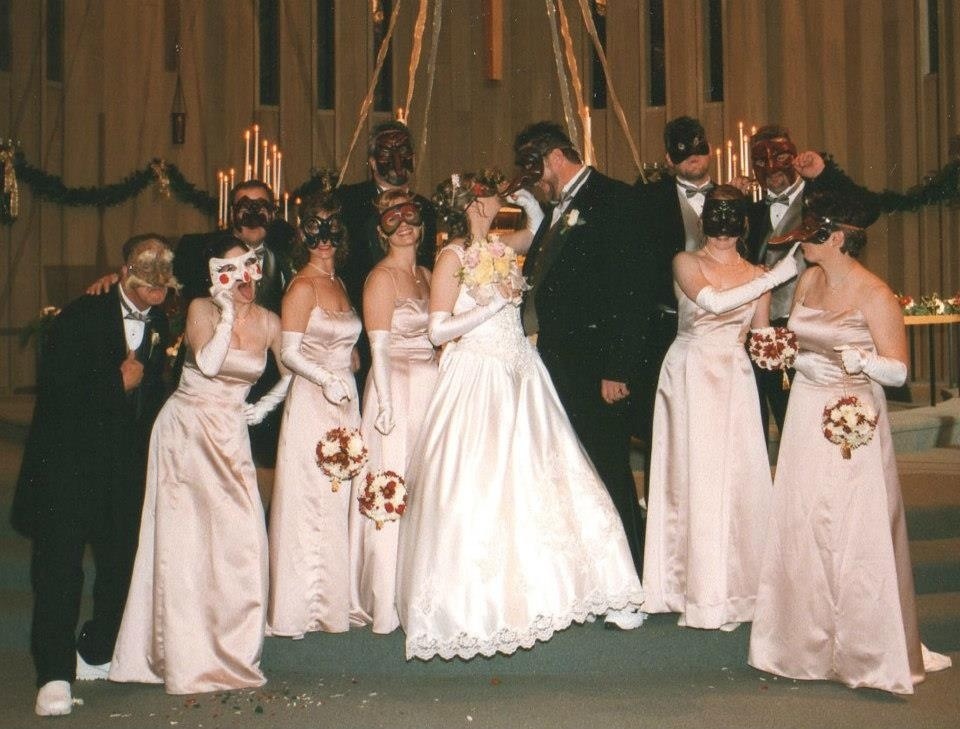
(Photo courtesy of Margit Elland Schmitt)
It’s the perfect event to crash. If the party is big enough, and you avoid the bride and groom together, you can mingle pretty freely. Everyone assumes you must be part of the “others.”
I was the “weirdo”. . .and Margit was delighted to see me.
Rodney! You came! Where’s your family?
It’s just me. I wouldn’t miss it.
I don’t blame you if you are slightly confused at this point. See, Margit and I had never met. Well, not in person. And yet, she was and is one of my dearest friends. And I have Orson Scott Card to thank for it.
Yesterday I gave my conference report for Life, The Universe and Everything (LTUE) where I talked about attempting to meet the Guest of Honor, Orson Scott Card (That’s a Fight You’re Never Going to Win.) It got me thinking about my interactions with Mr Card.
Back in the 1990’s, at the start of the internet. (Yes, I know Al Gore invented it long before that, but 1995 was when businesses started using it) Card had a website. (www. hatrack.com) The name comes from his collections of books about Alvin Maker in a fictitious place called Hatrack River. Except through the magic of the computer and the fertile mind of his readers, Hatrack River existed. It was a writing forum on Hatrack.com. The concept was part game and part collective writing experience.
To participate, you thought up a character that would fit in the Alvin Maker universe. You then wrote from your character’s perspective as you interacted with other authors’ characters. So, in a sense it was like World of Warcraft or any number of online games. The difference was it was all written, and we had a set of rules that prevented things like killing, or guns or “harming” other’s characters.
Anyway, it was an amazing creative place to practice writing fiction, to practice writing dialogue, to practice the writer’s mantra of “show don’t tell.” Most of the discussion took place in character, but there was also a location to go talk out of character.
Over the course of several years I met two very talented writers that complemented my own storytelling well. Margit was one, the other was a guy named Chasm. Like Margit, I became friends with Chasm without ever meeting him.
Chasm suffered from injuries from a severe car accident. Writing, especially the interactive writing we did, was his escape from the pain and the frustration of not being able to play with his kids, or hold a job or even sit up for long periods of time.
I decided to take a trip back East to his home of Yellville, AR. I was planning to surprise him. It was quite a trek from Seattle, but my wife and I thought we’d make a family vacation and take our kids to see the country for a couple weeks in the summer.
Chasm died in the Spring. It’s been nearly 20 years and I still am disappointed that I never got to shake his hand, or buy him a drink.
I was determined not to suffer a similar fate with Margit. Her wedding was near San Francisco. I flew down from Seattle in the morning and rented a car. I bought a nice Shakespeare collection at Barnes & Noble. Both Margit and Michael were Shakespearian actors.
I inscribed it
Congratulations. Please enjoy this collection of Shakespeare’s work. I tried to get you an autographed copy, but apparently he’s too big an author to do that sort of thing any more. Kind of surprising considering this is apparently the only book he wrote.
It was one of the funniest weddings I ever witnessed. The entire wedding party were actors and comic actors at that. The groom entered to the strains of John Williams Star Wars March. The ceremony was truly a performance. And it was a delight to see my friend so thoroughly happy. It also felt slightly creepy hanging around the chapel during the pre-ceremony pictures. Yeah, just try to “blend.”
But, like I told Margit, I wouldn’t have missed it. The benefit of living in Seattle was that I could catch an evening flight back and make a day trip of it. I’ve met her only one additional time, but we remain dear friends.
What’s this have to do with business?
Well, I could explain about the danger of putting off experiences like my failed trip to see Chasm. I could talk about the world of social media and how the norms of how we form and maintain friendships has changed and we need to realize that change is happening and prepare for it.
But, I really just wanted to remember the time I surprised one of my best friends whom I had never met by announcing I was that weirdo she met on the internet.
Rodney M Bliss is an author, columnist and IT Consultant. He lives in Pleasant Grove, UT with his lovely wife and thirteen children.
Follow him on
Twitter (@rodneymbliss)
Facebook (www.facebook.com/rbliss)
LinkedIn (www.LinkedIn.com/in/rbliss)
or email him at rbliss at msn dot com
Tell your friends about this!

Mr Card, we’re out of time.
So, anyone who needs to go to another panel, please go. I won’t be offended.
Mr Card, we need this room for another panel.
Okay, I think it was at this point he became offended.
If you’ve been reading my blog the last couple of days, you know that I’m at the Life, The Universe And Everything (LTUE) conference and Orson Scott Card is the Guest of Honor. Well, he would be if he ever arrived. Before we wrap the conversation I quoted above which happened on Saturday, let me take you back to Friday. As you know, coming to the Con, I had to decide if I was going to go all fanboy on OSC (How Not To Be A Fanboy. . .I Hope!) But, the east coast snow prevented him being there on Thursday. So the Con was actually Life, The Universe And Not Exactly Everything Thursday. But, there was a chance he might arrive Friday.
There is also a chance I might hit the Powerball numbers.
More snow. More delays. However, one panel had Scott (I’m still not his friend, but everyone who WAS his friend was referring to him that way.) Anyway, Scott and Michael Collins were doing a panel on Religion in Fiction. The decision was made to Skype with Scott.
As the “A” half of the A/V crew, I needed to set up the room so that:
1) Scott could hear the other panelist
2) We could hear him
3) The room could hear everything
We spent 45 minutes running speakers and cables and microphones. And it worked PERFECTLY. The crowd could see Scott on a big TV
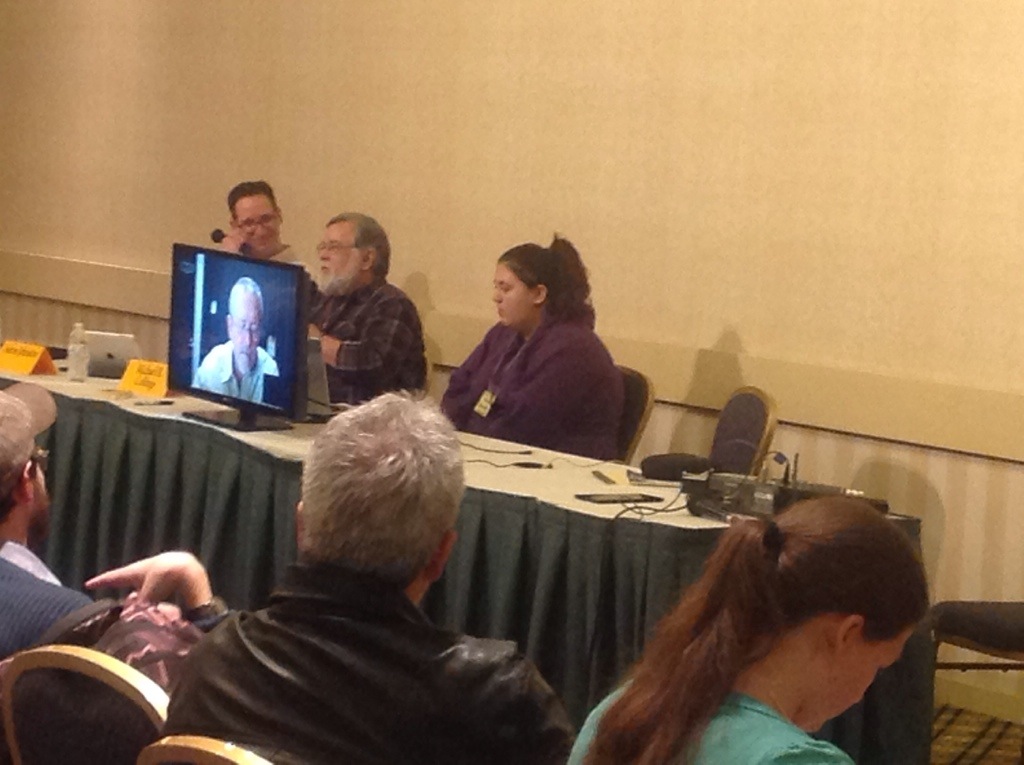
and my speakers filled the room with sound nicely.
I wondered if during the sound check I might get to meet him.
Mr. Card we need you to say a few words to test the sound levels.
Oh please, call me Scott.
No such luck. His wife performed the sound check. But, we were informed that he had a flight out Friday afternoon from North Carolina and he would for sure be there on Saturday. That was convenient since I was still helping out with the audio on Saturday.
Friday night my son gave me his copy of Ender’s Game to get signed.
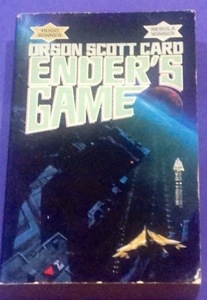
I put it in my bag with my copy of Maps In the Mirror.
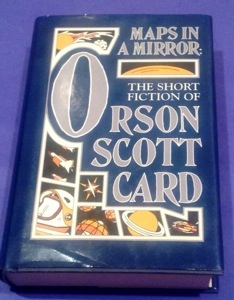
And wondered again if I would be able to control the inner fanboy.
The keynote was at 10:00 Saturday morning in the biggest room in the convention center. Surprisingly, they didn’t need me to do the audio. They were using the built in conference room mic and speakers. I actually arrived late and wandered into the back.
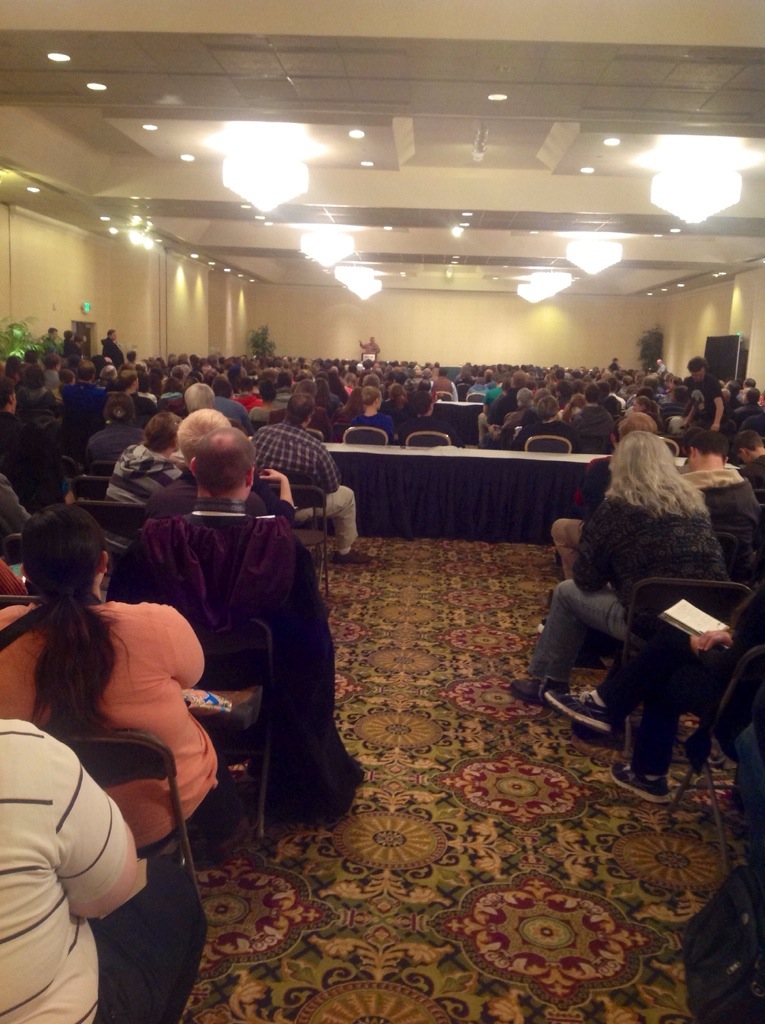
Yeah, that’s him WAAAAAYYYYY down there. Here he’ll look a little closer, but more blurry.
Part of the challenge of running a convention is making the guests feel like everything just WORKS, smoothly, efficiently without any fuss. But, to make it work, there are tons of people in the background running like mad. At LTUE those people were called “gophers.”
I was an A/V gopher, in fact I was THE A/V gopher.
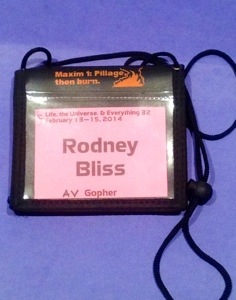
Since I was supplying my own equipment (about $1200 worth of speakers, wireless microphones and mixer board) I wasn’t given gopher tasks. In fact, other gophers were occasionally assigned to me to help me carry gear.
But, a normal gopher had to make sure water was in a room for the speaker. Then, 15 minutes before the end of a panel, they had to do a headcount. Then 5 minutes before the end they had to warn the speakers. Then at the end, they had to tell the speakers they were done. And the gophers were mostly high school kids who’s parents helped setup the Con.
So, some high school kid or slightly older told Orson Scott Card that it was time for him to stop talking.
I don’t blame the kids. They were doing what they were told to do. But, there was a whole lot wrong with telling Scott that he should stop. Eventually as he started to run into the next hour, someone with a little more clout showed up and again told him to stop.
The reason they wanted him to shut up was that the room he was in had another panel scheduled for after the keynote. The Con scheduled 10 minutes between sessions. For example, on Saturday afternoon I had 10 minutes to set up speakers and mics for a Skype call, to Britain this time. We took 16 minutes, but it was a marked improvement from the 45 minutes the prior day to Skype Scott in.
And that was the problem that the gophers didn’t get. This was a three day conference and the Guest of Honor had missed the first two days. People paid to see Scott Card. He was a big part of the reason people were there. And instead of three days to perhaps run into him or sit in on one of his panels, or get a book signed, or just say “I was in the room with him”, people were pretty much stuck with his keynote address.
Scott tried to be accommodating. Twice he turned to the audience and said,
Really, if you need to go, just go. The other panels really need people to attend them.
But, Mr Card we really need this room for another panel.
Okay, I’ll just stop then.
NOOOOOO!!!!
The last line was delivered by 800 people. “Paying customers” is what we call them in business. I remember thinking,
PRO TIP: Don’t pick a fight with your keynote speaker in front of 800 people who’ve paid to hear him speak. That’s a fight you are never going to win.
I was just the A/V guy. Well, just the “A” guy, so no one was asking my opinion on anything outside of sound setup. But, I knew enough to know that no one was going to get Scott off that stage until he had finished saying what he came to say. As organizers you can raise a stink about it and risk alienating your audience and your guest of honor and potentially souring future attendees and future guests of honor, OR you can say, “He’s the keynote and he missed the first two days. He can speak for as long as he wants!”
He finished up about 20 minutes late. . .and received a standing ovation.
I had one more shot at fanboy-dom. Scott was giving an “invitation only” panel at the end of the day. My gopher badge would have let me in the room with Scott and 50 other people.
Ultimately, I decided I wasn’t going to force it. I did have to laugh at the name of his final panel. Here’s a picture of the schedule.
A Thousand Idea In An Hour – (Preregistration required)
(2 hours)
Kind of summed up my quest to meet Orson Scott Card.
Rodney M Bliss is an author, columnist and IT Consultant. He lives in Pleasant Grove, UT with his lovely wife and thirteen children.
Follow him on
Twitter (@rodneymbliss)
Facebook (www.facebook.com/rbliss)
LinkedIn (www.LinkedIn.com/in/rbliss)
or email him at rbliss at msn dot com
Tell your friends about this!
So, did I or didn’t I?
Come on, you know you’re curious about whether I went all fanboy on Orson Scott Card, or if I managed to “act like I’d been there before.” (From yesterday’s “How Not To Be A Fanboy. . .I Hope.”
This is a classic good new/bad news scenario.
First, the good news. No. I did not embarrass myself and go all fanboy when I met Orson Scott Card (He’s just Scott to his friends. . .No, I’m not one of his friends.) So, mission accomplished right?
Wrong.
The bad news, there’s apparently some frigid precipitation related weather event currently engulfing the East Coast of the United States. It cancelled thousands of flights. Including the one that Mr Card was planning to take. He didn’t make it.
Ironically, Utah is experiencing an early spring. I went and sat outside the convention hotel at lunch yesterday. It was about 50 degrees. If you’re in California, that’s bundle up weather. If you live in the normally freezing, snowing, “greatest snow on earth” state of Utah, 50 is shirtsleeve weather. I did eventually have to go inside since it started to rain slightly.
For those who are curious, here’s what I did yesterday.
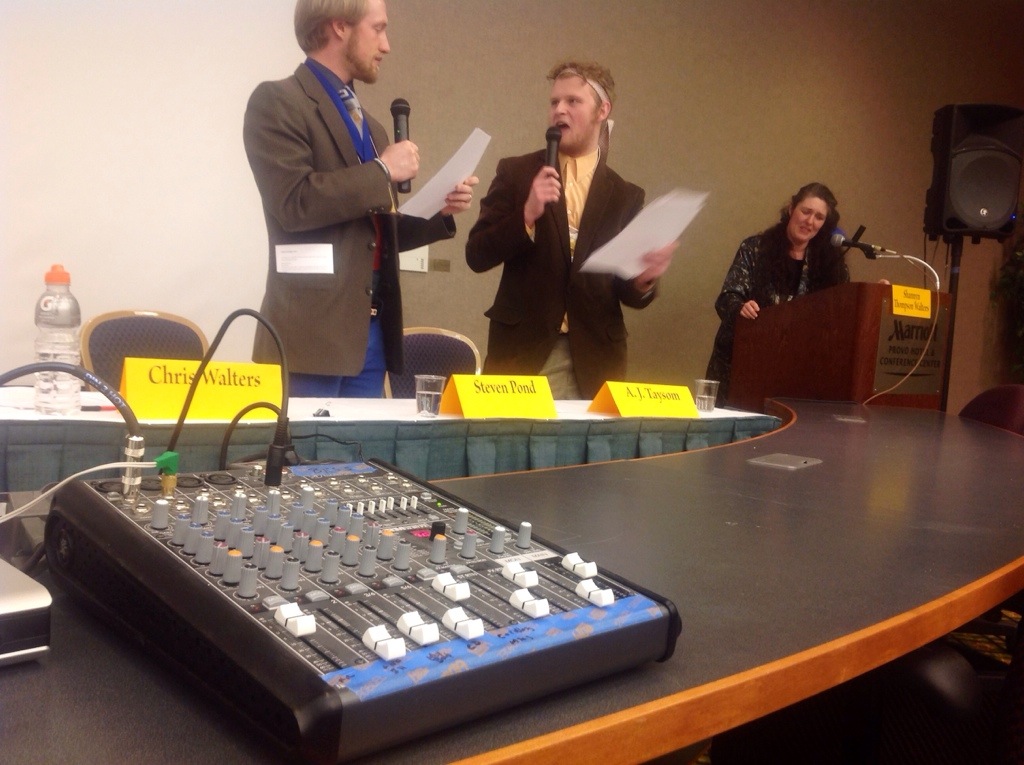
That’s my 8 channel Mackie mixer board. This is a reading of a play for four people. So, I ran multiple mics and speakers. It was a clever performance making fun of how Utahns talk.
There’s a chance that Orson Scott Card will be here today, but he’s for sure planning to come on Saturday. The current plan is to use Skype for one of his panels today if he can’t get a flight. Since I’m the A/V gopher
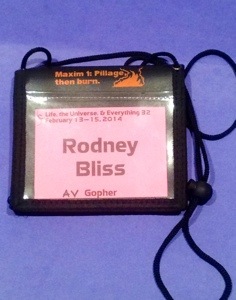
I’ll most likely be the one that hooks up the mics and speakers so that the auditorium full of people can hear him and ask him questions.
I’m pretty sure that I can contain my excitement if we’re just Skyping today. But, if he makes an appearance in person, I’m right back to having to decide whether to unleash my inner fanboy.
I’ll let you know.
Rodney M Bliss is an author, columnist and IT Consultant. He lives in Pleasant Grove, UT with his lovely wife and thirteen children.
Follow him on
Twitter (@rodneymbliss)
Facebook (www.facebook.com/rbliss)
LinkedIn (www.LinkedIn.com/in/rbliss)
or email him at rbliss at msn dot com
Tell your friends about this!
Howard Tayler, my friend who writes Schlock Mercenary related this story.
I was at a convention and we were headed to lunch. I invited Robert to join me for a business lunch that I was having with a colleague.
“Robert, meet Steve Jackson. Steve, this is my friend, Robert.”
. . .and before I could say another word, Robert jumped in with
“I LOVED your games when I was a kid. I’m so excited to meet you!”
I watched Steve’s “fan face” come up. And then Robert realized what he’d just done. I knew both of them really well and knew that Robert had just realized he’d gone all “fanboy.”
“Steve, he’s not really like that. It’ll be fine.”
Do you have someone that you would go completely fanboy, or fangirl over? For my 13 year old daughter it would be One Direction. For Robert, it was Steve Jackson.
I’ve been to conventions with Howard and watched people become fanboys at meeting the creator of Schlock Mercenary. Howard is unfailing gracious, but he definitely has a “fan face.” Watching people become fanboys an interesting phenomenon. I’m wondering if I’m immune.
I’m going to a convention today. Life, The Universe and Everything, otherwise known as LTUE is happening in Provo this week. It’s a writer’s conference. Through a friend of a friend I got volunteered to volunteer. I have a sound system and the convention is kind of on a shoestring budget, so I was asked to run sound for one of the rooms. It fit my schedule so I said yes, because it was a friend asking, and the convention is local. The payoff was also on a shoestring budget.
I will make sure that you get a chance to “mingle” with the writers.
Cool.
I don’t write fiction, but I’d like to someday. And writers are often strangely introverted folks with very interesting stories to tell, so I figured it would be an interesting couple of days.
And then I saw the poster.
You didn’t tell me that Orson Scott Card was the Guest of Honor!
Yeah, I did.
No. I would have remembered that! Trust me.
Okay.
You’re going to make sure I get to meet him right?
Yeah. . .sure. . .Rodney. . .
And I noticed him putting on a “fan face.” Maybe it was that he was slowly inching away from me at the time. I’ve been an Orson Scott Card fan for decades. Like many people I was introduced to him through the book Enders Game.
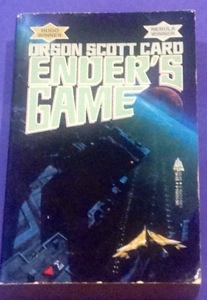
At this point, in some ways Orson Scott Card, like was described of Lord Byrun, is a dangerous man to know. With the release this year of the movie Ender’s Game, starring Harrison Ford and Asa Butterfield, Card has become more visible outside of his traditional science fiction circles. And with that visibility came increased scrutiny of some of his opinions on politics and homosexuality.
I’ll leave that to you readers if you really want to know more about his positions. For me, I was excited because of the many worlds he had led me to. At one point I owned nearly every thing he’d written in the fiction realm; literally dozens of his books. Lots of them in paperback, but a surprising number in hard back.
These are the ones within easy reach.
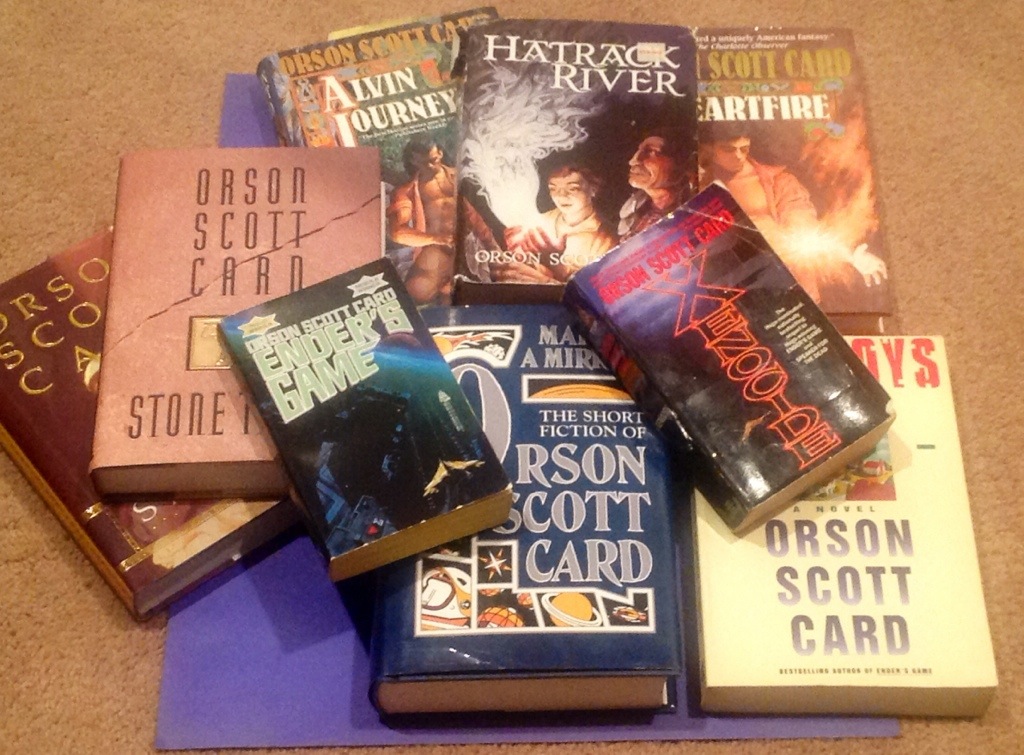
And since I collect autographed books, this seemed like an ideal setup for me. But then I remembered my friend’s “fan face.” And I remembered Howard’s story about Robert and Steve Jackson. And I realized that I did not want to show up with an armload (or a shopping cart, those hardbacks are heavy) and play the fanboy.
See, Orson Scott Card and I have been separated by two degrees for a long time. When I started my writing career back in 1997, my agent was a woman named Barbara Bova. She was also the agent for Orson Scott Card. Before the advent of blogs and self publishing via the internet, I did some creative writing on a site called Hatrack River. It was hosted on Orson Scott Card’s site. I have friends like Howard and David Farland who are ALSO friends with Orson Scott Card.
So, the odds are that this will probably not be the last time I see Mr Card. They tell NFL running backs who score a touchdown, “Act like you’ve been there before.” And that’s the advice I’m taking for today. I selected a single book that I’ll take to possibly get signed.
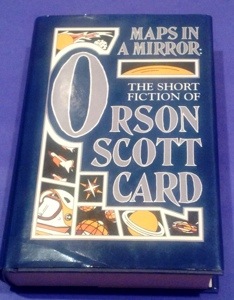
This is a collection of his short fiction, a format that I particularly enjoy.
And then, I’ll act like I’ve been there before. Besides, if that strategy doesn’t work there are still two more days of the convention to play fanboy!
Rodney M Bliss is an author, columnist and IT Consultant. He lives in Pleasant Grove, UT with his lovely wife and thirteen children.
Follow him on
Twitter (@rodneymbliss)
Facebook (www.facebook.com/rbliss)
LinkedIn (www.LinkedIn.com/in/rbliss)
or email him at rbliss at msn dot com
Tell your friends about this!
My career goal is to become the Pointy-Haired Boss from Dilbert.
I was in a job interview a couple weeks ago for a Project Manager job. I had a very good relationship with the hiring manager. We had covered the normal interview topics and had a few minutes before the next interviewer was going to come escort me to another conference room.
I’ve had a tough time finding people with the right balance of technical skills and manager experience.
I can see where that would be a tough role to fill. People tend to gravitate to one or the other.
Yeah. One guy I interviewed said his career goal was to become the PHB from Dilbert. And he was serious.
I use the Pointy-Haired Boss (PHB) a lot when I manage a team. He works well because he is such a caricature of the Boss From Hell. But, even then, he’s mostly harmless. That makes him useful as an absurd example of my own motivation.
I was leading a team of highly technical engineers at a large nonprofit corporation. At one point in my past I had been an engineer. I knew the concepts of what they were doing although the technical details of the newest system were lost on me at that point. In discussions with engineers it would have been fairly easy for me to assert my technical skills.
But, I had great engineers and I didn’t want them thinking that I was somehow second guessing them. In that case, it was easier to overtly adopt the persona of the PHB.
One of my favorite Dilbert strips had the PHB asking Dilbert to build him a new database. Dilbert asks,
What color do you want that database?
I think mauve has the most RAM.
So, when I had enough technical information to make a recommendation to management or make a buying decision, or simply to be assured the engineer had the right answer I would drop a “I think mauve has the most RAM” sentence. It meant that “I’m not going to try to second guess your technical decisions.”
I also regularly claimed that during my reviews with upper management “I’m going to take all the credit for your work anyway.”
In reality the team understood I was Telling Them It Was All About Me and Making It All About Them. The team and I understood that PHB references were designed to reinforce the confidence that I had in them as engineers. In return, they trusted that if I understood my role enough and most importantly, I was comfortable enough to joke about being a really bad boss, I was probably a pretty reasonable boss.
I’m not sure that’s what the earlier interview candidate had in mind.
Rodney M Bliss is an author, columnist and IT Consultant. He lives in Pleasant Grove, UT with his lovely wife and thirteen children.
Follow him on
Twitter (@rodneymbliss)
Facebook (www.facebook.com/rbliss)
LinkedIn (www.LinkedIn.com/in/rbliss)
or email him at rbliss at msn dot com
Tell your friends about this!
BOOM!! BOOM!!
The sound was unmistakable. I could immediately smell the acrid scent of gunpowder. The bomb, or bombs since there were two explosions were very close. Less panicked, but more scared than I expected, I looked for a place to take cover. The best I could muster was a folding chair. I was in the middle of the infield at Safeco Field, home of the Seattle Mariners baseball team. The rest of my coworkers had the same searching look on their faces as we tried to figure out which direction the threat was coming from.
“WELCOME TO THE MICROSOFT COMPANY MEETING!!!”
The voice was coming from the stage where two balls of dissipating smoke still hung in the air from the fireworks that someone thought would be a clever way to get everyone’s attention for the start of the Microsoft company meeting. It was late September 2001. Three weeks after the attacks of September 11th.
This was the first public gathering many of us had attended since the attacks. We had implemented stricter security on Microsoft campus. And, no one knew what the terrorists had planned next. Safeco field that day held about 6,000 employees of one of the largest companies in America. And Microsoft was one of the companies that was viewed as uniquely American. A symbol of the USA excellence in software and high tech. We were led by not only the richest man in America, but the richest man in the world. Talk about a target rich environment.
And someone thought it was a good idea to set off explosives at the beginning. It might have been different if they had been set off as part of a larger show, but they literally were the first thing on the agenda. We were all milling around thinking how cool it was that we got to be on the infield. We were taking pictures of each other sneaking under the rope around the pitchers mound when the bombs went off.
No, they weren’t really bombs. And no one was injured. But, I wouldn’t be surprised if someone got a really terrible performance review that year. There are bad decisions and then there are complete shake-your-head, what-were-you-thinking decisions.
It’s been 12 years since that Day The World Stopped Turning. We no longer worry about gathering in large groups. The battle against terror, or the battle for freedom, or the battle against extremists exists far away; visible through our computers and newspapers. Deaths in the Middle East are not even the lead story any more. We take off our shoes when we go to the airport, and we throw away bottles of water that we forgot about before getting into the security line. We still have attacks like the Boston Marathon bombing. But, for the most part we’ve established a new normal. The war and the terror are far, far away.
But, for one terrifying moment it was just a few feet away.
Rodney M Bliss is an author, columnist and IT Consultant. He lives in Pleasant Grove, UT with his lovely wife and thirteen children.
Follow him on
Twitter (@rodneymbliss)
Facebook (www.facebook.com/rbliss)
LinkedIn (www.LinkedIn.com/in/rbliss)
or email him at rbliss at msn dot com
Tell your friends about this!
I stared again.
Yes. There was no doubt about it. My game board definitely had a flaw. Right in the middle of the map, someone had stuck a letter ‘U,’ it was about a half inch high and nearly perfectly blended into the mountain-scape. I’m not even sure what made me notice it. I think I just glanced at the board from a slightly different angle and it nearly jumped out at me.
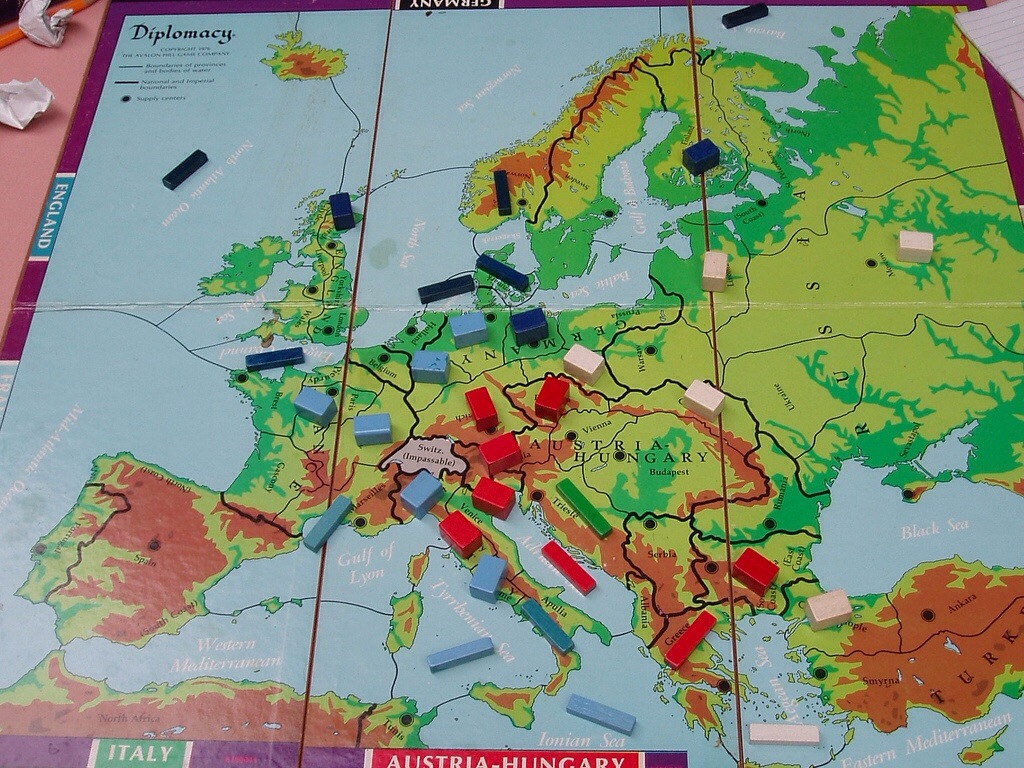
The board was a map of pre-WWI Europe. It was the map for the game Diplomacy. My brother (him of the Now Would Be a Great Time To Shut Up fame) and I had been playing Diplomacy for months. This particular game had been going on for weeks.
If you’ve never played Diplomacy, the game mechanic is very simple. Pre-WWI Europe is broken up into countries and then territories within each country. Each country had a certain number of supply centers. The object was to be the first to capture 18 supply centers. What made it challenging was that like chess, there were no dice involved. In fact, no element of chance at all. You wrote orders for moving armies and navies. If two armies were ordered to occupy the same space, neither got to advance. However, if one army had a second army supporting it, then the 2:1 advantage allowed it to advance.
The problem was that Diplomacy was not really meant to be a two player game. The whole point was that different people played the different countries and you tried to negotiate treaties and alliances and break treaties and you did lots of talking and very little actual fighting.
However, there was no one else around for us to rope into our game. We were in Junior High School, at least I was, and it was just the two of us. So, we played anyway. This led to absolutely zero negotiating, and a very long near-stalemate. We would spend hours studying the board for even the slightest advantage to try to dislodge the other person’s position.
And that is how I happened to one day notice that the map was flawed. That random letter ‘U’ just sitting right in the middle of the Ural Mountains of Western Russia. I couldn’t wait to show Richard.
Come see what I found on the Diplomacy board.
What?
Right there.
What?
Right above my finger. Don’t you see it?
WHAT!?!
A letter! It’s the letter ‘U!’
No it’s not. . . .Oh. . . well look at that!
It really did take him several minutes to be able to pick the letter out of the background. That got us thinking.
Why do you think they would put a letter ‘U’ in the middle of the map?
Maybe it’s part of a word?
Like. . .
RUSSIA!
We moved the pieces out of the way and started scanning the map. There were no more letters. Just the one. We both agreed that we could not see any other letters. And then, we got an idea.
We took a piece of paper and cut a small hole just big enough to display the ‘U.’ We then started moving this paper across the map like some backwards Ouija board.
THERE! An S! Move the paper.
And when the paper was removed and we could see the entire map, the ‘S’ mysteriously disappeared. Placing the paper so it blocked out the rest of the map and we could see the ‘S’ again. Finally, we were able to pick it out without the paper. And as you might expect we discovered another ‘S’ an ‘I’ an ‘A’ and back in the other direction an ‘R.’
The map had been printed with the name RUSSIA to identify that country. We simply stared at each other as the realization hit us that if the word RUSSIA was on the map, then the name of every other country must also be on the map. We painstakingly searched until we located
GERMANY
TURKEY
ITALY
ENGLAND
FRANCE
AUSTRIA-HUNGARY
This was not a big map. It was maybe 3′ square. In fact, here’s a picture of the version we had.
(Photo courtesy of Tom Hilton at flickr)
Even in this picture you can easily see the letters. So, why couldn’t we see the country names?
We had spent so many hours staring at that stupid map board, that the letters simply became part of the background. Even today I can picture that map in my mind’s eye.
The lesson here is pretty simple, of course. We all have blind spots. And like my brother and me, we often don’t even know we are missing seeing something. It’s part of the reason I love to work with interns or employees fresh out of college. They bring fresh eyes to an organization. They are not blinded by the “That’s the way we’ve always done it” philosophy. It’s important for ourselves to also check and make sure we aren’t being blinded by simply looking at the same situation over and over and being convinced there is only one possible outcome.
I’ve had employees tell me that they were considering moving departments because their current department will never see them as anything other than the position they started with.
A good friend of mine was the heir to a nationwide restaurant fortune. Although he was in his 20’s, he’d spent his whole life in the restaurant business and knew it inside and out. He was the Chief Operating Officer for one section of the country. A couple years later I bumped into him and he was working in a totally different industry, making a lot less money.
Randy, what happened with the COO job? Did they fire you?
No. I quit. They were never going to see me as anything except the owner’s son. It didn’t matter how good a job I did. I was never going to be accepted for my own contributions.
Randy had become part of the map, indistinguishable from the surrounding scenery. He’d rather struggle to make it on his own than stay and be unable to break out of his father’s shadow.
So, on those days when you suddenly notice the letter ‘U’ appearing where before there was nothing but mountains, take a moment to make sure that you haven’t been overlooking someone or something simply because you have been staring at the same board for too long.
Rodney M Bliss is an author, columnist and IT Consultant. He lives in Pleasant Grove, UT with his lovely wife and thirteen children.
Follow him on
Twitter (@rodneymbliss)
Facebook (www.facebook.com/rbliss)
LinkedIn (www.LinkedIn.com/in/rbliss)
or email him at rbliss at msn dot com
Tell your friends about this!
Rodney, Microsoft just released a new version of Windows. Do you think we should upgrade?
What will the new version do that your current version doesn’t?
Well, I don’t know. You’re the computer expert. Shouldn’t you be telling me?
This is an actual conversation I had when Windows Milennium came out. I wasn’t talking to a customer. My mother owned a CPA firm with about 10 workstations. I worked for Microsoft at the time and I was her tech support and consultant.
My question wasn’t rhetorical, or flippant. I wanted her to explain to me what the compelling business case was for upgrading. As a Microsoft employee, I suppose I should have been pushing the upgrade cycle. Even today, Microsoft doesn’t just want you to upgrade, they need for you to upgrade. Often they are their own biggest competitor. Because, let’s face it, if you are a Windows shop are you going to suddenly switch to Mac because Microsoft releases a new version? Or Linux?
No. But, you might decide to stay on the current version if it’s meeting your needs. Microsoft tries to give you some compelling reasons to switch. Sometimes it’s new features. Sometimes it’s a compatibility issue. New applications may not run on old operating systems. Sometimes it’s the threat that they will withdraw support.
I didn’t recommend that my mother upgrade to Windows Millennium simply because it was new. My Microsoft friends are laughing at me right now; that I would even consider Millennium. It was a terrible release. Marketing wanted to get it out for the year 2000 buying season, but it was the only operating system that your Microsoft coworkers would actively mock you for using. Internally we stayed on Windows 98 and waited for XP.
And that’s what I suggested my mother do. Eighteen month later when Windows XP came out, I called my mother.
You know the problem you’ve been having with your workstations randomly locking up?
Yeah.
The new version of Windows fixes that. We should upgrade your computers.
Windows XP officially shipped December 31, 2001. (Probably because Microsoft committed to getting it out in 2001.) Anyway, it has been a very stable operating system.
But, I titled this little essay, “Breaking Out of the Upgrade Cycle.” (BTW, don’t click the link it will just bring you back here.) So, skipping a version, as many companies did with Millennium and later Vista isn’t breaking out of the cycle. It’s simply refusing to pay for another ride around the park every time Microsoft sends the trolly past. And honestly, in business you have to upgrade. Even as stable as XP has been, and I still have one of my primary workstations running it, eventually it comes to the end. Microsoft has announced all support for XP will end in April 2014. . . and they mean it this time. . .they said.
Twelve years is a long time for an OS.
But, just because you keep your business machines relatively up-to-date there are still occasions to break the upgrade cycle.
I have eight PC’s in my house. Some of them, like my Windows 2012 Server with 16 GB of RAM and a six core processor are new. Others not so much.
This is one of the computers in my house.
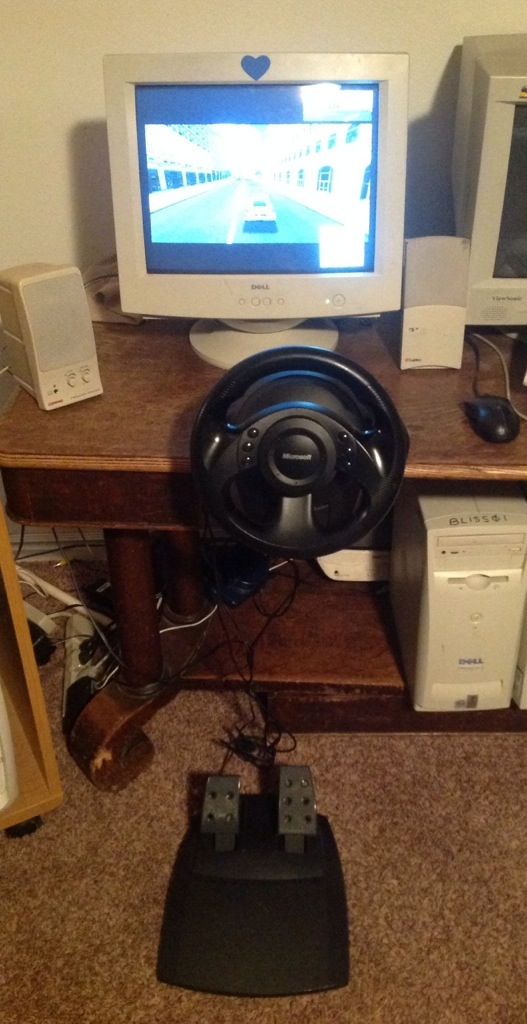
It’s a Dell Dimension L733R. It has a 128MB of memory and a 9GB harddrive. Yes, the hard disk is smaller than the amount of memory I have in my server. The processor is 730MHz.
Why would I keep such a dinosaur? Why not spend a few hundred bucks and buy a better computer?
Because my kids would kill me if I did. You might have noticed the wheel and the foot pedals. Microsoft tried out a lot of different hardware offerings in the past. This was one set. It was ridiculously expensive, as I remember, even at employee prices. But, it makes playing the game on screen much more fun.
Here’s a closer shot of the screen
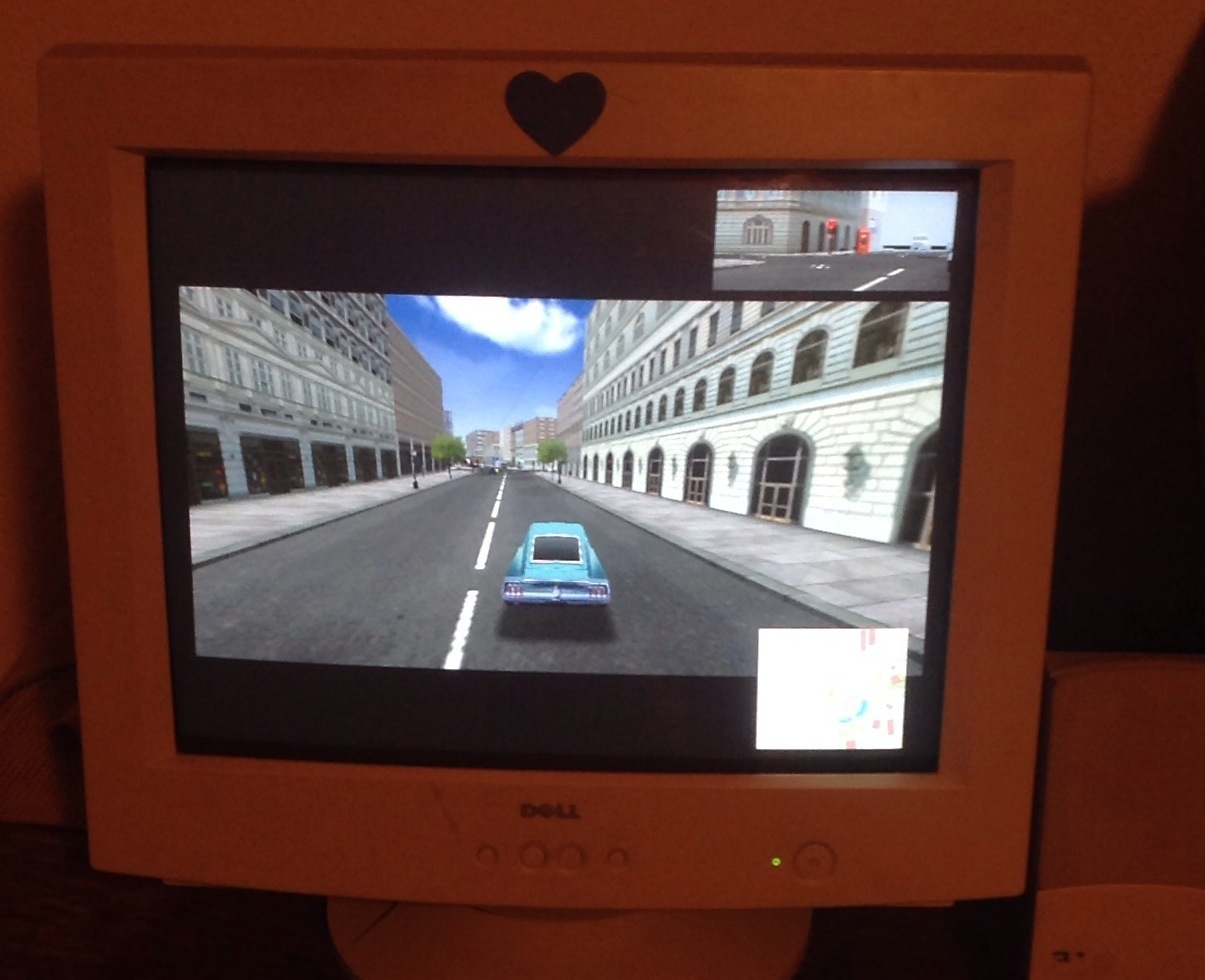
It’s a game called Midtown Madness 2, that Microsoft sold in the year 2000. It’s a driving game. You can play from the keyboard, but what fun is that?
The best part about this ancient setup is when we host game night at our house. Our kids (all 5 teenagers and 3 preteens) get to invite friends over. Some play foosball, some play air hockey. Some take turns on the XBox. Chess has even become popular. (I know, my kids have weird friends.) But, the most popular “station” is this 15 year old PC running 12 year old software.
The thing is, it was a fun game 15 years ago which was before my kids’ friends were even born. And none of them have ever seen it. Their friends think it is a very cool game. And by extension, parties at our house are cool. And by extension, my kids. But not me. I’m old.
So, upgrade when you need to, but keep in mind that just because Microsoft or Apple, or Linux say it’s time to turn in your old car, you don’t have to. If a computer continues to do what you need it to, you might want to keep it. And it just might help your kids hold cool parties one day.
Rodney M Bliss is an author, columnist and IT Consultant. He lives in Pleasant Grove, UT with his lovely wife and thirteen children.
Follow him on
Twitter (@rodneymbliss)
Facebook (www.facebook.com/rbliss)
LinkedIn (www.LinkedIn.com/in/rbliss)
or email him at rbliss at msn dot com
Tell your friends about this!
It’s an age old argument: “Today’s music is just so much noise. Music was better in my day” versus “That music is old and tired. Today is much better.”
Generally, the people arguing are at least 30 years apart: Think a child with music blasting loud enough to hear their iPod without headphones and a parent who’s idea of dancing is a twirl around the kitchen with a mop. Or a grandparent vs some young whipper-snapper.
But, I’ll settle the dispute right now. The music really was better when you were a kid. . .or younger. I’ll explain in just a minute.
Here’s the business tie-in.
Every organization has a history. That history includes events and processes. The events might have been one time happenings or the they might be something that happens on a fairly regular basis. Either way, they are something that people remember.
How many people did you talk to today? And by “talk to” I mean have a conversation with? Ten? Fifty? A hundred? Do you even remember? And that’s the point. We pick and choose what we are going to remember. Yesterday I talked about the fact that I recently passed my PMP exam. (Holding My Breath. . .For Four Months.) It was a very memorable day. And one I don’t think I’ll forget. However, even now, just a couple days later, I can’t tell you what brand of computer I was using. I met the woman who checked me in and we had pleasant conversation, but I can’t recall her name.
We pick and choose what we are going to remember. So what’s this have to do with business?
Simple, businesses do the same thing. We remember memorable events. (That sentence might actually be redundant.) Many of the experience I share on this page are things that have happened to me over the years. Datacenter CSI: The Day The Servers Died has become one of the most popular. It happened years ago, but the details are still fresh in my mind.
We tend to quickly forget those events and people who are not memorable. (Again, I’m pretty sure I’m being redundant.) When I think back on my Microsoft career, for example, I’m going to remember some really good events like getting a promotion (How You Get Promoted), and some really bad events like when we thought terrorists had bombed our company meeting. (I still need to write about that one.) But, I’m not going to remember much of the boring stuff. You can use this collective memory as a company.
When my oldest boys were 10 years old, they went on a campout to the foothills above our house. The Webelos leader and I also went. It poured down rain that night. So bad, in fact that the boys tent got flooded. Fortunately it was summer and other than getting wet, they weren’t otherwise hurt. The Webelos leader was a new leader. He was convinced that the campout was a failure.
Not at all. In fact, in a few months they will remember this as one of the best campouts EVER.
Sure enough, two years later, my boys, now Boy Scouts were on their way to a campout and the weather looked like possible rain. One boy said,
Remember that campout when we were Webelos where the tent got flooded?
Yeah, and our sleeping bags got drenched!
Yeah, that was so cool!
So, give your teams opportunities to build positive memories. It will give them a common experience to draw on during rougher patches.
So, what’s all of this have to do with music and the difference in generations?
Easy. We also have selective musical memories. If you turn on the radio today, you’ll hear dozens of different artists. I’m a country music fan, but the same experience applies to other genres as well. Of today’s artists, only a handful will have staying power. George Straight has been recording for decades. But, many of the artists will be one-and-done. So, thirty years from now, the artists we remember will be the ones who had staying power. The good ones. The ones with talent. Just listening to the radio today, you don’t know who those people are going to be.
The decades silence all the mediocre and poor bands. So, when we look back we only see the really good acts. In country music it would be people like Merle Haggard, Johnny Cash, Loretta Lynn, Hank Williams Sr. There are many more, but we don’t remember the one hit wonders or the merely mediocre.
When we compare “then” and “now,” the past will always win. Because we stack the deck and we only save the good ones.
Some might say I only hold this belief because I’m a fan of old country music and I’m pushing 50. To those people I say “Get off my lawn!”
Rodney M Bliss is an author, columnist and IT Consultant. He lives in Pleasant Grove, UT with his lovely wife and thirteen children.
Follow him on
Twitter (@rodneymbliss)
Facebook (www.facebook.com/rbliss)
LinkedIn (www.LinkedIn.com/in/rbliss)
or email him at rbliss at msn dot com
Tell your friends about this!
By the end, I wasn’t even sure I cared anymore. I just wanted it to be over. Okay, maybe I cared a little. Actually, I cared, A LOT. I’d just been holding my breath for 4 months and I really wanted to take a breath.
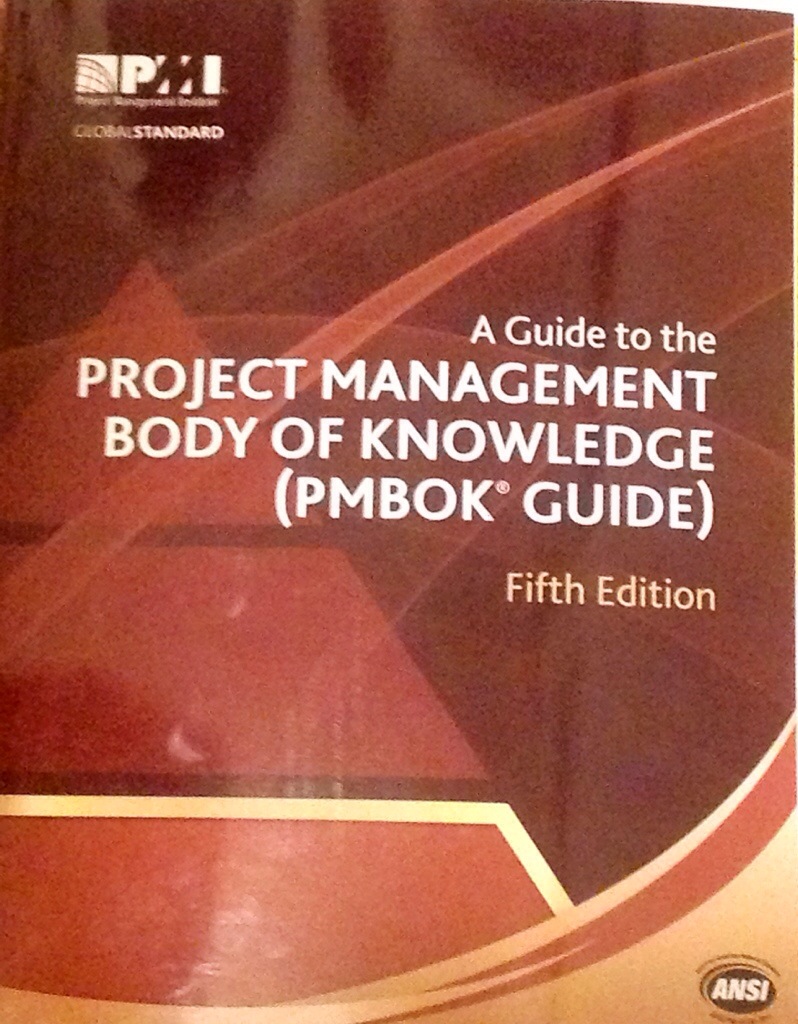
Back in October I talked about taking a PMP Course (Planting For The Future.) The course ended several weeks ago. Today I took the exam. And now I was sitting waiting for my score to appear on the monitor in the exam center.
I’m not sure that’s fair of test writers. I’m not sure I want my score immediately. My test had started at 9:00am and it was now after noon. How far, I wasn’t sure since, like some poorly decorated casino, the testing center had no clocks. Even the computers had their display setup to hide the clock. I was pretty sure with a few keystrokes, I could get to a WIndow’s command prompt. But, I’m pretty sure that might be viewed as cheating. And after slogging through 200 questions in 3 and a half hours, there was no way I wanted to do anything that might make me need to take the test again.
Not to mention the expense. The PMP exam cost $550. So, I was paying $157/hour for the privilege of answering questions on Risk and Quality and Stake Holders.
That was in addition to the $3,000 I had paid for the course. The course came with a guarantee. If I didn’t pass the test, I could retake the course for free. Somehow that wasn’t reassuring to me right now.
As I sat and waited for my score to appear, I thought about what had brought me to this point. I’ve worked in the software industry for over 25 years. I started at WordPerfect another lifetime ago. (Back To Where It All Began.) I’d worked for Microsoft. . .twice. I’d been President of a startup, and I’d been unemployed.
And it wasn’t until I went to register for the PMP exam that I realized how important that time had been. See, not just anyone can take the PMP exam. You have to not only complete a course, but you have to put in time working on projects. The standard is 3500 hours. However, because of a quirk in my education background, I had to find 10,000 hours. And it had to all have been within the last 8 years. There are 2080 work hours in a year. (52 weeks times 40 hours per week.) So, in 8 years there are 16,640 work hours. I had to find 10,000 of those that had been involved with project work.
I wasn’t even sure about all the companies I had worked for in the past 8 years. And the PMI people wanted addresses, phone numbers, contact names. I was saved by my vanity. I save a business card from each company I work for. And when I’ve been independent as I am now, I make business cards. So, I started digging through my archives and laying out the cards. Ironically the one I couldn’t find was a Microsoft card. (Pro Tip: Save your business cards!)
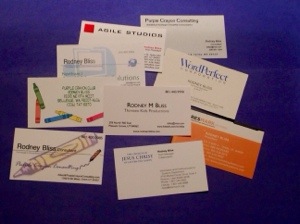
Eventually, I found more than 10,000 hours. I didn’t realize until I sat down to apply for the PMP exam just how much project work I’d done.
At this point some of you regular readers might be saying,
Whoa! Hold up! Rodney, you write often about Does The Paper Make a Difference?, and you tell people I Don’t Care What You Know. What Can You Do?
So, why the PMP course and the grueling test?
Because I’ve discovered that not everyone is like me. (It came as quite a shock, believe me!) And as much as I pride myself on judging a candidate’s ability to do the job and not just go off his resume, our industry is an industry of standards and certifications, abbreviations and acronyms. The industry name itself is an acronym. I work in the IT field. I work with PCs. Even our acronyms have TLAs (three-letter-acronym.)
And just as writing a book gives you a certain position of authority, a
certification after your name does the same. I discovered that some of the things I want to do would be easier to do with an industry certification. I’m not sure it made me any better of a project manager. But, some people want to see the certification.
And that brings me back to the Prometric Testing Center in Lindon, UT, testing station 2. I could hear the computer churning through the calculations to determine whether I would be back sitting in a classroom studying more, or not.
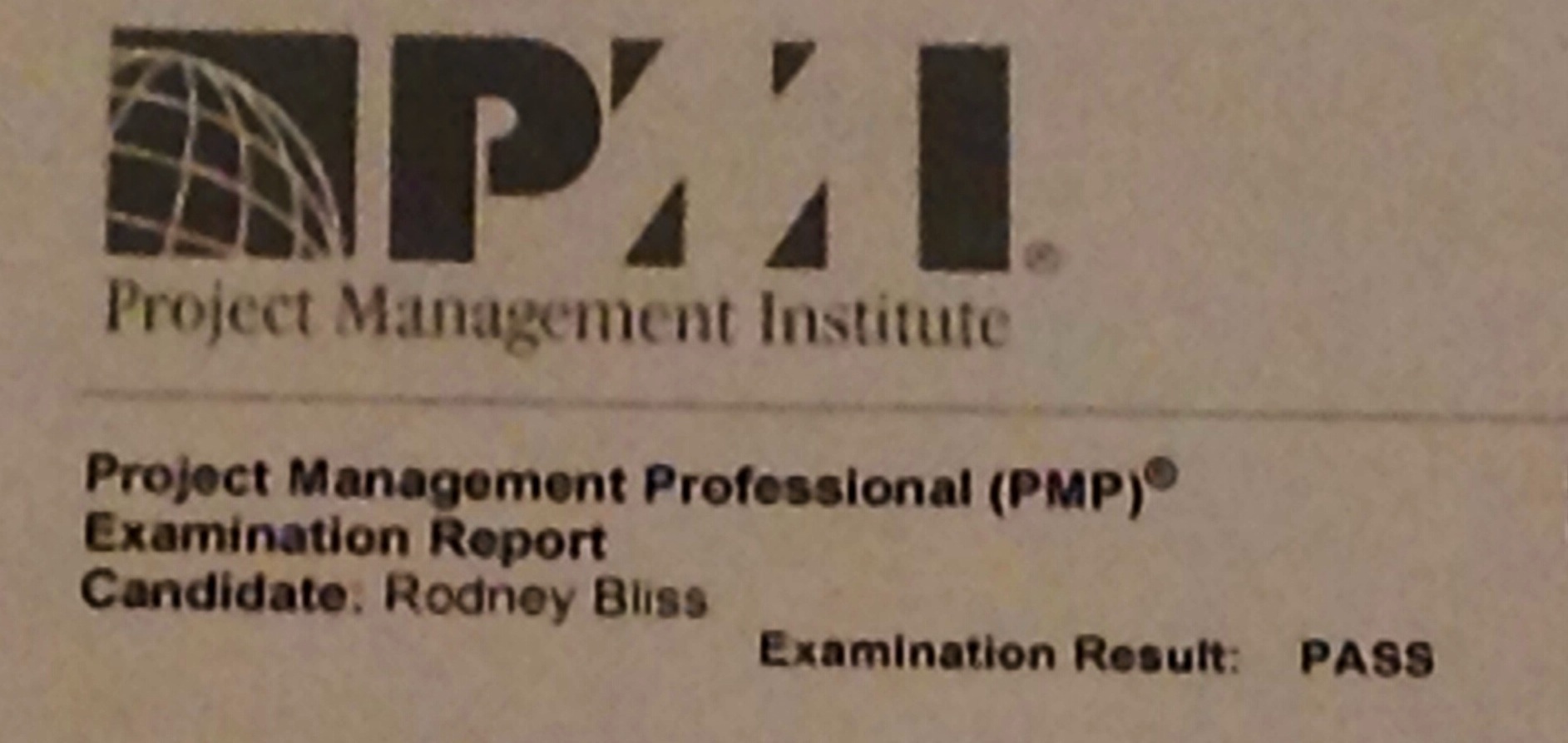
And after four months I finally quit holding my breath.
Rodney M Bliss is an author, columnist and IT Consultant. . .and a Project Manager Professional. He lives in Pleasant Grove, UT with his lovely wife and thirteen children.
Follow him on
Twitter (@rodneymbliss)
Facebook (www.facebook.com/rbliss)
LinkedIn (www.LinkedIn.com/in/rbliss)
or email him at rbliss at msn dot com
