It seemed like a logical question. The answer was, by far, the worst corporate response I’ve ever heard.
I explained in The Biggest Raise I Ever Received why I provided my employees with free pop (Sorry, East Coasters, I grew up in the West, it’s how we say it.) I learned this lesson early in my career. First at WordPerfect, and later at Microsoft they stocked the break rooms with pop, juice, WordPerfect even provided ice cream sandwiches.
It’s a trend that is fairly common across the tech industry. But, like I said, for me it started at WordPerfect, and in fact, it started from my first day in 1988, (Back Where It All Began) so it was going on long before then.
But in the fall of 1993 something changed. First all the really popular flavors started disappearing. You might have to check two or three different break rooms to find a Diet Coke.
The refrigerators were normally stocked twice a week and the delivery guy was clearly falling down on the job. It was kind of funny to think about. An account as large as WordPerfect and some poor slob missed making the delivery. I’ll bet his boss royally chewed him out.
But, then the next week came and now, not only was there no Diet Coke, but the rootbear was gone and the Squirt was running dangerously low. This was getting serious! Maybe someone in purchasing was screwing this up. We decided we’d give them one more week.
Next week, no delivery truck. All that was left in the fridges were a few tired cans of Country Time Lemonade. This required an email, actually a lot of emails to managers and executives.
The response was one of the worst corporate responses I’ve ever seen in my 25 year career. Obviously management had been getting bombarded with complaints. I don’t remember which VP sent the email but it went something like this.
Many of you have complained about the lack of pop in the break rooms. We are disappointed that employees have obviously developed such a sense of entitlement. The company is under no obligation to provide free drinks. We did so as a courtesy to you the employees. It costs over $1,000,000 per year to provide this benefit. This is a benefit that we can no longer cost justify. It is disappointing that as we try to improve the corporate financial picture in a competitive software environment, that the employees are not more willing to do their part.
The effect of the company-wide email was mostly confusion. It’s OUR fault? Some employees felt guilty for not being more understanding, ignoring the fact that we had no way of knowing why the benefit was being cut. A few, a very few employees understood that we shouldn’t be feeling guilty at all. There were over 5,000 WordPerfect employees. If you do the math that works out to $200 per employee annually. At an hourly rate, it’s about $0.10 per hour. A dime per hour!
What we didn’t understand was what a HUGE red flag this should have been. To you or me, or any of us support operators making $32,000/year, a million dollars is a huge amount. But, to a company with a payroll of 5,000 employees, a million dollars, while not insignificant, is not really a tremendous expense. I should have recognized one of the Five Signs Your Corporate Culture is Sick. But, it was my first real job and mostly I was just one of the ones who were confused.
WordPerfect didn’t trust its employees. Of course, you can’t share all your corporate financial data with your employees, but rather than try to engage us in the process, for example, by trying to get us to help look for ways to cut costs, instead they attempted to make us feel guilty about what had become a standard practice.
Many years later I learned the actual reason the WordPerfect quit providing free pop.
They were broke. By the fall of 1993, they’d burned through all of their cash reserves and were most of the way through a $100,000,000 line of credit. The company that I’d defended to my father, when he said it was sick and likely would never go public, was headed for bankruptcy. The executives knew it, of course, but us rank-and-file members just knew that there was no more pop in the break rooms and somehow that was our fault. We didn’t understand how serious the company finance problems were.
Well, we didn’t know until we got the next corporate-wide email, which shook us more than the loss of free pop.
It was entitled, “Pending Layoffs.”
(This is the second of a five part series on Leaving Utah: How I left WordPerfect and Went to Microsoft. Part One described Saying No To Microsoft. Part Three explains How NOT to Quit a Job.)
Tell your friends about this!

Back in the 1990’s a Harvard MBA professor asked his class:
How does a company make money in the software industry?
Accept Microsoft’s first offer.
The alternative can be pretty frightening. The companies that dominated their industry and later were crushed by Microsoft was pretty dramatic.
eMail – cc:Mail
Languages – Borland
Browsers – Netscape
Spreadsheets – Lotus 123
Networks – Novell NetWare
Graphic User Interface – Apple
Word Processors – WordPerfect
In 1993, I was at WordPerfect and we felt like we were in a war with the Evil Empire in Redmond. WordPerfect still had major marketshare, but Microsoft was making inroads. Even though I supported the email program, we all understood that the company lived and died with the word processor. It was our bread-and-butter.
So, why was I on my way to Microsoft for an interview?
Well, I didn’t want a job. Really. It was to appease my mother.
I grew up in Olympia, Washington, about 40 miles south of Seattle, and if you take the I405 freeway instead of the I5, it was also about 40 miles south of Redmond, home of Microsoft. My mother lived (and still lives) in Olympia. One brother and his family were back east, the other one didn’t have any kids. I had two. Mom really wanted some grandkids close.
Why don’t you go to work for Microsoft?
Mom. I’m happy here.
One of my clients is a manager at Microsoft. Would it hurt to just come and talk to them?
(Actually it did, A LOT, but I’m getting ahead of myself.) So, I sent a resume to mom who passed it on to her friend, who passed it on to HR. No way were they going to call me. This was MICROSOFT! They were Google, before there was a Google. I was a glorified support engineer. No way would they call.
They called.
Well, this was awkward. Remember the war analogy? Some people really believed it. And I’m going to go talk to the enemy? And I didn’t even want the job.
Thanks, Mom.
I decided that I wasn’t going to tell anyone. And I mean ANYONE. I had family working at WordPerfect and I didn’t want to put them in an awkward situation. I told Mom, of course. And that was a problem. But, I didn’t know it until later.
I was flying out Thursday night for a full day of interviews on Friday. Thursday afternoon we got an email saying that our team had an emergency MANDATORY meeting. This was after I Saved The EPA, and we had the full SWAT team set up. The meeting was to inform us that we needed to sign new employment agreements, and we had 24 hours to sign them.
The only agreement any of us had signed was the non-disclosure when we were hired. For some of us that was 4 or 5 years earlier.
Why do we need to sign new agreements?
Just a new HR policy.
What if we don’t sign them in the next 24 hours?
You’ll be terminated.
What? There must have been more to this meeting than we were getting.
It says here that if we quit we can’t go to work for any other software company for 6 months.
That’s right.
That seems a little extreme. What are we supposed to do during that 6 months? We’re software guys!
Look, if any of you come to us and say, “I want to go to work for Microsoft” we’ll let you out of this.
No, I didn’t clue in at that point. The document said we’d had a chance to talk it over with an attorney. None of us had an attorney. And certainly not one we could call on 24 hours notice. So we signed. I didn’t want to go to work for Microsoft anyway. I was just doing a favor for my Mom anyway. But, just in case, I made a copy of the agreement and wrote down my notes from the meeting. You can never be too careful.
So, that night I flew to Seattle.
Microsoft interviews take all day long, generally five or six hours. By the end of the day they know if they want to hire you or not. They wanted me. They offered me the insane salary of $35,000 and a few hundred things called stock options to come and be a Technical Account Manager.
I appreciate the offer, but I’m going to have to pass.
Mind if we ask why?
Well, WordPerfect is a private company. I think they’re going to go public within the next year. I’ve got 5 years and my wife has been there 4. I think my options are better staying there.
Okay. Well, thanks for coming and talking to us.
And that was the end of that. I spent the weekend with my parents in Olympia and flew home to Utah Sunday night. I quickly forgot the whole mandatory meeting thing and slipped back into my regular routine.
What I didn’t know was that nothing would ever be the same.
(This is the first of a five part series on Leaving Utah: How I left WordPerfect and Went to Microsoft. Part two will discuss how WordPerfect wasn’t as strong as we thought. And later I’ll discover my secret recruiting trip wasn’t as secret as I thought.)
Tell your friends about this!

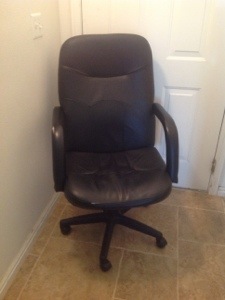
It was an accident really. I wish I could take credit for it.
As part of spinning off RESMARK to be its own company, we were moving offices. I was being installed as president and entrusted with running the new company. While I’d been in management roles before, this was my first time being the top guy. Everyone looked to me for direction and they just expected that I knew what to do. I apparently appeared more confident than I felt.
We were supposed to meet the property manager at our new office at 9:00. At 9:10 I was still in the parking lot surrounded by 6 programmers who were anxious to get in and get their computers set up.
No property manager.

Of course, his phone went straight to voice mail.
So, what are we going to do, Rodney?
Well, here was my first test as the newly minted “guy in charge,” and I had no idea what to do. In my head I did the calculation on how much per hour our little parking lot party was costing.
Tell you what, the new office has desks, but all we have is folding chairs right now. Why don’t you guys go with Dave to the office supply store and buy desk chairs. I’ll try to get us some keys by the time you get back.
It was a punt. It was something to keep them busy while I put out the current fire.
Rodney, is there a budget on the chairs?
Ah. . .
I tried to access the search engine in my head, “How much does an office chair cost?” I got back nothing. The prices are probably all within 20% of each other, so none of them can get too elaborate, right? Especially at Office Depot.
No. Just let people get one that’s comfortable for them.
I hoped I hadn’t just spent $1000 more than I needed to. Dave and the programmers headed off to go shopping and I tried the property manager again.
By the time they got back, I not only had the office open, I had my own set of keys. Dave and the rest of the programmers carried in their new office chairs. . .no two of them the same. Well, our office was already a hodge-podge collection. Mismatched chairs would fit right in. The prices were all within what I would have set as a budget anyway.
Over the coming weeks as we settled into our offices, a curious thing happened. . .well, didn’t happen. No one ever got their chairs confused. This might not sound like a big deal, but modern office chairs have more controls than an airplane cockpit. You can adjust the seat height, the arm height, the lumbar support, the tension when leaning back, and a bunch of other settings. Finding that someone else has changed the settings on your chair is distracting and annoying.
Also, if you’ve ever worked in an office where every desk and every chair is identical, you know that it can get confusing trying to keep track of exactly which burgundy colorer, fabric covered chair is yours. We never had the problem.
The second thing that happened was completely unexpected, although in hindsight I should have anticipated it. (Like I said, it was an accident.) Programmers sit for long periods of time. Any time they aren’t headed for the restroom or getting a diet coke, they are sitting at their desk. But, no one sits at a desk. They actually sit in a chair. By allowing the programmers to pick their own chairs, I allowed them to select the single piece of office equipment that would most impact their comfort at work.
My mother owned a CPA firm many years ago and she called me as they were in the process of upgrading their office equipment.
I need to buy chairs. What chairs does your company use?
Well, WordPerfect just outfitted their entire campus with Herman Miller chairs. They’re great. Really comfortable.
How much are they, do you know?
I think they’re about $800 each.
To a CPA that seemed like a lot. Even today, 20 years later it sounds like a lot. But, here’s the funny thing. After she got over the sticker shock, my mother went out and bought $800 Herman Miller chairs for her office. Because she realized that she was asking her staff to sit at their desk (in their chairs) for 12 to 14 hours per day during tax season. After she got the nice chairs no one complained about their back, or feet or legs aching from doing all that sitting.
I saw similar results with my staff. Our chairs weren’t $800, but they weren’t the $59 low end chairs either. By letting them select the chair that fit them the best, they naturally chose the chair that was the most comfortable to them.
The third benefit was that they thought I was the greatest boss ever. How many of you ever got to pick your own office chair? I know I never did. They thought it was a great way to start the new business.
I just wish I could take more credit for it.
Tell your friends about this!


I didn’t know what I did either. Well, I did in a high level “I’m president of the RESMARK company” sort of resume-placeholder way. But, exactly what useful purpose I served day-to-day? I struggled to figure that out most days.
It was the summer of 2006 and I was headed out on an extended road trip to visit our current and prospective clients for our Whitewater rafting reservation software. I know what you’re thinking: Whitewater rafting reservations? Do they really need a specialized software program?
During the roughly 100 days from Memorial Day to Labor Day, Echo Canyon Rafting in Canon City, Co will send 25,000 guests down the Arkansas River. They were the biggest outfitter on the Arkansas, but Noah’s Ark was only slightly behind them. Those two were both customers. They were doing all those reservations with paper and pencil.
In addition to being the president, I was the chief sales guy for RESMARK. Actually, I was the only sales guy. Fortunately we weren’t depending on sales just yet. We were running on investment money and our version 1.0 product was scheduled to ship just after the season ended on Sept 1. My job in the summer was to press the flesh with the customers who had signed up and make sure we were including the right set of features in the finished product.
We’d been working on the RESMARK program for a couple of years. We had spun the company off from Agile Studios the previous year. We were primarily a development shop. In addition to myself, we had Richard, our office manager, and Del, our IT guy. Everyone else was a programmer. Dave was our head programmer. My job was to talk to Dave and talk to our investors and make sure the refrigerator stayed stocked. Actually Richard took care of that.
“What is it you do here?”
“I have no idea. Maybe I could help write code?”
“If you do, I’ll need to hire two more programmers.
“Why?”
“To clean up after you.”
“That’s harsh, Dave.”
Dave liked to tease me, but there were days when I really wasn’t sure what value I added. So, when the weather warmed up, I headed out to visit our 10 beta customers across the United States. Ironically, I didn’t get to go rafting at all that summer.
After about 3 weeks, Dave called me.
I don’t know what it is you do here, but I need you here doing it.
Our programmers were pretty junior, and while Dave had over 10 years experience, at times he had to do more micro managing than he would have needed with a more senior staff. Having me in the office provided a little more “grown up” influence. Sometimes just showing up makes a difference.
Our staff was great, and they all went on to successful programming careers. But, sometimes they just needed someone there to remind them that we had investors and customers that were anxiously waiting for the program they were building. I think it helped them focus.
I still wasn’t entirely sure what I did, but it clearly was important!
Tell your friends about this!


We are getting rid of your Wordpefect Office email program.
What are you planning to replace it with, if you don’t mind me asking?
Anything else!
Doug was the Office Product Manager and he had a problem.
This was 1991. Our latest email server, WordPerfect Office 3.0 had been out about a year. Version 3.0 was our first multiple server version. There were a few hiccups during the beta (Racist Programs and Assaulting Servers.)
The product was starting to get some traction and we’d made a couple of big sales. The biggest was the Environmental Protection Agency. The EPA had about 40,000 employees and they were all using our email program. Well, they were trying to use it. We hadn’t tried to run on a system that big before. And there were definitely some growing pains.
But, you would think that if any company was positioned to provide help with a problem installation it was WordPerfect. As I mentioned in “You Want a What? We Don’t Even Make Those Anymore” we prided ourselves on customer service. We had the best customer service in the world.
There was just one problem. Our support model was built around supporting individual installations of WordPerfect’s word processor. Which meant that even for the Office program we had a team of operators and a phone queue. When someone called, they got routed to whomever was available.
That works great if you want to know how to write a keyboard macro, it doesn’t work so well when you want to know why Connection Server #5 is getting an error message that none of the other 4 is getting. We literally started from scratch every time the EPA called in. This was very frustrating.
Many of our DC sales guys were very technical. However, they weren’t allowed to touch the customers’ keyboards. They were expected to stand next to the customer and talk them through their demos.
The source of this policy was our Executive Vice President, Pete. He understood WordPerfect, but he really didn’t grasp the added complexities of an enterprise-wide email system.
“If our software is not simple enough for a customer to buy it off-the-shelf and install it, we need to redesign it until it is simple enough.”
That’s a great goal. But, it’s just not practical for enterprise level software. Remember, this was before the days of the internet and remote logins. Customers expected us to make it work. They didn’t want to have us tell them how to make it work.
Doug called Bernadette, the EPA IT administrator.
“One of your biggest frustrations is having to reexplain all of the background every time you call, right?
Yes. Especially if it’s a simple question.
Suppose I gave you a single support person to work with? You just call him when you have a question.
He would need to come on site and help configure the system.
Ah. . .okay. Would that keep you from throwing Office out?
We’ll try it.
Great. His name is Rodney Bliss.”
And that’s how I got tagged to be the first Technical Account Manager, WordPerfect SWAT Team member.
There was just one problem. Pete had that rule that employees were not to touch customers’ keyboards, let alone travel to Washington DC from Orem, Ut to touch their keyboards.
I met with Doug in his office.
“You’ve been temporarily reassigned to the Marketing team. You know the EPA administrators right?”
Yeah.
I need you to fly to Washington DC and Research Triangle Park in North Carolina and fix their system. We can get development resources if needed. I just need you to make it work for them.
Cool.
Oh, and one more thing. This is vital. I need you to not let Pete know.
The Executive Vice President?
Yeah.
Okay.
Doug was my air cover. He had a VP further up the chain that was providing his air cover. But, as I explained in “Sometimes You Just Need to Punt,” the first rule of air cover is that you never ever want to use your air cover.
I spent months shuttling back and forth between DC, Utah and North Carolina getting the EPA installation working. I didn’t interact with the Executive VP much, so keeping out of sight was easy. i had to be careful what i talked about at lunch to try to keep rumors from forming. I also had at least one executive level briefing with our executives. Once it was set up, of course, I was the one to maintain it.
Three things came out of Doug’s skunkworks project.
1. I fixed the EPA problems, saved the account and they enjoyed Office for many versions to come.
2. We expanded my role and formed the SWAT team to provide that same level of support to multiple companies.
3. Pete found out. He pushed the owners to fire Doug’s air cover VP. Instead, Alan and Bruce saw the value of what I’d done and they fired Pete instead. (I think the VP’s air cover was Alan.)
Anyone who loves Novell GroupWise really owes a debt to Doug. Had he not put his job on the line to save the EPA, WordPerfect Office might have died on the vine. At the very least it would not have been the technical marvel it was for many years.
The Executive VP was a big part of the reason that WordPerfect had a Sick Corporate Culture. He was gone before WordPerfect died, but it was his management that really set the stage. Doug was surprising because he was willing to disagree. WP policies were designed to Turn Honest Employees into Dishonest Ones.
I also owe Doug for plucking me out of obscurity and helping to launch my career.
Tell your friends about this!


I should have learned. But, this time I was SURE I was right. . .just like last time. I was arguing with my dad about this great company I worked for called WordPerfect.
But, they’ve got no corporate debt, they’ve got 93% of the word processing market. They’re a private company now, but, they’re going to go public.
Have they announced an IPO?
Well, not yet. . .
What percentage of their expenses are salary?
I don’t know. They threatened to fire us if we revealed our salary.
Their corporate culture is sick. I doubt they’ll ever go public.
What did he know anyway. Of course, they never did go public.
Actually he knew a lot. He recognized one of the signs of a sick company. There are many, but here are five that I’ve noticed in my career, and a prescription for fixing them.
1. Salaries are secret. I mean REALLY secret!
I’m not advocating publishing your salaries in the company newsletter, but, if your employees fear being fired for sharing their salary, you’ve gone too far. Salary discussions don’t have to be disruptive. Most places I’ve worked, and in fact in business in general, discussing money is considered gauche. A word my father would approve of. Often a gentle reminder will do the trick.
But, what if you have that employee who doesn’t get the hint? If it’s impacting people’s ability to get their jobs done, then it’s no longer a salary issue, it’s a productivity issue, and should be dealt with as such.
If you, as a management team are embarrassed to have salary information come out, either yours, or your employees, then you should consider why that is. Are you severely underpaying? Are you overpaying poor performers? Are you overpaying managers? How much is too much? That leads to the second sign of a sick company.
2. Your managers are paid more than their staff
This sounds counterintuitive. Shouldn’t those higher on the corporate food chain earn more than those below them?
It depends on what your company’s purpose is. Whose work is essential to the success of your company? Are you a software company? Then don’t just hire good, hire GREAT programmers. The great ones are expensive. Are you a sales organization? Don’t hire just good, hire GREAT salespeople.
I ran a couple of startup software companies, one as the Executive VP, the other as president. We were funded with investment money. My best developer made two and half times as much as I did, and he was working for less than he could have gotten elsewhere. I had a share of the company that we hoped would someday be valuable, but for straight salary, I was the lowest paid employee. Your managers don’t have to be the lowest, but they also should not be the highest.
Bill Gates as we all know, is the richest man in the world. What most people don’t know is that during most of his Microsoft career his salary was $250,000, and he was the only Microsoft employee who was not eligible for stock options. His wealth came because his company did well. His company did well because he was willing to pay others a lot more than he paid himself.
3. People are afraid to disagree
Last week, I talked about how a bad corporate policy was Turning Honest Employees Into Dishonest Ones. The problem I had was that WordPerfect did not exactly reward those who spoke up. I’m reminded of the executive who asked,
We all agree that ‘Yes Men’ have no place in organization, right?
Yes!
The story of “The Emperor Has No Clothes” teaches us the dangers of self delusion. However, equally important, I think, is the danger of surrounding yourself with those who refuse to disagree. No leader is an expert at everything. Often we aren’t even experts at what we think we’re good at. Why would you go to the trouble of hiring great people and then refuse to listen to them?
One of my favorite Microsoft stories is the story of Microsoft Bob. Bob was one of the most spectacular failures in the history of not just Microsoft, but the computer industry. You’d think there would serious repercussions for failing that badly. The program manager for Microsoft Bob was a woman named Melinda French. You might recognize her by her married name, Melinda Gates.
The point is that people will never give you their best work when they are afraid; either of disagreeing or failing. Give your people the freedom to share ideas and let them know that you hired them because they know stuff. The worst they can do is not to disagree, the worst they can do is to be silent when they should speak up. This principal is why I got told by my brother, Now Would Be A Good Time To Shut Up.
4. Your company success is because you’re smarter than everyone else
It’s not and you’re not. I’m sure you are smart. You wouldn’t be where you are if your weren’t. But in the mercenary business of business, no one is smart enough to beat everyone else all the time. Okay, if you’re Warren Buffet, welcome to my blog. For the rest of us, we need to be willing to let other people learn our lessons for us, and then take advantage of their experience.
We don’t want to hire MBAs. We will teach you everything you need to know about the computer business.
It sounds crazy, but that’s an actual quote of what a WordPerfect vice president told me. Less than 5 years later they were no longer a company, and five years after that they were barely still a product. I never got a chance to check back with that VP. I’m sure that in 1994, when they were out of cash and had burned through a $100M line of credit, they could have used some of those MBAs to help them adjust their business to working in a market with much lower margins. As it was, the computer business changed and WordPerfect didn’t have time to relearn everything you need to know about the new computer business.
This one is easy to fix. Check your ego. Be willing to learn. Be willing to recognize the fact that others know more than you do on certain issues. That’s why we have CPAs. It’s why a lawyer who represents himself in court has a fool for a client.
5. You manage with appeals to emotion
One of the underlying problem with My Manager From Hell was that he got offended and then made decisions based on that emotion. We’ve all known people who were “hot-heads.” But, when the hot-head is the manager, it’s a recipe for problems.
I worked one summer for a custom cabinet making shop in Western Washington. There were quite a few things wrong with the company. One of them was that the guy who stained the cabinets and doors would come back from lunch stoned, and as a result we’d get a wide variance in the color of the stains. Normally this didn’t cause a huge problem since we did lots of piece work. But, one time we got an order for ten 36″ solid oak doors. Each door was probably $500 or $600. Our stain guy did what he always did and sure enough the doors were slightly different shades of red oak. Since they were going in a long hallway, the mistake was pretty obvious. The owner called a team meeting. It was the first time I’d ever even talked to him. He gave us a sob story of how he couldn’t afford to pay to fix these doors on his own. He guilted us into coming in on Saturday and redoing the work for free.
It’s not only the sob story, how many times have you seen stories of the manager who rules through intimidation and fear? And that’s not even touching on the more romantic emotions and the fact there is no room in the workplace for them.
I know there are other signs of sick corporate culture. The real point is not what the exact sickness is, but being willing to recognize it and then work to correct it. Sometimes new management, or getting rid of a problem employee can fix it. Other times, sadly like WordPerfect, the disease kills the company. I’ve talked with some former WordPerfect executives over the ensuing years. Some of them clearly saw then, and see now what the problems were. Others are still convinced it was just bad luck and bad timing. Not surprisingly “luck” and “timing” are some of the reasons they had any measure of success in the first place.
Tell your friends about this!

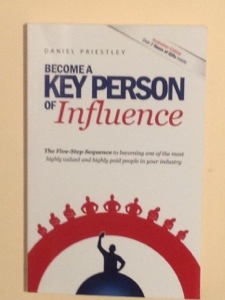
Today being a holiday here in the US, Memorial Day, I’m doing something a little different – a book review. I recently read a fascinating book called “Become a Key Person of Influence.” According to the back cover, the author, Daniel Priestley, is a successful entrepreneur, author and international speaker. The book is designed to help your replicate the rapid ascension that he experienced after arriving in London with “littler more than a suitcase and a credit card.”
What I liked
Priestley has a very conversational writing style. At 178 pages, it’s a very easy read. The author manages to convey an overwhelming faith in you the reader, to achieve anything you set your mind to. He manages to be inspiring without being insipid; visionary without vapid. Okay, maybe I should skip the alliteration.
He lays out a very simple five step plan to making yourself a KPI. I call it “How to become world famous,” but it’s essentially the same thing. He attempts to tell you how to become one of the experts in your industry. The five steps are:
1. Create a pitch, this is similar to the elevator pitch. Basically, figure out what you do and why you do it. He’s big on not just a niche, but a microniche: left-handed yak growers in central London.
2. Write a book. He even gives you some hints on HOW to write a book. I’ve written a couple. They can be hard. If you follow his advice I think writing a book will be . . .less hard.
3. Create something to sell. Basically turn your book into a DVD, or download.
4. Be on the front page of google search results. Again, he gives you some hints to help if you aren’t there already.
5. Find other people who offer complementary products or services and team up with them. Bring your audience for your partner to sell to and sell to his audience.
There is more, of course, but this is the heart of his “system.” The most valuable thing I got out of “Become a Key Person of Influence” was the systematic approach. At one point I was the world expert on migrating Microsoft Exchange 5.5 to Novell GroupWise. As I looked back on that experience I could see where Priestley’s principals had figured into my own success.
What I didn’t like
The biggest problem I had with the book was a reoccurring theme that Priestley’s REAL message was hidden and it was up to me as the reader to deduce it, even suggesting I go back and reread the book until I “got” it. Really? I bought your book. I even paid shipping from Australia because I couldn’t find a US distributor, just TELL me your point. It was annoying for two reasons.
First, it was really condescending, “You don’t know this yet, and I’m not sure you’re smart enough to figure it out. Show me that you are!” Second, it kept knocking me out of the flow of the narrative as I had to stop and think about the “real” point.
As near as I could tell the secret is that Priestley used his system to write his book. Or, more accurately this book is step 2 in his system. So, he is telling you the lessons and showing you them at the same time.
The other problem I had with the book was the idea that Daniel Priestley walked off the boat in London like some Horatio Alger character. What he doesn’t tell you on the back cover was that he was a successful businessman in Australia prior to moving to London. And he arrived without knowing anyone? Why didn’t he make some calls while he was in Australia? It’s not like we live in the 19th Century and he had to wait for a letter by boat!
What it means for you
If you feel that you have the capacity to be the very best at what you do, or if you already are the best and no one knows, “Become a Key Person of Influence” is a great starting point.
Rating
3 out of 5 Stars (I deducted an entire star for that “Guess my point” technique.)
Tell your friends about this!


You know that little inkling you get that something somewhere isn’t right? It’s a skill that really good datacenter managers develop. Almost Jedi-like.
I feel a great disturbance in the servers.
Well, today was not one of those days. Today was more like when you know your house is on fire because of all the smoke, flames, firetrucks and especially the alarms going off.
“We just lost another one. We’re at 69% of power supplies on the Cisco appliances.”
“That’s good right? We’re still above 50% so, we haven’t lost any servers yet, right?”
“Well, it WOULD be good if the power supplies would fail uniformly. But, we’ve lost both the primary and the secondary in several chassis.”
“Do we even know how much is down?”
“We’re working on it. . .There went two more. We’re at 63%.”
This was a full-on meltdown. And the frustrating part was that we had no idea why our power supplies were just falling over dead. By the time the event was over we had lost over 50% of the Cisco power supplies in our primary datacenter. Interestingly we lost none in any of our five other datacenters.
Putting things back together involved stripping out the bad power supplies, reshuffling our good ones, pulling every single backup from across the enterprise and shutting down our lab machines so we could rob them. Then, we ran with a single power supply in each device until Cisco could get us more. Getting several dozen power supplies put a bit of a strain on their production.
Now we got to play detective. Why did more than 90 power supplies suddenly decide to give up the ghost at the same time? We sent several of the fried power supplies off to Cisco for analysis and we started looking at the design of our datacenter.
In addition to our other datacenters, none of the other high tech companies had any problems. A good friend is the Global Datacenter Architect for a global company with a local datacenter and he reported their datacenters were fine. . .he also said they didn’t have any spare Cisco power supplies since their architecture was different.
The first thing we looked at was to see if there was any difference between the failed power supplies and the ones that didn’t fail. Many were from the same manufacturing facilities and had been installed at the same time. Some of the failed power supplies were old, some were almost brand new.
We looked at the physical layout of our datacenter. Living in a desert state we cool with outside air. Could something have gotten into the air intake? Nothing unusual, however we were only a couple of miles from a coal fired power plant. Why it should affect us today was anyone’s guess.
One thing we noted was that inside all our components, both the good ones and the bad ones there was a fine white dust. That dust had been in the datacenter for as long as anyone could remember. We’d install new cabinets and after a few weeks the tops would be covered in the dust. We never could find a source for it, and since it had been there for years, we looked elsewhere for our culprit.
We checked the calendar and noticed that exactly a year earlier we had a similar failure. It was July 6, two days after the big Stadium of Fire, 4th of July celebration. The previous year we also had a failure right after the Stadium of Fire celebration. We never figured out the cause of the previous failure. Could it be fireworks smoke that got sucked in the air intake?
We were successful in pinning down one of the contributing factors: humidity. A huge summer rain storm had rolled through and the humidity in the datacenter spiked into the 70-80% range. It’s normally in the under 20% range. One of the dangers of cooling with fresh air. Normally, Utah’s desert climate gives us nice dry air, but when Mother Nature brings the rain, there’s little we can do.
Meanwhile the Cisco analysis was going on all around the world. We’d get weekly updates from Germany, San Francisco and sites around the US. It was very telling that while ALL the Cisco power supplies did not fail, all the power supplies that failed were Cisco power supplies. IBM, HP and NetApp ran just fine.
We replaced the burnt out power supplies, but continued to pour over temperature, and server logs. Finally Cisco came back with their tentative findings. It was the dust. The dust combined with high humidity caused a condition where a capacitor could arc in the power supply. They had never seen this behavior anywhere else in the world. And their best guess was that it was the dust.
So, where did the dust come from? The datacenter was not particularly old. I think it’s less than 10 years old. And if you’ve ever been in a datacenter, they are not particularly dirty places anyway. We checked the air intakes again, but the dust wasn’t on the intake screens. It was being generated from inside the datacenter.
We checked incoming packages. We moved a lot of equipment in and out of the datacenter, but the packages were not particularly dirty, and the dust they did bring in wasn’t white. We checked under the floor. Datacenters are cooled through the floor. That’s why they have that weird “tile” look. We pulled up the tiles and checked the AC units and the area under the floor. But, the dust was coming from something above the floor.
We all had our own theories. Most of them pretty flimsy, since the facts we had to go on were pretty thin.
Finally, a chemistry professor at the local university solved it. He analyzed the dust and discovered it had the exact same chemical makeup as the powdered cleaning solution our maintenance crew used. I think it was Sodium Bromide.
They would mix the powered cleaner in water and then mop the floor. When the water evaporated it would leave a trace of the cleaner behind. As we walked around the datacenter the cleaner would turn to dust and become air born. So, the more we cleaned, the dirty it got.
Once we found the problem the solution was simple. We quit using that type of cleaning solution. We also learned that CSI stuff is harder than it looks on TV.
Tell your friends about this!

The email was entitled, “New Sick Leave Policy.”
Starting immediately we will be implementing a new sick leave policy. Employees will be allowed to take a maximum of three days per calendar year to care for sick family members. Employees may continue to use accrued sick time for themselves, the new policy only affects time spent caring for an immediate family member who may be sick.
Most people’s reaction was, “Someone in HR doesn’t have anything better to do than make up new rules.” However, violating the new leave policy carried very severe penalties. You could be written up, otherwise reprimanded or fired.
In reading this, you might think it’s not a GREAT policy, but it’s not too terrible is it?
Yes. This policy is designed to turn honest employees into dishonest employees.
I was a phone operator at WordPerfect. I didn’t have any pull with anyone, and WordPerfect had a nasty habit of punishing people for speaking out. However, my wife and I both worked there and we had two little kids at home. . .well, okay, they were in daycare, but they were home when we were home.
You might be wondering exactly how this policy would make you dishonest? It’s inconvenient, but why couldn’t you simply work around it. Did we have family in the area? Didn’t we have friends and neighbors who could help?
Yes, we had a great support structure; family, friends, even a strong church organization. But, that wouldn’t help.
Imagine this scenario: it’s late in the year and we’ve already used our three (six in our case since there were two of us working for the company) sick days for taking care of our kids. And any of you who’ve had young kids know that six sick days in a year is optimistic. So, it’s October and we wake up at 5:00am and one of the kids is throwing up.
We’re not up at 5:00am just because the kid is sick. We get up at this time every morning since we have to be at the daycare at 6:00am to be at work at 7:00am. So, what would YOU do? Call friends? At 5:00am? That would be a fun call.
“Yeah, this is Rodney. Listen, my kid is projectile vomiting this morning and I was wondering if you’d mind if I drop her by your house since daycare won’t take her and my company has this crazy ‘3 sick days for family’ policy?
So, would that be okay?
Hello?”
Call family? I suppose you could, but would you?
Nope. Every one of us would call into work and put a little rasp into our voice,
“Yeah, this is Rodney. I’m not feeling too good this morning. I don’t think I’m gonna make it.”
Congratulations, you’ve just implemented a company policy that
1) Forces employees to choose between family and their job
2) Turns honest employees into dishonest employees
I knew that suggesting this to management would probably get me a black mark for grumbling and would most likely never make it past my manager. SHE didn’t want to get a black mark from HER supervisor for grumbling after all.
Instead, I adopted a more covert strategy. I got four interoffice envelopes.
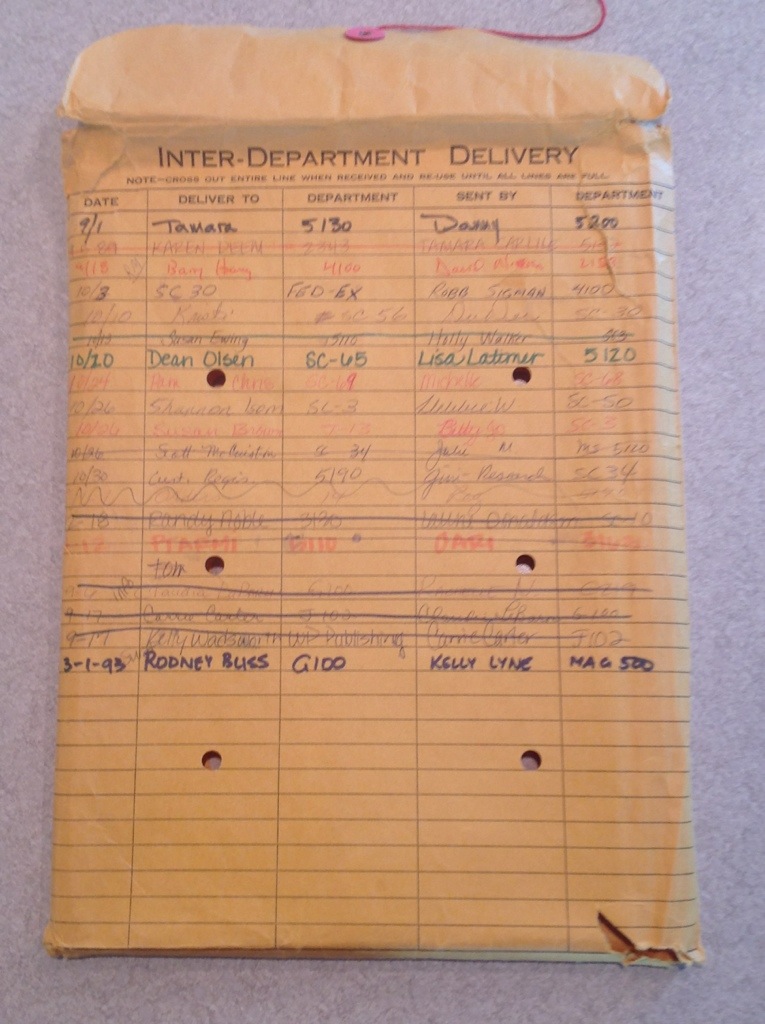
I was so paranoid, that I didn’t even risk getting them from the mailroom in my own building since they would show the previous person they were addressed to. I went to the buildings where the programmers worked and got some of their envelopes. Then, I drafted a letter covering the above scenario and concerns. I signed it “Veritas Valebit” (Truth will Prevail.)
I then sent copies in my random interoffice mail envelopes to the President, Alan Ashton, the CEO, Bruce Bastian, the Executive Vice President Pete Peterson and the VP of HR, Claire Averett.
Ten days later we got another email titled, “Update to the Sick Leave Policy.”
“We have decided to rescind the recent changes to the sick leave policy. Employees may once again use sick leave to care for ill family members.”
Your employees probably like their jobs. Some of them hopefully love their jobs. But, they love their families even more. Don’t make them choose between the two. They’ll follow company rules rather than get fired, but they will lie to protect their families. Remember that the reason they are at work is so they can get money to care for their families.
And if you are going to give employees sick leave, don’t make people feel guilty for taking it.
Tell your friends about this!
“A template for WordPerfect 2.3.”
“You know that the current version of WordPerfect is 5.0, right?”
“Yeah, I know. I was just hoping that there might be some way you could help me get another one.”
“Well, what happened to your old one?”
“My dog ate it. . .Really!”
I mentioned yesterday, in talking about My Manager From Hell, that I spent my entire career at WordPerfect supporting various versions of Office and Library. So, why was I talking to a customer about an ancient version of the word processor? WordPerfect had hundreds of incoming phone lines and dozens of numbers. In addition to the Office/Library team, there were separate lines for
– Printers
– Features
– Macros
– Network installations
– Macintosh
– Data General
– VAX/VMS
And a bunch more speciality groups. With that many groups, WordPerfect typically reused phone numbers. Many years earlier the number that we were using for Office/Library calls was the main feature number.
The woman on the phone was named Summer. I don’t remember her last name. Details fade after 20 years.
If you called up a company today and asked them a question about a version of their software that was five years old, what do you think the response would be? You’d get a polite, thank you for calling. And probably a “Can we upgrade you to the latest version?”
That was not how WordPerfect trained their support operators. People bought our software, we agreed to support it. . .forever if possible.
“Let me see what I can find.”
“Oh? Thank you! Thank you!”
“There’s no guarantee.”
I went to find one of the support managers that I knew had been with the company many years.
“Debbie, do you by chance have a WordPerfect 2.3 template?”
“Well, I’ve got a 2.4 and they were really similar. You have to PROMISE to take care of it!”
“I need to make a copy for a customer.
“Oh, in that case, sure. Get it back to me when you can.”
This might be a good time to explain what the template looked like. Later versions of WordPerfect used templates that went on the function keys. Here’s a WordPerfect 5.1 Template for modern keyboards with the Function keys across the top.

(Photo courtesy of minuszerodegrees.net)
Here’s a template for the older style keyboards that had the function keys grouped on the side, kind of like a ten-key keypad.
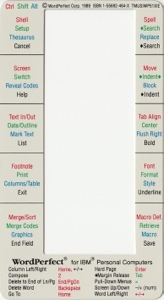
(Photo courtesy of minuszerodegrees.net)
However, WordPerfect 2.3 used the ALT, CTRL and SHIFT keys along with the keys on the top row of the keyboard, not the Function keys. The only one I remember is ALT-[EQUAL SIGN] was the original sequence to exit. Later this functionality was mapped to F7.
The template for WordPerfect 2.3 looked like an “L” laying on it’s side. The short leg looked like the square template above. The long side looked similar to the long template above.
I now had a copy of the template. My next stop was the art department. I found one of the artists who create the current templates. Once I explained that I was trying to help a customer, the artist was more than happy to mock up a new template based on the one I’d borrowed from Debbie. We then printed it on card stock and then cut and laminated it.
“Summer? This is Rodney with WordPerfect. I’m sending you a new template today.”
“Really? Oh, you are an angel! Thank you, thank you!”
Obviously we couldn’t have done that much work for every customer who called. But, that was the point. Every customer didn’t need it. We could be exceptional occasionally because we were only occasionally asked to be exceptional. That level of support was the reason that even after Microsoft Word had crushed WordPerfect’s market position, many customers refused to switch. To this day, I meet loyal WordPerfect customers. I wouldn’t be surprised if somewhere Summer is still using WordPerfect 2.3. . .and keeping her dog away from the keyboard.