Bruce’s facebook post seemed simple enough. It was a pattern puzzle. Bruce is a friend from high school and absolutely brilliant, so I enjoyed the prospect of challenging myself on a puzzle he created.
Given the following sequence, what comes next???
Blue
Red
Yellow
Blue
Green
Red
???
Stop reading now if you want to try to figure it out yourself. I’ll wait.
. . .
. . .
Did you find the pattern? Post your solution in the comments. Here’s what I came up with
Purple
My thinking went like this:
Primary colors
Blue
Red
Yellow
Primary color with “opposite” secondary color
Blue –
Green – combine primary color above and primary not below
Red –
Purple – combine primary above (red) and not primary below (yellow, assumed since it’s the one not yet listed.)
In addition I assumed that after purple would be yellow, the next primary color and then orange, the third secondary color. After orange I assumed he would go back to blue and possibly go to tertiary colors, but I wasn’t sure I could keep the pattern straight.

The correct answer?
Blue
That really threw me. I went back over my logic, and couldn’t find anyway that blue would be next. Finally, I admitted I was stumped and asked Bruce for the logic behind an answer of blue.
Here‘s where he pointed me.

Google’s 1997 logo.
Sometimes I tend to overthink things. . .by a lot.
Here’s the business tie-in. We make assumptions everyday. I’m in the middle of a very big, very stressful project at work. We are working to launch a service for a very important client. The client wants us to run everything past them. We are defining what programs phone agents will have on their desktop. The client wants to approve every.single.program.
More than once we have assumed that we knew what they wanted, or knew what they would approve. And when we check with them, we discover their answer is “blue.” Not, purple followed by yellow and then probably orange. No, just blue.
And to us, to me, it sometimes makes no sense. Why blue? Why do it this way when I think I’ve figured out a way that makes sense, that follows a pattern, that is logical?
Because the customer can see the Google logo from last century and they are basing their requirements on criteria that I don’t even understand exist.
Definitely illustrates why it makes sense to ask about everything. . .and sometimes Google the answer.
Rodney M Bliss is an author, columnist and IT Consultant. He lives in Pleasant Grove, UT with his lovely wife and thirteen children.
Follow him on
Twitter (@rodneymbliss)
Facebook (www.facebook.com/rbliss)
LinkedIn (www.LinkedIn.com/in/rbliss)
or email him at rbliss at msn dot com
Tell your friends about this!


It wasn’t really unexpected. In fact, we’ve really seen it coming for months. It really became clear a few months ago that the end was close. We’ve even know the exact date for weeks.
April 8th, 2014
Whistler was barely 12 years old. August 15 would have made Whistler officially a teenager. . .ancient really.
You probably didn’t call it Whistler, that was a development name. You called it Windows XP. I got busy with other posts last week and didn’t have a chance to properly say goodbye.
The name was meant to emphasize Microsoft’s Windows eXPerience. It was a great name for a great product.
I remember the release of Windows XP, August 15, 2001. It replaced the abysmal Windows Millennium (We Didn’t Come Here To Win The Boot). Millennium was so bad that we didn’t run it internally. We were still on Windows 98 when XP became available. Of course, we were running it well before August. But, we knew it was a solid product. I don’t think anyone knew how solid.
Microsoft’s biggest competitor has often been it’s own previous versions. Trying to knock XP off been very frustrating for the marketers in Redmond.
I have a personal software Hall Of Fame. There are only a few products in it. DOS 3.3, Lotus 123, WordPerfect 4.2 and Windows XP. So, it really is with a touch of sadness that I watch the death of Windows XP.
The product didn’t really die, of course. April 8th is just the day that Microsoft quit supporting it.
Big deal, you might think. Who really cares? My copy still works great.
And it does, but the reason you should care is Heartbleed. Heartbleed is the name of a security flaw in the OpenSSL standard that governs secure connection with your bank, online merchants and pretty much any site that puts that little locked padlock image.
What does Heartbleed have to do with the death of Windows XP? Just this, if someone finds a Heartbleed type bug in Windows XP, Microsoft will not fix it. Think about that for a moment. Many of us hate that autoupdate that sometimes reboots our laptops and resets our location in our Firefly viewing marathon. But, we know that the reboot was to make our software more secure. We grumble and then take our medicine.
Well, the doctor will no longer be making a house call. We are on our own.
This is where the fear of zombies comes in. Windows XP is still running all over the world. Of the 6 Windows PCs in my house, half of them are still running XP and will for the foreseeable future.
They are the walking dead. Not yet dead and gone, but not exactly alive. And while it may not be the Zombie Apocalypse, it’s still a serious security risk. I will run my ancient computers until they won’t turn on because the hardware is too old for Windows 7 or 8 and there are apps that only run on those ancient dinosaurs (Breaking Out Of The Upgrade Cycle.)
But, for new computers I’ll go with updated software.
Windows is dead. Long Live Windows!
Rodney M Bliss is an author, columnist and IT Consultant. He lives in Pleasant Grove, UT with his lovely wife and thirteen children.
Follow him on
Twitter (@rodneymbliss)
Facebook (www.facebook.com/rbliss)
LinkedIn (www.LinkedIn.com/in/rbliss)
or email him at rbliss at msn dot com
Tell your friends about this!
Management Rules That Make No Sense #7
It’s not what you think.
Tell your friends about this!
One foot by one foot.
One square foot.
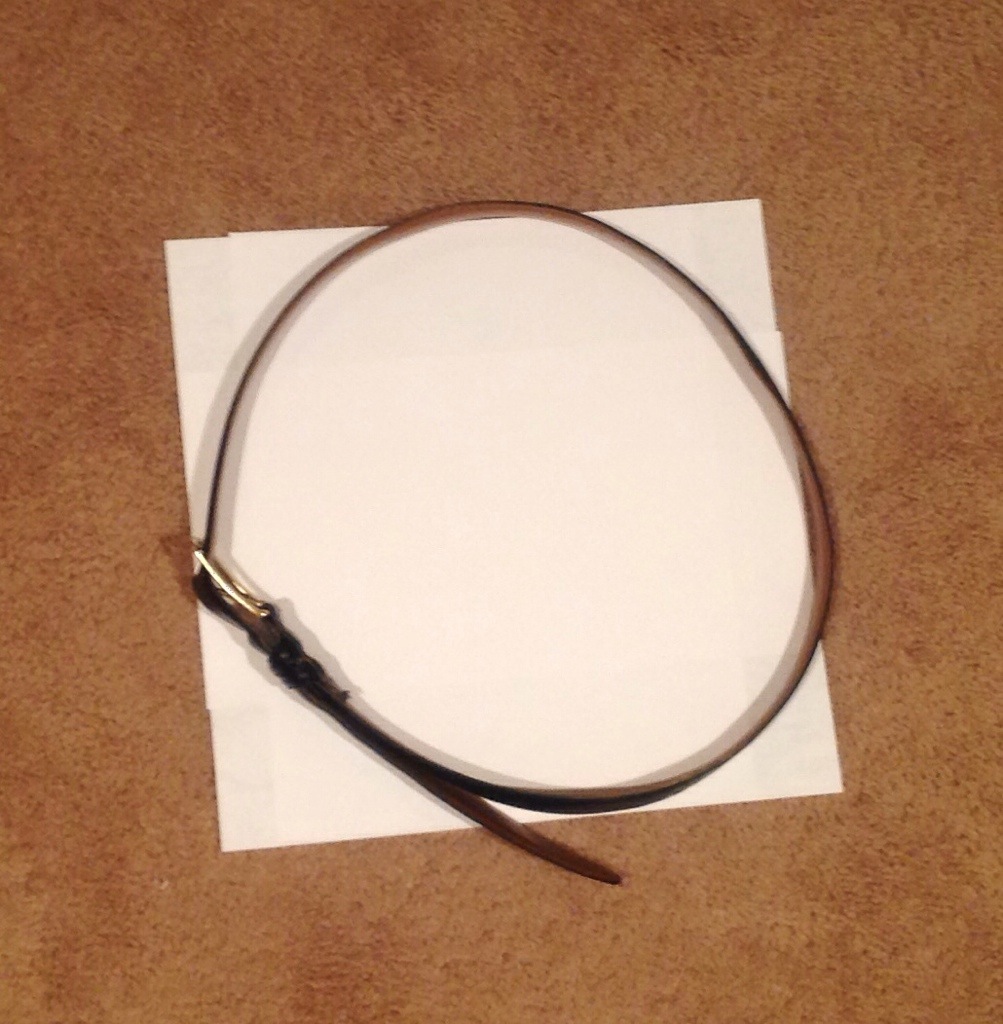
Not big enough to hardly reach into. Certainly not big enough to climb through. And the concrete ceiling was only about 2 feet above the acoustical tile ceiling that I needed to climb into.
I was a making more money than I had ever made in the past. In addition to my campus job working in the telephone office, I had picked up a summer job working for a company hired to rewire the entire BYU campus. Three things stick out in my memory about the wiring job.
First, it was the first job that I ever got a paid holiday. No one worked on the 4th of July, but we all got paid. As a 24 year old newlywed who’s first car was $500, a paid holiday was an amazing gift.
Second, we got to see parts of BYU campus that none of my classmates even knew existed. And that led to the third thing that stood out.
I spent most of my days crawling around in ceilings. . . and hoping to not fall out of them.
How much of our daily lives do we take for granted? Do you remember how excited you were to buy your first car? I do. It was that $500 Mazda. We bought it used from a less reputable dealer with money that my inlaws gave us for a wedding present. In fact, the car had no catalytic converter, even though it was supposed to. We didn’t know to check. Oh to be that young and naive again.
The car died in a scary crash as my lovely wife was bringing me a homemade apple pie. She was turning right and someone turned in front of her. In our view she had the right of way. However, the guy that hit her was the radio announcer for BYU’s basketball team. And the accident happened on campus. There was no way he was going to be found at fault.
I still remember how I felt when she called me. . .Helpless.
Lots of memories in that car.
Today, I have three cars and while each has a history, I doubt that 25 years from now I will be remembering the times we had with them.
Many of you know I recently started a new job. It’s a very interesting and challenging job and I’m excited to have it. But, it’s a job. Now, my FIRST job? Stable boy. I told the story in The Cow In The Cemetery.
Finally, I remember the first time I came to Utah. I was a missionary at the Missionary Training Center in Provo, UT. (The Day I Found Out I Was A Jerk.) The mountains were awe inspiring. They still inspire me. (Rocky Mountains Of Perspective.) But, not like they did those two months back in 1984.
So, that first paid holiday really meant a lot.
My time in the ceiling was both exciting and at times scary. First, to fit through a one square foot hole, I had to take off all my tools. I had to remove my belt. Then, I would put my arms above my head and cross my wrists to pull my shoulders in. My waist was 32″. If you do the math (Circumference = pi * diameter) if my waist were a perfect circle the diameter would be 11″. It was a TIGHT fit.
After getting through the hole, it was a challenge to remain in the ceiling. Those acoustical ceilings have a deceptively solid look. I would balance on the 1″ wide metal supports. I eventually learned that I couldn’t crawl through any space smaller than my head. (That situation actually came up on a frequent basis.)
None of the other students on our crew would do it. And in hindsight, that was pretty memorable too.
So, if you are starting out on your career. Or even if you have an established career and you are making a change to a new company or a new area. Remember to look for and enjoy those firsts. I think the real tragedy of growing old is when we no longer can recognize “firsts” in our lives.
Rodney M Bliss is an author, columnist and IT Consultant. He lives in Pleasant Grove, UT with his lovely wife and thirteen children.
Follow him on
Twitter (@rodneymbliss)
Facebook (www.facebook.com/rbliss)
LinkedIn (www.LinkedIn.com/in/rbliss)
or email him at rbliss at msn dot com
Tell your friends about this!
They were drunk. Everyone admits that the only reason they did it was they had consumed too much of the free beer. Still, they weren’t THAT drunk. The leather couch was worth at least $1000, probably more. They did check for people walking below before they dumped it off the third floor balcony. It crumbled into a pile of leather, wood and stuff on the floor of the atrium.
A drunken frat party?
Nope.
A bunch of high school kids who got into their parents liquor cabinet?
Nope.
They were a collection of millionaires. And later no one would care about the couch. . .or the holes in the walls. They did get a little upset about the impromptu pool.
Where do you draw the line between blowing off steam and going over the line? I’ve seen justification for raucous celebrations by the phrase “work hard, play hard.”
The University of Connecticut mens basketball team won the national championship this week. According to a CBS News report,
Jubilant fans celebrating UConn’s Monday night national basketball championship win smashed a window in an engineering building, broke street lights and overturned furniture inside the school’s student union.
…
“A lot of it was alcohol-related,” Breen said. “There was breech of peace, destruction of property, and we had a fireworks charge.”
Ironically, this sounds very similar to what happened at Microsoft. Are they really that much different? Police arrested dozens in the UConn case, while at Microsoft folks got ship it awards and congratulations.
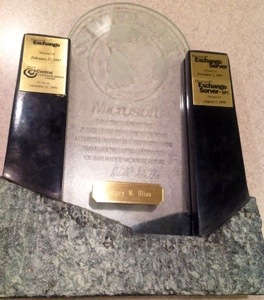
I see three major differences:
1. The Microsoft guys (and women) had permission to be crazy. The company did eventually crack down a little. It involved the Art Department requesting that they be informed before any future Shipping Parties so they could remove the original art work from the building.
Brian Valentine, the director over the Exchange team held a meeting when the Exchange group moved into a brand new building. He announced that the parking garage seemed to have too many handicap parking spots. He then reached in to a bag and held up a tow chain.
I’ve got a chain and a truck that anyone is free to borrow to fix it.
2. The Exchange team only trashed their own stuff. Unlike the rowdy (rioting?) college kids, the guys on the Exchange team mostly just broke stuff in their own building. There was no one who was going to come and complain. . .well there might have been, but all those people were already getting drunk at the party.
3. Most importantly, the Exchange programmers, and testers, and admins, and trainers, and marketing folks, and everyone else actually contributed to the success of the product. The kids in Connecticut didn’t do anything other than get accepted to a University that has a really good basketball team. In the Microsoft case, those guys throwing the couch off the balcony just made the company millions of dollars. Buying new furniture and fixing some holes in the wall were considered a small price to pay.
I think they did draw the line at the green jello wrestling. . .especially when the “ring” broke and spilled all over the carpet. But, that’s a story for another day.
Rodney M Bliss is an author, columnist and IT Consultant. He lives in Pleasant Grove, UT with his lovely wife and thirteen children.
Follow him on
Twitter (@rodneymbliss)
Facebook (www.facebook.com/rbliss)
LinkedIn (www.LinkedIn.com/in/rbliss)
or email him at rbliss at msn dot com
Tell your friends about this!
The Wall starts off as little more than a raised curb; a few names engraved in the black granite. As we walked down it was as if The Wall rather than we were moving. Standing at the base of the deepest part, The Wall was over ten feet tall . . .and covered with all those names.

(Photo credit: digital salutations)
I knew that guy.
What?
That guy right there. I served with him.
Oh. . .
This was my first visit to the Vietnam Veterans Memorial. I was attending with my friend Jim Abbott. Jim was the local Washington DC rep for WordPerfect Corporation. And he was a Vietnam Veteran. It was somewhat overwhelming to be standing in front of those 58,000 names with someone who, but for the grace of God might have joined them. I’m a history buff and Jim was one of those people willing to talk about his experience.
The most important thing I learned in Vietnam was that knowledge was power. The rest of the guys in the unit were very interested in keeping me alive.
We typically think of people who are information black holes as a bad thing. In business we don’t want information bottlenecks. When only a few people know how to do something it’s often called “tribal knowledge.” The information isn’t written down, it only exists in the heads of the experts.
As a project manager, I have to treat tribal knowledge very carefully. The problem is that it is normally the technical experts who hold the tribal knowledge. Engineers and programmers are terrible at documentation. They know their code, or their systems and documentation is often viewed as wasted effort.
Would you write down your own phone number? Or directions to your house? Of course not. That’s how technical people think of their systems. Why document what you know? Of course, we end up programming numbers into a phone and then tend to forget them. We move to a new address and no longer remember exactly how to get to our old house. We certainly don’t remember well enough to describe it to someone else.
But, as a PM if I push too hard against the Tribal Knowledge, I risk alienating the very people I need to help me do my job. I tend to do lots of my own documentation. This practice in turns leads to another type of information sharing. The person with the documentation tends to become known as the person to ask. If they don’t know the answer they know who to ask.
But in all cases, we want to avoid having just one guy know a key piece of information. I mean, what happens if he gets hit by a bus, or catches a bullet in the jungle?
My friend explained why he was so valuable to his unit.
We used microwave transmitters and receivers for our radios at the forward landing zones. Depending on how far you were from the base, you needed to set the gaps to different distances. The army produced a booklet with tables to help you determine the correct gaps. The tables were wrong.
So, how did you set them up?
I was the only guy in my unit with enough math ability to derive the correct values. No way was I going to teach that to anyone else. Our unit would drop in and secure an LZ. Once it was secure they’d fly me in on a helicopter. I’d set up the radio and then they’d fly me back behind the lines as fast as possible. My unit was very interested in keeping my alive.
I guess if it was a matter of life and death, I might do a little less sharing as well. Fortunately, we don’t have to dodge bullets in our data centers.
To Jim and all the veterans, especially the guys who served in Vietnam, a grateful nation thanks you.
Rodney M Bliss is an author, columnist and IT Consultant. He lives in Pleasant Grove, UT with his lovely wife and thirteen children.
Follow him on
Twitter (@rodneymbliss)
Facebook (www.facebook.com/rbliss)
LinkedIn (www.LinkedIn.com/in/rbliss)
or email him at rbliss at msn dot com
Tell your friends about this!
George Cheeseman rushed out to his driveway just in time to see a bunch of guys grabbing stuff off his moving van. He punches the first one he can reach, at which point everyone stops and looks on in horrified surprise.
The FBI agent who was responsible for relocating the Cheesemans from New Jersey to rural Utah rushes up to stop any more violence.
George, what are you doing?
They were stealing my stuff!
We’re your new neighbors. We were just trying to help!
At that point George throws a couple of bucks to the guy he just decked.
Try not to break nuthin.
This is one of the pivotal scenes in the movie “Mobsters and Mormons” written and directed by my friend John Moyer, (who also plays the FBI agent.)
John, who is originally from New Jersey, but now lives in Utah, wanted to show just what a different culture exists in Utah. Culture shock is an issue in business as well as communities. Failure to properly prepare for it can lead to uncomfortable situations and worst case, having to replace new people who don’t “fit in.”
I also grew up outside of Utah. But, I’ve lived here for the better part of 20 years. I thought I understood the culture. I was wrong.
Two years ago we moved from one part of our little town of Pleasant Grove, UT to a different part. We’d rented a couple of places over the previous years and were finally buying a house. Having lived in Pleasant Grove for years, we really got to pick our spot, and we picked a gorgeous one. Just under the “G” on the mountain.
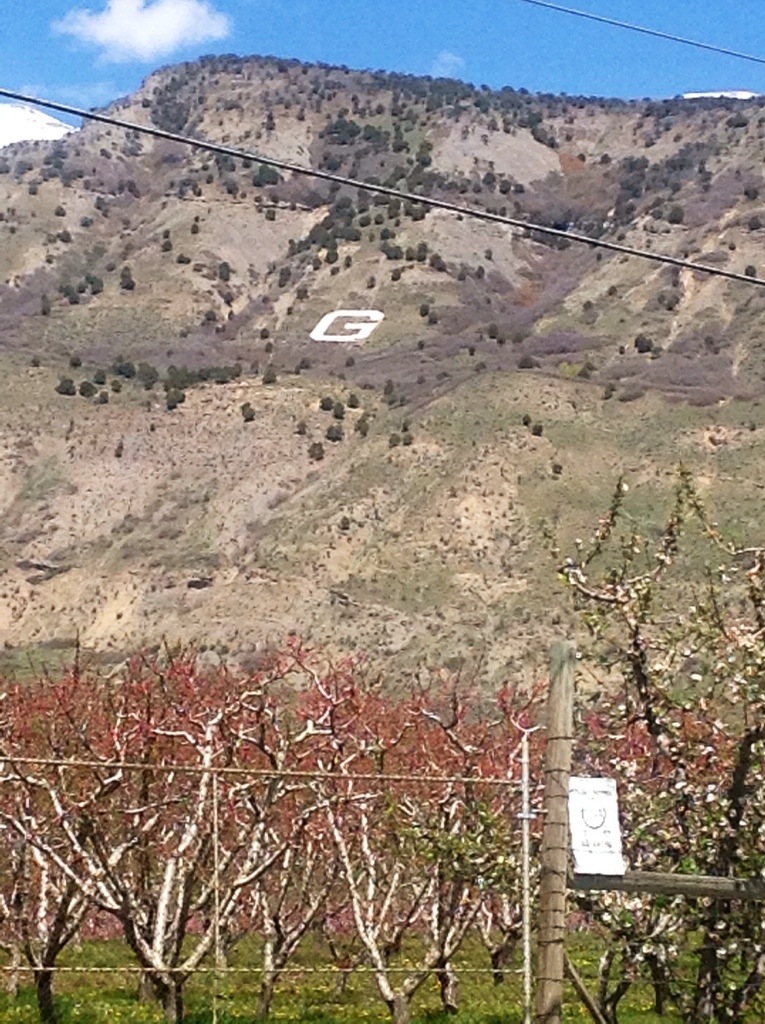
We have a beautiful view of the lake.

And most importantly we have a house with nine bedrooms: every kid still at home has their own room.
Because our lease overlapped slightly with our closing date, we had the luxury of moving in over the course of about 10 days. We packed up most of our house and moved little bits at a time. The first day I pulled a UHaul up to our new house I had to deal with someone showing up to steal my stuff!
===================
Microsoft has a very unique corporate culture. I’ve talked before about some of the attitudes of people who worked for the biggest and baddest software company during the 1990’s. We found ourselves needing to hire a new manager for my team of courseware writers. We each had our own area of focus. Several of us were focused on Microsoft Exchange. Others on Windows NT. We felt we were among the very best at what we did. But, none of us were particularly interested in being the manager.
So, we interviewed a bunch of people. The one that seemed to stand out the most was a woman who was working for Boeing at the time. We all sat in on the interview, but in hindsight we didn’t really think too much about culture. We naturally assumed that Kelli would adopt our culture, and not the other way around.
In case you weren’t aware, Boeing was very much a “by the book” type of buttoned-up corporate culture. Not at all like Microsoft’s wild side.
One of the first exercises that Kelli wanted to go through was writing a team mission statement. We thought she was joking. Our first suggestion was “We’ll learn ya.” Kelli tried for 15 minutes to emphasize the importance of a well rounded, all inclusive mission statement. After a very frustrating quarter hour she abandoned the effort.
It was a minor event quickly forgotten by most of us. But, later as more “corporate” policies were put in place it became obvious that we hadn’t really done a good enough job trying to hire someone who matched our corporate culture.
Back to my moving experience. I had loaded up most of the electronics for the first trip, things like TV’s, XBox, stereo and computers. I backed the truck up to the garage, opened the back and grabbed the first box and headed inside.
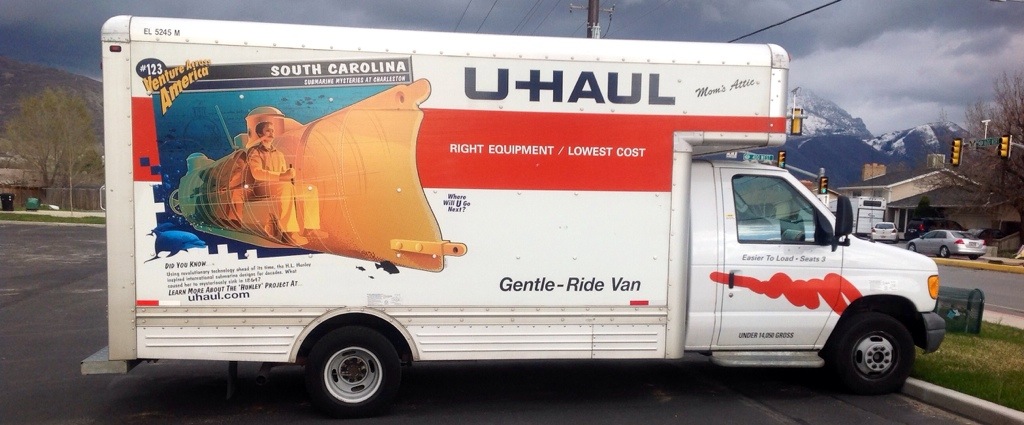
As I came back for the next armload, I saw a teenage kid standing next to my truck and looking over my stuff. It occurred to me that our house was going to sit empty for the next several days, with all this stuff just piled inside. I was immediately suspicious of this teenager eyeing my electronics.
Are you guys moving in?
Yeah. . .
Do you want some help?
Ah. . . sure. . .I guess.
My name’s Steve. I live two houses down. Clint is also coming over too. I called him when I saw the truck.
It sounded reasonable, right? Well, except for the part about two teenage boys taking part of their Saturday to wander the neighborhood helping random move-ins.
That was just the first of several “stealing my stuff” experiences.
Nothing went missing over the coming days. And on the following Saturday we were going to move the heavy stuff: washer, dryer, beds, couches, dressers. I pulled up to find about 20 people waiting in our driveway. Later another 10-15 showed up. There were women helping my wife put the kitchen together. Men with power socket wrenches putting my kids’ beds together, and lots of people hauling stuff from the truck into the house.
Yes, I had moved into a neighborhood where the neighbors took an active interest in helping each other. Later that evening after everyone was gone and we were collapsed on our couch dreading the hundreds of boxes, my cell phone rang.
Hi, this is Rodney.
Hi Rodney. My name is Joe. I wanted to come help you guys move in today, but I had to watch my grandkids all day. My daughter just picked them up and I was wondering if there’s anything left that you need help with tonight?
I was speechless.
I mumbled something. But, I was shocked by the number of people who had showed up to “steal my stuff.” Trust me, those type of neighborhoods still exist in this country.
Rodney M Bliss is an author, columnist and IT Consultant. He lives in Pleasant Grove, UT with his lovely wife and thirteen children.
Follow him on
Twitter (@rodneymbliss)
Facebook (www.facebook.com/rbliss)
LinkedIn (www.LinkedIn.com/in/rbliss)
or email him at rbliss at msn dot comt
Tell your friends about this!
Rodney, I don’t get it.
What?
You said you have a reason for everything you do at work, right?
Yeah.
I don’t understand why you give the employees free soda.
Russell was my office manager at RESMARK. We hadn’t worked together for long. I explained that I had a reason for every decision I made. And I did. But, I wasn’t surprised that Russell didn’t understand. I had done some things that looked strange.
– I provided all employees free soda. (Discussed more in “The Biggest Raise I Ever Received“.)
– I sent the employees off to buy their chairs (Let Them Pick Their Own Chairs.)
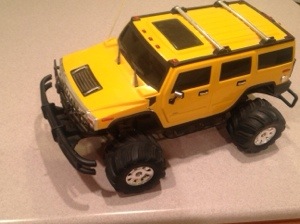
– I bought everyone remote control cars.
– I bought everyone a binary clock (It’s About Time)
– I wore a sportcoat, slacks and a starched shirt everyday
There were also things I DIDN’T do.
– I didn’t hang out in the “bull pen” where the programmers sat.
– I didn’t buy MYSELF a binary clock.
– I never wore jeans
– I never played games at work
Employees really do take their clues from leadership. When I was asked to be president of RESMARK, I decided the image that I wanted the company to have, and by extension, the image that I needed to maintain.
Internally “image” is called Corporate Culture. I couldn’t pay people the most, but I wanted to do as much as I could to make RESMARK a positive place to work. If I couldn’t compete on benefits, I wanted to compete on culture.
As the face of the company, it was important for me to be consistent. Every time I met with customers they saw me in a jacket and slacks. It was odd working in the rafting industry and showing up in slacks. The rest of the people who showed up wore jeans if they wore pants. Many of them wore shorts and t-shirts.
But, my software cost $10,000 and I was trying to sell to people who didn’t know much about software. They only thing they had to judge our software on was me. If I inspired trust, they would trust us. If they saw me goofing off or acting unprofessional, they would assume our software was not worthy of trust.
Similarly, my employees knew exactly what to expect from me. I developed these management rules while learning to lead a team. The key is decide on your strategy and then be consistent.
Oh, and the answer to Russell’s question, why did I give them free drinks? Because they would stay at their desks and work longer.
You are always on stage. Don’t forget your lines.
Rodney M Bliss is an author, columnist and IT Consultant. He lives in Pleasant Grove, UT with his lovely wife and thirteen children.
Follow him on
Twitter (@rodneymbliss)
Facebook (www.facebook.com/rbliss)
LinkedIn (www.LinkedIn.com/in/rbliss)
or email him at rbliss at msn dot com
Tell your friends about this!
I still don’t know if he did it on purpose. It seemed like a pretty extreme length to go to in order to make a point. However, he was just crazy enough to have attempted it on purpose. If you really want your employees to remember a lesson, it helps if you nearly die while teaching it. I think that’s why R.O.P.E.S courses are so popular.
I was a high school sophomore in a electronics class. We were learning the completely unapproved list
Bad
Boys
Race
Our
Young
Girls
But
Violet
Grins
Willingly
to memorize the color bands for electronic resisters. Each word relates to a particular color Bad == Black, Boys == Brown and so on.
The teacher offered us a more acceptable mnemonic, but someone who’s older brother had been in the class blurted this one out, with a couple of changes, and that’s the one that stuck.
The time the teacher nearly killed himself was during the time we were learning about resisters. The all look mostly the same.

(Photo Credit: High School Physics)
The bands use the color code mentioned above to show how strong the resistor is. That’s all very boring. Our teacher wasn’t boring. We took various sized resistors and blew them up. We pushed 120 volts through them. Some of the resistors were powerful enough that they could easily handle 120 volts. Some were just strong enough to get warm and some of them were weak enough that they exploded in an exciting fashion.
The way we got the charge to them was to take an electric lamp cord and strip the wires back. We would wire the resistor to the two naked strands, plug it in and watch the fireworks.
This is where the teacher nearly died. He was sitting on the lab counter. He took our stripped lamp cord and careful to not touch the ends together he plugged it in. He picked up one end of cord with his left hand.
As you can see. So long as I’m not grounded and I don’t complete the circuit, I can safely handle the wire. However, if I were to complete the circuit. . .
We didn’t actually hear what would happen if he completed the circuit, because it was at that moment that he absentmindedly leaned his right elbow on the water faucet. . .an excellent ground. He flew off the counter and landed on his feet about 8 feet from the counter. Fortunately this also broke the connection. He delivered the rest of the lecture well away from any electrical sources while rubbing a very soar elbow.
35 years later, I’m still not sure if he did it on purpose. Either way it made a lasting impression.
If you are going to teach an important lesson, it helps to impress people if you risk death.
Rodney M Bliss is an author, columnist and IT Consultant. He lives in Pleasant Grove, UT with his lovely wife and thirteen children.
Follow him on
Twitter (@rodneymbliss)
Facebook (www.facebook.com/rbliss)
LinkedIn (www.LinkedIn.com/in/rbliss)
or email him at rbliss at msn dot com
Tell your friends about this!
I knew he was lying. He wasn’t even trying to hide it. And the crowd was openly laughing at him. The judges too.
I also knew he wasn’t going to be a good enough liar. The competition was just too tough. He was better than the kids had been, though. Kids have a natural penchant for it, but lack some of the polish that adults bring to the art of lying.
April 1st is a day for pranks and gags. It’s also the time of year that brings out the liars. I had the opportunity on Monday night to be the emcee for Utah’s Biggest Liars competition. It’s part of the world famous Timpanogos Storytelling Festival. (I know that Monday was actually March 31, but scheduling impacts our little event.)
The Liar’s Contest celebrates the tall tales. We heard from eight adult liars. . .although they are referred to as “tellers” in storytelling vernacular. Here’s a picture of the winners.
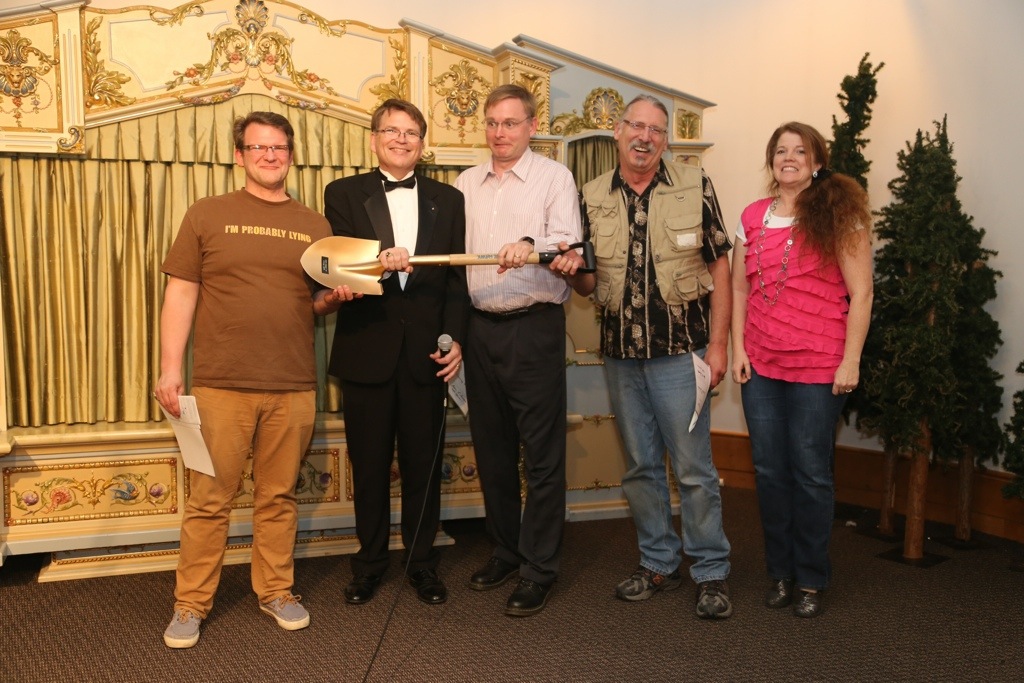
2nd Place and People’s choice Dale Boam, MC Rodney Bliss, 2014 champion George McEwan, 3rd Place David Bullock, Founder April Johnson.
I’ve been involved with this competition for the past 3 years. It’s one of my favorite events of the year. You might think it would be simple to tell a lie, but to win a competition like this you need to understand the format and also be entertaining. The tellers are judged on 5 criteria.
Technique: How well did the teller use the stage and mic, voice inflection, body language?
Story Development: It has to actually be a lie. The best tellers start with something completely ordinary and take you quickly into the realm of the absurd.
Originality: It has to be an original story
Effectiveness: How well did the crowd respond?
Time Limit: They have to do all of that in 6 minutes or less.
The winning story, told by George McEwan started with him flying a plane from Salt Lake to Idaho. He soon hit a thermal and got stuck. Then, while sitting on the wing eating his lunch, a flock of eagles show up and manage to spin his plane so hard his milk turns to butter. Then, the seagulls show up and after that it gets weird.
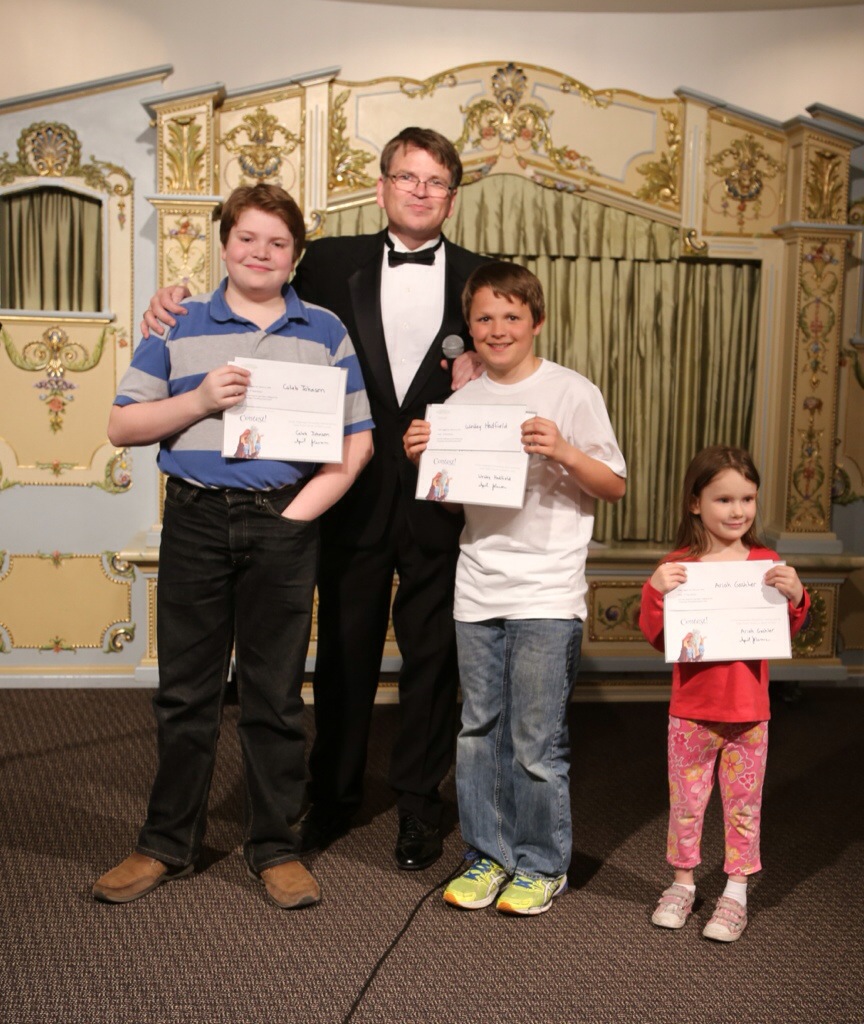
We also have a youth competition. This year, our youngest teller was 5 years old. I’m not sure I could talk when I was five. She won the Crowd favorite award. Our oldest youth teller was 13. Here’s me with the young liars.
In addition to a cool t-shirt,
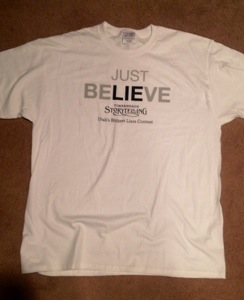
winners get a family pass to the Timpanogos Storytelling Festival in August, and a certificate. The winner gets bragging rights and a golden shovel. We never really explained why we give the biggest liar a shovel.
There’s no real business tie in for this post. I suppose I should remind you that lying at work is a really bad idea. However, lying in public can sometimes win you fame and a golden shovel.
(Photo credits: Dana Johnson and Timpanogos Storytelling Festival. Used by permission)
Rodney M Bliss is an author, columnist and IT Consultant. He lives in Pleasant Grove, UT with his lovely wife and thirteen children.
Follow him on
Twitter (@rodneymbliss)
Facebook (www.facebook.com/rbliss)
LinkedIn (www.LinkedIn.com/in/rbliss)
or email him at rbliss at msn dot com