A lamb to the slaughter.
Looking back on it now, with the benefit of 20 years experience, that’s what I was.
I was in my first “real job.” I’d been at WordPerfect for about 3 years. After being trained for two weeks on WordPerfect 4.2 right after I was hired, I was immediate reassigned to a group called WordPerfect Library. We were not filing books. Library was a cool little text based menu program.
We also supported the new WordPerfect Office product. It include all of Library plus an email program. The year was 1989. That assignment so many years ago really set the course for much of my career. My first day on the phones, I didn’t really get any training. A senior engineer put his customer on hold and explained how to run the setup program, (genoff /i.) And pointed me at the phones.
I quickly mastered Library and Office. After a couple of years, I was part of the Strategic WordPerfect Assistance Team. Yes, we called ourselves the SWAT team. Coolest named team I’ve ever been on.

It was on the SWAT team that I encountered the Manager From Hell. I’ll call him Frank, because that wasn’t his name and I’ve never really met anyone named Frank. (Apologies to any readers named Frank.) Frank really enjoyed being a manager. He never let us forget that HE WAS THE BOSS. At the time, I didn’t think much of it. Frank didn’t know anything about Office and I was the best Email engineer he had.
SWAT was responsible for taking escalations from the rest of support. If a problem couldn’t be solved in the teams, it eventually came to us. If need be, we got on a plane and went to the customer site to fix it. (By “need be” I mean, if they wanted to pay for it.)
One day, Frank said a phrase that has become a Post Traumatic Stress Disorder (PTSD) trigger for me, “Can I see you in my office?” At the time, I had no reason to suspect anything might be wrong. Frank was sitting behind his desk when I came in and he had his two lieutenants sitting on each side of him. They were all behind the desk, like a panel of judges. My chair was about 5 feet away from the desk. That put me right in the middle of the room.
“I’d like you to read this statement and respond.”
Frank handed me a paper with three allegations.
– The Support teams claimed that I was ignoring their requests.
– Marketing felt that I was trying to “create” a position outside of the SWAT team.
– Testing felt that I was not respecting their role, and basically being rude to them.
I told Frank that I really had no idea why these groups would say these things. I certainly wasn’t trying to do any of this. We talked a little more and they dismissed me.
Well, I’ve always been a proactive rather than reactive employee. I went to see the Support Team Manager and find out if I wasn’t helping her team enough.
“No. Things are good. Not sure why Frank would suggest that.”
I called the head of Marketing and asked him if he felt that I was pressuring him to create a position?
“No. I don’t see a problem.”
Finally, I went up the hill to the Testing building to see the head of the Office Testing group. Sue was fairly direct.
“I never said that. I’m going to call Frank!”
Her end of the short conversation went,
“Why did you tell Rodney that I felt he didn’t respect testing’s role? I never said that! Ok. Goodbye.”
Turning to me as she hung up the phone she said, “Frank wants to see you in his office.”
Okay, at this point I was starting to get an inkling that today was going to get worse. I didn’t realize how much worse until much later.
Frank was not happy. And he let me know using language and a volume that was hardly damped by the thin walls of his office. I tried to explain that I was trying to solve the problem that he had presented to me. He was having none of it. Physically he was a large man and not above using his considerable bulk to physically intimidate his employees.
It’s been years since that day in his office. I avoided going into management for a long time because I never wanted to be required to have that kind of a conversation with an employee. It took me years to realize that good managers never do.
Just about everything about that day was wrong. Just a few points that could have gone differently.
1. Obviously someone gave him some negative feedback about me. Rather than defend his people, he turned those accusations on me. Had he been a good manager he’d have known what kind of a job I was doing and either corrected me for things he knew I needed correction on, or he’d have told people, “Nope, Rodney wouldn’t do that.” He took the coward’s way out.
Defend your people. If you do they will move mountains for you. If you don’t, they will never trust you and they will leave as soon as possible.
2. The setup in his office was almost comical in its attempt to intimidate. He wanted me to feel uncomfortable. It’s a stupid tactic employed by bullies. He should have pulled me aside one-on-one and discussed any concerns. I’ve always tried to talk to my employees without a desk or a table between us. And certainly not while they were sitting in the middle of the room.
3. He got mad when the Head of Testing called him. More accurately, I think he got embarrassed. In hindsight, it probably made him look bad in front of the Testing manager. One of his employees had told Testing that Frank was putting words in their mouths. First, he should have realized that if he pointed out a problem to an employee, it’s actually a good thing if that employee attempted to fix the problem or repair the damage. But, even before that, he should have checked with Testing before he told me they had a problem. Again, he took the coward’s way out.
4. In 20 years of business, I’ve never found it necessary to yell at an employee, nor found it necessary to have a manager or leader yell at me. I’ve had to fire people for screwing up. I’ve had to tell people their contracts were not being renewed and they had a melt down in my office. We aren’t 12 years old yelling insults on the playground. Looking back, if a manager that worked for me, treated an employee like that, we’d have a very serious conversation and if they didn’t correct their actions they’d be gone.
In some ways, that experience all those years ago has been a blessing. It’s created a negative management touchstone. At times I’ve thought “What would Frank do?” And I’ve often found the opposite choice to be the right one.
However, to this day, it strikes fear in my heart and my stomach knots up if my manager says, “Can I see you in my office?”
(Edit: Someone asked for a larger picture of my SWAT business card. Here it is)

Tell your friends about this!

I was a management snob. I’m not ashamed to admit that I revered “Leaders” and held “Managers” in disdain.
Leaders are visionaries.
Managers implement someone else’s vision.
Leaders give stirring speeches.
Managers run boring meetings.
Leaders risk much and aren’t afraid to fail.
Managers play it safe and are overly concerned with meeting preset criteria.
Leaders, inspire people to achieve great things!
Managers, don’t.
Think of the great leaders in history:
General George Patton
President Abraham Lincoln
Bill Gates
Reverend Martin Luther King
General Sam Houston
Now, let’s list some of the great managers in history. . .
Well, I’m sure their families know their names even if we don’t. This is why they don’t make movies called, “The Guy Who Figured Out How To Increase Production by 19%.” And they don’t have awards like, “Met quarterly goals for 9 quarters in a row.”
When I started in business, back at WordPerfect I dreamed of being a leader. I didn’t particularly want to be a manager. And I was just a little disappointed when my supervisor turned out to be more of a manager than a leader.
Two things changed my mind about leaders vs managers.
Education
The more I learned about business, the more I realized that managers fill a critical role. Managers can be leaders, but that’s not their role. I read “First Break All The Rules” and was amazed at what a difference good managers made to successful businesses.
Richard Branson is an industry leader. He has vision. He is willing to risk much. He’s building a private spaceship line. THAT is vision. But, he’s not the first to dream of going to the stars, or running an airline, or any of the other things he’s doing. Without someone to take that vision and turn it into reality, he’d probably be one more guy with big dreams who couldn’t get them off the ground.
Experience
My education really took off when I was put into leadership and management roles. I ran a couple of startups. We were living on investor money trying to get our version 1.0 out the door. I had a good team, but most of them were very junior. I spent lots of time on the vision and big picture. I left it mostly to my Director of Development to plan the work. If you are familiar with Agile Programming, it was Dave’s job to plan the tasks for each sprint. He measured our velocity. I told him which features were most important, but he took care of the management tasks of actually figuring out how to get them done. We shipped on time, because Dave made sure we met our development goals.
And in the management roles I’ve been in, I realized that while there is a need for the person up front leading the pep rally, after the rally, the team is going to come back all excited and asking “What do we need to do to achieve that vision?”
People, especially engineers and programmers want to know what is expected of them. A good manager makes sure they understand what to do. A great manager makes sure they understand why they are doing it.
So, I apologize to all those managers over the years whom I secretly derided for not being visionary leaders. In hindsight, they were very good at what they did. Once I figured out that the role of a manager I tried to adopt some of their management traits.
I introduced this post as a cage match. While I think I now understand the role of leaders and managers, if the prototypical leader and manager DID get in the cage, the leader would tell a rousing speech and get the crowd on his side and then the manager would very quickly take him apart, while the crowd booed.
Tell your friends about this!
Okay, where are we?
Ah. . .here?
pointing to my map.
Wrong! Drop and give me 20!
We were somewhere West of the mountains and South of the Provo, UT Temple. Other than that, I couldn’t really say. I had a map. We all had maps. We were also all doing pushups because none of the ten of us knew our location on the map.
Some might have cut us some slack. The maps were at least 20 years old. They showed a big field, a water tower about half a mile away and not much else. In the ensuring years the area had become more developed. We might have been here

Or here

Or possibly here

We were the BYU Ranger Challenge team and this is what we did most mornings. We’d get up and run in the dark through the streets of Provo, UT using out-of-date maps. Major Turbiville, our coach, would stop at random times and turn to us and demand to know where we were on the map. A mistake resulted in 20 pushups. He was the one who’d supplied us with the maps.
It was almost comical to watch the squad emerge from the darkness into the golden halo of a street lamp. Everyone quickly trying to orient themselves to the map before we plunged back into darkness. It wasn’t often that we were all wrong, but today we were.
That was the last stop of the morning and we headed back to the field house as the sun started coming up. Being one of the fastest runners, I nearly always ran at the front next to the Major. Suddenly he turned to me and stated:
I was wrong.
Excuse me?
I was wrong about where we were on that last stop.
He pulled out his map and we looked at it while we ran.
I thought we were here, but we were actually over here.
If it’s any help sir, I didn’t think we were at that spot either.
He didn’t say anything more the rest of the way back. As we were cooling down after our run the Major called the squad together.
I was wrong about our location on that last stop. You each had to do 20 pushup because I made a mistake. I can’t take back the pushups that you did, so I’ve decided to match them. This afternoon during our lab time I’ll match a pushup for each one I made you do.
To say we were surprised was an understatement. If you’ve never been involved with the military you may not be familiar with the “4-count” pushup. Basically, you do two pushups, but count it as one. So, what the Major has just committed to do was 400 pushups.
That afternoon we arrived at lab in our uniforms and Major Turbiville did pushups. I don’t remember how long it took him, but I don’t think he took a break. He was a world-class athlete. As impressive as his physical strength and endurance was, it was the lesson in leadership that most impressed me.
He did two very important things with his offer.
First, he showed us that he valued us. We were cadets, some of first year cadets. He was a Major. He’d served in combat. He was an instructor, a professor. But, he felt that we were important enough to attempt to correct a mistake that we had to pay for.
Second, he showed us that he was willing to hold himself to the same standard as he was holding us to. If we made a mistake we were expected to pay for it. He was showing us that not only were leaders also held to account for their mistakes, when you are a leader, you are held to a higher standard.
The purpose of the ROTC was to train officers. We were embarking on a training course that was supposed to prepare us to lead men, possibly to lead them into combat or death. Major Turbiville was showing us that leadership is a privilege and an awesome responsibility.
In business, I’ve tried to remember that the manager is one more position on the team. While I might be the one calling the shots and setting the course, I have a responsibility for those that I work with. If we screw up, especially if it is because of my decisions, I also need to take responsibility for it and make it right.
I’ve had some great managers in my career. Major Turbiville was the greatest leader I ever had.
This is the fifth of five blog posts on leadership and business lessons I learned during a semester taking ROTC classes at BYU in the Fall of 1990.
Tell your friends about this!
3. Keep the Correct Goals in Mind
That’s how many times the BYU ROTC Ranger Challenge Team has been regional champions over the past three decades, including my year in 1990 when they went on to be crowned national champions. You could say they were dominate.
That’s why you could hear an audible gasp when during the first event of the first competition in 1990, BYU finished last. It wasn’t even close. The competition was held at University of Utah. The weather was perfect. From the 20-25 cadets who had showed up the first day of practice, twelve had stuck with it to the first competition. Nine men competed in each event.
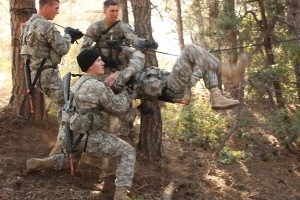
The first event was the rope bridge. Basically, you string a one inch thick rope between two telephone poles about 50 feet apart and then each team member crosses the rope. Then, you tear down the rope and get everyone past the finish line. A good time was 90 seconds. A GREAT time was under 60. We were in the 75 second range.
But, there was just one problem. When the team went to tear down the bridge, somehow an extra knot had gotten into the rope. Any knots left in the rope are a 30 second penalty. We should have dropped the rope and taken the penalty. Instead we spent 5 minutes trying to get the knot out and were awarded last place for that event.
Unlike later competitions that would include multiple events over multiple days, this event was only four events.
1. Rope Bridge
2. Weapons assembly
3. Grenade throw
4. 10K Run in full gear with rifle
Five teams were competing and only the top two would move on to regionals at Fort Huachuca in Arizona. We had just put ourselves into a HUGE hole. You could see the other teams’ eyes light up at the prospect that they were going to take out BYU.
After the weapons assembly and grenade throw we had improved to third place. The 10K run was the final event. Fortunately it counted as two events for scoring purposes. We had to win the 10K and hope that anyone except Utah State took second.
The race course was up to the U on the side of the mountain and back. While nine men are on the team, the rules require that eight men and all their gear cross the finish line. We would typically drop the slowest runner, and the other eight would run as a group, the stronger runners helping the weaker ones.
We won the race in 62 minutes. All those mornings running in the rain up and down the hills in Provo, UT paid off. Then it was a matter of waiting to see who came in next. The team from the University of Utah finished just a few minutes ahead of USU. We had taken second for the competition.
I noticed Major Turbiville, our coach talking to Lieutenant Colonel Norton, the battalion commander. Colonel Norton was not happy.
I wanted to win the boot!
We didn’t come here to win the boot, sir.
The “Boot” was the trophy awarded to the top team from Utah. We felt that trophy rightly belonged in our trophy case.
But, Major Turbiville was right. We weren’t there to win the state competition. He was looking at surviving to the next round of competition. I left the team before BYU went on to win the Regionals, and eventually scored high enough to be declared national champions.
In business, our challenges are not as cut and dried as an athletic event. Typically, you don’t line up with your competitors loaded down with 25 lbs of IT gear and a laptop and have to run a race. But, we do sometimes get caught up in “Winning the boot” when we should be looking at the bigger prize.
I was working for Microsoft in 1999 when they release Windows Millennium. That was a release designed to “Win the boot.” It wasn’t ready for release, but marketing had chosen this really cool name and we were forced to release it before it was ready. In my decade long career at Microsoft, Millennium was the ONLY Microsoft product that your coworkers would actually mock you for using. Microsoft Bob had a better reputation internally than Millennium.
Maj Turbiville understood why we were at the U of U that day and while I’m sure he would have been happy to win the boot, that’s not why he brought us there that day.
Keep the correct goals in mind.
Picture source: BYU Marriott School
This is the fourth in a series of five posts about leadership and business lessons I learned while attending BYU ROTC for a semester in 1990.
Tell your friends about this!
2. I Might Die Right Here on This Hill
Have you ever thought you were going to die? I don’t mean in a “Someone broke into my house with a gun,” or “I got mugged in the park” way. I mean, have you ever done something. . .something hard and thought,
“This activity might kill me. . . .I wonder how I feel about that?”
It teaches you a lot about yourself. At least it did for me. My moment came at 6:30 on a cold September morning. In the rain.
It’s not a steep hill, as hills go.

If you are familiar with the Provo, UT area, it’s the road that goes up past the LDS Temple and leads to Rock Canyon. On a warm summer’s afternoon it’s a pleasant walk. I saw it under slightly different circumstances.
I had just joined the ROTC program. I have always had natural athletic ability, but I’ve never really been a runner. You can’t be in the Army, or the ROTC program without being a runner, as I was quickly learning.
This was one of the first runs with the Ranger Challenge Team. Ranger Challenge is the competitive team of Army ROTC. At BYU, any cadet could join the team. And you were a member as long as you wanted to be. You could drop at any time.
Naturally, there’s no small amount of prestige associated with the Ranger Challenge Team. The first morning, we had about 20 people show up at 5:30 am. Major Turbiville was our coach. He led out into the light drizzle that carried just a hint of snow. As we ran for about 45 minutes, the weather got worse. The wind came up a little. It was still very much night at that hour, so we were running in the dark. And unlike when the company ran in formation, we were all mostly running at our own pace.
As we headed back toward campus, the Major turned left and headed up toward the temple. My legs ached, or they would if I could feel them through the numbing cold. My hair was plastered to my head and water was running into my eyes. My shorts and t-shirt were completely soaked. The 4500 feet elevation was making itself felt in my lungs. Every breath was a burden.
As we started up the hill, I knew that it was at least another half mile to the temple, and that was assuming the major was planning to turn around there. It was another couple miles to the mouth of the canyon if he decided to continue that far.
Frankly, I wanted to quit. Not just the run, I was seriously having second thoughts about the Army. I was half the major’s age and he seemed to be running easily.
This is stupid!
No one is forcing me to do this.
Just quit!
But, I thought about what it meant to be a soldier. Then, I thought about what it meant to commit to something. Was I the type of person who would give up when the first difficulty showed up? Would I stop at the first hurdle and pack up and go home?
If I couldn’t even run in the rain, would I walk away if my marriage got hard? Would I quit a job because I had to do hard things? I didn’t want to think of myself as that kind of person. Maybe I am, and I’m just too stubborn or stupid to admit it.
I kept running.
And it got harder. The slope increased. The wind was coming out of the canyon blowing the rain into my face.
Just quit.
I couldn’t feel my legs or my hands. My ears were ringing so bad I wouldn’t have heard a car horn even if anyone had been on the street that time of the early morning.
I kept running.
Now my legs were burning. My thighs started screaming in pain. My back hurt. My breathing was labored. My vision was blurry.
I kept running.
I might die. I might actually fall over and die right here on this hill. Is this really the way you want to die?
Yes. Well, no, I didn’t want to die, but If I was destined to die, I decided it would be while struggling to top this hill. My entire world view boiled down to a single goal. I was going to make it to the top of this hill or die trying.
Interestingly, I don’t remember reaching the top of the hill. I don’t remember the run back to the field house, or how sore I was the next day.
However, I remembered that moment when I chose, I made the conscious decision, to push through the pain, the doubts and the rain. I’ve had to endure hard things over the course of my career. I never again exercised so hard I thought it would kill me. And that’s the point. I knew that if I could survive that run up that hill in the rain, pushing through to complete a project, or land an account, or have a crucial conversation with an employee were things that I could do.
It’s a comforting thing to measure yourself and realize that on that day, at that time, you measured up.
This is the third of five posts about leadership and business lessons I learned while attending the BYU ROTC classes in Fall of 1990.
Tell your friends about this!
1. Reward the right things.
Wildfires in Utah are a pretty big deal. I live in a desert state. Just about everything revolves around water. In the winter, we worry we won’t get enough to carry us through the next Summer. In the Spring we worry that we’ll get too much if the snow pack melts too fast and we’ll get flooding. In the summer, though is when it gets really bad. The state dries out, the tall grass of Spring turns into the bone dry fields of August. A spark, a hot car, sometimes even a stray bullet can start a fire.
The summer of 1990 was no exception. While a member of BYU’s Army Reserve Officer Training Corps our unit got a chance to go to Camp Williams to see how the real soldiers train. It was late August. We were divided into groups of underclassmen, and upperclassmen. We rotated through the various activities. Rappelling off a 60 foot tower was fun, but the coolest event was the firing range. We fired M16 assault rifles and an M60 machine gun.
If you’ve never fired a machine gun, it’s different than a rifle in that you don’t “sight” a machine gun to aim like you do a rifle. Instead, you point it in the general direction you want to shoot and you use the phosphorescent tracer rounds to “walk” your shots to your target. If you’ve ever seen a film of a dogfight between two airplanes and you can literally see the bullets, those are tracers. . .and they are on fire. That’s why you can see them.
The instructors didn’t want us to burn down the camp, so they told us if we wanted to shoot the M60, we had to “break” out the ammunition and remove the tracer rounds and then put the belts back to together without the tracers. After removing just a few dozen rounds this way, our fingers were incredibly sore. I think my M60 turn was about 8 seconds.
As we rotated off to another station, the upperclassman rotated into the firing range. These men and women would soon be graduating and joining the ranks of the military full time. A group of them decided that it was too tedious to break out the tracer rounds. They decided to fire the M60 with the phosphorescent rounds.
They started a fire. The firing line was immediately shut down and the cadets were sent down range to stomp out the fire before it could spread.
The following week we were all called into formation and these upperclassman were called to the front of the unit.
“Oh boy,” I thought. “They are going to get chewed out in front the entire company for disobeying orders and putting the Camp Williams exercise at risk.” (The military readers have already figured out how wrong I was.)
“For their quick thinking and fast actions, we would like to present these cadets with COMMENDATIONS for containing the fire.”
So, they caused a problem, but because they were heroic in solving that problem, they got rewarded.
I’ve worked for many organizations like this. The guy who pulls an all nighter to solve a problem. . .caused by his slopping engineering. The woman who goes to great lengths to win back a key account. . . which left because she missed their deadlines.
I’ve always tried to make sure I’m rewarding the engineers or developers, or marketers who do their jobs so well that they don’t cause fire drills. It’s a lot harder to recognize the employee who is so good at their job that they make it look easy. The next time you are tempted to hand a STAR card to a employee who went to extraordinary lengths to solve a problem, make sure you aren’t rewarding them for their own poor planning.
This is the second in a five part series on business and leadership lessons I learned while taking ROTC classes at BYU for a single semester in the fall of 1990.
Tell your friends about this!
My career with the ROTC was short and uneventful. For a single semester I got up early, ran in the dark and the rain, and was in the best shape of my life. I seriously considered a military career. Even now, looking back, I think I would have enjoyed an Army career. My daughter is currently in Army ROTC and the Reserves. She’s loving it.
Even though I was part of the ROTC at BYU for only a short time, that one semester made a strong impression. There are many lessons that have helped shaped my business career over the years. I’ll be writing about a few of them this week.
1. Reward the Right Things
The Army is very big on orders and standard operating procedures. I was a with a group that nearly caused a disaster because of disobeying orders. An important lesson.
2. I Might Die Right Here on This Hill
No exaggeration. I thought I might actually die. My reaction surprised me, and has helped set a course to the current day.
3. Keep the Correct Goals in Mind
Winning isn’t everything, it’s the ONLY thing. . .or is it?
4. The Greatest Example of Leadership I’ve ever seen
Without a doubt the single greatest leadership lesson I have ever seen. And it resulted from a mistake.
I chose business instead of ROTC. The men and women who wear our national uniform have my utmost respect. The military knows a thing or two about training and leadership. Even if you only hang around them for a semester, you can’t help picking up lessons in how to be a leader.
This is the first of five posts about leadership and business lessons I learned while attending a single semester of ROTC classes at BYU in Fall of 1990.
Tell your friends about this!

If email is more important than ever, how come no one remembers your email address? I was having a facebook conversation with a friend. Actually, she was a friend of a friend, so I really didn’t know her. She said,
I can’t tell you my hotmail account email even. It’s been 2 years since I stopped using it and I kinda wish I could remember. I had some photos of me when I actually looked awesome hidden in there lol.
She did move to gmail and back to yahoo, but she also uses Facebook and Skype.
I was working for Microsoft when they launched MSN on August 24th, 1995. Initially it was an Internet Service Provider. (Yeah, this was back in the dial up days.) Internally, they strongly encouraged, actually they begged us to sign up for accounts. We pretty much had our pick of any email address. I picked “rbliss” and the domain name, of course was “msn.com.” Eventually, I left Microsoft and my [email protected] address. But, I took my MSN address with me. Through private consulting, multiple stays at companies large and small, I’ve kept that address and more importantly kept it off most SPAM lists. You could always get me there.
When I left my most recent position, I sent the obligatory “So Long, and Thanks for All the Fish” email. But, I didn’t give people my msn.com address. Instead I said, “My LinkedIn profile is always up-to-date. You can reach me there.” Several of my friends have kept in contact. They have no idea what my email address is, nor do they care.
*I* care, of course. It’s the login name for LinkedIn. But, if I change my address, no one is going to care.
Email is dead.
Why say “Email is Dead. Long Live Email?”
Being an American, I think I can be forgiven for spending most of my life screwing up the phrase, “The king is dead. Long live the king.” My English friends, (And my Scottish friends who no longer bother to correct me when I call them English) explained that the phrase was actually talking about two people. It’s the idea that when one king dies, another takes his place. But, don’t you guys have a queen?
So, what took email’s place?
You already know. You are most likely coming to this blog from Facebook, LinkedIn or Twitter. My www.staging.rodneymbliss.com address auto-updates to those three services. Some of you have signed up to be notified when I post a new blog entry. (A fact that is both humbling and inspiring to me. Thank you!) Chances are, I do not know your email, nor did you probably know mine, before I gave it to you above. But, if you have a question, or you disagree with my ramblings, there are multiple avenues where you can comment.
I needed something today from a group of 10 friends. I had a momentary panic attack when I realized that I didn’t have email address for all of them. Then I remembered we are living in the 21st century, not the 20th. I sent some by email, others by Facebook private message and some via LinkedIn message service.
Because I have notifications set up in my mail client for all the various services, the responses all arrive in the same place with links back to the various social media sites. I still own a half dozen email accounts. I have two gmail accounts, a Hotmail account, and a couple low volume ones associated with services I subscribe to. But, when I get an email they all flow into a single client, so I often don’t know what service a message came from. And I don’t care.
It’s like Deja Vu All Over Again
We’ve been through this before.
I’m old enough to remember this.

Honestly, I remember the ones with a dial, but I don’t actually own one of those really old ones. You’ll notice there’s no cord attached, I don’t have dial up service at my house. We just have an extra Cricket phone that we use for the house phone.
But, back when I used the analog phone, I had to either memorize phone numbers or keep a list next to the phone. I still remember phone numbers from high school. Today, I don’t know my own mother’s phone number. I don’t need to, it’s in this.

And I’ll bet you don’t remember many phone numbers either. We get it once, or more often “Text me so that I’ll have your number in my phone,” and save it to your contacts list.
We get the number and don’t even look at it. Phones have a big disadvantage compared to email. My cousin recently announced “I lost my phone, everyone call or text me your numbers.” She posted the message on Facebook, of course.
Yes, email is dead. Long live email.
Tell your friends about this!
“The Marshmallow Test” was a series of experiments conducted by Walter Mischel in the 1960’s and 1970’s at Stanford University. You’re probably familiar with them. Mischel offered kids an immediate reward, like a marshmallow, or he promised them two treats if you would wait for 15 minutes. The hard part was the kids had to sit with the marshmallow in front of them for the 15 minutes, knowing they could eat it whenever they wanted.
I’ve often wondered if I were part of that experiment, would I be an “eat it now” or “wait and get double later” kind of guy?
When I was about five years old, I had a problem with my hearing. I don’t remember much about it, but I ended up at Washington State University with a set of headphones listening for tones. I think they had to train my ear. Anyway, when I corrected detected a tone I got an M&M. I distinctly remember deciding that rather than eat them as I got them, I was going to save them so that I could enjoy eating a bunch all at once. The flaw in my plan was evidenced the next time I missed a tone. The audiologist reached out and took one of the M&Ms out of my pile. I promptly ate the rest!
In follow up research, Mischel realized that kids who deferred and were able to wait for the second marshmallow did better later in life. They had higher SAT scores, lower body mass indexes, and did better in school. It’s not clear in the research whether it was their self control or their strategic thinking that aided them.
There have been other times in my life where I had a chance to “eat the marshmallow” first and chose not to.
Schlock Mercenary Buffer
I’ve talked in this column often about how much I enjoy Schlock Mercenary. One of the benefits of knowing the author is that I had access to the buffer. Howard tries to stay two to four weeks ahead. It allows him to go on vacation, or get sick, or take longer on a particular strip. However, I quickly realized that if I read the buffer, then I would miss the enjoyment of reading the strip each day. I avoided the buffer at all costs. The problem got worse when he released his Schlock Mercenary iPad app. 
It includes the current strip plus the next two days (or maybe three, I haven’t actually checked.)
Dilbert “Buffer”
Like most people in the tech field, I’m a fan of Scott Adam’s “Dilbert” strip. One of my engineers had one of those Dilbert desk calendars. When I was by his desk I’d pick it up and read the current day, but also read ahead. 
“Have you seen this one for next Thursday?”
“Oh, I never read ahead.”
I didn’t get it, until I received one for Christmas. Now, I get it. I don’t read ahead either.
I don’t consider myself as someone with great self-control. In fact, I tend to obsess over things at times. However, I think my motivation in avoiding reading the buffer is strategic rather than a result of willpower.
I’ve been in business long enough to know that success is a result of consistency. You don’t eat your seed corn. So, I’m forced to admit that I don’t read the buffer because I’m too selfish to deprive myself of the future enjoyment.
But, most of the successful people I know are “wait for it” type of people, so I’m in pretty good company.
Tell your friends about this!
Ever wanted something really bad? I mean, you wanted it so much that not having it physically hurt? Have you ever wanted something as badly as you wanted a root canal?
Yeah, I probably lost a few of you on that last one. No one wants a root canal, right? Root canals are so bad that they are the punchline to really bad jokes.
Nope.
Last week I bit into a piece of ham and it bit back. It bit back like I’ve never felt before. My jaw pretty much exploded. I can’t tell you if it was the worst pain in the world since I’ve never given birth and I can’t pull my lower lip over my head. But, I don’t remember ever experiencing pain like that. Not even during the time “I Really Did Have a Dentist Appointment.”
It was constant; an ice pick through my skull. Ibeprophen (i.e. Advil) wouldn’t touch it. Oh, I ate them like candy, so maybe without them my head really would have exploded. At times the pain made my eyes water. I retreated to my room and closed the curtains and the door. Not because that really helped, but I didn’t want to keep scaring the kids.
I knew exactly what it was. I had some work done a couple of months ago and the dentist warned me that I might need a root canal in the future. Well, WELCOME to the future!
The problem was it got really bad on Friday. My dentist isn’t open on weekends. And besides, I’m a tough guy. Maybe it will go away?
Yeah, and maybe I’ll die of an aneurism before Monday!
Saturday night I got pretty much no sleep. Sunday was lots of pain and dark rooms. Sunday night was worse. By the time Monday morning rolled around, I couldn’t wait to call the dentist. I wanted it really bad. I wanted a root canal more than anything.
“Can I get a root canal done today?”
“Excuse me? Ah. . .how’s 11:30 sound?”
(It sounded like an eternity!) “Yeah, that’ll be great.”
How early is TOO early to show up for my appointment, and would my car insurance cover an accident if I black out from pain induced migraines on the way to the dentist?
 Just make the pain go away!
Laying in the chair waiting for the dentist I’m thinking,
“Can’t you numb it NOW? Do we really have to wait for him?”
When my lip went to sleep, I nearly did too. Blessed numbness. The pain was gone.
Okay, so what’s the big deal, Rodney? You had a toothache and you got it treated? Why are you dragging the readers through that. . .and on a business blog?
Because, in comparison, the pain of a root canal is short and it solves a much bigger problem. How many of us avoid the pain points in our organization because we are avoiding the pain? The sales guy who hasn’t made his quota in 3 months? The engineer who just screwed up another customer installation? The vendor who just raised their rates for the third time in four months?
But, I hate the dentist, you say. The sales guy MIGHT turn it around.
Yeah, and my tooth might just suddenly stop hurting on its own.
The engineer did great work in the past.
Yeah, and four days ago my teeth were fine.
I’m not suggesting you immediately terminate an employee at the first sign of struggles. One of the best engineers I ever had “Deserved to Be Fired.” He wasn’t, and it was the right decision. But, at some point, you realize that the situation isn’t going to improve. Postponing the inevitable simply drags out the pain. The sooner you get through the painful change process, whether it is letting an employee go, or reorganizing your reporting structure, or replacing a vendor, the sooner you will get your organization back to a healthy state.
Today, my tooth feels like it did a week ago, before the pain. But, the memory of the pain is still fresh and so in comparison my tooth feels WONDERFUL.
I really, REALLY wanted a root canal. I’m grateful I got to have it.