I’m sorry your backsplash isn’t ready yet. Try back tomorrow. I’ll try to get the guys working on it first thing. Should be ready by about 10:00.
This was the sixth time I’d been in to this shop, and the third or fourth time since it was scheduled to be done. I needed it, or at least wanted it early the next morning to install it. However, as I drove away in frustration I realized it was my own fault that it wasn’t done. And I learned a lesson that anyone can use who needs to get someone else to do something for them.
I’m helping a friend remodel a house. I only get to help him one day a week or so. He’s asked me to simply be responsible for certain pieces. I “own” winterizing the shed and most of the kitchen repairs. I’d spent the last month trying to get a kitchen backsplash. When you are a single contractor with a small job, you pretty much get pushed to the back of the line. I knew this. I expected and planned for it even. But even my planning didn’t go far enough.
My first task was to find a laminate that would match, or at least compliment the existing countertop. I took these pictures into various shops saying, “It looks kind of like this. Can you match it?”
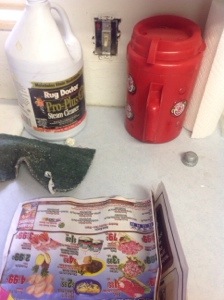

I found this little custom cabinet shop just a couple miles from my house in Pleasant Grove. They suggested I go look at the laminate samples at Home Depot and then come tell them the color when I found one. I picked Wilsonart D381-60, a light grey.

Wilsonart Fashion Grey
(Photo credit: wilsonart.com)
Back to the cabinet shop with the number.
Okay. Great. I’ll talk to our supplier and get you a quote. It will probably be around $100.
Off I went to work on computers and writing. Eventually, I decided it had been too long since I had heard from the cabinet shop. I stopped by, now for the third time.
I’m happy you stopped by. I lost your contact information. Oh, and do you still remember what color you picked?
So, off I went to other work. Again it seemed like a long time before they got back to me. I finally called them.
Yeah, we found the color, and it looks like it will be $125 total. It should arrive tomorrow and be ready on Friday. Would you mind paying for that now?
I didn’t mind. I mean it’s not like they would get very far on my $125 if they decided to run off with my money. Friday I stopped by, now for the fourth time.
You know, we’ve been real busy and the guys just haven’t been able to get to it yet. But, try back on Monday.
You might be thinking that I’m being WAY too easy on them. And maybe I was. Maybe, if I’d thrown a fit and yelled, I’d have gotten it quicker. I don’t know. Monday, I didn’t go to the cabinet shop. I waited until Wednesday. This was now my fifth visit.
We’ve got the laminate, but we haven’t got it cut and glued up yet. Do you want to see it?
No. I really want my product.
Probably, Friday.
And off I went without the backsplash. I didn’t go on Friday. But, at this point I started to get a little smarter. A “little” smarter, but not yet smart enough. If I were really smart I would have figured out how to get it sooner. I needed it on Wednesday, so on Tuesday, I went to the shop. Now for the sixth time. It was this visit when I was promised they would do it the following morning. The problem was I was headed to the job site early. And, installing this backsplash was a big part of what I had planned for the day. I was going to have to make an additional 40 mile round trip to get it in the middle of the day.
Wednesday, I headed off to the job site, sans the backsplash. At 9:30, they called me.
This is the cabinet shop. It’s going to be a little later than 10:00. I wouldn’t come by until say. . .eleven. . .thirty.
I was talking to my friend about it.
You know, it’s really my own fault that these weren’t ready until today.
Really? How so?
Well, I knew they were going to late. That’s why I went to get them on Tuesday. I was going to strap them to the top of my Suburban and have them ready to go. So, knowing they were going to be late, I should have shown up on Monday. They would have promised them the next day and I would have been able to get them on Tuesday.
He laughed, but I considered project management. I really didn’t care about making them a better shop. Or helping them improve their delivery or customer service. However, I cared very much about my schedule. The solution is not to assume that they will change. Instead I should look at my own actions and make whatever changes I need to accomplish my goals. And when I look at it that way, changing my actions would have gotten me the backsplash when I needed it. I thought a day early would have been enough. I should have made it two.
Here are the before and after pictures of the kitchen backsplash. The first step was to clean the kitchen.

Here’s the kitchen without a backsplash.

And with the backsplash installed.

I opted for a complementary color, rather than trying for an exact match.
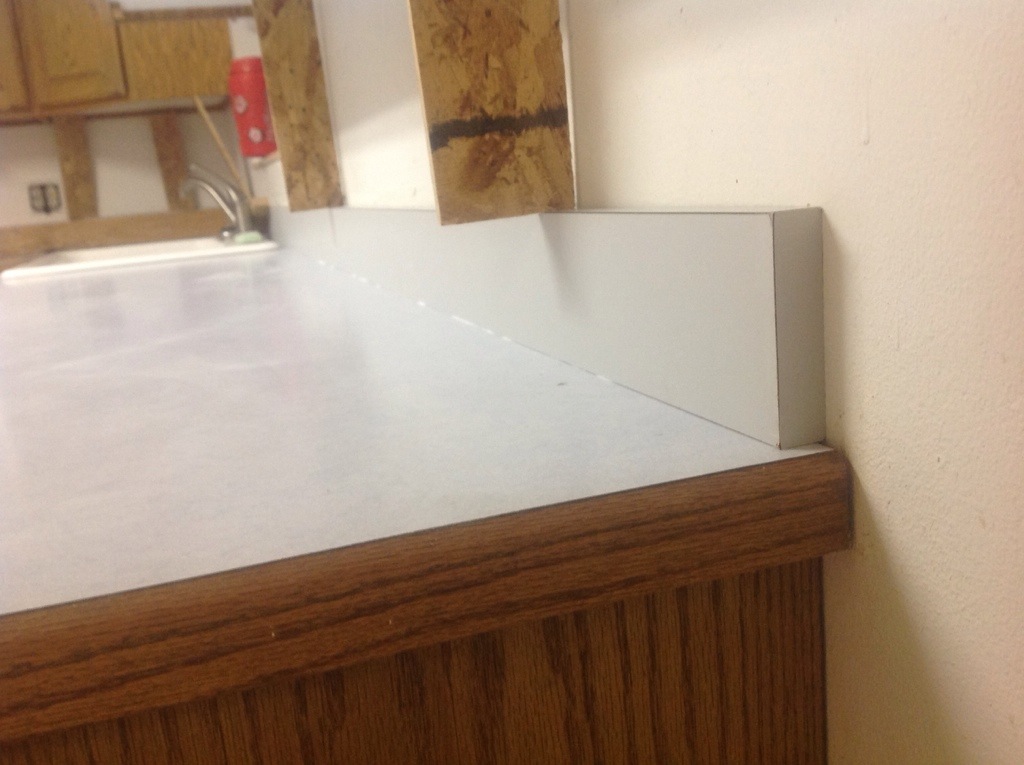
Bracing it every which way I can until the glue dries.

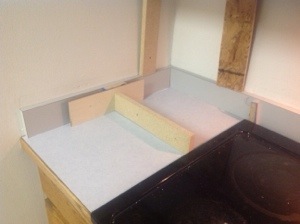

It’s a fun diversion from my normal fare of computers and writing. It’s very satisfying when you can smack your problems with a hammer.
Rodney M Bliss is an author, columnist and IT Consultant. . .and occasionally swings a hammer. He lives in Pleasant Grove, UT with his lovely wife and thirteen children.
Follow him on
Twitter (@rodneymbliss)
Facebook (www.facebook.com/rbliss)
LinkedIn (www.LinkedIn.com/in/rbliss)
or email him at rbliss at msn dot com
Tell your friends about this!

Man is the only animal that blushes, or needs to.
– Mark Twain –
I didn’t realize that I had stopped getting embarrassed at work until I was working at a large non-profit corporation and one of the guys on my team mentioned it. It got me thinking. I know I have been embarrassed at work, especially early in my career. At one point, while working for WordPerfect. After I had Saved The EPA we had to figure out a way to replicate that success. I ended up getting moved back into a support role and the EPA could still call me, but I was no longer quite as visible and I was feeling a little disappointed. I didn’t handle it well. During a call with the EPA network administrator I vented a little more than I should have. Okay, probably a lot more than I should have. I didn’t realize that phone calls were recorded. . .until. . .I met with my manager, the head of support and I think there was someone else there. I was smart enough to realize that I had screwed up and be properly embarrassed. I think management realized it was a rookie mistake and I didn’t lose my job, although I certainly could have and the company would have been justified.
So, there have certainly been times in my career that I’d been embarrassed about. And it’s not like I don’t still make mistakes.
At this same non-profit where my team pointed out my lack of embarrassment, I remember going into an “Outage Review Meeting.” That’s not what we called them, but it was a meeting we held after something broke. We gathered the involved parties and tried to figure out who to blame. Oh, management would deny that was the purpose of these meetings, but essentially, the team managers went into that meeting with the goal of getting as little of the outage blame assigned to their team as possible. But, I was new, and I didn’t want to play the “Don’t blame me” game.
Yeah, that was a mistake on my team. We didn’t see the alert. It was sent. We just missed it. We’ve made some process changes to make sure it doesn’t happen again.
And that was it. Afterward another manager pulled me aside.
Why did you do that?
Do what?
Accept blame for that outage.
Ah. . .because my team screwed up. Hasn’t your team ever just missed something and it caused an outage?
Well sure, but no one ever admits it!
I tried to think of what the difference was between my screwup at WordPerfect at the beginning of my career and situations now that don’t affect me as much.
Truth
That’s what I think the difference is. I like the Twain Quote above, but my favorite Mark Twain quote is
If you tell the truth, you never have to remember anything.
I think that was it. I’ve learned that it’s much easier to be 100% truthful, in both my actions and my motivations. In The Biggest Raise I Ever Received, I talk about why I bought free soda and bottled water for my programmers. It wasn’t because I was altruistic, I wasn’t. Instead, I did the math and it was cheaper to get extra work from them with free pop than with any other method. But, the thing is, I TOLD my team why I was doing it. Dave, the head of the developers said,
I know you are using this to manipulate me. And yet even knowing that, it still works. That’s amazing.
Once I started being completely honest, I had to make sure my motives were also honest and could stand scrutiny. That wasn’t always easy. Sometimes we want to spare someone our true feelings. Or we think that keeping some information to ourselves will give us some advantage.
At one point, at this same non-profit, another department really screwed up. They screwed up so badly that it almost cost us a project that we had been working on for 3 months. I did what I needed to salvage the project, but I was livid at the screw up of the other team. They had promised to deliver a service and then the day it was to be implemented they informed us that they changed their mind and weren’t going to deliver it after all.
We got the service, but I had to pull in a lot of favors and I also burned several bridges. I decided the project was important enough to warrant it. A couple of weeks later, after I’d cooled down, I went and talked to the director of the other department.
Darrell, your guys nearly caused our project to fail right at the end.
Yeah, I’m sorry about that. I went back after we talked and reread the email thread where you requested the service weeks in advance. Our team totally dropped the ball.
I was coming here today to tell you that I would NEVER work with your team again. I knew I would need to, but I was prepared to tell you that I would do everything possible to avoid having my projects’ success dependent on your team.
But?
But, you’ve had some personal changes in the last couple of weeks. When Roger, the team manager over that team left the company I decided that I’m willing to make the attempt to restart the relationship.
Well, I appreciate your frustration. Hopefully, we will be a better partner going forward.
I hope so.
Darrell and I were friends, so I had an idea of the reception I would get from him. But, I felt that being completely honest with him on my feelings was the right way to go. Two days later I got a phone call,
Hello, this is Rodney.
Yeah, this is Paul. I’m an engineer in Darrell’s division. I was wondering if you would let me take you to lunch, my treat, and talk about the needs your team has and how we can help you with those?
I realized that the reason I don’t get embarrassed at work is that I’m conducting myself in a way that I’m comfortable with anyone knowing about. Back at WordPerfect when I was crying to the EPA about my boss, I knew that was not a conversation I would be comfortable with management hearing. I no longer have those conversations.
I don’t know that I’ve completely taken Twain’s advice to not remember anything, but it’s amazing what a difference just a slight change of attitude made. I didn’t do it to avoid embarrassment, but I’ll take that as an added bonus.
Rodney M Bliss is an author, columnist and IT Consultant. He lives in Pleasant Grove, UT with his lovely wife and thirteen children.
Follow him on
Twitter (@rodneymbliss)
Facebook (www.facebook.com/rbliss)
LinkedIn (www.LinkedIn.com/in/rbliss)
or email him at rbliss at msn dot com
Tell your friends about this!

Once upon a time there was a professional basketball team in Seattle. They were first called the SuperSonics and later simply the Sonics. They even won a championship once, in 1979 Lenny Wilkins coached them to a championship win over the Washington Bullets. Neither the Sonics nor the Bullets exist anymore.
The story of how the Sonics team was stolen is best told elsewhere. I want to relate a story from a few years earlier. A tale of deception and arrogance that should serve as a warning for managers everywhere. In 2000, Seattle drafted a young player out of Oklahoma State named Desmond Mason.

Mason was what was called a cutting guard. He could sky above the rim, and had a crossover that occasionally broke the ankles of the best defenders in the league. He was also my neighbor. Literally, my next door neighbor.
Desmond and his fiancee Andrea were great neighbors. We both owned houses on large wooded lots in Maple Valley, WA. Desmond and I became friends. One day, Desmond called me,
Rodney, you work for Microsoft, right?
Yeah.
I was wondering if you could come help me get my computer working. We tried to upgrade it to the latest version and . . .I don’t really know what went wrong.
Sure. I’ll come by tomorrow after work.
Turns out that Desmond had a friend who was helping him upgrade his computer. This was before high speed cable modems. We had old style dial up. When he ran the pre-upgrade checklist one of the pieces that was not going to able to be updated automatically was the modem. His friend’s advice was
No problem, we’ll just download the latest modem driver after the upgrade.
You can probably spot the problem with that statement right away. It was like when they mailed us the passwords to our new email system. If the modem is broken, you can’t use it to dial up and get an updated modem driver. Anyway, with the help of my friend KC, we got him back up and running.
Later, I was putting up a basketball hoop and asked him to come help me mount the rim and backboard. I was on a ladder, he. . .wasn’t. After I got it securely screwed in place Desmond started to head home.
Wait.
What?
When do you think I’m ever going to get this chance again? An NBA player to break in my hoop? You have to take the first shot.
Desmond clanked two in a row off the front of the rim.
I don’t care how close you stand Desmond.
During the summer of 2002, between his first and second year, Desmond and Andrea got married in Hawaii. Of course, all the Sonics players and owners were there. (No, I wasn’t there, we got them a nice planter or something.) The owners made a point of telling both Desmond and Andrea
You are the future of the franchise. Next year after your rookie contract is up, we’ll put together a long term contract.
Desmond and Andrea naturally assumed they were in Seattle for the long term. Nothing is ever certain in the NBA but they felt pretty comfortable buying their house, starting a local charity bowling tournament and putting down roots. Some of you who are Sonics fans know where this story is going.
At the start of the 2003 season, the Sonics had a chance to trade for Ray Allen. He was at the beginning of a superstar career. Desmond was practicing one morning when his best friend on the team, Rashard Lewis came out on the practice floor,
Desmond?
Yeah?
It’s on Sportscenter. You and Gary Payton been traded to the Milwaukee Bucks for Ray Lewis.
I don’t fault Howard Schultz, the Starbucks founder and then owner of the Sonics for trading a player he had promised to keep. It’s a business. It happens. But, the part I don’t understand is once the trade had been finalized and the owners were ready to tell the media, you couldn’t pick up a phone and make a simple phone call?
Hey Desmond, I’m really sorry, but we felt we needed to trade you to Milwaukee. Good luck.
Fifteen seconds, tops.
I talked to Desmond the following summer as he came back to get his house ready to sell.
How’s Milwaukee?
Good team. I like Coach Karl. They want me to buy a house.
Yeah?
I told them that once we sign the long term contract, we could discuss it. Until then, I’ll rent.
They traded him to New Orleans two years later.
I’ve often thought about that experience. At Microsoft, I worked with some very rich, very smart people. I discovered that money and position do not make a person a good manager. The guy running a lawn crew could very well be a better people manager than the multi-millionaire owner of a string of coffee shops. You may not have control over whether you manage a group of 1 or an entire company. But, whatever position you hold, remember that you can be an effective manager regardless how many people report to you. If you feel you have to trade your star player, pick up the phone. . . especially if you don’t have to.
Desmond retired in 2010 and now does charity art production. He’s really good.
Rodney M Bliss is an author, columnist and IT Consultant. He lives in Pleasant Grove, UT with his lovely wife and thirteen children.
Follow him on
Twitter (@rodneymbliss)
Facebook (www.facebook.com/rbliss)
LinkedIn (www.LinkedIn.com/in/rbliss)
or email him at rbliss at msn dot com
Tell your friends about this!

Rodney, how did the meeting with the Senior Director go? Did he ask about the router replacement schedule?
Great. I took total credit for your work and told him I’d solved the entire thing!
Oh good. I was afraid you’d forget to give me any credit.
Josh, the engineer I was talking to knew that I had done nothing of the sort. Part of the reason our maintenance windows went as well as they did was that the engineers felt safe enough to focus just on the work to be done. No one had to worry about trying to also make sure they looked good.
I’ve talked before about about joking with my team (Yeah, But You Guys Are Screw Ups.) Humor, even good natured teasing, is often a risky endeavor. Part of what makes something funny, is that it’s unexpected. Telling Josh I’d stolen the credit is only funny if Josh absolutely believes I would never steal credit. If he has even a slight suspicion that I might fail to properly credit him, my joke is going to sound more like gloating. And if that suspicion exists, then engineers and team members are going to lose focus on the common goals of the team and instead will start focusing on their own reputations and goals.
I was very careful to cultivate a culture of 100% trust on my teams. Rather than stealing credit when meeting with our senior executives, my prime goal was to give away as much credit as possible. It’s ironic in a way that the more you give credit to your team, the more you are viewed as a successful team manager or project leader. The rule I tried to follow was:
Be very specific when reporting good work. Give names and specific examples.
Be very general when reporting problems. Use passive voice and shoulder as much blame as you possibly can.
At this point some of you are saying, “What an idiot. He’s going to torpedo his career.” I know it looks that way, but I’ve seen this principal work. And it works for two reasons. Management doesn’t want to manage your team and your project. They expect you to do that.
Your team, especially if it’s a team of engineers or programmers, does not want to talk to management. They expect you to do that. So, you’ve got those below you on the org chart and those above you on the org chart looking at you to literally be the man in the middle.
I’ve noticed that reports get smaller and smaller the higher they go up the org chart. I might have a 10 slide PowerPoint deck to explain a new project to my team. I will cut that down to 3 for my boss. He will ask me to cut it down to one for his boss. And that guy will ask for two bullet points for his presentation to his boss.
It’s the same thing with project work. The higher up the org you go, the less they want to hear. I’ve often been asked to boil down my project status to a single red or green indicator. In that environment, it’s easy to lose sight of the fact that engineers are doing a lot of work to get that green status light. It’s the job of the project manager to make sure that senior management hears about truly exceptional work. Again, like any other time, you get a very short period of time to share your success story. I once had an engineer step out of his area to assist on a task and he literally saved us from 6 hours of unscheduled downtime. THAT engineer got mentioned in the meeting with the Senior Executive.
But, what about describing problems in passive voice and taking the blame? Well, in addition to short status reports, executives also value loyalty. It sounds a little corny, but in every organization I’ve worked for, the executives really valued people who believed in the company. So, if they hear you being disloyal to a team member by “throwing them under the bus,” they are naturally going to suspect your loyalty to THEIR objectives and the company is weak.
I have had setbacks in my projects, like all projects have. When I report those setbacks, I make it a point to say something like, “The backups didn’t get done on time and that caused a problem.” My English teachers in college would have been all over that sentence. It’s passive. It’s weak. It lacks focus and direction. And I wrote it that way on purpose. Of course I know why the backups didn’t get done. And generally there is name attached to that failure. However, I also know that I need that engineer to buy into my future projects. So, I would identify the problem and put measures in place to fix it for next time, but I gain nothing by shaming him in front of management. And I lose a lot.
If pressed, “Why didn’t the backups get done?” I’ll generally take as much blame as possible. “I didn’t communicate the seriousness of my request to the backup team, so it didn’t get prioritized high enough to run last night.”
Did you see what I did there? “I didn’t communicate well,” is a very direct statement. “It didn’t get prioritized,” is right back to passive voice. Generally this is enough to satisfy most executives in a briefing. Very rarely, I’ve been pressed even further. “Who was responsible for actually running them?” In that case, you really have no choice. You have to give up an engineer.
I used this approach when one of my engineers deleted an entire department out of our Active Directory. (He Deserved To Be Fired.) It was impossible to shield my engineer. Fortunately, I was able to save his job, but only just barely.
If your team knows that you take the blame and share the credit, they will move mountains for you. If they understand that you are loyal to them when you are briefing the senior execs, they will also be loyal to you when it comes time to do the hard things to get your project done. But, it has got to be sincere. If you even once take credit that should have gone to, or could have gone to the team, they will find out and you’ll find yourself very short of resources when you need them to make that extra push.
If you want loyalty. . .be loyal.
Rodney M Bliss is an author, columnist and IT Consultant. He lives in Pleasant Grove, UT with his lovely wife and thirteen children.
Follow him on
Twitter (@rodneymbliss)
Facebook (www.facebook.com/rbliss)
LinkedIn (www.LinkedIn.com/in/rbliss)
or email him at rbliss at msn dot com
Tell your friends about this!
We should give Frank more money.
What? Why? We already paid him for his program!
I know, but he’s put in a ton of work adding bug fixes. He charged us $500 and we were considering a competing program that cost $20,000. Call it “consulting money” or a “maintenance fee” or something.
Are you crazy? Why would we give a vendor more money after they’ve already signed a contract?
Because it’s the right thing to do.
We didn’t do the right thing. And that pains me to this day. We were rolling out a 30,000 seat Microsoft Exchange installation at a large non profit organization. The particular feature that we were buying from Frank was a piece of software that made the message waiting light on your desk phone light up when you got a new voicemail to your corporate email server.

(Photo credit: Extreme Voice and Data)
With this version of Exchange 2007, we were implementing Unified Messaging. In other words, your voicemails would now appear in your mailbox. This was a very useful and innovative step. You could now forward voicemails, save them to a network drive, have your computer read them to you.
The problem was that Exchange didn’t have a way of telling your desk phone that you had an unread voicemail. But, Frank had figured out how to make that work. So had a couple of big companies. The one we were evaluating offered the reasonable pricing of $0.80 per user: about $20,000. Frank was a programmer, but he wasn’t a business man. He put a flat price of $500 on his software. He was mostly selling to small companies. He had never had a customer with more than 500 users. I’m not sure how we found him, but we were happy we did. But, since his program was written for small businesses, it didn’t scale to an organization our size. Frank was constantly fixing bugs for us. Sometimes sending us 2 or 3 updates per day.
And given the amount of work he was doing, I thought it was reasonable for us to provide him a little more for his software. My father always said, “If a small business owner underprices his product, pay him what it’s worth and educate him on pricing.” It was clear in our project meeting that no one agreed with me. They all had reasons:
This will make his product better for other companies.
Microsoft has announced this functionality in the next release. Frank has a window of six months and then his market will be gone.
Having his product installed in our organization will help him get into other large accounts.
Contractually, he’s not allowed to tell anyone he’s working with us. Not sure how that’s helping him.
He should have known better.
Maybe, but what about US. What are OUR values? Do we believe in paying people what they are worth, or do we pay them as little as we can get away with? We are a non-profit charitable organization. We are cheating him out of his time and labor. Why? Simply because he didn’t know the value of what he’d built. How is he going to view our organization in the future? I’m thinking we offer him something like $2500. Isn’t it worth that to do the right thing?
Apparently it wasn’t. The team kept coming back to the argument that “He should have know better.” Well, maybe he figured he was dealing with this well know, large, charitable non-profit organization and that they would offer him an equitable deal, so he didn’t have to worry about getting screwed out of thousands of dollars?
I have no idea where Frank ended up. The next update to Exchange came out and we replaced Franks software with what was included in the Exchange product. I’ve often reflected on that meeting. We all hope that when presented with the opportunity to do the right thing, we would respond appropriately.
What do you think? Should you pay people less than they are worth, or less than their product are worth simply because you can? Is it always “seller beware” in these cases? Or, should you help small business owners correct their pricing if they are better programmers than they are salespeople?
My answer is pretty clear, but I understand I’m probably in the minority.
Rodney M Bliss is an author, columnist and IT Consultant. He lives in Pleasant Grove, UT with his lovely wife and thirteen children.
Follow him on
Twitter (@rodneymbliss)
Facebook (www.facebook.com/rbliss)
LinkedIn (www.LinkedIn.com/in/rbliss)
or email him at rbliss at msn dot com
Tell your friends about this!
Rodney! Good to see you. I heard you left Microsoft. What are you doing now?
Hey Doug. I’m doing independent consulting.
Rodney, none of us are EVER unemployed, we just become independent consultants.
That conversation happened nearly 10 years ago at Brainshare in Salt Lake City. I’ve often reflected on it. The meaning of my friend’s words have changed over the last decade. At least they have for me. At the time I think Doug was ribbing me about being unemployed and finding a different word for it. Perhaps he thought I was clinging to the idea of “independent consulting” because I didn’t want to admit that I didn’t have a job. Ten years ago, Doug might have been right.
There’s an adage in business
The best way to get a job is to already have a job.
Hiring managers tend to bias in favor of people who are currently working. Maybe, it’s that if someone else thinks you are a valuable employee we will too. Or maybe it’s simply a case of “If you can’t work hard enough to get a job somewhere, we don’t want to be the place you start.” I honestly don’t know. But, most people I know will go to great lengths to look like they are employed. And I put myself in that category. There’s always something you can do. I wrote a few weeks ago about The Busboy And The Gardner Are Doing Just Fine. Even if the only job you can find is mowing lawns, it’s good to get up, get out and do something.
So, maybe that’s why we never say we are unemployed. The IT field is unique in that you can have senior, experienced guys who work as contractors. It means that they come and go. Sometimes they are working, sometimes they are waiting. I’ve said before that consulting is like Feasting On Brownies. . .Every Three Weeks. For me, writing has always been the constant when things around any change. Writing (Running Away From The Writer) is always in demand, because if you don’t get anyone to pay you to write, you can always write a book. IT workers are resilient that way.
And then a few weeks ago, I had another thought about my friend Doug’s comment. Maybe it’s not a matter of being embarrassed. Maybe it’s not about being resilient. Maybe instead, it’s a matter of craving independence. As a freelance consultant, you don’t have a boss. You end up having multiple. But, while any one of them can fire you, that one firing doesn’t necessarily affect the other jobs and bosses. There is a great freedom in being independent. There’s also a lot of fear and trepidation. But, if you truly embrace independence, you really are never unemployed, because every day you are working. You might only get paid every three weeks, or three months, but you are certainly working.
No, we are never unemployed. We are just independent consultants.
Rodney M Bliss is an author, columnist and IT Consultant. He lives in Pleasant Grove, UT with his lovely wife and thirteen children.
Follow him on
Twitter (@rodneymbliss)
Facebook (www.facebook.com/rbliss)
LinkedIn (www.LinkedIn.com/in/rbliss)
or email him at rbliss at msn dot com
Tell your friends about this!
Winter is coming to Utah. Fall is my favorite time of year. I’ve written here before about the beautiful fall foliage that the high mountain desert of Utah enjoys.

Saturday I was on the BYU campus. It was our last day of “Summer-like” fall. We had our first serious snow today. We’re now into “Winter-like” fall.
As I bought a gyro for lunch from a street vendor, I noticed this wasp catcher.

The concept is simple and effective. You place a small bit of bait into the trap and wasps, attracted by the scent climb into the trap, down the cone where they spend the rest of their lives very confused as to both where the food went and how to get out. What makes the trap effective is that it uses the natural instincts of the wasps against them. Once the wasp gets confused enough, it attempts to leave. Naturally, the wasp equates “up” with “out.” But, the top of the trap is a frustrating cap of plastic. The wasp actually has the ability to escape. All it would have to do is fly to the bottom of the center cone and climb back out the way it came in. But, that path doesn’t look like the way out. Who wants to go “down” and “in” to get out?
So, the wasp continues searching the top of the trap for an exit point until it dies.
How often have you seen people who’s career goals mirror the actions of the wasps? I’ve found myself in the wasp trap a few times. I went to work for a company with high hopes. But, I found myself stuck in a position that I was a terrible fit. The worse the job got, the more I tried to make it work. I was that wasp banging my head against the ceiling hoping that things were going to get better. That situation rarely turns out well. It didn’t in my case. Eventually, the company took action and I was out looking for work again.
In another case, I was so consumed with trying to move up within the organization that I found I really wasn’t enjoying my job. But, I thought, one more promotion and things will get better. If I simply put in another couple years and get enough seniority, my life will improve. Except it doesn’t. Again, I was pounding my head against the ceiling trying to move up.
It’s been rarer, but much more satisfying when I’ve taken that step back and assessed what it was I really wanted to do. At one point it was to go back to school. I only took an additional semester of classes, but it was exactly what I needed to get me excited again about learning. And because I was doing it for myself, I had a blast that semester. I slightly miscalculated my class load and ended up with 8 credits instead of 9. This still disappoints me since it was my only semester getting straight A’s. Had I taken that additional credit I would have been eligible for the dean’s list, something that my previous academic career never approached.
I’ve taken great inspiration over the years from my friend Howard Tayler. Howard draws the award winning comic Schlock Mercenary and has for 13 years. Five or six years ago, Howard walked away from a six figure job in the software industry to become a cartoonist fulltime. We’ve talked over the years about what that meant for his career, for his family and for him. It was back in January 2013 that I was part of layoffs from my last employer.
I had a big enough severance package that it gave me the freedom to figure out what I really wanted to do. It was during that period that I started seriously writing on this blog. A couple of weeks ago I talked about Running Away From The Writer. Choosing to pursue writing has been my attempt at getting out of the wasp trap. Instead of constantly looking up and out, I’ve started looking down and in. I have some great things planned for next year. I’ve already hinted at the first book that will be coming out in February. I’m also working on multiple other projects and writing that you’ll be hearing more about in the coming months.
In the past, I’ve always written as a sidelight. I’ve been a Support Engineer, who also wrote. I’ve been a Operations manager who also wrote. Getting out of the wasp trap is realizing that what I really want to do is be that writer. Maybe a writer who also does Project Management, or a writer who also works as an IT manager, but a writer.
Have you ever been stuck in a wasp trap? How did you escape?
Rodney M Bliss is an author, columnist and IT Consultant. He lives in Pleasant Grove, UT with his lovely wife and thirteen children.
Follow him on
Twitter (@rodneymbliss)
Facebook (www.facebook.com/rbliss)
LinkedIn (www.LinkedIn.com/in/rbliss)
or email him at rbliss at msn dot com
Tell your friends about this!
How many of you think Microsoft is an evil company?
Slightly more than half the hands in the room went up.
How many of you think Microsoft is NOT an evil company?
The other half of the hands in the room went up.
How many of you think General Mills is an evil company?
Now every face in the crowd game me a confused look.
I was a teaching assistant for a Computer Ethics class at Brigham Young University. This was several years ago before the rise of Google. The point of the question was to help the students realize that we tend to ascribe noble or evil motives to computer companies that we do not ascribe to non-technology companies.
BYU is located in Provo, UT. The people in that class, at least the locals, had more reason than most to hate Microsoft. Provo was the historical home of Novell Corporation. At one point Novell Netware was the most popular network software in the world. Microsoft nearly killed Novell. At least Novell still exists today, although as a much smaller company, now headquartered in Boston. WordPerfect Corporation was maker of the world’s most popular word processor. Microsoft put them out of business. You can still buy WordPerfect software from Corel Corporation. Microsoft did most of the damage, but WordPerfect contributed to its own demise.
The point was that thousands of IT workers in Utah lost their jobs as a result of losing a war with Microsoft. And that’s how people viewed it. (How I Became a Pawn In the War With Microsoft (And My Brother Got To Be A Knight)) Even today, People have a strong view of Microsoft and whether it is a “good” company or a “bad” company.
We can understand why the people in Utah think Microsoft is evil, but why do others around the country and world? Why is Microsoft viewed as evil and a company like General Mills is not considered evil or good at all? I think part of the reason has to do with the nature of a system with two choices. Before the rise of Linux, Microsoft and Apple were the only two viable choices for desktop computers and laptops. Often when there are two choices, people will develop strong opinions about one or the other. Coke vs Pepsi and Ford vs. Chevy come to mind. And of course Democrats and Republicans.
What is ironic about the Microsoft/Apple rivalry was that the companies themselves were less passionate about the rivalry than the fans. In 1997, Steve Jobs was coming back to Apple, the iPod was still years away and Apple was on pace to lose a billion dollars. Microsoft ended up “investing” $150M into it’s rival. There are those who say that Microsoft was simply paying on a patent infringement suit, and that may be the case. But, having worked for Microsoft at the time, the feeling was that Microsoft needed Apple almost as much as Apple needed Microsoft. Bill Gates loved to be number one in whatever market he was in. However, being number 1 is less attractive if there is not a strong number 2.
Today, we’ve mostly moved on from the MAC/PC wars. Today it’s Google who is taking over the world, and like Microsoft before it, we could ask,
Is Google an evil company or a good company?
Ask a group of IT workers and you are likely to get similar mixed reactions like I got all those years ago in the class at BYU. And as we debate the morality of a computer company we are still left with the non-question regarding companies like General Mills.
In many years working in this field, I’m still not sure why we feel the need to vilify technology companies. Is it their power? Their size? The unique hold they have over our personal information?
I have to admit that I don’t know. What do you think?
Rodney M Bliss is an author, columnist and IT Consultant. He lives in Pleasant Grove, UT with his lovely wife and thirteen children.
Follow him on
Twitter (@rodneymbliss)
Facebook (www.facebook.com/rbliss)
LinkedIn (www.LinkedIn.com/in/rbliss)
or email him at rbliss at msn dot com
Tell your friends about this!
Don’t freak out about our driver.
What do you mean?
Well, the driving laws are different here than they are at home in the US. Let’s just say that it’s going to be a bit scarier.
You’ve never been to India either!
True, but driving in most developing countries is the same the world over. So, I want to you to look at our driver’s car. And remember that he drives that car everyday. So, even though it looks like he’s a crazy driver and so is everyone else, if you don’t see a bunch of dents in his car realize he’s probably a pretty good driver.
What if it’s a new car because he wrecked his old one?
Okay, she had a point. My wife and I were in New Delhi, India to adopt my daughter. We had hired a car for the three days we were planning to be in the country. If you’ve ever taken a taxi, or worse yet, driven in a developing country, you already understand that traffic laws are more suggestions than actual laws. I had traveled a lot outside the US on business. Riding with my friend through the Scottish highlands was unnerving, but mostly because he kept driving on the wrong side of the road. (If you ever have the argument with a Brit about which is the right side of the road, ask him to stand in the middle of the street and raise his right hand. THAT is the right side of the road in more ways than one.)
Our travel in India was uneventful, which is to say that we didn’t hit anything. . .no matter how close we came to it. We got our daughter on the first day from the Sisters of Charity orphanage. On the second day we took a trip to Agra to view the Taj Mahal.

(Photo credit: www.indiatourinaut.com)
I’ve seen many beautiful buildings. Mormon Temples are some of the most beautiful. But, the Taj was by far the most beautiful building I’d ever seen.
The road from New Delhi to Agra is a divided highway. While we were fine, we passed a terrible accident involving an overloaded truck, a car and an elephant. The elephant was unhurt, but it appeared at least one of the drivers died. Could that have been us? We tried not to think about it.
My home state of Utah is famous for having terrible drivers. Our freeways will allow you to drive 75 mph, and some of our citizens want to drive 55. I’ve thought a lot about why I sometimes feel more frustrated on the streets of Provo than I did on the streets of New Delhi, or Guangzho China, or Bogota Columbia, or even Chicago, Boston or New York. I think it has to do with expectations.
When I was driving in Chicago where I lived for a couple of years back in the 1980’s, the drivers were extremely aggressive. But, they were ALL aggressive. In other words, you didn’t have to wonder if the driver next to you was going to let you merge nicely, or if you were going to have to force your way in. Of course, you were going to have to force your way in. Everyone did. In Columbia, the drivers all drove the same way. You pretty much knew what to expect.
Provo, UT is the home of Brigham Young University, my alma mater. There are over 30,000 students from all over the world and all over the country. Unlike University of Utah, in Salt Lake, where most of the students come from the local area, BYU, as a private university draws students from all over the US and the world. So, you end up with a vast mix of cultures and driving styles. This wouldn’t be an issue except that BYU has 33,000 students and Provo has about 115,000 residents. So, nearly a quarter of the residents of Provo are from somewhere else. They students pretty much dominate the driving habits in this case.
Harvard draws a diverse population, but the enrollment of Harvard is dwarfed by the population of Boston. The same thing goes for most universities in large cities. In other places, the drivers simply adopt the driving style of the location. I discovered this when I travelled to Athens, Greece. The taxi driver who took me from the airport to my hotel told me that his goal was to move the United States and become a race car driver. After a week in Athens, I observed it was the goal of EVERY taxi driver to move to the US and be a race car driver.
So, when you travel to another location where they drive crazy, and the cars don’t have seatbelts, and entire families share a single motorcycle. Just look at the car, and don’t get into a taxi with a bunch of dents. . .and avoid the brand new ones too. . .just in case!
Rodney M Bliss is an author, columnist and IT Consultant. He lives in Pleasant Grove, UT with his lovely wife and thirteen children.
Follow him on
Twitter (@rodneymbliss)
Facebook (www.facebook.com/rbliss)
LinkedIn (www.LinkedIn.com/in/rbliss)
or email him at rbliss at msn dot com
Tell your friends about this!
I lived the wrong distance from my high school. It was about a mile and a half. It was too close to ride a bus, and too far to walk. Or at least that’s what I thought. Especially in the rainy fall and winter in Lacey, WA. As a freshman I would cut as many corners as possible to shorten the distance. One of those shortcuts involved cutting through a pioneer cemetery.

(Photo credit: Woodlawn Funeral Home)
Coming from my high school, you had to walk through the new section first. As you came up a slight hill, you entered the old section where you could see pioneer headstones from the nineteenth century. This day there was something else in the cemetery. There was a cow. She wasn’t really going anywhere, just chomping on the luscious grass that is found in most graveyards.
My first thought was, “Well, that’s something you don’t see everyday. ” My second thought was to wonder where it came from. This was Western Washington and while it was heavily wooded, it was still mostly residential. Someone’s cow wandered out of their backyard? The cow didn’t seem to be going anywhere, so I went to the nursery next to the cemetery. No one was home. The next property had a really long dirt driveway disappearing up and over a little hill. And there was a gate.
My resolve began to falter a little. What was I going to say? “Excuse me, you don’t know me, but I was wondering if you might have lost a cow. No? Well, sorry for bothering you.”
But, I finally decided to face my fear. I opened the gate noisily and paused as I listened for a dog. No sound of one. Carefully I closed the gate behind me and trudged up the hill. There I found an ancient house. It must have been built in the 1940’s. As a 14 year old, anything older than me was ancient. My knock was answered by a middle aged woman and a beautiful Collie. Seriously, it could have been Lassie that greeted me.
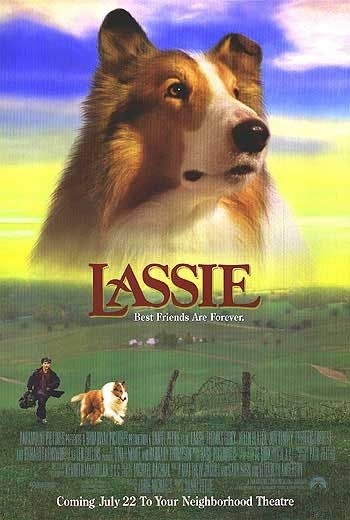
I later found out that the dog, a male, had played Lassie in one of the remakes.
Can I help you?
You don’t know me, but I was wondering if you might have lost a cow?
Did she get out again?
The woman disappeared briefly and reappeared with a coat a hammer and some big tacks.
Well, let’s go get her.
Apparently I was now part of the roundup grew. We walked back to the cemetery where the cow was still grazing contently. The woman scolded the cow with some harsh words but a good natured tone and shoved her back toward the new section of the cemetery. The cow seemed to understand the jig was up and offered no protest as we herded her back through the new section and down a trail through the trees, where we soon arrived at a downed barbed wire fence. The cow ambled back across the fence.
Can you repair a fence?
Ah. . sure. Just tack the wire to the poles?
Yeah. And put two tacks over each wire. She’ll be at this again.
As I sought a solid portion of the weathered fence post, the woman spoke again,
Thanks for stopping by. She doesn’t wander far, but she sure loves that cemetery grass.
Ah, happy to help.
Do you want a job?
Excuse me?
We mostly have horses. Arabians. Prize winners. I need someone to come and muck out the stalls once a week and spread fresh sawdust. Pay is $2 per stall. We’ve got 8 stalls.
Sure. I’ll have to ask my parents, but I’m pretty sure they’ll say it’s okay.
Great. See you on Saturday.
And that was how I got my first job. I worked that job for three years.

(Photo Credit: FDWallpaper.com)
Starting out as a stable boy gives you an interesting prospective on work. The metaphor of cleaning up after horses has stood me in good stead in certain jobs. In other jobs I’ve been struck by the idea that it’s often those doing the work who get the work. We often make our own opportunities.
What was your first job? Add a comment and let me know.
Rodney M Bliss is an author, columnist and IT Consultant. He lives in Pleasant Grove, UT with his lovely wife and thirteen children.
Follow him on
Twitter (@rodneymbliss)
Facebook (www.facebook.com/rbliss)
LinkedIn (www.LinkedIn.com/in/rbliss)
or email him at rbliss at msn dot com