My best friend is 6’5″. He’s a brilliant programmer, a very funny guy and he’s also Black. We are like brothers. One day we were discussing race and racism.
CK, can a white person ever say the n-word without it being offensive?
He paused for only a moment.
You could call me that.
Not when anyone else was around, I couldn’t!
He misunderstood my question, but got the point. Has that word, which you all know and I’m not going to write, become so offensive that even in a discussion of word origins and meanings a white person cannot utter the word without it being offensive?
In business, of course, the best option is to avoid any possibility of offense. Stay way away from the line and you don’t risk going over it. The topic has been on my mind recently as I’ve considered a speech I’m going to give to my Toastmasters club. I’m working on a speech that retells a folk tale. Rather than retelling something from Grimm’s fairy tales, which are surprisingly dark, I opted from something from Joel Chandler Harris.
Harris was a newspaper writer in the late 19th Century. He collected a series of stories from Blacks working in the cotton fields. The stories, while closely tied to the American South, trace their origins to African folk tales. His book was called Uncle Remus: His Songs and Sayings. Disney did an adaptation of it in 1946 called Song Of the South.
The collection of stories I have is called Giant Treasury of Brer Rabbit.
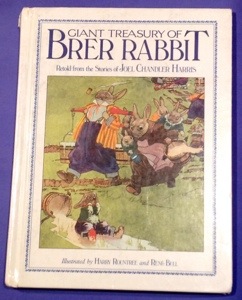
Uncle Remus has been banished to the 1880’s. The modern translation skips the entire story of Uncle Remus, a kindly old slave telling the stories to a young white boy from “the big house.”
And therein lies my dilemma, or question. Are the stories themselves racist or even racial? Can we separate the stories’ origins from their message? Disney couldn’t. Song of the South will never be released on DVD or BlueRay. Disney simply cannot find a way to make it socially paletable.
Mark Twain’s Huckleberry Finn, is one of the most banned books in history. It uses the n-word liberally.
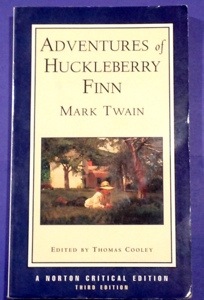
And yet, the book itself is clearly anti-slavery. Twain allows Jim, the “escaped slave” to become involved in many of Huck’s adventures only to reveal at the end that Jim has been free all along. Twain forces us to confront the prejudices of the scenes and how the simple designation of free or slave changes the meanings, without changing the setting or characters.
Uncle Tom’s Cabin is another contemporary book that used language that we today find uncomfortable. In reading Uncle Tom’s Cabin, I couldn’t find a single instance where the narrator used the n-word to refer to characters of African descent. Harriet Beecher Stowe put that word into the mouths of her characters, but not her own.
The Brer Rabbit stories in my book, of course not only don’t use the n-word, they don’t even have any people. The action is all carried out by Brer Rabbit, his nemisis Brer Fox, the wiser-than-he-seems Brer Bear and a host of other characters.
But, is it possible to pull the story out of environment? Is it a disservice to tell the story without giving a context? Do the stories belong now to all Americans regardless of color? Or, am I applying some sort of literary black-face if I endeavor to retell them? I am after all, putting myself into the role of Uncle Remus. Despite the 20th Century editing, these stories trace their origin to the stereotype of a “happy slave” performing for the “young master.”
I have a couple of weeks before the speech, but considering that I first heard these stories when I was 10 years old and my mom bought the Song of The South soundtrack, I’m not sure another week or two is going to get me any closer to a clear mind.
Rodney M Bliss is an author, columnist and IT Consultant. He lives in Pleasant Grove, UT with his lovely wife and thirteen children.
Follow him on
Twitter (@rodneymbliss)
Facebook (www.facebook.com/rbliss)
LinkedIn (www.LinkedIn.com/in/rbliss)
or email him at rbliss at msn dot com
Tell your friends about this!

The young girl approached the microphone with trepidation and fear. She stood at the pulpit, handwritten remarks in hand. And then she looked up. And like a deer in the headlights realized she couldn’t move.
I like to talk.
Oh sure, I like to write too, but really I enjoy conversation. I realized early in my life that I loved to talk. It took me a lot of years to figure out how to shut up. I’ve written in the past about both my ADD (I Worked From Home Because The Light Turned Red) and my tendency to be completely socially oblivious (The Day I Found Out I Was A Jerk.)
So, when I discovered Toastmasters, it was like the “Rodney Club.” Seriously, it’s a club where you go and practice talking. Well, some people practice. For me, it was a another room to perform. I’ve posted one of the speeches I gave (His Dream My Reality.)
I’m a member of the Olympic Orators. We meet in the old American Fork city hall building every Tuesday at noon.
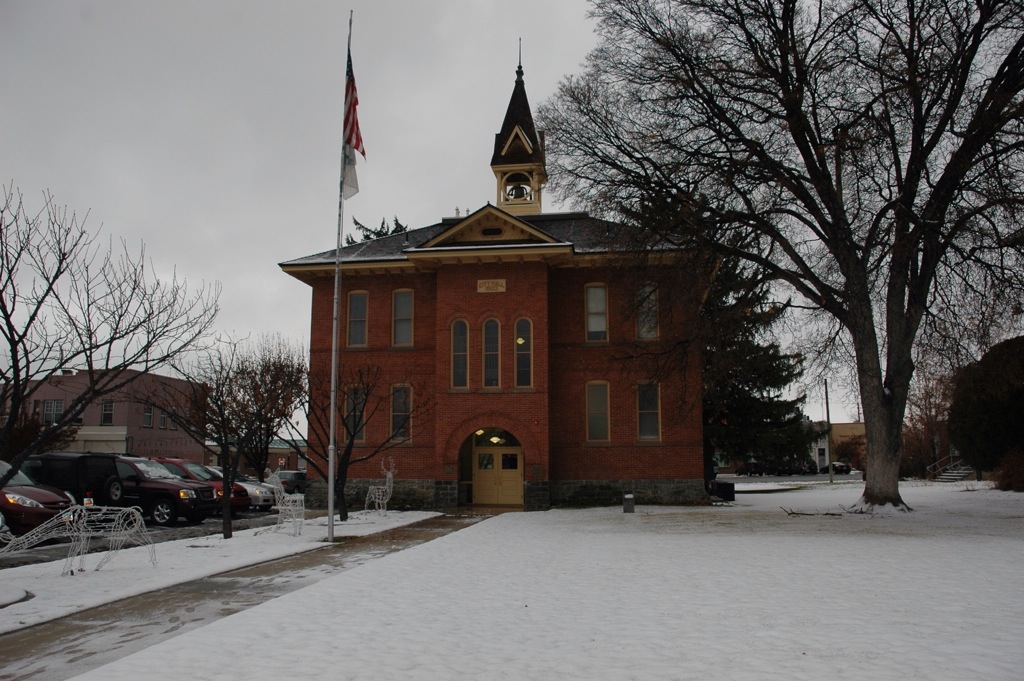
(Photo credit: via Wikipedia)
I recently got an award. This is it.
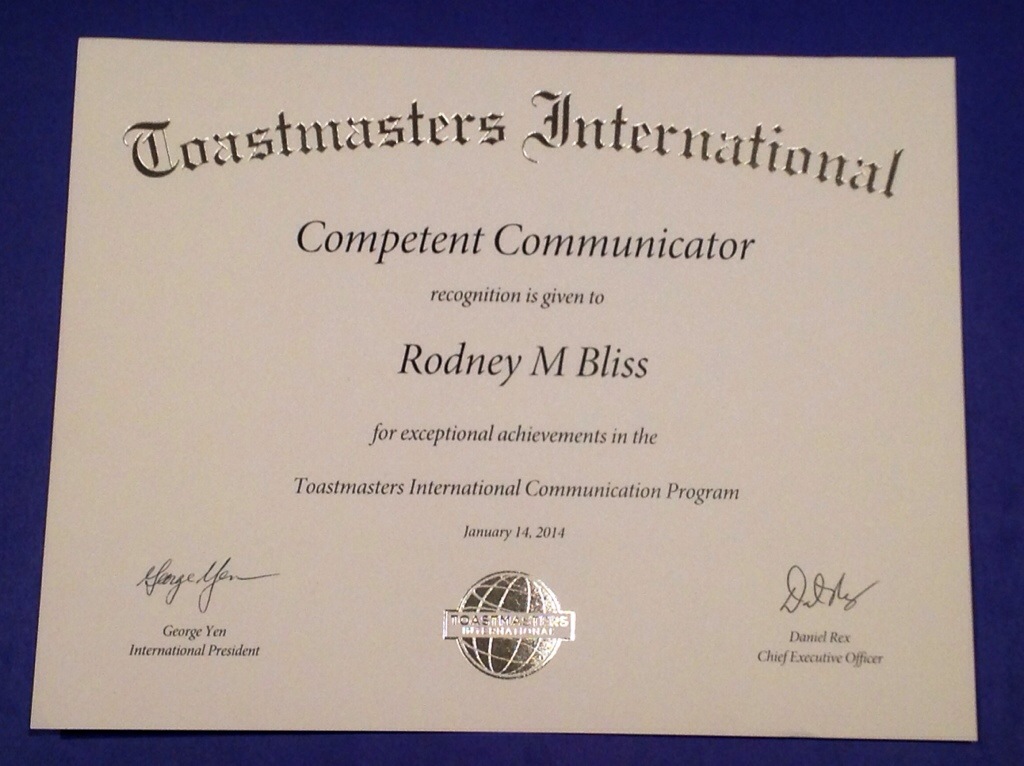
I got it for giving ten speeches. The Martin Luther King speech was one. I also talked about my family. I talked about hammers. Seriously I did an entire 6 minutes speech on hammers. It went really well. I also talked about books which are works of art vs books that are tools. I even got slightly political talking about my belief that gay couples should be allowed to adopt children in Utah. That one was slightly controversial in conservative Utah.
Some of the speeches went exceptionally well, like the hammers and the Martin Luther King speech. Some didn’t go as well as I would have liked. Most of them were not difficult for me to prepare and present.
Receiving the Competent Communicator award made me think again about certifications. It’s a topic I’ve touched on before. (I Don’t Care What You Know, What Can You Do?) And like that previous discussion, I have to think, “Am I any different than I was before I had this certificate?” I don’t think I’ve grown a lot as a speaker. Not that I can’t, or that I’m Tony Robbins or something, but the process of standing up and giving a 5-7 minute prepared speech every couple of weeks isn’t particularly scary or challenging for me.
It is for some people.
Our family moved across town a couple of years ago and we ended up attending a different church. It’s still the Mormon church, but we were going to church with a whole different group now. After a few months, our family was asked to speak in church. One of my sons and one of my daughters volunteered. And I volunteered. . . of course.
The Sunday came that we were to speak. My 12 year old son went first and did a great job. He’s very confident anyway and was well prepared. He sat down, we all sang a hymn and it was my 13 year old daughter’s turn. I knew she was prepared. She walked to the microphone. Looked out at the 300 people assembled and she froze. She couldn’t go forward and she couldn’t retreat.
It’s an experience I’ve heard others talk about, but never in my life experienced. What was she going to do? What was I going to do?
I knew that if she sat down without delivering her remarks that she would never accept an assignment to speak in church, or probably anywhere else, ever again. I stood up and walked up behind her and gently put my arms around her. We stood there a moment. I pointed to the first word on her hand written speech.
“Say that one,”
I whispered.
“Dear.”
I pointed to the next word.
“Say that one.”
“. . .brothers. . .”
And so it went. I have no idea how long we laboriously made our way through her speech one tortured word at a time. When she finally reached the end, she quickly retreated to her seat and buried her head in her hands; embarrassed at the 300 pairs of, in her mind, accusing eyes.
It was my turn to speak. I had my remarks prepared but I stood there for a moment to collect my thoughts.
“People see the ease and confidence I have standing in front of groups, and they think I’m brave for doing so. I’m not brave. The fact is, I can’t ever remember a time when I didn’t enjoy being behind a microphone talking to any size group of people.”
I paused to let the next sentence sink in.
“But, what you have just witnessed is probably the bravest thing I’ve ever seen. She was terrified and she volunteered and did it anyway. That’s bravery.”
I can’t even remember what I said that day. I think my remarks were well received. At the end of the meeting my daughter wanted to escape the chapel as quickly as possible, skip the rest of the meetings and go home. No amount of my encouragement could convince her that her talk had gone well.
She was blocked by a quirk of geography. The pulpit where we were sitting was the furthest distance from the doors, which were in the back of the chapel. We had to make our way through the congregation. And it seemed like every single person stopped her and told her how much they had enjoyed and appreciated her remarks. By the time we reached the back of the church, she had gone through a complete transformation. Of course she wanted to stay, and no, Dad, I’ll be fine. See you later.
It seems odd that I received an award for doing something I was already accomplished at. Something that, while enjoyable was not any sort of exceptional work on my part.
It’s really the people like my daughter, who overcome their fears who deserve an award for public speaking.
Rodney M Bliss is an author, columnist and IT Consultant. He lives in Pleasant Grove, UT with his lovely wife and thirteen children.
Follow him on
Twitter (@rodneymbliss)
Facebook (www.facebook.com/rbliss)
LinkedIn (www.LinkedIn.com/in/rbliss)
or email him at rbliss at msn dot com
Tell your friends about this!
It was going to make them all rich.
It was the late 1990’s and this “internet” thing was finally starting to take off. Some of the visionary companies could see a day where we would shop online. And look up movie times on line. And a whole bunch of other stuff that we didn’t even know yet!
And everyone wanted to figure out how to make money. AOL, figured out how to make money getting people hooked up to the Internet. Netscape figured out how to make money by selling people an internet browser so they could get around.
And then there were companies trying to own the cool addresses, addresses that people would pay big money for. They were essentially speculating on virtual real estate. And like physical real estate, for a time the prices went up.
For example in 1999 capital.com sold for $750,000. Not bad considering someone bought it for about $10. Other noteworthy sales in 1999 were:
$824,000 drugs.com
$1,000,000 britain.com
$1,100,000 bingo.com
$1,500,000 fly.com
$2,000,000 england.com
$2,200,000 autos.com
$2,500,000 tom.com
The model was so simple it was scary: find a word that people will want to use and snap it up yourself and later sell it to someone for big bucks! The trick of course, was to figure out which word was the valuable one. Some companies just started hedging their bets. They literally went to a dictionary and started scooping up names.
One such company was Mail.com. They had hundreds of thousands of words registered.
I knew a guy, Robert, who worked for a company called Allegro who made anti spam software. They were the first company to figure out how to scan companies email without having to host the email. They redirected the customer’s email to their site. (This was accomplished by changing the DNS MX records.) Then they scanned the email and forwarded it on to the company.
It was very innovative for its time and Robert was the one who invented it. What does this have to do with domain names? Well, Mail.com was scooping up all the names they could find and they were also scooping up companies. They came courting Allegro. The problem for Robert was that he wasn’t an owner. The company was entirely owned by one particular family. They all got huge stock grants from Mail.com
What about Robert? He had to settle for a cash payment of $500,000. Six months later it became clear that out of all of them Robert had clearly gotten the best deal.
Your grandfather probably told you to buy land because “they don’t make any more of it.” This concept didnt’ translate well to the web. Because they DID make more of it. And while Mail.com was busy trying to scoop up all the names in the dictionary, people figured out that while sometimes a single word might be valuable, more often people either found a company via a search engine, in which case it literally didn’t matter what the domain name was, or they used a sentence mypony.com is probably just as good as pony.com.
Oh sure, there are still some big money domain names. Just a few years ago sex.com sold for $14M. And in 2007 the most expensive domain name ever vacationrentals.com sold for $35,000,000.
But, for every vactionrentals.com or sex.com or even drugs.com, there are literally thousands of names that someone bought and never managed to sell. So, Mail.com lost a ton of money. They are still a company at mail.com. I don’t know if it’s the same guys from the 1990s.
Yesterday, I talked about the changes coming to the internet top level domains (Everything You Knew About Internet Addressing Changed Yesterday.)
I think a similar land rush will occur as we saw in the 1990s. Companies will spend hundreds of thousands of dollars to snatch up attractive names and top level domains.
But a friend suggested that if a domain name doesn’t end in .com, .org or .net that the average user will be confused and those new addresses won’t necessarily catch on.
With thousands of new TLDs it very much looks like the TLD may simply take the place of the old domain names. You will see people run out and spend a bunch of money for TLDs. But, a year from now, you’ll still be visiting .com, .net and .org addresses.
Rodney M Bliss is an author, columnist and IT Consultant. He lives in Pleasant Grove, UT with his lovely wife and thirteen children.
Follow him on
Twitter (@rodneymbliss)
Facebook (www.facebook.com/rbliss)
LinkedIn (www.LinkedIn.com/in/rbliss)
or email him at rbliss at msn dot com
Tell your friends about this!
You probably didn’t know that the Internet changed yesterday. It looks the same as it always did. Meaning that Facebook still won’t show you all your friends’ updates and there are still plenty of cat pictures. But, there was a fundamental change yesterday that will start affecting you over the coming year.
To introduce the change, let me ask you a question. What’s a TLD? (Also called a gTLD)
My geeky friends probably recognize the acronym for a Top Level Domain, or a generic Top Level Domain.
My non-geeky friends are still saying “That didn’t help much.”
A TLD is the three letters that comes at the end of a website address. For example, this blog is hosted at www.staging.rodneymbliss.com. The “.com” portion is the TLD. In this example, rodneymbliss is the domain name. You can also have a subdomain that typically goes before the domain. So, I could rearrange my website so that my blog appeared at the address of myblog.staging.rodneymbliss.com. In this case “my blog” is a subdomain. The “www” that appears at the beginning of a domain name identifies the domain address as a World Wide Web address. We kind of take it for granted, but an address can also have other prefixes like FTP (File Transfer Protocol,) for example.
Next question. How many TLDs are there?
You can probably name a few. There’s:
.com (Commercial)
.net (Networks)
.org (Organizations)
.gov (US Governments)
.mil (US Military)
.edu (US Educational institutions)
There are probably a few more you’re thinking of; especially if you’ve ever registered a domain. (.info, .us etc.) There are also country specific TLDs. Like .uk for the United Kingdom.
There are 22 generic TLDs. Or rather, there were until yesterday. There are now 29. And there are soon going to be a whole lot more. A few years ago, the organization that makes up rules for the Internet (that would be ICANN, the Internet Corporation for Assigned Names and Numbers) decided that the list of available TLDs was too small. They allowed companies to essentially buy new top level domains. Some people think the change is more about sticking companies for the fees to register than it is about opening up the Internet. The fees can run into the hundreds of thousands of dollars.
Anyway, yesterday a company called Donuts Inc. opened up the first 7 new top level domains.
.guru
.bike
.singles
.clothing
.holdings
.plumbing
.ventures
You can go out to GoDaddy.com right now and request a domain name that ends in one of these seven words. I would suggest holding off for a while. The names right now are a little pricey. For example www.rodneymbliss.guru could be mine for $12,539.99. (Because really, $12,540 would be too much.) Oh, and that’s the ANNUAL price.
The names will come down in price over the coming week. That’s a good thing because Donuts Inc has another group ready to go on sale next week.
.camera
.equipment
.estate
.gallery
.graphics
.lighting
.photography
In all Donuts Inc plans to release more than 200 gTLD names over the coming year. And while Donuts Inc is the first to market they are by no means the only ones. There will be literally thousands of gTLDs available in the coming year. What will the ultimate result be? It’s really hard to say. We’ve never really tried anything like this before. Oh sure, they released the .xxx TLD a couple years ago, but it was specifically for porn sites and the porn sites were perfectly happy with the .com addresses they already have. The worry of course, is what happens if someone registers a similar name with a different TLD? www.rodneymbliss.guru will be selling for $39/year after next week. would someone grab it and try to lure away my readers? No, probably not going to happen with that name. But, there is certainly more valuable real estate that people might target.
So, expect to start seeing a lot more names at the end of web addresses.
Rodney M Bliss is an author, columnist and IT Consultant. He lives in Pleasant Grove, UT with his lovely wife and thirteen children.
Follow him on
Twitter (@rodneymbliss)
Facebook (www.facebook.com/rbliss)
LinkedIn (www.LinkedIn.com/in/rbliss)
or email him at rbliss at msn dot com
Tell your friends about this!
We all have that story, don’t we? The one that you bring out when you want to see just how far the person you’re talking to will believe you; because the story sounds too good to be true, or too outlandish.
I was once lost in a rainstorm on the Arabian peninsula.
This is one that I often use when playing Two Truths and a Lie. It has all the elements of a good lie. . .or true story. There’s the exotic location. The Arabian Peninsula sounds like something out of an Indian Jones movie, or 1001 Arabian Nights. There’s the danger aspect. Being lost in the desert sounds serious. Then, there’s the unexpected part. The curious bit. A rainstorm? In the desert? And finally, there’s the sheer believability or unbelievability. Why would Rodney be on the Arabian Peninsula and in a position to be lost?
Well, the story is 100% true. About 10 years ago I was working for Microsoft as a corporate trainer. Occasionally I got to travel around the world to deliver the training I created. One of those trips took me to Dubai in the United Arab Emirates. Because I was traveling from the USA, and because their workweek started on Sunday instead of Monday, I ended up with an extra day to get used to the time zone. My hotel suggested an authentic desert feast. At $80 it was a little pricey, but I realized I might never make it back to Dubai. And so far I haven’t.
The trip through the desert was going to be in a Toyota Land Cruiser. It showed up around 8:00am. Most of the other people on the tour were couples on vacation. Since I was a solo, I got to sit in the front seat. This decision would directly affect us getting lost. But, at the time I didn’t think anything of it.
We headed out of the city toward the desert. We met up with several other Toyota Land Cruisers full of tourists. I think there were eight cars in all. Then we headed out into the desert. There were no roads. We simply drove up and down sand dunes. The sides were often quite steep, so one minute we were facing up and then quickly headed down a steep sandy slope.
This was early April. And a rain storm was rolling in off the Persian Gulf. The rain was intense but intermittent. And all the while we are going up one side of the dunes and down the other. Eight silver land yachts riding the sandy waves. There was a cry of distress from the back of the Land Cruiser. The driver quickly pulled over and a very sick German woman added some decoration to the desert. She explained that the constant motion of the car had made her ill. Fortunately she didn’t get sick inside the car.
Since i knew that the front would probably be less upsetting to her, I offered to switch seats which she gladly accepted. Once I got in the back I understood why she’d gotten sick. I don’t get motion sickness and it was a little uncomfortable for me. Visibility was definitely better in the front.
Meanwhile another rain squall had rolled through and while we were waiting for the woman to get herself back together, the rest of the group had left. Our driver didn’t know where they were headed. He always relied on following the herd. There are no cell towers in the desert. At least there weren’t at that time.
So, we drove around in circles. . .in the rain. . .as night started to fall. Finally the driver spotted a landmark he recognized. Then he found a road that led to the site of the banquet.
The food was all cooked in a traditional manner and it was excellent. We also got to ride camels. But, the most memorable part of the trip was getting lost in a rainstorm on the Arabian Peninsula.
(Edit: A earlier version described them as Toyota Land Rovers. My friend David M. who is a better “car guy” than I am pointed out that Toyota doesn’t make the Land Rover. I’ve fixed it.)
Rodney M Bliss is an author, columnist and IT Consultant. He lives in Pleasant Grove, UT with his lovely wife and thirteen children.
Follow him on
Twitter (@rodneymbliss)
Facebook (www.facebook.com/rbliss)
LinkedIn (www.LinkedIn.com/in/rbliss)
or email him at rbliss at msn dot com
Tell your friends about this!
No George. Technology doesn’t work that way.
I’m telling you, that Apple can track your iPad through the wifi networks.
George, I do this stuff for a living. Trust me, Apple cannot access an iPad over random wifi networks.
Well, George wasn’t right, but as I was to discover he also wasn’t totally wrong. George is my brother-in-law. We were at a wedding reception for our niece. We were content to sit out of the way and hope no one asked us to help in any way. Technically I was watching kids while my lovely wife helped her sister, the mother-of-the-bride. I say, I was supposed to watch them, but the backyard was fenced, so it’s not like they were going anywhere.
I explained to George about losing my iPad several months earlier (I’m Not The Sharpest Tool In The Drawer.) I explained that even though I had enabled the Find My iPad feature, because I had a screen lock enabled, no one could access the iPad and if they couldn’t access it, then they couldn’t authenticate on a network and let the iPad “phone home.” The iPad is wifi only. If it had cellular capacity, it would have been able to use that connection to phone home. But the wifi only version couldn’t broadcast it’s location unless it was on an authenticated network.
George was convinced that if the iPad was turned on, Apple could find it if it was within range of a wifi network, any wifi network. George manages a museum. He’s a smart guy, but his technical training was not much more than what was needed to set up his home computer.
I, on the other hand, had a long and impressive resume. I’d worked for some of the biggest computer companies in the world. I’d flown all over the world to deliver training classes. I’d written books on computers. I wasn’t trying to be condescending, but there was no way he knew more about networks than I did.
Yeah. . .I didn’t know quite what I thought I did.
George tried to convince me that iPads tracked their location based on wifi. I in turn tried to explain Global Positioning Satellites (GPS.) He wasn’t getting it. Finally, I told my son to go get my iPad from the car. We had used the maps feature on the iPad to find our way to this house. I’d show him exactly how you configure the GPS settings.
It was several minutes before I admitted defeat.
Okay, he had the good grace to not tell me “I told you so.”
When did Apple stop using GPS? And I had never heard of them using wifi to track your location, but it’s brilliant.
So score one for George.
And I’m sure that Apple can trace you through those wifi connections.
This time I stopped short of telling him he didn’t know what he was talking about. But, I explained authentication. And the NSA might be able to hijack your wifi router and push their own data through it, but there was no way that Apple could do that. I explained that the iPad was simply asking each wifi router for it’s location. Actually, it’s asking for the IP address and then trying to approximate the location.
But, if it can get that information, it can still send data back to Apple!
No, see the iPad is doing the equivalent of reading street numbers and then mapping those. What you are suggesting is the equivalent of breaking into people’s houses and using their phones. The iPad, and Apple don’t have the capability to do something like that.
Uh huh. That’s what you said about the iPad using wifi to map its location.
Okay, that’s a good point.
Rodney M Bliss is an author, columnist and IT Consultant. He lives in Pleasant Grove, UT with his lovely wife and thirteen children.
Follow him on
Twitter (@rodneymbliss)
Facebook (www.facebook.com/rbliss)
LinkedIn (www.LinkedIn.com/in/rbliss)
or email him at rbliss at msn dot com
Tell your friends about this!
I can’t remember where I heard it. It might have been in a book. It might have been a motivational speaker. The setting has escaped me, but I remember the story. A salesman is trying to convince his friend of the beauty of a bluetooth headset and a cell phone.
I can take a call out on the river and they don’t even know I’m fishing!
Neither do you!
I thought of that story during my own “fishing” story. I own a set of golf clubs, but I’m by no means much of a golfer. The clubs were my dad’s. He was several inches shorter than I am and I think the clubs are several inches too short for me. I don’t play golf enough to know.
But, typically a golf course is just so beautiful that I enjoy the opportunity to play occasionally. Especially here in Utah, where the lush greens of the course contrast with the desert landscape. (Yeah, I know the environmental impact and the water usage. But, let’s try to focus on happy thoughts for this post!)
So when Russ said that Novell was inviting him and a couple friends to go golfing and would I like to round out the foursome, I accepted willingly. The only problem was the Tee-time. We were scheduled for 11:15 on Wednesday morning. My manager had his team meeting every Wednesday from 10:00-11:00. He was a stickler for attendance. You either had to be there in person, call in, or have a doctor’s note. I was pretty sure that he wouldn’t go for “I blew off your team meeting to go golfing.” My boss wasn’t a golfer, or that excuse might have worked.
There wasn’t time to get to the course after an 11:00 meeting.
You’ve probably already figured out what I did.
You’re right. I met the group at the club house and then retired to a covered cart to dial into my meeting. My manager was responsible for multiple teams. I owned the messaging team. Gary owned the developers. Brian owned Directory. And there were teams for Network, and a couple of others. Mark, my manager really wanted people to be engaged in the meeting. However, because the meeting was mandatory, it meant that I was often bored. I frankly didn’t care about many of the topics that the other teams brought up.
Before you judge too harshly, I expected the other managers didn’t care about my issues either. For example, we were having a problem getting Yahoo to place our IP address on their whitelist. We generated so much email, much of it of a test nature, that Yahoo’s automatic algorithms kept classifying us as a potential spam site. We were working on changes to our MX records, and were attempting to split our outbound email between two IP addresses, a “clean” corporate address that Yahoo would (hopefully) approve and a “dirty” address that could be used for testing and would consequently have a poor reputation.
Do the technical details of any of that make sense to you?
Unless you are a messaging expert, probably not much. This was a really important topic for me, and equally important for my manager. But, the rest of his team really didn’t care. They would disappear into their laptops when I would go into these discussions. In fairness, I retreated to my laptop when it was their turn to talk about how our Active Directory schema had a compatibility issue with the forest that a separate department maintained and they walked through the manual process of normalizing the records between the two domains.
So, there I was sitting in a golf cart only half listening to each team manager go through their issues. I listened just enough to catch my name if it was mentioned. I gave my bit when it was my turn and that was about it.
It was a beautiful day for golf. I almost hit par on one hole. I drowned 4 golf balls in the river before they took pity on me and let me take a drop on the far side. The best part? I shared a cart with Gary, the Team Manager over the programmers.
They didn’t know he was fishing either.
Rodney M Bliss is an author, columnist and IT Consultant. He lives in Pleasant Grove, UT with his lovely wife and thirteen children. His typical golf score is “mega-bogey.”
Follow him on
Twitter (@rodneymbliss)
Facebook (www.facebook.com/rbliss)
LinkedIn (www.LinkedIn.com/in/rbliss)
or email him at rbliss at msn dot com
Tell your friends about this!
It was a crazy corporate policy. Maybe I should have just left it, but when you get a chance to write. . .No, when you get a chance to be published, it’s hard to turn that down.
I’ve wanted to be a writer since very early in my career. I’m not really sure what drives it. I think partly it’s the idea of teaching. I love to teach. And, I like to talk. So, that’s probably part of it. And of course, there’s the prestige of seeing a book in print with your name on it. I didn’t understand it when I wrote my first book, but there is also a level of prestige associated with being a published author.
So, when I had the chance to write for WordPerfect 6.0 Superbook, I jumped at it. After all, I was working for WordPerfect at the time. And that was part of the problem. WordPerfect had a policy that employees were not allowed to write books. I never really got a good answer to why they created this rule. I think it had something to do with the idea that employees had access to information that outside writers didn’t. There was the idea that it was somehow an unfair advantage if you were an employee. Of course, that’s the point. Not the unfair advantage, but books written by people close to the source are highly sought after.
In the days before the Internet, computer books were a necessary expense for anyone wanting to really learn a product. You would think that software companies would be able to write documentation well enough that 3rd party books weren’t necessary. It didn’t happen.
So, I got invited to write some chapters for Sams Publishing. I took it. The book was a collaboration from about 12 of us. I knew that if I put Rodney Bliss as the author, it would negatively affect my job. So, I came up with Milan Keeney. The first name has an American pronunciation, like “my LAN” even though it’s the name of a city in Italy pronounced “me lawn.” How do I know? Because it’s me. The “M” in Rodney M Bliss stands for Milan.
Keeney is also me. It’s the name I was born with, Rodney Milan Keeney. When I was fourteen years old, I was adopted by my step-father, Lloyd V Bliss. So, when people tell me that they like the name “Bliss” I can truthfully tell them that I picked it out myself.
If I had to create a pseudonym, I felt better using one that was actually my own name. A huge part of that, of course, is because like every writer, at least part of my motivation was the idea of my mother seeing my name in print.
Rodney M Bliss is an author, columnist and IT Consultant. He lives in Pleasant Grove, UT with his lovely wife and thirteen children.
Follow him on
Twitter (@rodneymbliss)
Facebook (www.facebook.com/rbliss)
LinkedIn (www.LinkedIn.com/in/rbliss)
or email him at rbliss at msn dot com
Tell your friends about this!
What is it you wanted again?
I need to know if you guys can modify the Windows NT backup so it can point to a network location rather than a tape drive?
Rodney, you obviously don’t know anything about backups. The reason you back up is so that you can secure a copy offsite. How could we do that if we were just backing up to another location on the same server or the network?
I was a course developer for Microsoft writing training materials for Microsoft Exchange. The patronizing Program Managers were the Windows NT backup PMs. I was writing a training course that was focused on problems we had seen with Exchange backups. As everyone knows, the purpose of backing things up is so that if something goes wrong you can restore from backup.
The problem was that Exchange had a bug that made it look like the backup was successful when it wasn’t. The customers didn’t realize their backups were corrupt until they tried to restore them. That obviously is not the time you want to figure out your backup is worthless. It caused a lot of grief for multiple customers, and in the process we realized our support engineers didn’t understand our backup and restore process well enough. So, I wrote a training course.
This was all happening in 1999. Networks were pretty well established, but IT hadn’t yet embraced the idea of online storage. Everything was physical media. Backups went to physical tape. We also still used floppy disks.
My problem was that in order for the course to be effective, students needed to be able to perform multiple backups and restorations during the 2 day course. But our training rooms were not equipped with tape backup units. Microsoft had dozens of training rooms and we made our courseware available to partners who had hundreds of training rooms and thousands of computers. It was completely impractical to upgrade all of those rooms and computers with tape backup units for a single class. I considered writing the labs in such a way that only the instructor’s computer would need a tape drive, but with potentially up to 30 students per classroom, it would be a pretty weak experience. I could have also created a video of me doing the backup, but the whole point of the training was to give engineers hands on experience. So, I ended up trying to convince the Windows NT backup guys to modify their utility to let me point to a network location.
They didn’t just say no, they said . . .more than that.
So, I went looking for a solution. There was a team of programmers attached to support. They were called Critical Problem Resolution, or the CPR group and that was often their function. They were the group who got the old out of date products and at times they needed to go in and make software changes for customers. The Windows NT development group were the guys making new cars, the CPR group was a backyard mechanic who would try to keep your worn-out 1972 Pinto running. I went to see Chris, one of the Exchange CPR developers.
Chris, I need a favor.
Sure. What’s up?
I need a way to backup an Exchange database to a location on the local disk and then restore it.
I’ve got a utility that I kind of threw together to do some testing. It doesn’t have a User Interface. Basically you run it from a command prompt. Its functionality is very limited, but it can backup and restore.
It was exactly what I needed. But, Chris wasn’t lying about the UI. You typed a single line to backup
c:\backup.exe /d-c:\backupdirectory
And to restore the database you typed
c:\restore.exe /d-c:\backupdirectory
Fortunately the courses I wrote were for internal audiences and trusted partners. I didn’t have to worry about trying to create a course that would be sold for thousands of dollars to customers around the world. If I were, there is no way I could have gotten away with including such a kludgy tool.
I took Chris’s tool and finished writing my course. Before we release a course to our engineers we first teach it in a our own lab with random volunteers. One of the volunteers I recruited was Larry, the Lead Program Manager over Windows NT. Larry was the guy responsible for all of Windows NT, including backups. I’m not even sure how I convinced him to give me two days of his time. I think it might have been because my course was supposed to help solve some of the issues that NT support was getting beat up about as well.
The course went pretty well until we got to the first lab.
Rodney? What’s this kludgy DOS utility backup? Why aren’t you using Windows NT backup?
Well, I talked to your backup guys and asked them to modify NT Backup to be able to point to a network location. They told me that wasn’t a feature they were interested in pursuing.
That seemed to mollify Larry, but he took very careful notes during the course. The course Microsoft Course 1618: Managing Your ESE Database shipped with Chris’s DOS utility and it got good reviews. The development team had corrected the bug in the software and the training course helped our support engineers to understand the backup process well enough to handle the customer calls.
I never did hear back from Larry. But, I noticed that the next version of Windows NT Backup included the ability to backup to a local disk or a network location. Had I convinced the backup guys to build a version for me that had online backup capabilities, there’s a possibility it would have taken much longer for the shipping version to be updated. Sometimes you end up changing the world because you don’t have the influence not to.
Rodney M Bliss is an author, columnist and IT Consultant. He lives in Pleasant Grove, UT with his lovely wife and thirteen children.
Follow him on
Twitter (@rodneymbliss)
Facebook (www.facebook.com/rbliss)
LinkedIn (www.LinkedIn.com/in/rbliss)
or email him at rbliss at msn dot com
Tell your friends about this!
It’s a common exercise. Try to imagine you are somewhere else, or someWHEN else. Books and movies do it for us all the time. We pay our money for a few hours of suspended disbelief. As a history buff, I’ve often thought about life in other times. What would it be like to live during the time of the American Revolution? Or the Civil War? Or the Roman Empire? Of course, when we play these pictures in our heads, at least when I do, I am always one of the good guys. I’m never the oppressed slave. Sure I’ve seen Ben Hur, but he’s only a slave for short period and he triumphs!
But, as distracting as these diversions are, I’ve often asked myself what I would miss the most if I lived at a different period in history. My career has been spent building computer software. Would I miss computers and the internet? Perhaps. But, one of my hobbies is to build things with my hands. I’m helping a friend remodel a house. I spent a day last week ripping drywall off walls and ceilings.
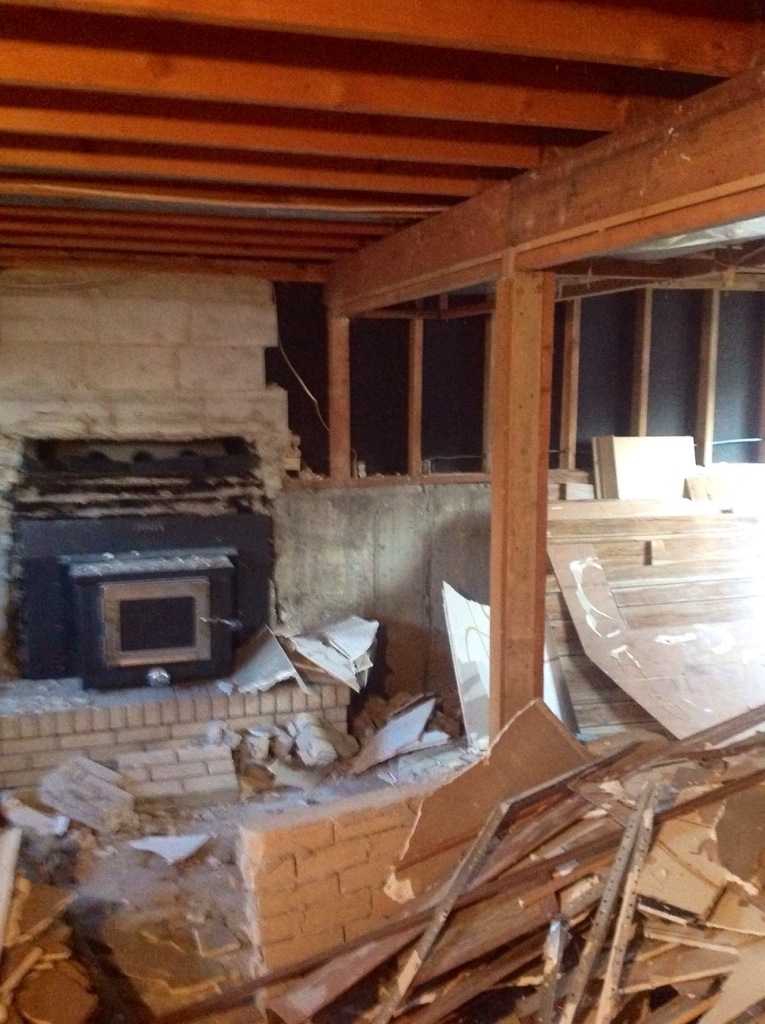
The only connection I had with technology that day was I used my iPad to play music while I worked. It was great.
My son has a birthday this week.
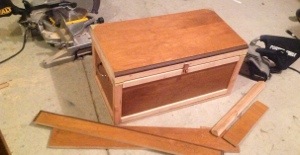
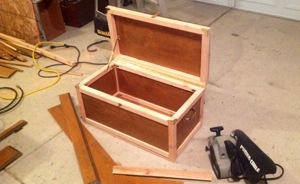
I spent my spare the time the past two weeks building him a handmade footlocker. I drew the design and used some door panels salvaged from the remodel. It came out great.
I think I could survive without computers.
How about cars and the ability to travel great distances in a short amount of time? Again, maybe. But, I love road trips. I truly enjoy the travel for it’s own sake. Often the end of the trip finds me wishing to take one more spin around the state before pulling into my driveway. If a trip took a week by train and horseback rather than a day by car, or an hour by plane, I think I’d be okay with that.
I finally narrowed it down. I think what I would miss the most is fingernail clippers.
I’m not joking, although it sounds like a silly answer I know.
Have you ever tried to trim your fingernails with a knife?
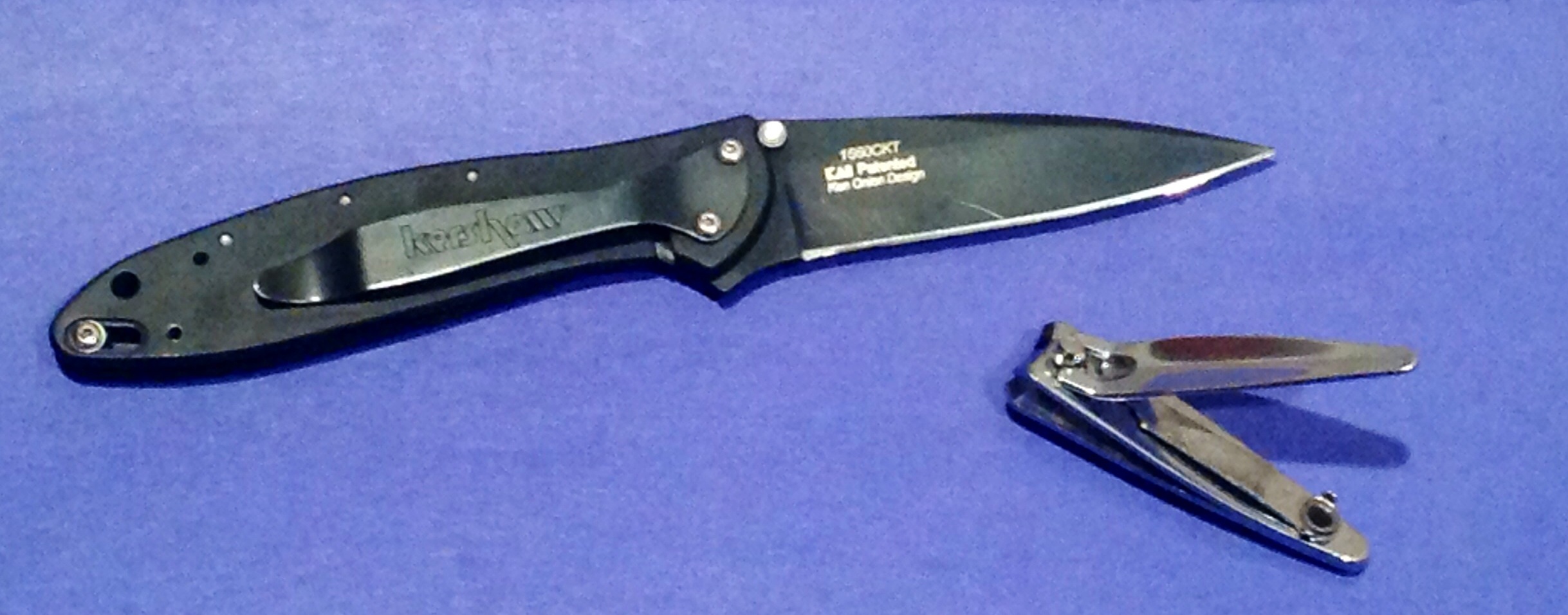
I have a really nice Kershaw knife, that I keep very sharp. Using it to pare my nails is a disaster. They never come out as neat and trim as when I use clippers. And if a nail starts to break and fray and it has that jagged feel to it? I can’t hardly stand to touch anything with that finger until I get a chance to clip it properly.
So, what’s this have to do with business, leadership or teams?
I think we often overvalue the wrong things. For example, for as long as writers have existed, editors have been our bane. There are many excellent editors, but the nature of the publishing process often pits writers and editors against each other. Editors often want the manuscript sooner than the writer is ready to hand it off. Editors change the prose or the text that the writer spent weeks constructing. Even when they are working in concert, the two roles have a certain amount of built in conflict.
You know what I miss most about being a blog writer? I miss an editor. Any of you who have read my meager scribblings know that what my post looks like at 7:00am when it goes live is different than what it looks like at 7:30am when I catch the rest of the editing mistakes that I made. Yesterday I talked about “microwaves.” Years of habit and muscle memory wrote that word as “microsoft” instead. I fixed it every time except the last instance. I caught it before my sharp eyed readers started noticing, but still, the damage was done.
I think I’m a good enough writer that I understand the role of editors. I know I am. But, until I set out to self publish, I didn’t realize how much I missed them.
Like I said, fingernail clippers. We don’t realize how valuable certain things are in our life until they are not there anymore.
Rodney M Bliss is an author, columnist and IT Consultant. He lives in Pleasant Grove, UT with his lovely wife and thirteen children.
Follow him on
Twitter (@rodneymbliss)
Facebook (www.facebook.com/rbliss)
LinkedIn (www.LinkedIn.com/in/rbliss)
or email him at rbliss at msn dot com