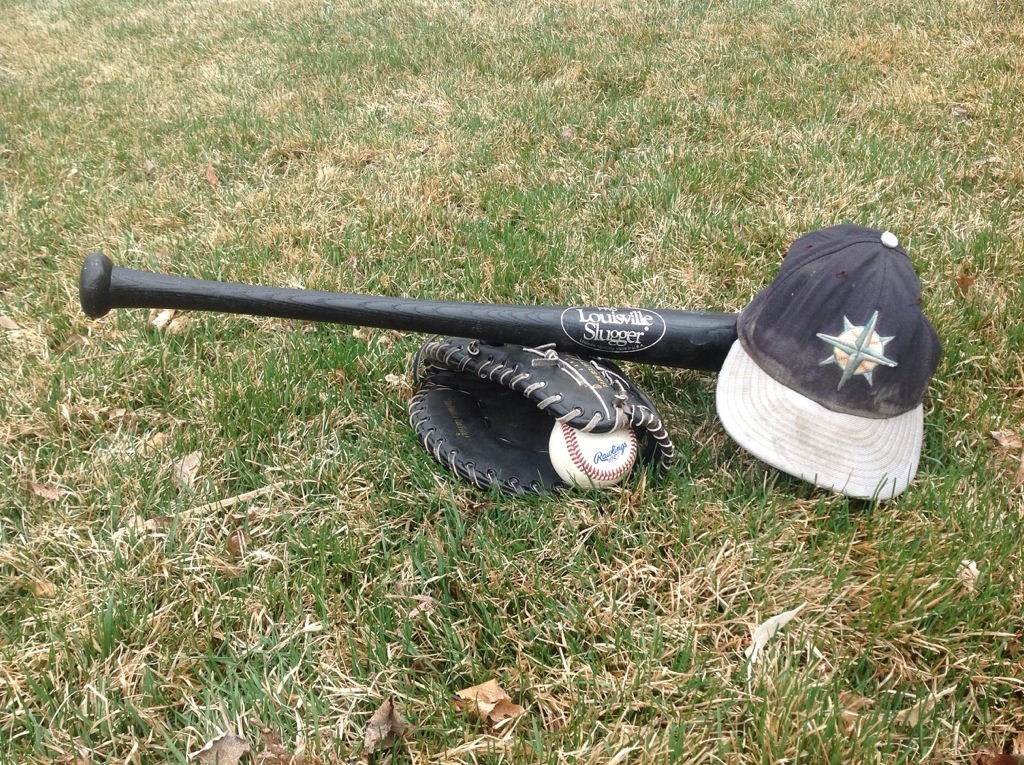
I did something today that I’ve done for years. I took part in a ritual that goes back to the last century, goes all the way through the 20th century and finally comes to rest in the nineteenth century. It’s true origins, like all great historical events is part history, part legend and clouded with controversy.
Question, what are the two most exciting words in sports? (Yes, this is another sports column, sorry, I only do a couple per year.)
And one?
Hail Mary?
Yankees lose?
The last one’s close:
Opening Day.
Some people think the two most excited words in sports are actually “play ball.” And while those words are pretty exciting, they get called out multiple times per year. Opening Day is a once per year thing. Well, Opening day was actually last week as the Dodgers and Diamondbacks flew to Australia to open the season. And while today is the first games for the rest of the league, the Mariners are opening on the road. Their first home game will be April 8th, so that’s another Opening Day. I guess “Opening Day” happens a few times.
What makes Opening Day so special? Three things: The future, the past and the present.
The Future
A baseball season is 162 games long. It’s the longest schedule in any sport. At three hours per game on average that’s 486 hours, over 8 solid days of baseball. By August, most of the teams will be out of the pennant race. The fields will be hot and dusty. The teams will be gutting it out through the “dog days.”
But, in April (okay, it’s started in March, but April just feels right.) In April, every team is tied. Anyone could go on a tear. Baseball is full of Cinderella teams who vastly overachieve. On Opening Day every team is a World Series contender. As fans of the game we understand that our team most likely won’t be there in the September, but like daisies in spring, hope springs eternal.
The Past
More than any other sport, baseball honors it’s past. The game has changed and continues to change. This year, baseball is expanding instant replay. Last year it was only for home run calls. This year it will be for additional plays. Baseball continues to move forward, but if you took today’s fans and placed them in a game in 1946 when Jackie Robinson was making his debut, or 1908, the last time the Cubs won the World Series, the fans would enjoy the game just as much as fans did a hundred years ago.
Opening Day has been happening for over a century. Even during the days of World War II, baseball continued as many of the big leaguers went off to fight.
The Present
Let’s face it, Spring Training games don’t count. They don’t count because they don’t count. Managers are tweaking their lineups. Guys are working on skills and situational plays. The Spring Training records get wiped once the games start to count.
It’s been 5 months since the Red Sox won the World Series. For baseball fans, the long winter of our discontent is finally over. We look forward with hope and are excited to finally have the umpires calling balls and strikes again.
Rodney M Bliss is an author, columnist and IT Consultant. He lives in Pleasant Grove, UT with his lovely wife and thirteen children.
Follow him on
Twitter (@rodneymbliss)
Facebook (www.facebook.com/rbliss)
LinkedIn (www.LinkedIn.com/in/rbliss)
or email him at rbliss at msn dot com
Tell your friends about this!

3 And why beholdest thou the mote that is in thy brother’s eye, but considerest not the beam that is in thine own eye?
4 Or how wilt thou say to thy brother, Let me pull out the mote out of thine eye; and, behold, a beam is in thine own eye?
5 Thou hypocrite, first cast out the beam out of thine own eye; and then shalt thou see clearly to cast out the mote out of thy brother’s eye.
– Mathew 7:3-4
No one likes to be called a hypocrite, but that’s what I was. I didn’t mean to be, so maybe that was a point in my favor and it all turned out okay.
My daughter and I sat in my car outside the police station waiting for an officer to arrive. It was about 11:30 on a Saturday night with a light rain threatening. What does it say about your town that the police station is essentially “drive through only” late at night? We had tried to walk in, but there was a “call box” outside the locked door.
Provo Police how may I help you?
Yeah, my name’s Rodney Bliss and I need to talk to an officer.
Is this an emergency?
No.
We’ll have someone there as soon as we can.
Should I wait here or in my car?
Ah. . .yeah, probably in your car.
About 15 minutes later an officer comes walking across the street. We figured out where we needed to go and decided he would follow us there. I turned to my daughter,
Remember to put your seatbelt on. I think there’s a cop behind us.
She smiled and buckled in. It was a short drive to where we needed to go. When we got there I went to unbuckle my seatbelt and as you’ve probably guessed, it wasn’t buckled.
Yup, I was the hypocrite. I figured out why it wasn’t buckled afterward. When we went back to the car from the police station, it was cold enough that we turned on the heater. Since we weren’t actually driving anywhere, I didn’t put on my seatbelt. Later when we went to leave, I didn’t think of it. Like many people, I put on my seatbelt when in a particular order when I’m getting ready to go somewhere.
My daughter didn’t even notice, and if she had, probably would have been more amused than offended. But, it reminded me that as managers we set the example for our staff. If you don’t want them taking two hour lunches, don’t take two hour lunches. If you want them to be careful with company funds, don’t book yourself into a 5 star hotel when you travel.
We are managers because we are good at leading people, and while it’s not how we would typically describe it, we are good at telling people what to do. Just make sure that you remember to tell yourself. . .and buckle up!
Rodney M Bliss is an author, columnist and IT Consultant. He lives in Pleasant Grove, UT with his lovely wife and thirteen children.
Follow him on
Twitter (@rodneymbliss)
Facebook (www.facebook.com/rbliss)
LinkedIn (www.LinkedIn.com/in/rbliss)
or email him at rbliss at msn dot com
Tell your friends about this!

Thank you for calling WordPerfect Office Support. Is there anything else I can help you with today?
Yeah, I had just one more question. . .
My customer proceeded to ask me a question that I had no idea how to answer. Now what?
While working for Microsoft I had an opportunity to interview many different people. I was an expert on the communication process between a Microsoft Outlook client and a Microsoft Exchange server. Often my portion of the interview would start out like this:
Can you explain what happens when you click SEND on an email message that is addressed to someone at another company?
Well, the Outlook client sends the email to the Exchange server. . .
Yeah, how does it do that?
The Outlook client machine makes a network connection to the Exchange server and then transfers the message. . .
How does it know where to locate the Exchange server?
Well, it makes an DNS query. . .
How does it know what name to query?
Eventually, we would reach the level of the person’s understanding. There was no way the candidate knew more about Outlook to Exchange communication than I did. If they understood DNS, I would drill down into the communication protocol used when talking to Exchange (RPC.) If they knew about RPC, I would drill down into the encapsulated protocol (MIME.) If they knew about MIME, I would drill down into the RPC call number (2). If they knew that, I’d drill down into what offset in the file of an RPC call to the End Point contained the IP address of the Exchange server.
The point was only partly to figure out how much they knew about Exchange. Really, we could teach them the technical details. The main point was to get the candidate to the point where they DIDN’T know the answer. What did they do at that point? Did they guess? Did they bluff?
The correct answer was for them to get to the point of saying, “I don’t know.” In other words, were they willing to be honest?
It was amazing to watch. The candidates who bluffed, or made up an answer never realized that it was at that moment that they failed the interview. If you were willing to lie about something that simple, how did we know they wouldn’t lie when it was more important?
It’s very hard, especially for technical people to say, “I don’t know.” But, ironically, it’s amazingly liberating. If you are willing to say “I don’t know” it actually builds credibility. People realize that they can trust your statements since they know you would admit it if you were wrong.
I learned this while on the phones supporting WordPerfect Office. In the original example above, when I was asked this question I didn’t know the answer to, I started to panic a little bit. I was one of the senior engineers. I didn’t have anyone I could go ask. No one on the team understood Office as well as I did. I thought about calling one of our programmers, or testers, but they didn’t have experience with Office being used by customers.
There was literally no one whom I could ask to find an answer to this question. And that’s when I had the epiphany. If I didn’t know the answer, then there was no one on the planet that knew the correct answer.
Hello, sir?
Yes.
Thanks for holding. I did some research on your question and I’m afraid I don’t know the answer. In fact, I cannot even think of anyone to ask to find an answer. I don’t think anyone knows.
Oh. . .That’s fine. I was just curious about it anyway. Thanks.
Sometimes the smartest answer is saying, “I don’t know.”
Rodney M Bliss is an author, columnist and IT Consultant. He lives in Pleasant Grove, UT with his lovely wife and thirteen children.
Follow him on
Twitter (@rodneymbliss)
Facebook (www.facebook.com/rbliss)
LinkedIn (www.LinkedIn.com/in/rbliss)
or email him at rbliss at msn dot com
Tell your friends about this!
Five
That’s the number of badge readers I have to pass through to get from my car to my desk. I work in a very secure building.
Two
That’s the number of badge readers I have to pass through to get from my desk to my car.
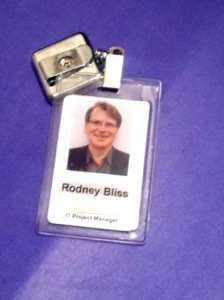
I work in an area where if you forget to badge out, you set off an alarm. AND you can’t get back in until security fixes your “out-of-sync” issues. (Although, actually if you get someone to let you back into the secure area you can badge yourself out and get back in sync.
Our building is in the process of being renovated. We are moving people around and repurposing space. That has played havoc with our card readers, especially the “we WILL lock you out” ones in my area.
We also have some very important client information in our building. The clients have insisted that we not put their name on our building, or even tell people that we are working together. Our training rooms have both physical security with the “you’ll set off alarms, if you don’t badge out” doors, but they also have extreme network security. The workstations are locked down pretty tight.
So, security is something we are VERY concerned with.
Here’s a challenge, the easiest thing during the reconstruction would be to block open our secure door. Then, we don’t have to worry if the card readers are being reprogrammed. But, how do we convince our risk analysts to allow that?
People are motivated by a lot of different things. Fame, power, money and pain are just a few. We don’t like pain. . .well, most of us don’t and those that do, scare me more than a little. We don’t like physical pain, of course, but we also don’t like emotional pain, often called stressed.
I don’t like confrontations!
~ Rex the Dinosaur in Toy Story
One of the ways to get people to do what you want, is simply make it easier to do it your way than to not do it your way. I once led a group of engineers who had a reputation for “a lack of engineering discipline.” That doesn’t mean they were bad engineers. In fact, they were all very talented. The problem was they didn’t think through their changes at times. They tended to go out of process to fix things. I could have imposed some sort of penalty for failing to follow the process. I probably could have forced compliance. But, they would have hated it and me.
The challenge was rather than motivate them by fear, to motivate them by pain. I didn’t expect them to gain a testimony of the necessity of following our proscribed process. That would have been too much to hope for. Instead, I was hoping to make it more painful to NOT follow process than to follow it. There are several ways of accomplishing this. The most common is to design your process so that exceptions require more approvals and documentations. (Engineers HATE documenting things.)
My process was simple:
If you get your change requests to me before the deadline, I will fill out the change request form and get all the approvals for you. If you don’t get them to me in time (or by implication if you don’t fill out the form) then you have to go get approvals yourself and do all the paperwork yourself.
An amazing thing happened. I started getting the change requests before the deadline. The engineers were doing more work than they had been before, in giving me their changes, but they were doing LESS work than would be expected of them if they put in changes themselves.
Bring the pain. Make doing the right thing easier, faster, cheaper, or cooler than doing the wrong thing, and watch people RUSH to comply.
Back to our door problems at work. How did we get the security analysts to let us block open the door? We didn’t. We got them to do it. The analyst happened to be closest to the door. When someone had a problem with the card reader, they’d knock and he had to get up out of his chair and walk over and open the door. After a half dozen times of doing that, he got sick of it and propped open the door. Problem solved!
Rodney M Bliss is an author, columnist and IT Consultant. He lives in Pleasant Grove, UT with his lovely wife and thirteen children.
Follow him on
Twitter (@rodneymbliss)
Facebook (www.facebook.com/rbliss)
LinkedIn (www.LinkedIn.com/in/rbliss)
or email him at rbliss at msn dot com
Tell your friends about this!
I’m sorry sir, all flights to LAX have been cancelled.
All of them? What happened?
Apparently they experienced a power outage.
So, someone unplugged the entire airport?
It would appear so. Is there anything else I can help you with?
Can you put me into a nearby airport? I really have to be at my meeting tomorrow.
I’m sorry, the LAX problems have put a strain on the other airports. All flights are full and have waiting lists. . .You won’t make it.
How about a rental car? Can I rent a car? How far is it from Oakland to LA?
It’s about 400 miles. But, we are completely sold out. The only rentals we have are locals.
I wasn’t actually headed to LA, I needed to go to the Kern River. Actually, I needed to get to a rafting company in Kernville. The directions seemed to be turn East at Bakersfield and drive until the road ends.
I was the president of RESMARK systems and I was spending the summer visiting customers and prospective customers. Ironically, I visited dozens of rafting companies and never went rafting that summer. I’d seen several companies in and around Oakland. The next leg of my trip was Oakland -> LA/Kernville and then home from LA.
I’ve never really been one to accept that I couldn’t change my circumstances. I’ve written before about being stuck in the middle of nowhere with a dead car and a deadline to be somewhere else in less than 24 hours. (What Would You Do? Stuck on a Lonely Road With a Young Child And A Dead Car?) I refused to believe that something as simple as a shuttered airport was going to stop me. But, what were my options? I couldn’t fly. No matter how I looked at it, there was no way to fly into the LA area in time to get to where I needed to be. Kernville was a three hour drive from LA.
And I couldn’t drive. I was stuck at the Oakland/SF airport. They were not going to rent me a car to take to LA. Actually, I was going to have rent a car once I got to LA anyway, and drive out to Kernville.
My flight out of LA was in two days. If I couldn’t get to LA, I was going to have to reschedule that flight to leave out of Oakland. . .and then it hit me. (You’ve probably already figured out the solution.) I couldn’t drive to LA and leave the car at the LA airport. But, I COULD rent a “local” in Oakland with unlimited miles and drive to Bakersfield, turn left, drive another hundred miles to Kernville and then reverse course after my meeting. A quick calculation told me that I was probably looking at 500 miles each way. Eight hours there and eight hours back.
They had the new Dodge Chargers for rent. . .okay, call it six hours there and six back.
A quick call to my office manager to get him started on changing the tickets a silver Charger and long stretches of pretty boring scenery, and I made it to my meeting in Kernville on time.
Ironically, by the time we got the Oakland to LA flight refunded and the Oak to Salt Lake City flight booked, the cost was less than my previous trip, even with the rental car.
Sometimes you just can’t find a way around an obstacle. But, if you are going to strike out, go out swinging. You might just connect and get to drive around the bases in a really cool car.
Rodney M Bliss is an author, columnist and IT Consultant. He lives in Pleasant Grove, UT with his lovely wife and thirteen children.
Follow him on
Twitter (@rodneymbliss)
Facebook (www.facebook.com/rbliss)
LinkedIn (www.LinkedIn.com/in/rbliss)
or email him at rbliss at msn dot com
Tell your friends about this!
I stared at the alarm clock. It was nearly midnight local time and I wasn’t even sure how many time zones I was away from my normal Pacific Time Zone. Outside, the sound of busses and sirens confirmed that Athens was also a city that didn’t sleep, at least not before midnight.
But, it wasn’t the traffic sounds that were keeping me up. If anything, they were a reassuring reminder of home. I had the pre-performance jitters. Tomorrow, I had to face a room full of Greeks and teach the latest Microsoft course that I’d created. The fact that the course would be taught in English was small consolation. I turned off the light and stared at the red digital numbers as they ticked over to 12:01.
It’s been years since I was a trainer. Today, I’m a project manager. Our big project is kicking off at work this week. It involves training several hundred phone agents. Today was the first day of training. Training started at 6:00am.
We had the normal first day hiccups. Our instructors are brilliant. It’s a good thing too. The course is four weeks long and there are 30 people in each classroom.
I was in the classroom today to observe, and to help shadow our customer who was there to watch the first batch of agents go through training.
During one of the breaks I approached Alyssa, one of our trainers.
So, how’s it going?
Good. Just the usual login issues. Typical of the first day.
What time did you get here?
About 5:30, but I kept waking up every 15 minutes last night. “It’s time to go to class!” Finally, at 3:00 I just stayed up. I get the pre-performance jitters.
Yeah, me too. I miss the chance to get up in front of a class and “facilitate” a course. That’s what our trainers are doing. The course is a lot of self study, videos and text. But, I still miss it.
I don’t miss the pre-performance jitters though. Back in that hotel room in Athens, I finally decided the only way I was going to get any sleep was to open up the text and make sure I was familiar enough with the content.
I hauled out my teacher manual and opened to lesson 1.
It worked. My jitters immediately went away. I remembered. . .Oh yeah, I wrote this.
Rodney M Bliss is an author, columnist and IT Consultant. He lives in Pleasant Grove, UT with his lovely wife and thirteen children.
Follow him on
Twitter (@rodneymbliss)
Facebook (www.facebook.com/rbliss)
LinkedIn (www.LinkedIn.com/in/rbliss)
or email him at rbliss at msn dot com
Tell your friends about this!
Kevin, my truck is starting to burn oil.
How bad?
Probably about a quart every couple of tankfuls.
You’ve got what, 150,000 miles? Well, if it gets worse bring it in and for $1500 we can drop a new engine into it.
Wait, when my old Honda Civic started burning oil, you said to run it until it dies and then junk it. I bought the Civic new. The truck was used and cost me $1000.
Yeah. . .but, it’s a truck!
Last week I talked about my old truck (The Truck Was Mostly Green.) I put a lot of money into that truck, certainly many times what it initially cost to buy it. And here was my mechanic, whom I trusted telling me it was a good idea to buy a new engine that cost more than the entire truck.
In some ways our employees are like my old truck. Occasionally, you have to incent people to come to work for you, but unless you are a professional sports team, or poaching high level executives, you probably are not paying huge amounts to get a new employee. Sure, we all know how expensive it can be to get the right employee, but there are still often multiple applicants for each position.
Often a challenge is that employees do not have the skills we need. I once had both my SharePoint engineers leave for more money. I knew that I couldn’t afford to replace their skill level. SharePoint expertise was just too expensive. So, I found the most competent engineer in our org and I reassigned him to SharePoint.
However, that engineer didn’t know anything about SharePoint. We sent him to classes. We sent him to trainings. We spent tens of thousands of dollars to train him on SharePoint. And it was worth every penny.
It’s the same principle my mechanic was using. My Dad always said that the cheapest car to own is the one you already have. In the case of a truck, or an engineer, that is very true.
Rodney M Bliss is an author, columnist and IT Consultant. He lives in Pleasant Grove, UT with his lovely wife and thirteen children.
Follow him on
Twitter (@rodneymbliss)
Facebook (www.facebook.com/rbliss)
LinkedIn (www.LinkedIn.com/in/rbliss)
or email him at rbliss at msn dot com
Tell your friends about this!
Of all the 16 rules in my list of Management Rules, this is the one most misunderstood. Typically when hearing it for the first time people either nod knowingly, or shake their heads derisively.
Here’s what it means.
Of course, the “one way” is employees being loyal to companies. It’s never the other way around. And here’s the secret sauce: Companies are not loyal because loyalty is an emotion and companies not only can’t, but shouldn’t have emotions.
Let’s deal with the detractors first; people who think “Of course, they are loyal.” These people include my mother. My mother built two mult-million dollar companies. First was a CPA firm that she ran for about 20 years and sold for $1M. While running the CPA firm she also built a financial services firm. She later sold it for around $2.5M.
If anyone knows about business, and successful businesses, it’s my mom. (No, I’m not expecting to inherit anything, but that’s not really the point.)
During the economic downturn of 2008, my mother, like many companies struggled to keep her business afloat while riding out the storm. She was a fairly conservative investor and shielded her clients from much of the economic fallout. However, everyone had less money. And her business dropped off pretty dramatically.
She restructured her personal compensation so that she could put a big pile of money aside to allow her to keep her people employed. This was loyalty, right? Wasn’t she showing loyalty?
I love my mother, but no. She wasn’t being loyal, she was mitigating an economic risk. She had some very highly trained people. She didn’t want to lose them. She knew that eventually the market would come back and she’d need those people.
When you have employees, the state assigns you a percentage of your payroll that you have to pay in unemployment tax. The percentage is variable depending on how likely the state thinks you are to fire people, and thus make them take unemployment benefits. While she ran her CPA firm, my mother always paid the highest percentage. She went through people like water. As a small business it was very important that everyone not only do a good job, but fit in with the rest of the office. Numerous family members, including both my brothers went to work for her. She ended up firing every family member that ever worked for her.
Loyalty? Or rather was that disloyalty? Not from a business standpoint. She was making business decisions. And if you are measuring her success by business metrics, she made the right decisions. Her small business flourished and is still in business today under the stewardship of my brother.
Let me give you one more example. I told the story of Daryl, a sys admin we hired when I was running RESMARK. (You’re Fired. Fireworks in 3, 2, 1) Everyone loved Daryl. I loved Daryl. Unfortunately Daryl wasn’t very good at his job. I was running RESMARK on investment money. I couldn’t afford to keep someone on the payroll who wasn’t doing their job.
It wasn’t a question of loyalty. I would have loved to keep Daryl. But, I had to make a business decision.
The second half of this rule, of course is the danger of letting loyalty to a company keep you from making decisions that are best for you and your family. I had a great engineer who worked for me one time who came to me and asked if I thought he should pursue a position with a company that was trying to recruit. As his manager, I definitely did NOT want him to leave. He was my #1 engineer. However, as his friend, I told him that he should do what was best for him and his family.
Every company I know has done layoffs. Microsoft laid off 5,000 people last year. Novell, here in my neck of the woods did layoffs every year for a while. WordPerfect, a company that I LOVED did layoffs, and they weren’t pretty. Even the LDS Church IT department laid off people last year. (I know, who would expect a church to do layoffs.) In each case, it was a business decision.
So, while your company isn’t going to be loyal, realize that you really don’t want it to be. You want it to make good solid business decisions. In return, remember that you owe yourself and your family your first loyalty.
Rodney M Bliss is an author, columnist and IT Consultant. He lives in Pleasant Grove, UT with his lovely wife and thirteen children.
Follow him on
Twitter (@rodneymbliss)
Facebook (www.facebook.com/rbliss)
LinkedIn (www.LinkedIn.com/in/rbliss)
or email him at rbliss at msn dot com
Tell your friends about this!
I’m not going to get anything done today.
Oh?
Well, I’m going to run down my login issues.
Rodney, it’s been two weeks. What makes you so sure you can solve the problem today?
I haven’t focused on it up until now. If I focus on it, I’m sure I can resolve it.
I was back for my second stint with Microsoft. The first time I spent nine years as a full time Microsoft employee, what we’d call a W2 employee, meaning I worked directly for Microsoft. On my second go around I was working as a contractor. And for some reason there was a problem getting a login for the network.
Fast forward several years to today. I started a new job this week. I’ll be working for Teleperformance as a dedicated project manager working with a large account. I started on Monday. As of yesterday, Wednesday, I still didn’t have full access to the network. It made me laugh remembering the issues I had 6 years ago when I went back to Microsoft.
Microsoft contractors have much of the same access as full time employees (FTEs.) We had ID badges, although ours were orange and the FTE’s were “blue badges.” Our login account started with a v- if we were a vendor, or a c- if we were a contractor.
I was actually a vendor. But, despite filling out all the paperwork, the MSFT Operations group refused to set up my login. There was never any reason given. Just a vague “working on it.”
I knew something that my client didn’t. I knew that when I had left Microsoft years earlier, it had been less than amicable. In the words of Jim Collins who wrote “Good to Great” I found myself in the wrong seat on the Microsoft bus. Rather than look for the right seat, they showed me the door. It wasn’t exactly like getting fired, but it was a lot like getting fired.
However, since I hadn’t done anything malicious or criminal, I was rehireable.
On the day I decided to solve my login issues, I started with the front door.
Microsoft Help Desk, how can I help you?
This is Rodney Bliss, there’s some issue with my login. I’m hoping you can help me.
I can see your account. But, I don’t have access to modify the HOLD status.
Who does?
I don’t really know.
Could I speak to your supervisor?
Eventually, I escalated enough to find out that I had to go talk to a totally separate group. I don’t remember their names, but if the Help Desk guys were the gatekeepers, this new group were the guys guarding the inner doors.
Hello, this is Kyle.
Kyle, my name’s Rodney Bliss, I’m trying to figure out how to get a HOLD removed from my account.
How did you get this number?
Eventually Kyle led me to an even more senior and more connected person. This time, It was a little tougher to get past.
Yeah, I can see your record. It’s got a HOLD on it.
I know it has a HOLD. I’m trying to figure out who can remove the HOLD?
Well, I could. . . but I won’t.
Okay. Why not?
I can’t tell you that.
I suspected that he really wanted to help me, but you don’t get to be one of the keepers of the inner sanctum without knowing how to say no. I tried some of those listening techniques from Talking Your Way Out Of A Knife Fight.
Look, I don’t really care why it’s on HOLD. I’m simply trying to do my job as a PM in the Microsoft Dynamics team. They hired me two weeks ago, but I haven’t been able to get on the network. Any help you could offer would really mean a lot.
Well, I can’t tell you why the HOLD is there. But, only HR can authorize it being removed.
So, you just need an email from my HR rep?
Yeah, I guess that would do it.
I knew why the HOLD was there, even if the Ops guy didn’t. But, he’d finally let me know what I needed to do to get it off.
Hi, this is Kerri.
Kerry, this is Rodney Bliss.
Oh, did you get your login stuff figured out?
That’s what I’m calling you about. A guy in Operations told me that they need an email from you saying that I have HR’s permission to be on the network.
Really?
Yeah. I don’t understand it either, but that’s what he said. If you’ll send him an email, he’ll remove the HOLD on my account.
Okay, but I’ve never heard of having to do this.
Yeah, crazy, huh? Thanks!
By the time Kerri sent the email it was late in the afternoon. I called the Ops guy back to verify that he’d received Kerri’s email.
Yep. You’re good to go.
The next morning I went to see my manager in the Dynamics team.
So, how’d it go?
I now have a login for the network.
How did you manage that in one day after two weeks of delay?
Just focused.
It’s not a bad thing to be known as a bit of a miracle worker.
Rodney M Bliss is an author, columnist and IT Consultant. He lives in Pleasant Grove, UT with his lovely wife and thirteen children.
Follow him on
Twitter (@rodneymbliss)
Facebook (www.facebook.com/rbliss)
LinkedIn (www.LinkedIn.com/in/rbliss)
or email him at rbliss at msn dot com
Tell your friends about this!
I need to sell my truck before we move. What do you think I should ask for it?
Well, based on the amount of money you put into it. . .probably ten or twelve thousand dollars.
It was old. Not old enough to be really valuable, simply old enough to not be considered new at all, probably about 30 years.
It was green. Well, that’s not true. It was mostly green. It showed patches of primer and a couple different home patch jobs.
It was worn. The truck was originally manufactured in Canada so it was in kilometers, 216,000 km, or about 135,000 miles. And they were hard miles.
I think it had originally been a service vehicle of some kind. It had never had a radio. The spot where the radio would go had a plastic cover with the word “Ford” on it. It was an F250, but about as stripped down as you could get. The heater worked well. Air conditioning was accomplished by opening the wing windows and driving really fast. Not that it was built for speed. It was a truck built strictly for work.
And I loved it.
The conversation I quoted at the beginning was with my mechanic. I think he put one of his kids through college on what I paid him in labor on that truck. I didn’t much care about the looks of it. In fact, I took a certain amount of pride in how badly it looked. But, the engine was kept in prime condition.
I had to have emissions tests down every two years, and it was always fun to watch the emissions tech. He’d stick the tailpipe probe in and run the test. Then, I’d see him double check the results. Then double check the placement of the probe and finally run the tests a second time. He simply couldn’t believe a truck that ugly could have an engine that ran that clean.
I owned the truck during my time at Microsoft. As you might imagine it was a terrible vehicle to commute in. Not only was there no radio, of course, but it got about 9 mile per gallon. It had a great big V8 engine and even idling it sucked gas out of it’s twin 20 gallon tanks at an alarming rate.
The truck had two huge advantages. First, when driving a vehicle like that, freeway merging is simple. I would put my blinker on and just move over. It looked to the rest of the people on the freeway like I didn’t care if I smashed into someone or not. I didn’t put a dent on it the whole time I owned it, but it was pretty beat up when I bought it. On the rare occasions I drove it to Microsoft, I used to love to find some really nice Porsche or Miata, or some other nice car to park REALLY close to.
The second advantage is that it was a manual transmission. My first daughter learned to drive in that old truck. We’d go find a parking lot and I’d make her practice starting, stopping, backing and turning. The clutch was so stiff she nearly had to stand up to press it down. By the time she moved on to small automatics, she had no trouble controlling her cars.
So, what’s this doing on a business blog?
Probably I’m a little reminiscent. I sold the truck for $1,000 and I think the buyer overpaid. We had to move out of state and taking the truck was impractical.
But, the truck was a tool. And because it was beat up and well used, I was more than willing to pitch in and do whatever needed to be done. I have friends who own trucks that are nicer than my Suburban. They are a little more hesitant to toss it into a situation where it might get a little more banged up.
As project managers, we need to remember that not all trucks need to look like they just rolled off the showroom floor. As we assemble teams, we should look for the resources and people that will best fit the job and not necessarily those that look the nicest.
And on the freeway, let the beat up truck merge in. You never know.
Rodney M Bliss is an author, columnist and IT Consultant. He lives in Pleasant Grove, UT with his lovely wife and thirteen children.
Follow him on
Twitter (@rodneymbliss)
Facebook (www.facebook.com/rbliss)
LinkedIn (www.LinkedIn.com/in/rbliss)
or email him at rbliss at msn dot com