Do you have a service ticket open for this?
No.
We really aren’t supposed to do any work without a ticket.
Yes, I understand. Now, I need you to remap VDN 55718 from skill 224 to 210. And I need you to do it right now.
In the 1965 movie “Battle of the Bulge,” the American general is being chased across France. He spends much of the first half of the movie retreating and protecting his soldiers and especially his tanks. He withdraws from encounter after encounter. He finally reaches a point where he realized the Germans are running out of fuel for their tanks. It becomes clear their objective is a supply debit and its gallons of fuel.
Gentleman, I’ve decided to commit my armor.
The general throws his tanks against the the German armor. The American tanks are inferior to the German tanks, and the battle goes the German’s way. Too late, The German commander realizes the American commander’s strategy. It was not to win the tank to tank conflict. Instead, by forcing the Germans to stop their advance and fight a battle, he forced them to use too much fuel. The Germans win the battle, but don’t have enough fuel left to take the supply depot.

The American Sherman tanks were no match. . .
(Photo Credit: National WWII Museum)

. . .for the German Tiger Tanks.
(Photo credit: totalwar.org)
I love that movie. It is in no way historically accurate. But, it illustrates an important business point:
You have a limited amount of political capital. Spend it wisely.
The conversation I quoted at the beginning really took place. I’m clearly being “pushy.” If I force them to complete my request, there will most likely be consequences. It will cost me political capital. Should I back off, create their ticket and wait to get my VDN switched? If I did, it would certainly build up my political capital.
Thanks guys, for explaining the process. I’ll be happy to get the ticket created and submitted to your queue.
I would be viewed as a “team player.” I would validate to the team I was working with that I respected their process and in turn they would respect me. It would build our relationship. And since a project manager gets most his success from the relationships he can build it would make sense for me to attempt to build good will. And most times I would do exactly that.
This wasn’t most times.
If we do this work without a ticket, and something goes wrong it will be escalated as a major incident.
If you don’t remap that VDN for me right now, this will be an major incident.
Well, if this really is a major incident we need to track agent downtime. How many agents are impacted?
I’m not going to call this a major incident at this time. I’m in the middle of a product launch and I’ve got 60 agents, a couple VPs, and a bunch of client VIPs who currently are waiting on this change. I need you to remap that VDN as soon as possible. I will create a ticket for this in a couple hours.
Okay, I guess.
Nope, he was not happy. And I knew it. And at that point I didn’t care. Actually, that’s not true. I did care. I just cared more about getting my product launched than I did his hurt feelings.
Your VDN is remapped. You should be able to use 210 now.
Thank you.
I paid for it. Next day I got an email from my boss.
Rodney, I received some feedback that we were a little pushy on getting the VDN remapped yesterday. Specifically it was called in as a Major Incident, and the impression left was that this was called in to cut corners.
I explained that the client made some last minute changes that prevented us from launching until we made the VDN changes. Every minute that we delayed meant that 60 agents were not taking calls. So we were losing an hour of billable time per minute of delay. The ten minutes it might have taken me to create a ticket and get it escalated would have represented a considerable amount of money. Not to mention the negative impression we would have with the client and VIPs as they sat and waited on me to finish the process. This was the point at which I was l was committing my armor.
I have some bridge building to do with the teams that I ran roughshod over. In fact, later that day I created the ticket they wanted. I reached out to the engineer who had done the work and thanked him.
It’s just that if I make an undocumented change and it causes a Major Incident, I’m the one they are going to blame.
I know. I also figure that if I ask an engineer to go out of process and it screws up, it’s my responsibility as the project manager to take the heat for that. I wouldn’t have left you hanging out to dry.
I rarely use this much political capital all at once. It takes a long time to build it back up. But, part of my job is to know when to make those compromises, to know when process needs to take a backseat to production, to know when to commit my armor.
Rodney M Bliss is an author, columnist and IT Consultant. He lives in Pleasant Grove, UT with his lovely wife, thirteen children and one grandchild.
Follow him on
Twitter (@rodneymbliss)
Facebook (www.facebook.com/rbliss)
LinkedIn (www.LinkedIn.com/in/rbliss)
or email him at rbliss at msn dot com
Tell your friends about this!

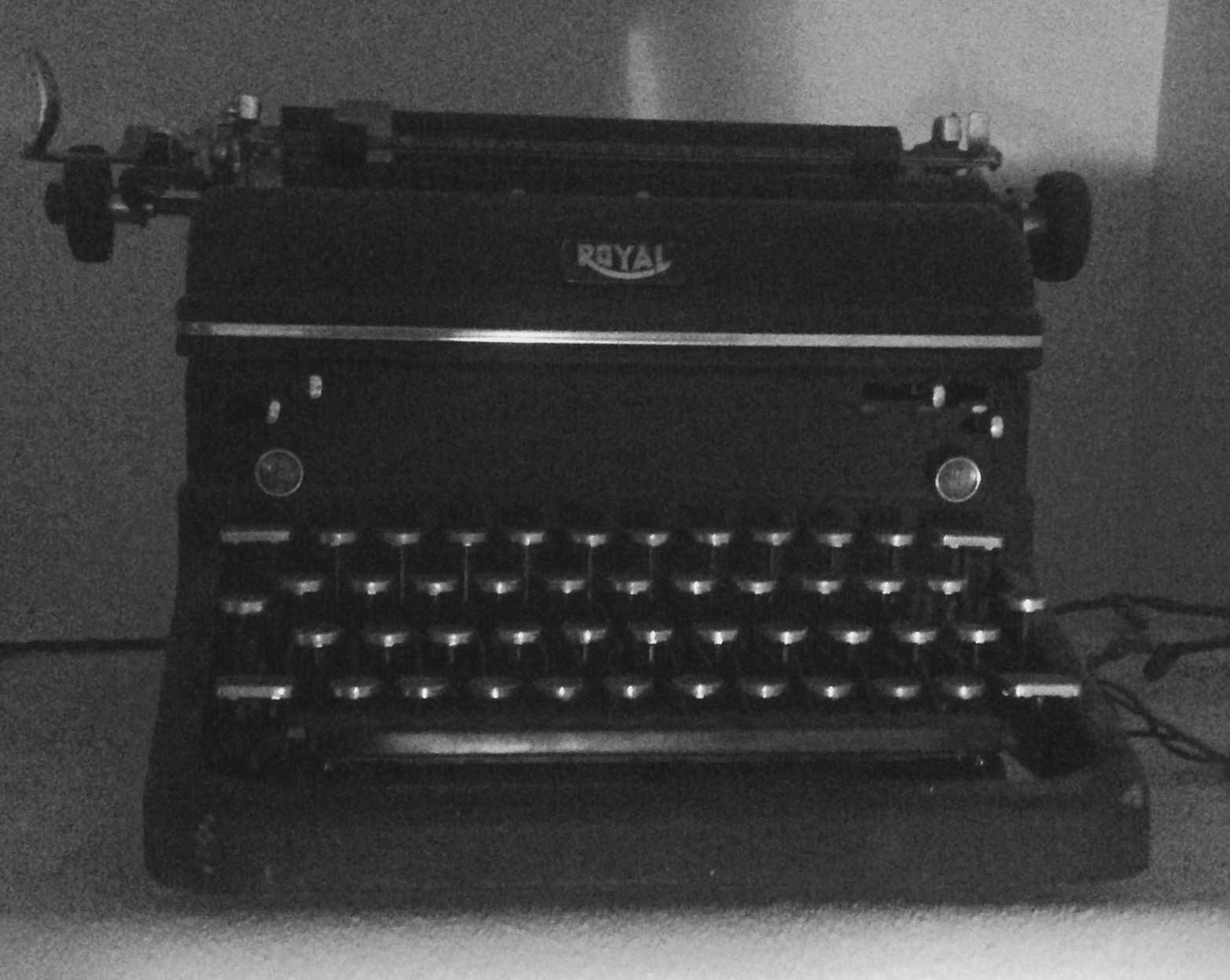
I’d like to become a writer. But I don’t know how.
Write.
Well, yeah, of course. But, how to I learn what kind of stories people will want to read?
Write.
Okay, got that. But, how do I become better at figuring out what degree of detail to include in a blog post?
Write.
Right! Got that. I’m asking for some advice on the process of how to become a better writer. I realize it’s a journey, I just was hoping you could help me figure out how to get from here to there.
Write
Arggg!
I published my first book in 1993. I was a coauthor on the WordPerfect 6.0 Superbook

This was the first book I had published, but it was not the first book I wrote. I wrote a book called WordPerfect Library Guide. Library was a product that included several DOS based utilities and a Shell program. (Sometimes You Just Get Lucky.) You won’t find the WordPerfect Library Guide online. It only existed on my hard drive. It shares a lot in common with my most recent book attempt, Microsoft Server 2012 Administration Fundamentals. And it’s not a happy association they share.
The conversation I quoted at the beginning is one that every writer has had. It sounds trite to answer nearly every question with the same answer, and it’s a slight exaggeration, but at its heart, it’s true: writers write. It’s what we do. If you only want to be a writer, but you don’t write, then you are not a writer. (But, you are in very good company!)
The difference between a writer and an author is that both write, but an author has actually had something published. When I started writing 20 years ago, that meant you had to convince a publisher. The beauty of technical writing is that you get paid in advance. With fiction, especially as a new author you have to write first, then get paid. . .hopefully.
Today, with the proliferation of self-publishing possibilities, the line between writer and author becomes more blurred. My friend Howard Tayler (www.schlockmercenary.com) self publishes. He sells thousands of books. He’s an author. I have friends who self publish and they’ve sold 5 copies. . all to family members. They are . . . less successful authors.
In my own writing, I’ve been inspired by several influences. First was my grandmother, Venda Castleberry. She was a writer, an English teacher, and pushed me to always get better. She took up writing late in life, and had the misfortune to be just starting to break into writing TV scripts when a writers strike hit Hollywood. She has published some items of Mormon literature. But, her life convinced me that it’s never too late to start a writing career.
Next, Ben Bova inspired me. Ben and I were friends years ago. He once told me,
I never had writers block. I couldn’t afford it. If I didn’t write, we didn’t eat.
I have not had the courage to put my family into a situation where my writing needed to support us. However, what I took from this statement was the idea that what many call writers block is something you can push through. Ben also told the story of going on a cruise with a bunch of writers.
Walking down the hallway at night you could hear the clicky-clak of everyone pecking away on their typewriters, except for Isaac Asimov’s door. Because Asimov wrote 10,000 words per day by hand.
I don’t approach Asimov’s output, but, this blog has convinced me that I can write content. Each entry is between 600 and 1200 words. There are over 416 posts. That’s more than 200,000 words. Generating content is not a problem. At least not when I get to pick my topic. (More on that in a minute.)
Finally, the western writer Louis L’Amour inspires me. His autobiography said,
I think of myself in the oral tradition–as a troubadour, a village tale-teller, the man in the shadows of a campfire.
Part of the reason I started writing this blog was to put down in words some of the crazy events that have happened over my years in IT. And over the last couple of years, I’ve found myself focused more on the story and less on the business lesson to be learned. From L’Amour I learned that it’s okay to want to tell stories. The world likes storytellers.
One of the other pieces of advice I got from reading Louis L’Amour was his comments on the writing process.
I could sit in the middle of Sunset Boulevard and write with my typewriter on my knees, temperamental I am not.
I’m not the writer that L’Amour was, of course, but I always admired that quote from him, because I wasn’t sure I could do it. There are many more people want to have written than want to write.
I wasn’t sure I could stick to a writing schedule. Patton Oswald remarked,
A lot of screenwriters are working on page 7 before they switch over to check facebook and quit.
I was worried that would be me. Since I started posting daily updates back in March of 2013, I haven’t miss a day. Not every entry has been Shakespeare, but I’ve been able to write. I’ve discovered that like L’Amour, I can write on the side of a road. I can write on airplanes. I can write in hotel rooms. I can write on camping trips. I can write a buffer so that I can be gone for a hiking trip and still update. I can write when I’m too tired to keep my eyes open. More than once I’ve fallen asleep on my keyboard and woken up to a screen full of
zzzzzzzzzzzzzzzzzzzzzzzzzzzzzzzzzzzzzzzzzzzzzzzzzzzzzzzzzzzzzzzzzzzzzzzzzzzzzzzzzzzzzzzzzzzzzzzzzzzzzzzzzzzzzzzzzzzzzzzzzzzzzzzzzzzzzzzzzzzzzzzzzzzzzzzzzzzzzzzzzzzzzzzzzzzzzzzzzzzzzzzzzzzzzzzzzzzzzzzzzzzzzzzzzzzzzzzzzzzzzzzzzzzzzzzzzzzzzzzzzzzzzzzzzzzzzzzzzzzzzzzzzzzzzzzzzzzzzzzzzzzzzzzzzzzzzzzzzzzzzzzzzzzzzzzzzzzzzzzzzzzzzzzzzzzzzzzzzzzzzzzzzzzzzzzzzzzzzzzzzzzzzzzzzzzzzzzzzzzzzzzzzzzzzzzzzzzzzzzzzzzzzzzzzzzzzzzzzzzzzzzzzzzzzzzzzzzzzzzzzzzzzzzzzzzzzzzzzzzzzzzzzzzzzzzzzzzzzzzzzzzzzzzzzzzzzzzzzzz
But, not every writing project has been successful. I’ve failed miserably at two of them.
First, my very first book. I was so excited to get a contract, that I didn’t really worry about discussing the focus of the book with the editor. I wrote every night. I wrote about 40 hours per week and had a fulltime job at WordPerfect. I actually finished writing the book. And then, the editor actually looked at it. I didn’t realize they should have been looking at it all through the writing process. If they had, they should have stopped me quickly from writing a reference book when what they wanted was a tutorial.
Okay, no big deal. All authors occasionally get sideways with their editors. But, the publisher then sent me the most demoralizing letter I had ever received. I didn’t keep a copy, but it basically told me that I was a terrible writer. That no amount of editing would fix my prose. That I should go learn how to write by taking a college course before I ever attempted to do something like this again. Well, let me tell you, after reading that letter there was no danger of me ever wanting to try it again.
Fortunately, I had a really, really good agent. She assured me that I was not a horrible writer. And she would know. She had many world famous authors that she represented. She assured me that the editor that wrote that was doing it to save their own job. They were expected to deliver a book that was no longer going to be published. They had to blame me for that.
It was a great learning experience, and a great introduction to the cutthroat world of publishing. But, to this day I will never buy a book published by Que Publishing.
Most recently I attempted a book on Microsoft Windows Server. I used to work for Microsoft. My most popular book was a book about a Microsoft product. I set up a home lab and discovered that while I could write. I had lost the knack for technical writing. I had a very patient editor who worked closely with me, but I finally had to admit one day that I just couldn’t write this book. It was a heartbreaking realization.
And it really confused me. Because all through the process I was writing this blog every day. I would sit down to write about business and the words would flow. Switch to technical documentation and it would dry up.
The weakness, I think, goes back to something I referenced at the beginning of this column. I let my technical writing skills lapse as I pursued other opportunities. And it is not just like riding a bicycle. At least it’s not for me. I have to train myself back into the habit of writing.
And I’ll end where I began. If you want to be a writer, the most valuable advice you will ever receive on how to accomplish it is write!
Rodney M Bliss is an author, columnist and IT Consultant. His blog updates every weekday at 7:00 AM Mountain Time. He lives in Pleasant Grove, UT with his lovely wife, thirteen children and one grandchild.
Follow him on
Twitter (@rodneymbliss)
Facebook (www.facebook.com/rbliss)
LinkedIn (www.LinkedIn.com/in/rbliss)
or email him at rbliss at msn dot com
Tell your friends about this!

I work in IT. We are the ones who get asked to make the microphone work and then get sent out of the ballroom before the speech starts.
We setup the fiberoptic light display and then don’t get invited to the party.
So Y2K was a BIG deal for us. The Year 2000 problem was a software problem where computers that could only store two digits for the year couldn’t tell the difference between 1900 and 2000. In the early days of software, computer memory was very precious. You wrote programs to use absolutely as little as possible. It took twice as much RAM memory to store 1900 than it did to store 00. And 40 years ago there wasn’t much concern about the problems that it would introduce at the turn of the century.
Eventually, we, the IT community were able to convince you, the rest of the world that this was a very big problem. One that needed to be fixed. We convinced all of you of this by explaining that if we didn’t fix it
– Airplanes would fall from the sky
– Nuclear power plants could melt down
– Elevators would stop between floors and never open
– The sun would refuse to shed it’s light on the earth if the problem wasn’t fixed
Okay, that last one wasn’t an ACTUAL Y2K problem. But, us IT guys realized that the rest of you needed us. You REALLY needed us and for once we were not only going to set up for the party, we would be invited to attend.
It was a great time to be in IT. The two or three years leading up to December 31, 1999 were great. How often do you get to go back and fix a mistake from your past? We had that opportunity. IT budgets ballooned. Programmers, project managers, testers, quality assurance folks. All across the board, everyone was hiring.
It’s estimated the Y2K preparations cost $300 BILLION dollars. But, we assured you that it was going to be worth it. We promised that we would keep the planes flying. We would keep the elevators working. The lifesaving medical equipment wouldn’t stop working at midnight.
We promised you a lot of things. But, we also knew we could deliver on those promises.
The big night finally arrived. We were nervous. Of course, we knew our fixes would work. We had tested by resetting the clocks on our test computers to 11:59 December 31, 1999 multiple times until we got it right. Our biggest worry was
What if we missed something?
We knew the systems we’d patched were going to work, but what if we missed a critical system? It was on every programmer’s mind that night as the clock wound down.
Interestingly, we also knew that Jan 1, 2000 was not the start of the new millennium. Hey, we lived and breathed number systems. We understood that the calendar system started with year 1 instead of year 0, and therefore you wouldn’t get to 2000 years until January 1st, 2001. But, we stopped explaining that fact to people when they threatened to un-invite us from the cool New Year’s Eve parties.
As the ball dropped in Time Square and the calendar rolled over, we all held our breath. (No, we didn’t kiss someone. We were geeks at the cool kids party. we didn’t have dates!) And the lights stayed on. The airplanes kept flying. The medical devices stayed on. And we all breathed a sigh of relief, congratulated one another and lined up at the snack table to get some champagne, or sparkling grape juice depending on our preferences.

And it was right then that the problems started. We started getting some snide looks from the other people at the party.
Hey, Rodney, I thought you said that awful things were going to happen at midnight. Looks pretty normal to me.
Well, we fixed it. That’s why nothing broke. Cool huh?
No, you didn’t think it was cool. In fact, people started to feel like maybe the IT guys had pulled a $300 billion dollar con.
But, seriously ‘the worst bug in history’ and NOTHING broke? Really?
Yeah. We’ve spent three years making sure we found every last little system that might break. We are really good at our jobs. It’s awesome that we managed to find them all!
Nope. You didn’t think it was awesome either. You felt like we’d duped you. No matter how much we tried to explain that the emperor really did have clothes, you insisted he was actually naked the whole time.
We’d gotten new computers, new systems, tons of overtime. (We’re salaried so we don’t really get overtime, but you still accused us of overbilling.)
I was working for Microsoft in 1999. I’ve often thought about how Y2K truly was the IT crowd’s finest hour. We proved that given enough time and money we could fix a computer issue that was buried so deeply in critical systems that it made brain surgery look simple.
And yet, at the time when we felt we should have been hailed as heroes for literally saving the planet, we were branded as shysters and conmen. We quickly got uninvited from the cool parties. We went back to our cubicles and returned to being geeks and nerds.
But for one glorious moment, we were kings of the world.
Rodney M Bliss is an author, columnist and IT Consultant. His blog updates every weekday at 7:00 AM Mountain Time. He lives in Pleasant Grove, UT with his lovely wife, thirteen children and one grandchild.
Follow him on
Twitter (@rodneymbliss)
Facebook (www.facebook.com/rbliss)
LinkedIn (www.LinkedIn.com/in/rbliss)
or email him at rbliss at msn dot com
Tell your friends about this!
Health?
Wealth?
Fame?
I know what I want. I want my project to be successful. I want to lose another 10 lbs. I want to get the dings in my car has fixed. I want a raise. I want to fix our oven that broke last week. I want to learn to play the guitar.
I also know what I REALLY want. I really want to pay off my house. I really want to do a good job at work. I really want my daughter to graduate from college. I really want my kids to stop fighting. I really want get the cracked living room window fixed.
I also know what I really, REALLY want. I really, really want to have enough money to retire. I really, really want my wife to have good health. I really, really want to publish a book this year. I really, really want to pass the classes I signed up for. I really, really want my children to grow up with good morals and to become successful adults. I really, really want to be able to help my neighbors and those less fortunate.
These were easy. But, what do I really, really, REALLY want? Three “reallys” asks, “what am I willing to sacrifice for?” What am I willing to keep as a goal for years even when it looks like I’m not getting any closer? Really, really, really means it’s one of my two or three overriding goals.
My friend Howard Tayler did an “Ask Me Anything” on Reddit. Howard really, really, really wanted to be a professional cartoonist.
Howard and I have known each other for 20 years. We’ve been friends for slightly less than that. For more than a decade he has known exactly what he wanted to do. And he went out and did it.
My friend Kevin and I have been friends since high school. Kevin really, really, really wanted to run a Television studio. He not only runs the studio, he runs a “group” of TV studios.
I’m not sure I’ve wanted something that much. Both Howard and Kevin put their minds to their goals and dedicated a good portion of their lives to achieving them. Both are absolutely delighted in their current jobs.
In some ways it’s depressing. Seriously, talking to them, they know what they want. . and as far as careers go, they got it.
I know I’ve really, really, really wanted things in the past. I really, really, REALLY wanted to marry my wife. It took me asking twice, and several months of serious courting, and several years of knowing each other. But, I really, really, really wanted it. I am absolutely delighted with the person I married. We celebrate 27 years this December.
I really, really, REALLY wanted to be a father. When you adopt kids, you go through a slightly different emotional journey than when children are born to you. Not better, not worse, just different. With each of my adopted kids, there was a point at which it was in doubt whether we would be allowed to adopt them. I really, really, REALLY wanted it. I’m absolutely delighted that I get to be a father to this Bliss Bunch.
I really, really, REALLY wanted to earn my Project Manager Professional certification. The truth is, I’d been out of work for over a year. We had gone through the severance pay. Our health benefits would soon run out. I was desperate for a job that would pay what we needed to support my family. The PMP led directly to me getting the job I have now. I like my job, and I am absolutely delighted that I get to put PMP after my name.
But, what now? What are the big goals? The multi-year goal that I’m willing to sacrifice to achieve?
I could define my goals “negatively.” I really, really, REALLY never want to move my kids into a barn again. (Starting Over At 40) I really, really, REALLY never want my kids to have to deal with abuse.
But, those aren’t really goals. They are simply things I want to avoid.
I think I settled on three.
I really, really, REALLY want to finish my degree. I spent years studying Computer Science at BYU, but quit school to go to work at WordPerfect (Back To Where It All Began)
I really, really, REALLY want to be a professional author. Part of the reason I write here every weekday, is that I enjoy the idea of sharing stories with you guys. When I first started blogging a friend asked, “Are you going to run out things to write about?” Well, it’s closing in on two years and my topics list is longer than when I started. However, I also believe that you have to practice. This is my writing practice. I’ve learned that I can write on a plane. I can write in a hotel room. I can write sitting on the side of the road waiting for a tow truck.
I’m still working on putting together my 16 Management Rules That Make No Sense. I’ll let you know when I get closer.
I really, really, really want to have a job where I sell me. I don’t yet know what that looks like. An author? A storyteller? A consultant? A lecturer? An artist? When I started this blog in 2012 I had a goal in mind. Remember I was unemployed at the time. In the IT world we call it “self” employed.
I went out and did a google search on my name. I think I was the 5th or 6th entry. And it was for a book I’d written nearly 20 years earlier. (Microsoft Exchange Connectivity Guide) The goal with the blog was to build an online reputation. In IT if you are looking for a job, you can bet that anyone you interview with is going to google you. I wanted them to see what I had done lately. There was a realtor named Rodney A Bliss who lives back east. His website was the first entry.
Today if you google Rodney Bliss, I’m number 1 and 2. The realtor is number 3 and then I’m the next four. If you google “Rodney M Bliss,” I’m the entire front page.
None of my really, really, REALLY wants are tied to money (I want enough to get by and not go into debt), fame (I enjoy it, but I have 13 of the best fans I could every want.) Health? Maybe a little. No one wants to suffer. But, I’m comfortable with my mortality. We are all going to return to the dust someday. The prospect doesn’t scare me.
What do YOU really, really, REALLY want? Are there dreams that you don’t even give yourself permission to have?
Rodney M Bliss is an author, columnist and IT Consultant. His blog updates every weekday at 7:00 AM Mountain Time. He lives in Pleasant Grove, UT with his lovely wife, thirteen children and one grandchild.
Follow him on
Twitter (@rodneymbliss)
Facebook (www.facebook.com/rbliss)
LinkedIn (www.LinkedIn.com/in/rbliss)
or email him at rbliss at msn dot com
Tell your friends about this!
Well, boys, why don’t you pick out a spot for . . .
You can’t camp here.
What do you mean? This is our assigned campsite.
You’ve got 6 boys, I’ve got 22. The lower campsites are closed because of problem with the bathrooms. We’re camping in this spot.
Well, we could maybe share if you . . .
That’s not going to work. Our troop is going to need all the spots. You have to go find another spot.
Just because the Scout Law says “a scout is friendly” doesn’t mean the other troop’s Scoutmaster is going to be.
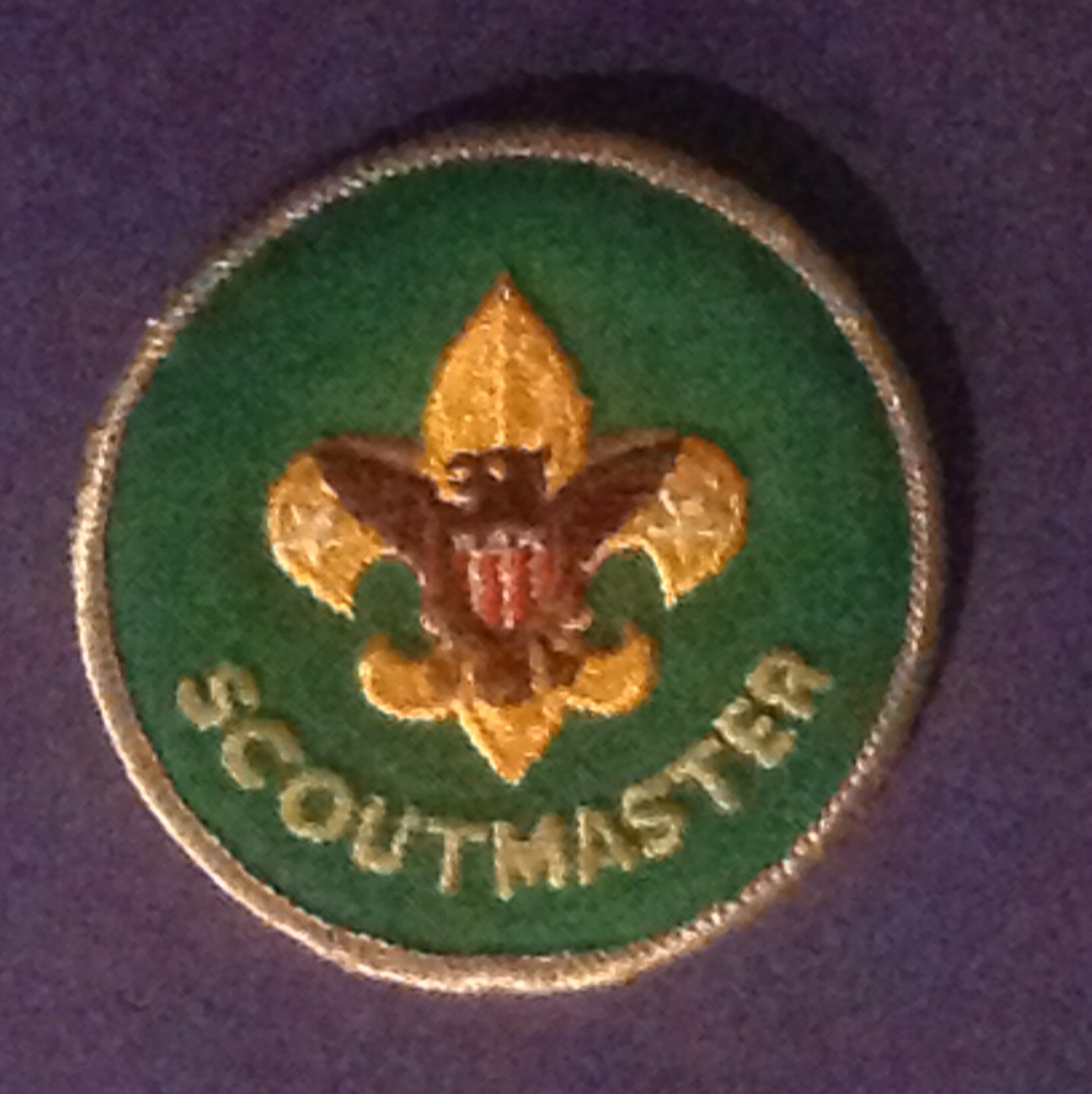
We ended up pitching our tents in between the vehicles. With six boys, we only had a couple tents. Two of my sons were sleeping in the tent with me. So, we made do.
But, I have to admit, I was less than charitable in my feelings for the Scoutmaster of troop 832. Fortunately, I didn’t have to interact with him again. . .or so I thought.
Let’s face it, you are going to have to work with some jerks in your life. I’m not talking about engineers and programmers with low social skills. Those I can deal with. (Why I Like Prima Donnas) But, some people just rub you the wrong way.
While working on the WordPerfect SWAT team, we had engineers that covered every product that WordPerfect sold. I was one of the email engineers (How I Saved The EPA (Don’t Tell Pete)) Edward was a network engineer. That’s odd because WordPerfect didn’t make a network. But, there were some unique aspects of running WordPerfect on a network back in the 1990’s. Edward and Rob were the Network guys. Rob was very cool. Edward was a jerk.
Maybe he was only a jerk to me. Maybe he felt threatened by my role as one of the founding members of the team. Maybe he was just a negative person. The problem was that the team manager loved him. Not in a weird way, but the manager thought Rob and especially Edward could do no wrong. We called them his “Golden Boys.” It didn’t help that the manager hated me. (My Manager From Hell)
I remember one time I was working on an issue where a customer reported that occasionally one of his employees’ computer would lock up. But, only when it was running the WordPerfect Office program. (Different than the Microsoft Office program of the same name. . .yeah, it was confusing for us too.) Edward was positive the issue was corruption on their network. If it was, then the client would need to talk to their network provider, not us. As I was preparing to fly out to see them Edward approached me.
Rodney, tell them the problem is they have a bad network setup and they need to have Novell look at it.
Well, it could be something unique to how Office interacts with the driver. .
NO! Tell them it’s a NetWare problem and they need to engage with Novell.
Uh huh. Right.
We did some fairly intensive workstation testing and discovered a problem with their network interface card, that only seemed to be exposed when our email client sent big files to the network.
Edward never really forgave me for being right. And frankly I didn’t care. He was part of the reason that a couple years later I left for Microsoft. (How Not To Quit A Job.)
The point was that I could simply ignore him. Would it have been better to work through our differences? Sure. And it would be better if we all quit eating ice cream and exercised more. To this day, he’s one of the few people that I would immediately turn down if he were applying to our company.
Ignore those negative people and move on.
And that brings me back to the rude Scoutmaster. A few months after this campout we bought a house and moved across town. (They’re Stealing My Stuff.)
My new neighbors came out to help us unload the truck. . .including the rude scoutmaster. Maybe you’re thinking I could still ignore him. Turns out he lived directly across the street. He had kids the same age as my boys. And more importantly, I wanted to be involved in the scouting program. It’s impossible to be involved in the scouting program and not interact with the scoutmaster.
Yep, in religion you call that a need to repent. I set out to make him my friend. It wasn’t excessively hard. I discovered his personality is kind of rough. But, that he’s a great neighbor.
And eventually we talked about that campout. And it was then that I finally understood. In our little troop we had 6 boys, three of whom were my sons. Getting the troop to change direction was as simple as saying,
Okay, guys. Not that way. Let’s try this way!
Keeping track of 6 boys is not all that tough.
My neighbor had a troop of 22 boys. Getting 22 boys to do anything in a timely manner was an exercise in herding cats. The other scoutmaster didn’t have the luxury of changing plans on the fly. What I didn’t know was that his 22 boys hadn’t driven to the campsite high in the Wasatch range that day as we did. They had hiked up Rock Canyon. And then found out that their assigned campsite was closed. And the boys were all exhausted. The scoutmaster did what he felt he needed to take care of the boys.
We laugh about it now. We’ve been on numerous campouts together. And he really is a great neighbor. In fact, although he was a bit of jerk, I’m really glad we moved.
Rodney M Bliss is an author, columnist and IT Consultant. His blog updates every weekday at 7:00 AM Mountain Time. He lives in Pleasant Grove, UT with his lovely wife, thirteen children and one grandchild.
Follow him on
Twitter (@rodneymbliss)
Facebook (www.facebook.com/rbliss)
LinkedIn (www.LinkedIn.com/in/rbliss)
or email him at rbliss at msn dot com
Tell your friends about this!
The Americans have need of the telephone, but we do not. We have plenty of messenger boys. — Sir William Preece, chief engineer of the British Post Office, 1876.
The telephone didn’t get off to a roaring start. Western Union turned it down. They were perfectly content with their telegraph. And as the quote above shows, the British weren’t very impressed either.
If you think about it, the telephone had a bit of a chicken and egg problem. Why get a phone if none of your friends have phones? But, your friends won’t get a phone if you don’t have one.
BTW, for the younger readers I’m talking about the old phones. The ones that were attached to the wall and didn’t do texting, or email, or have a clock or apps, or even make a very good flashlight. (Book Review: Exploding The Phone.)
Of course, eventually the telphone caught on and today Who Doesn’t Have A Cell Phone?
I was working for Microsoft. This meant that my mother’s CPA firm had a built in source for software and support. I didn’t always advise she upgrade. (Breaking Out Of The Upgrade Cycle.) My speciality was Microsoft Exchange. And much to my chagrin, my mother’s office didn’t have email. This was about 1998. The internet was just starting to get it’s sea legs.
Mom, you should let me install Microsoft Exchange email for your office.
Why would we even want that?
Well, you can schedule client appointments in the Scheduler program and avoid conflicts.
Everyone maintains their own schedule and has a office. We don’t really have conflicts.
Well, you can send messages. And if you aren’t here to get the message it will go to your inbox and you can read it the next time you come in.
We don’t need that. We have plenty of pink Message slips.
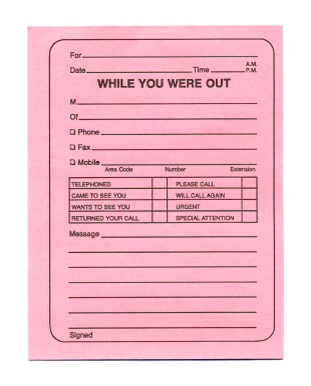
(Photo credit: One Woman’s Eye)
How do you argue with logic like that? The secretary would take messages and then tape the pink messages slips to people’s office door. Ironically, my mother’s firm was one of the more aggressive at adopting technology. She had a network very early on. She saw the advantage of centralized storage. Her firm was one of the first in the small town of Olympia, WA to go completely digital. Everything went into the computer. The network let every accountant have access to all the records. Later, she was one of the first to push her clients to file electronically.
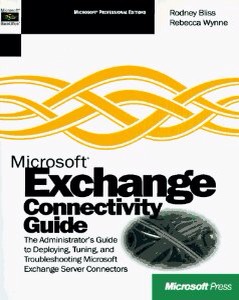
The idea that she was being a Luddite about email was maddening. Especially since I was an email expert. I not only worked for Microsoft writing courseware about Microsoft Exchange, I’d written one of the first books on Exchange. (Microsoft Exchange Connectivity Guide.)
But, how to convince her that she really needed a tool that she didn’t think she wanted?
Tell you what, Mom. You’re tired of me hounding you about email. Here’s a deal. You let me setup an Exchange server and put all your accountants on it and if they don’t like it after a month, I’ll come take it out and not bug you about it again.
Deal.
Well, I’m sure you know how that conversation went a month later.
It’s been 30 days. Did you want me to remove the Exchange server?
If you do, the staff threatened to quit.
Which ones?
All of them.
I can’t take great credit as a salesman. The software was free. I cannot imagine how much more difficult the conversation would have been had I asked her to pay several thousand dollars to test my deal.
Rodney M Bliss is an author, columnist and IT Consultant. His blog updates every weekday at 7:00 AM Mountain Time. He lives in Pleasant Grove, UT with his lovely wife, thirteen children and one grandchild.
Follow him on
Twitter (@rodneymbliss)
Facebook (www.facebook.com/rbliss)
LinkedIn (www.LinkedIn.com/in/rbliss)
or email him at rbliss at msn dot com
Tell your friends about this!


Do you realize that these requirements introduce a lot of security risks?
Yes, but. . .
How do we even know that the client is going to need physical devices?
Well. . .
I mean could they use an emulator instead of an actual device?
Ah. . .
And how often will they need to access each device. I’m not sure we even know enough to start building their solution. There are A LOT of unknowns.
What do you do when the client asks you for something you don’t necessarily want to build? We had built an environment for our client that was pretty locked down.
– 24 Hour security
– 100% camera coverage including all entrances and every desk
– A one strike policy on cell phones. Bring it on the floor one time and yred
– Turnstiles that prevented “passback.” Meaning, once the system knew you were “inside,” your badge could not be allowed to gain access until you went “outside”
– No paper
– No pens
– No laptops
– No thumbdrives
– Frosted windows on the ground floor.
– Multiple card readers to get in and no line of sight from outside the production area
– No internet access
– 100% of calls were recorded
I worked for Microsoft for nearly a decade and we didn’t have anything approaching this level of security even in our most sensitive areas. My current employer took security very seriously. Our agents had access to credit card data, insurance information, pretty much anything you would need to steal someone’s identify.
The call floor was a secure as we could make it.
And now, the client wanted us to take on a new line of business supporting their mobile customers and provide our agents for this new line with
– Cell phones
– Laptops
– iPads
– Nooks
– Kindles
– Multiple computers
It was a security officers worst nightmare. The client wasn’t much help. This was the first time they were outsourcing their work to a 3rd party provider. They could tell us what hadn’t worked for them, but they were less helpful on what would work.
We had multiple internal meetings. It wasn’t necessarily IT vs security, but as the IT project manager, I was trying to figure out how to provide the service the client wanted, and security was trying to protect corporate ass-ets; ours and theirs.
The executives had already signed a contract and they were looking to us to figure out how to fulfill it. Unfortunately the more meetings we had the more scenarios security came up with for how someone could use these tools to steal member information. We were getting further from our goal not closer. And we had a deadline for providing our client with a technical proposal.
Project Managers have an interesting role. No one reports to us, but from the client view-point, we own the technical solution. And yet, I couldn’t build it myself.
Look guys. We could speculate all day on how they might use these tools.
And we have to answer those questions before we can proceed, Rodney.
No. No we don’t. The fact is we will never understand the role until we actually start taking calls. So, we can pool our ignorance and try to guess on an answer, or we can do exactly what they asked us.
What do you mean?
I mean that the contract says we put these items on the production floor. We make whatever security restrictions we can, but ultimately we do what the contract asked us to do.
But, the security. .
Right. Put it down in a document and we provide it to the client along with our proposal. It’s called a Risk Register. We get them to sign off on the risks. What we cannot do is keep delaying because we want to have perfect clarity before we make a move.
Your job as a consultant or a project manager is to provide the best advice possible to the client. However, once the client makes a decision, sometimes you have to actually give them what they have asked for.
Rodney M Bliss is an author, columnist and IT Consultant. His blog updates every weekday at 7:00 AM Mountain Time. He lives in Pleasant Grove, UT with his lovely wife, thirteen children and one grandchild.
Follow him on
Twitter (@rodneymbliss)
Facebook (www.facebook.com/rbliss)
LinkedIn (www.LinkedIn.com/in/rbliss)
or email him at rbliss at msn dot com
Tell your friends about this!

(Photo Credit: U2)
I’m sure it seemed like a good idea at the time. After all, U2 is a legendary band. And who doesn’t like free?
It turns out a lot of people don’t.
By now you’ve seen the U2 album in your iTunes application. Apple decided that you wanted it. They gave it to you. . .it’s like a gift. Why wouldn’t you want a gift?
Partly because if I have to take something, it’s not a gift. It’s more like a fee or a tax. But, worse is what that 500,000,000 “giveaway” does to the struggling artist, or writer, or musician. It kills them.
You might ask:
How does U2 giving away an album hurt anyone?
Because it reinforces the idea that music, especially online music, is not worth paying for. Why should I buy albums when I can download them off of Youtube? Why should I buy books if I can access them from www.gutenberg.org? If a picture is posted on the internet doesn’t that mean that anyone can freely copy it? (Not really.)
U2, regardless of the quality of their music, has reinforced the idea that digital rights do not apply.
I can see you now, saying:
Rodney, I think you’re overreacting about a simple launch promotion.
Think about this. If you go on iTunes and buy the newest Brad Paisley album, Moonshine In the Trunk, are you allowed to burn those tracks to a CD and hand them out to your friends? Of course not. You can make your own “archive” copy, but that’s it. Why? Because you paid for it.
Now, imagine you have a friend who doesn’t have an iTunes account. Odd, I know. Maybe think of a grandparent or something. Can you burn the new U2 album to a CD and hand it to your grandma?
See the problem?
If I never paid for it. If none of us paid for it, then it’s not really possible to pirate it. Of course, you can make a copy for grandma. And if you can burn U2 to a CD and give it away, why can’t you do that with your other iTunes songs? Does the U2 album include clever “share freely” stickers that are missing from the other albums? Nope.
Now, you might ask,
Rodney, why do you care?
I’m glad you asked.
I care because I am a content creator, and I have friends who are content creators. U2 can afford to give away an album. (The reported $100,000,000 from Apple means U2 isn’t exactly coming out on the short end of the stick.) But, most artists cannot afford to give their music away for free. I have a sister-in-law who is a professional photographer. She deals with piracy all the time. No, pictures on the internet are not free to copy.
Someone recently asked me if I worry about people plagiarizing my blog posts. Seriously? No. I don’t. I love and appreciate you readers, but if someone wants to take my writings and spread them around? It’s why we write.
On the other hand, I’m completely scrupulous when I post a picture. I always include a link to where it came from. Sometimes that’s the content owner, sometimes it’s someone who lifted the picture from elsewhere. Regardless, I know it isn’t mine.
U2 is helping the pirates.
Today is September 19th. It is the official Talk Like a Pirate day. I’ll leave it to you if that pirate would say
Arggh, Me hearties. More rum!
or
Can you copy the new Brad Paisley album for me?
Rodney M Bliss is an author, columnist and IT Consultant. His blog updates every weekday at 7:00 AM Mountain Time. He lives in Pleasant Grove, UT with his lovely wife, thirteen children and one grandchild.
Follow him on
Twitter (@rodneymbliss)
Facebook (www.facebook.com/rbliss)
LinkedIn (www.LinkedIn.com/in/rbliss)
or email him at rbliss at msn dot com
Tell your friends about this!
Hey, Rod, why don’t we go to lunch next week?
Sure, Dad. That sounds great.
It wasn’t. I loved my Dad. He’s been gone about 5 years and I still miss him. But, none of his kids wanted to “go to lunch” with him.
Oh we did at first. . .before we learned.
Food is a strange ritual. We are not all that much different than our ancestors who would “break bread.” Meals become a ritual as well as a source of nourishment. Food has never been that important to me. (You Don’t Get To Pick Anymore.)
Last week I was in Richmond, Virginia. I arrived on Sunday. The rest of the team didn’t arrive until Tuesday. Monday night I was on my own for dinner. I found a local comedy club (Bottoms Up Pizza.) The Pizza was outstanding. The comedy was mixed, but everyone was enthusiastic. The comics invited me to come out to the shows for the rest of the week at various other locations.
Watching comedy is not for everyone. Tuesday night was going to be a business dinner. It wasn’t scheduled, or on anyone’s calendar as such, but with our management team in town and important clients in town, there was no way we weren’t going to dinner.
The executives left Wednesday afternoon and Wednesday night I was back trolling comedy clubs. Actually it was a bar, but a really cool bar called McCormacks.
While working for Microsoft I had a manager once whom I really didn’t get along with. (Finally Putting Down The Rock.) We both knew I was leaving his team one way or another. I dropped a comment that I really hadn’t intended to say.
You should really watch who you end up going to lunch with.
What do you mean?
The only team member you ever go to lunch with is Morgan. And she just happened to get stack ranked #1? Ahead of your senior engineers?
He had no idea. She was the one who did the inviting to lunch. There was nothing improper about it. The lunches were always very professional and above board, but he didn’t realize that Morgan was using the lunches as a way to sell him on her contributions to the team.
And to her credit, it worked. The #1 stack ranking probably netted her several thousands of dollars. It also protected her in the event of the team downsizing. You take the people at the bottom of the stack rank (like me in that case) first.
Prearranged lunches with Dad were always an opportunity for him to tell you what he thought you were screwing up on. Sometimes it was very personal. Often it was completely uncalled for. My brothers and sister eventually figured out that an invitation to lunch was the adult equivalent of a trip out behind the woodshed.
Like my clueless manager, my Dad may not have even realized he was using them that way. He didn’t want to have that talk at his house because it would be awkward. We didn’t have it at my house because he would feel at a disadvantage. So, the talks were held in a public place over soup and sandwiches. . .which eventually lost any appealing taste.
Eventually I quit accepting. I love my Dad and I knew he only wanted what was best for me, but it was hard for him to show it at times.
My adult daughter recently asked me to go to lunch. All of a sudden I was right back to being the child and fearing a tongue lashing. Did she have something negative to tell me? Was she angry about something? Was her marriage okay?
Why would she want to go to lunch with me!?!?
Turns out, she wanted to go to lunch so that she could see me and give me a chance to play with my granddaughter. No hidden agenda. No ulterior motive.
Sometimes a meal actually is about the food and company.
Rodney M Bliss is an author, columnist and IT Consultant. His blog updates every weekday at 7:00 AM Mountain Time. He lives in Pleasant Grove, UT with his lovely wife, thirteen children and one grandchild.
Follow him on
Twitter (@rodneymbliss)
Facebook (www.facebook.com/rbliss)
LinkedIn (www.LinkedIn.com/in/rbliss)
or email him at rbliss at msn dot com
Tell your friends about this!
I’ll see you next week, right?
You will? Where?
In Richmond.
Why?
Aren’t you still coming out for the launch?
Right. The launch. . . what line of business are we launching?
I started a new job about six months. Actually it was exactly six months ago today, March 17th. The original job posting was for a product manager. My job is to work with one of our biggest clients. I’m a dedicated PM. That means that when the client travels to one of our call centers so do I.
That’s not exactly how it was presented. The original posting didn’t mention travel. I asked about travel more out of habit than anything.
Probably not more than 5%.
I thought maybe an occasional conference. Maybe a trip to Texas to meet the client. There are 2080 work hours in year. (40 hours per week times 52 weeks.) Five percent is 104. I love my job. I like my boss, but he totally lied to me about that travel commitment.
In the past six months I’ve been to:
Texas: Twice
Richmond, VA: Three or four times (I honestly don’t remember which.)
In the next six months I’m scheduled to go to:
Texas: Once
Richmond: Three times
Louisville, KY: Three or four times
Flying isn’t as fun as it once was. Every trip involves at least once layover. Security is annoyingly invasive. The seats are so close together that the “sardine can” analogy is more true than not.
However, flying represents some unique opportunities. I’ve met with my company president in informal brainstorming sessions. I’ve had to make on-the-fly decisions that fortunately turned out to be right, but would have been passed through some layers of management if I weren’t at a remote site. And there is really no substitute for meeting people in the same room.
Being there in person changes people from a just a voice on the phone to real people. You can work with real people. A voice on the phone has no real substance.
So, I’ll keep packing my kit, shoving my overstuffed bag into the overhead bin.
I travel because I have a job. And having a job is much better than the alternative.
Rodney M Bliss is an author, columnist and IT Consultant. His blog updates every weekday at 7:00 AM Mountain Time. He lives in Pleasant Grove, UT with his lovely wife, thirteen children and one grandchild.
Follow him on
Twitter (@rodneymbliss)
Facebook (www.facebook.com/rbliss)
LinkedIn (www.LinkedIn.com/in/rbliss)
or email him at rbliss at msn dot com