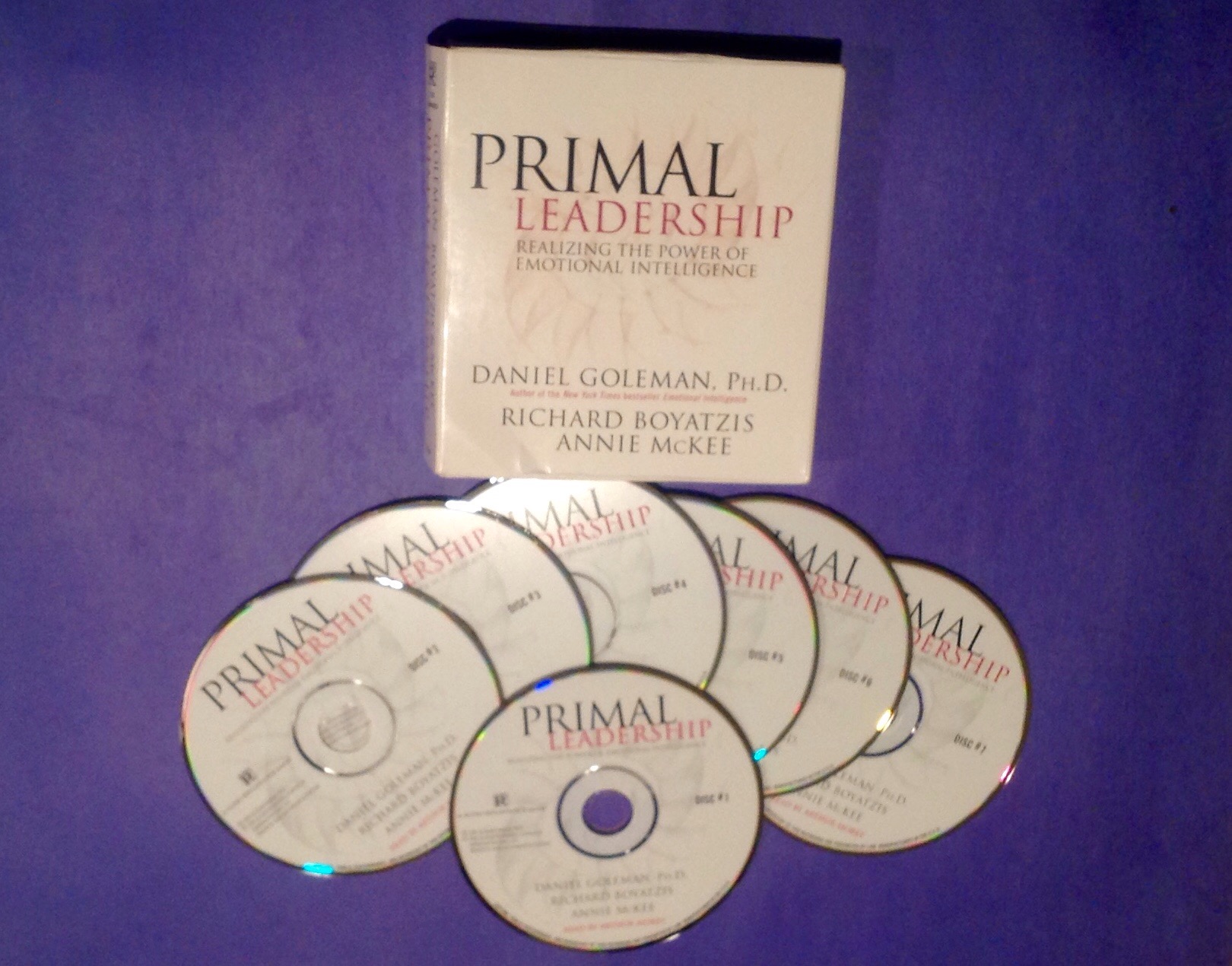
I wasn’t sure what to expect by Primal Leadership. The title sounds like a description of tribal leadership, or “What we can learn about leadership from primates.” It was written by a group of researchers under the direction of Daniel Goleman, author of the New York Times Bestseller Emotional Intelligence. And that’s really where Primal Leadership picks up from. The subtitle is “Realizing the power of emotional intelligence.”
In their case they are using “Primal” to mean basic, or fundamental. The researchers focus on how a leader’s emotional intelligence affects a team or a company. They go through the various leadership types; the coach, the hard charging sales pacesetter, the visionary and more. Each leadership style has it’s own place and purpose. At times a group needs a visionary. At other times a team needs a pacesetter. The authors spend a lot of time explaining the advantages and disadvantages of each style.
I tried something new with this book review. I listened to the book on CD. I commute about 90 minutes per day, 45 minutes each way. I thought I would hate it. I really like music. I’m the only person in the USA who still buys CDs. In my car right now I have the latest Brad Paisley CD, the latest Miranda Lambert, and the latest Toby Keith.
But, a funny thing happened, I didn’t hate it. I kind of enjoyed it. I found myself lingering in my car in the driveway as the voice actor, Arthur Morey finished up a point. The downside is that a made a trip right in the middle. And it was hard to come back two weeks later and pick up where I left off. Also, I’m a very visual learner, and especially when the text makes a series of points that all relate to each other, it was challenging to hold the entire list in my head going 75 mph.
Anyway, on to what it means for you.
What I Liked
They authors gave practical suggestions. The book unfolded in such a way that it was easy to figure out which of the six styles you identified with. Then, they took you through the process of identifying your strengths and weaknesses. And if you are a particular leadership style and had been frustrated in the past in certain leadership scenarios, you now have the knowledge necessary to both identify the problem and make changes. The book was both validating and an impulse to change.
What I Didn’t
The authors are obviously very educated in their fields. At times I felt like the book was directed at their peers rather than at me. They spent way too much time talking about the portion of the brain that controls different impulses or desires. It was all fine and dandy if I had bought a book on how the brain works. But, in a leadership book, I just wanted the author to get through the medical mumbo jumbo and get back to talking about leadership.
What It Means To You
This is a great book to help you become more aware of your own leadership style. It can help you to recognize these leadership styles in those you work with. And if your manager has a particular style, “Primal Leadership” will help you to better know how to interact with him.
***
Three out of five stars.
Rodney M Bliss is an author, columnist and IT Consultant. His blog updates every weekday at 7:00 AM Mountain Time. He lives in Pleasant Grove, UT with his lovely wife, thirteen children and one grandchild.
Follow him on
Twitter (@rodneymbliss)
Facebook (www.facebook.com/rbliss)
LinkedIn (www.LinkedIn.com/in/rbliss)
or email him at rbliss at msn dot com
Tell your friends about this!

There’s an old joke about a Congressman trying to reduce the budget,
It has come to my attention that there are thousands of cattle guards in the West. I propose that these people be retrained for more productive professions.
If you are reading this somewhere outside of the American West you may not understand why the Congressman’s comment was funny.
This is a cattle guard.
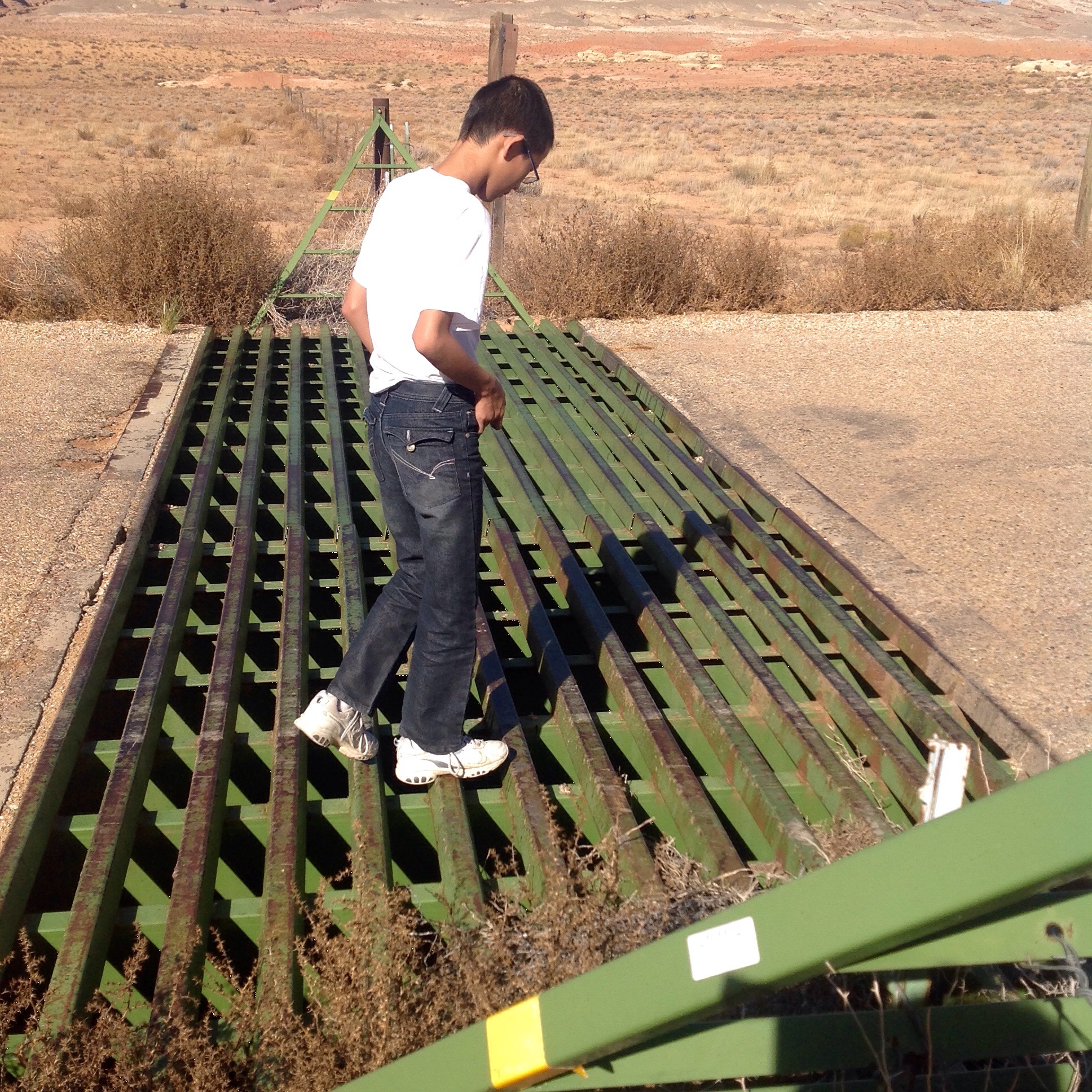
Not the boy, that’s my son. What he’s standing on is a cattle guard. A cattle guard is designed to stop cows from escaping a location by walking down the road. It’s common in the West for cattle to be allowed to graze on an open range. Last weekend I was at The Valley of the Goblins in Southern Utah.
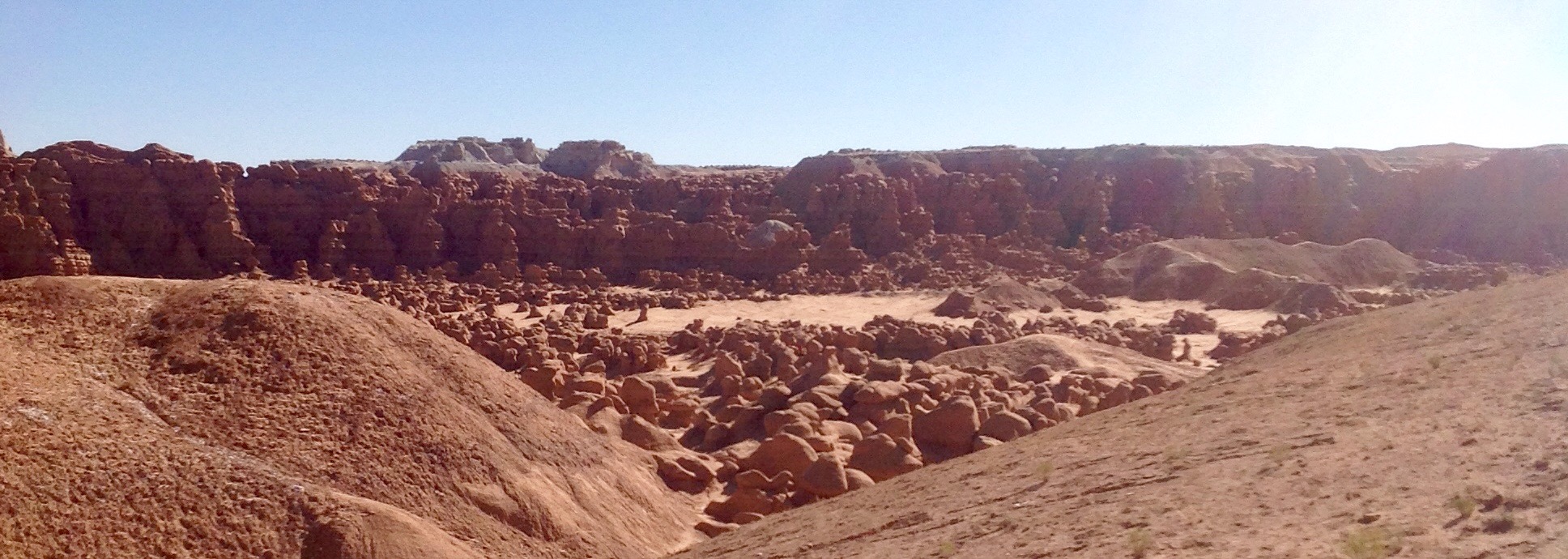
The state park sells grazing rights to local ranchers. We ended up driving through an area where we might come around a corner to find a cow in the road. If a 2000 lbs cow wants to stand in the road there is very little you can do to move her. It would be prohibitively expensive to fence along each side of all the roads through the park, so they fence the exterior. But, how do you allow the cars to go in and out without also allowing the cows to escape? You could put in a gate, but that requires people to stop, get out of the car open the gate, drive through, stop, get out and close the gate. And if they don’t close the gate, your cattle get out. The solution?
Cattle guards
Using a cattle guard, you can fence the exterior of the field and allow cars to freely drive in and out.
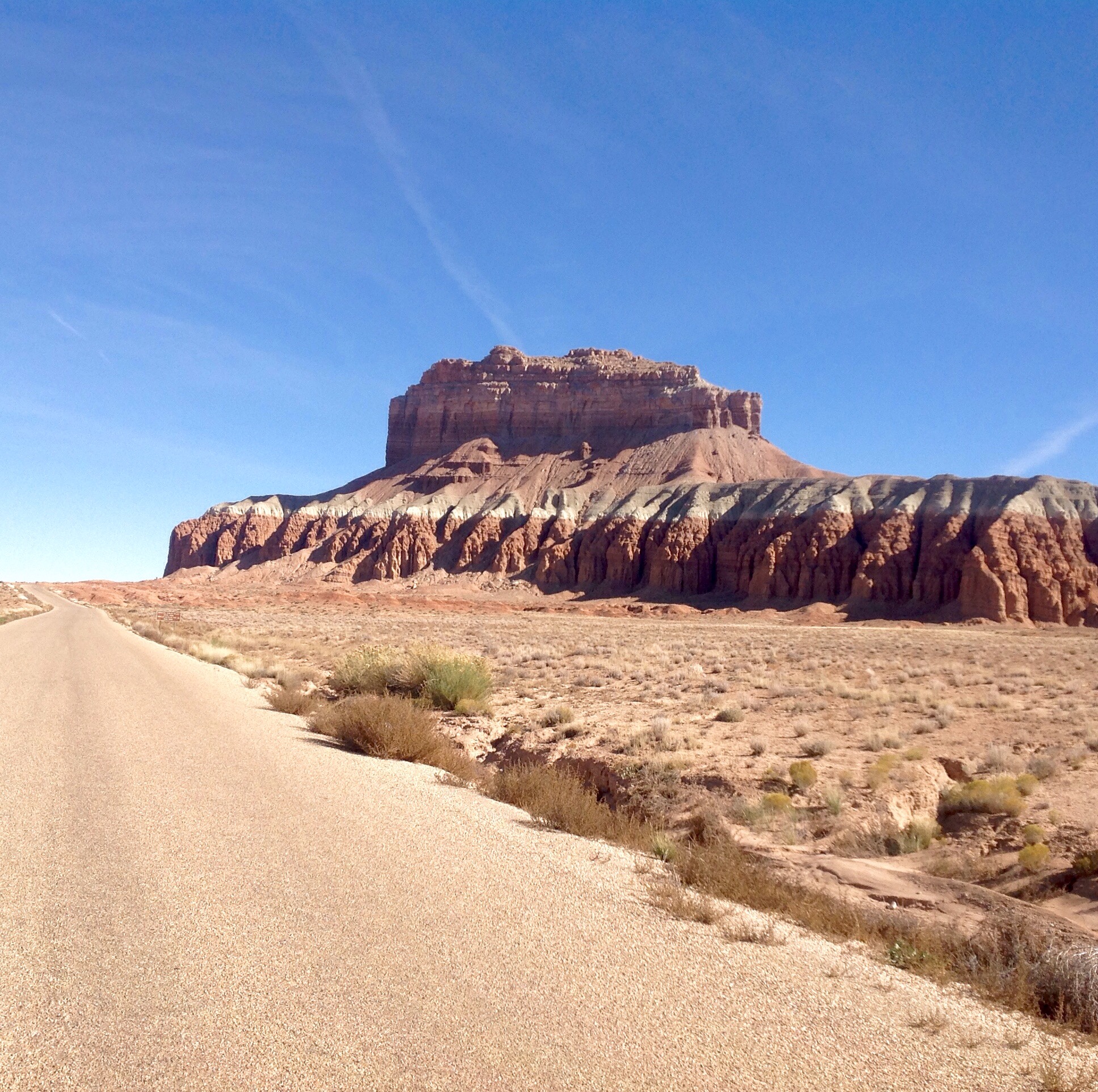
The science behind this simple solution relies on the fact that a cow cannot walk across this grate. What my son is doing so effortlessly is impossible for a cow. The cows will not even attempt it. What is surprising is that you don’t even need a real cattle guard to keep cows in. You can create a fake one with a little paint and it works just as well as a real one.
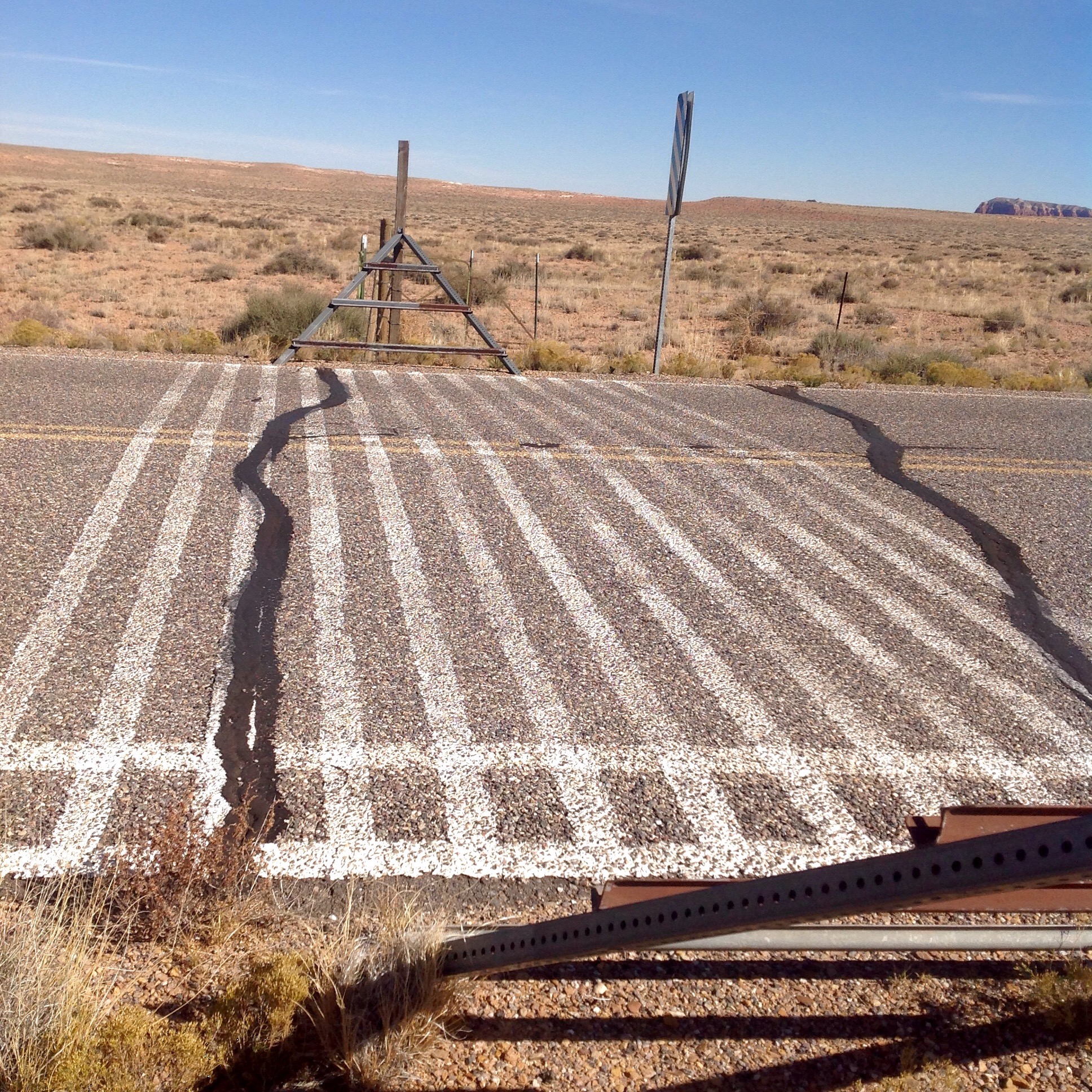
This is exactly what it appears to be, a painted cattle guard. The road is completely unbroken. Anyone or anything could walk across this with ease. That includes the cows. So, why is this just as effective as the large grate?
Perception
The cow cannot tell the difference between the actual grate and the painted one. Why not paint all the guards? Why bother with a physical guard at all?
Because it snows here. While it’s unlikely that ranchers will graze this as winter range, they might. Snow will hide the marks on the road. The large metal guard is at the perimeter of the park, the painted version is located by the ranger station for the campground, inside the park.
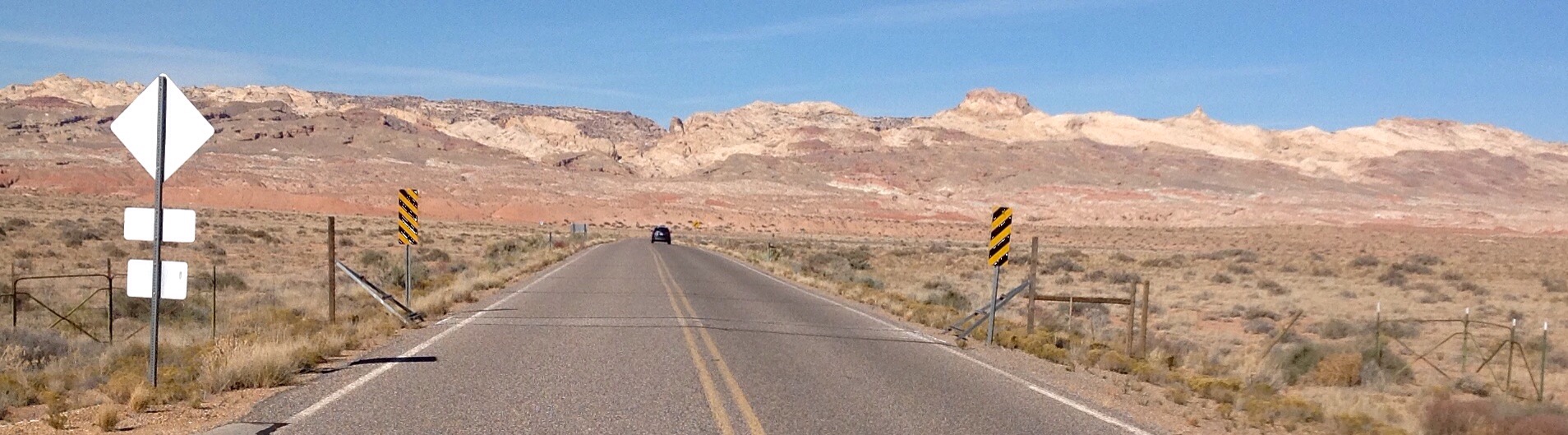
The cows physically cannot walk across the first cattle guard pictured, but it’s only their imagination that keeps them from walking across the painted version. It’s not a true impediment. It’s only the cows’ imagination, if cows can be thought to have imaginations, that keeps the cow bound by the second guard.
I’m sure you saw where I was going with this several paragraphs ago. We are like the cow. Occasionally there are true impediments to our success. I read a story on Reddit today about a guy who woke up at 46 years old and realized that he had wasted his life. He talked about the dreams he had at 20 of traveling the world and writing a novel. Now at 46 he hadn’t accomplished anything toward those goals in 20 years.
We all have goals from our youth that are unaccomplished, and some that could have never been accomplished. But, as I read the story of how this man had allowed his dreams to whither, I thought, “Why?”
Not, “Why did you let them whither,” but rather, “Why, now that you’ve recognized your life is not the life you wanted, aren’t you changing it?” Life goes on and drags us along for the ride. Will this man wake up at 72 and realize that he’s accomplished no more toward his goal in his 70’s than he had at 46?
But, we have true impediments. It’s unlikely that at 49 I’m going to become a professional musician, or a full time novelist. There is not enough time for me to put in the thousands of hours of practice to become a professional musician. I’m not sure the percentage of people who publish their first work of fiction after age 50 that go on to become full time novelists, but I’m guessing it’s pretty small.
However, that doesn’t mean that I need to be blocked by a painted cattle guard. I can write music. I can plink at the piano, as I’ve done. If I choose to devote time to it, I can take lessons that will help me get better. It’s not the destination that defines our lives, it’s the journey.
I can write. The odds of me becoming a full time novelist is low, but the odds of me writing a novel are only limited by my own restrictions. Am I afraid to step out on that cattle guard because it will actually stop me, or simply because I’m afraid it will?
My son is smarter than a cow. . . am I? Are you?
Over the coming weeks, you will see my attempts to cross that painted cattle guard. We all have limited time, and we each have all the time in the world. My dad used to tell me that I could do anything, but I couldn’t do everything.
Watch this space for more of anything.
Rodney M Bliss is an author, columnist and IT Consultant. His blog updates every weekday at 7:00 AM Mountain Time. He lives in Pleasant Grove, UT with his lovely wife, thirteen children and one grandchild.
Follow him on
Twitter (@rodneymbliss)
Facebook (www.facebook.com/rbliss)
LinkedIn (www.LinkedIn.com/in/rbliss)
or email him at rbliss at msn dot com
Tell your friends about this!
Hey Dave, how long to add a location field to the reservation program?
That’s simple. probably an hour.
Okay then.
It took two days.
But, that’s fine. I expected it. Programmers are eternal optimists. Project managers are eternal pessimists. So, the formula to translate a programmer estimate into an actual schedule was to double the estimate and then move to the next unit of measure.
1 hour == 2 Days
2 Days == 4 Weeks
1 Week == 2 Months
3 Months == You aren’t going to get it this year. . .and next year is looking iffy
Why are the estimates so far off? I think it has to do with two competing desires, both of which lead to underestimating.
I joke that anything I don’t know how to do must be easy (I Learned Management from Dilbert’s Pointy-Haired Boss.) Developers think the same thing. When you ask a programmer to do something you are issuing a challenge. Especially when it’s something new or unique. (How To Talk To A Programmer. . .And Get Results.) And once they work out the logic of it, the implementation is often an afterthought. I’ve seen actual programmer design documents that say,
And then the miracle occurs.
They assume they will be able to figure it out eventually. Eventually is almost always longer than they expected.
The second thing that blows up schedules is that programmers want the product to ship. They really do. They don’t want to say,
If I try to add this feature it’s going to delay our ship date.
Partly they don’t want to say that because they know the PM will cut the feature. And it’s a good feature. It’s something that they WANT to code. I’ve seen developers work a feature “off the clock” because they decided that they would just put in some long weekends to make their dates.
During the months leading up to Windows 95’s release, the product suffered one delay after another. Bill Gates was asked in a company meeting if now that he’s no longer coding, does he ever get tempted to try to “help.”
Yes, I do. I’ve been tempted to take the entire code base home and write it over a weekend.
They can’t help it. All programmers do it.
So, what’s a Project Manager to do? Run with it. Seriously, encourage it every chance you get. Why? Because as I pointed out above, your programmers will put in extra time to try to add features to your product. They will spend late nights and weekends trying to make their date. You know they are going to miss there delivery dates, but they don’t. And when they miss their original date, but come in under your buffered date, you will get your feature and not blow your schedule.
The thing to be careful of is never, never let them know your buffer. If the programmer tells you it will take a day and you budget 2 weeks, you will get your feature. If you tell the programmer, you’ve budgeted two weeks, he will think,
What feature can I add that takes 2 weeks?
And guess how long that new feature is going to take him to code?
Rodney M Bliss is an author, columnist and IT Consultant. His blog updates every weekday at 7:00 AM Mountain Time. He lives in Pleasant Grove, UT with his lovely wife, thirteen children and one grandchild.
Follow him on
Twitter (@rodneymbliss)
Facebook (www.facebook.com/rbliss)
LinkedIn (www.LinkedIn.com/in/rbliss)
or email him at rbliss at msn dot com
Tell your friends about this!
It was mind numbing work.
Step
Scoop
Step
Scoop
Repeat 500 times.
Yesterday was my last day in Louisville for the week. Today is the audit. While it’s happening I’ll be 35,000 feet headed home to Utah. We’re ready. Our team has been working round the clock for weeks getting ready. There’s always one more thing. My role was pretty simple. I was supposed to pick up the instruction books off the chairs.
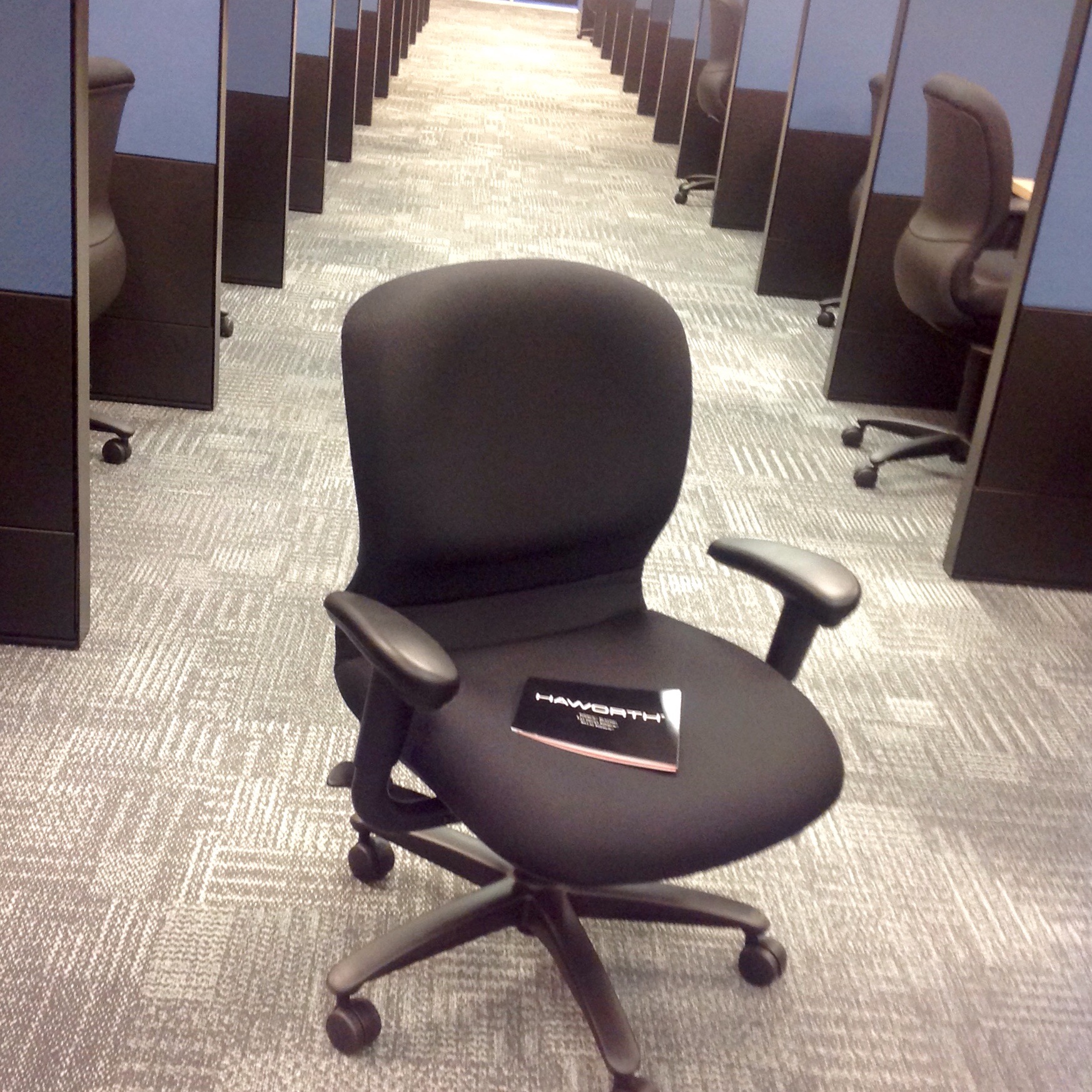
I picked up about 40 or 50 books before it occurred to me that I was picking up an instruction book for how to use a chair. I thought I already knew how to use a chair. I thought most people older than 5 knew how to use a chair.
I opened up the instruction book to see what hidden chair knowledge I might be missing. First they wanted to make sure that I understood what a chair looked like.
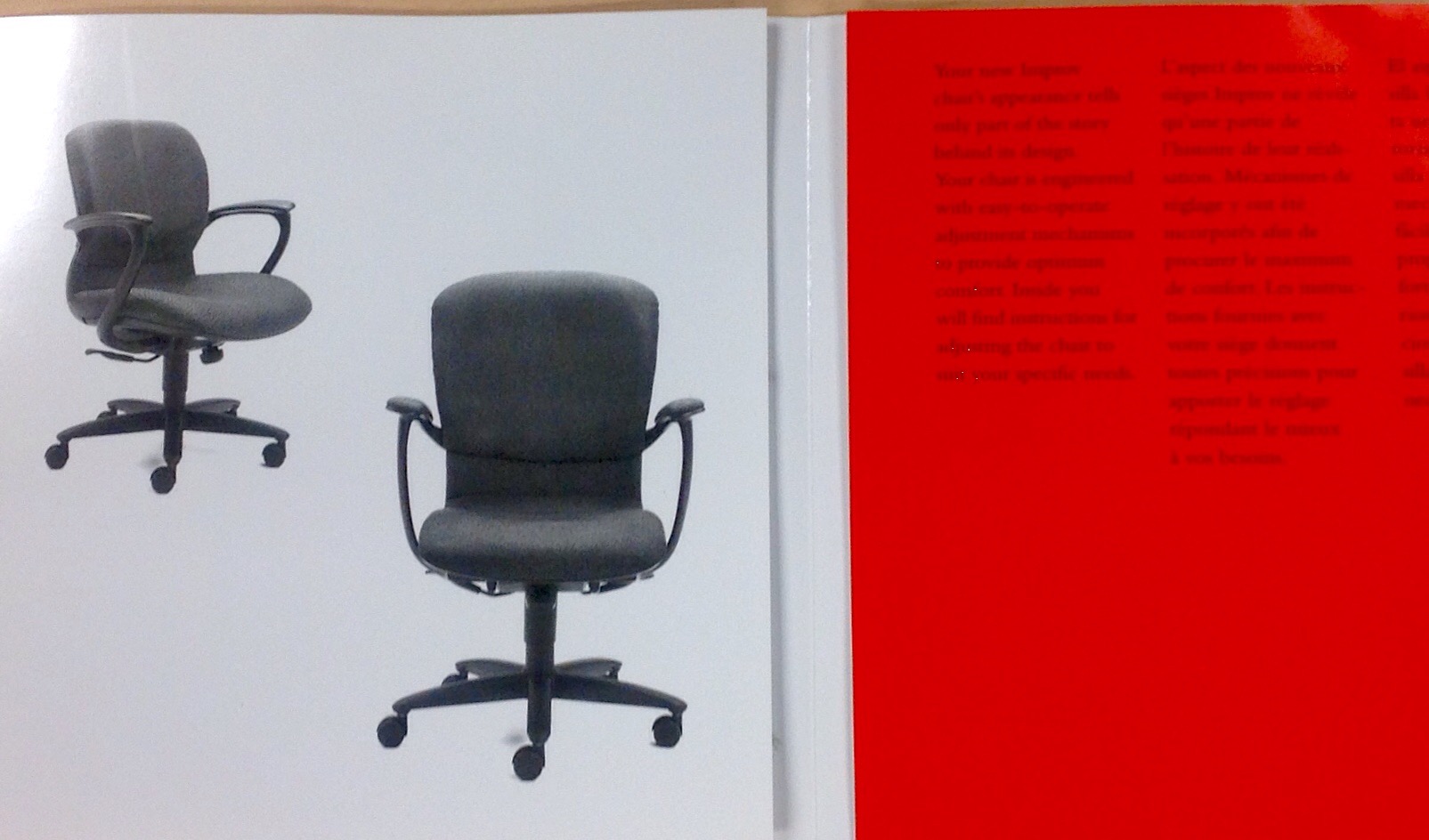
I appreciated the fact that they included two views, just in case I couldn’t recognize it from a single view. Open the instruction book up fully revealed pages and pages of diagrams and instructions.
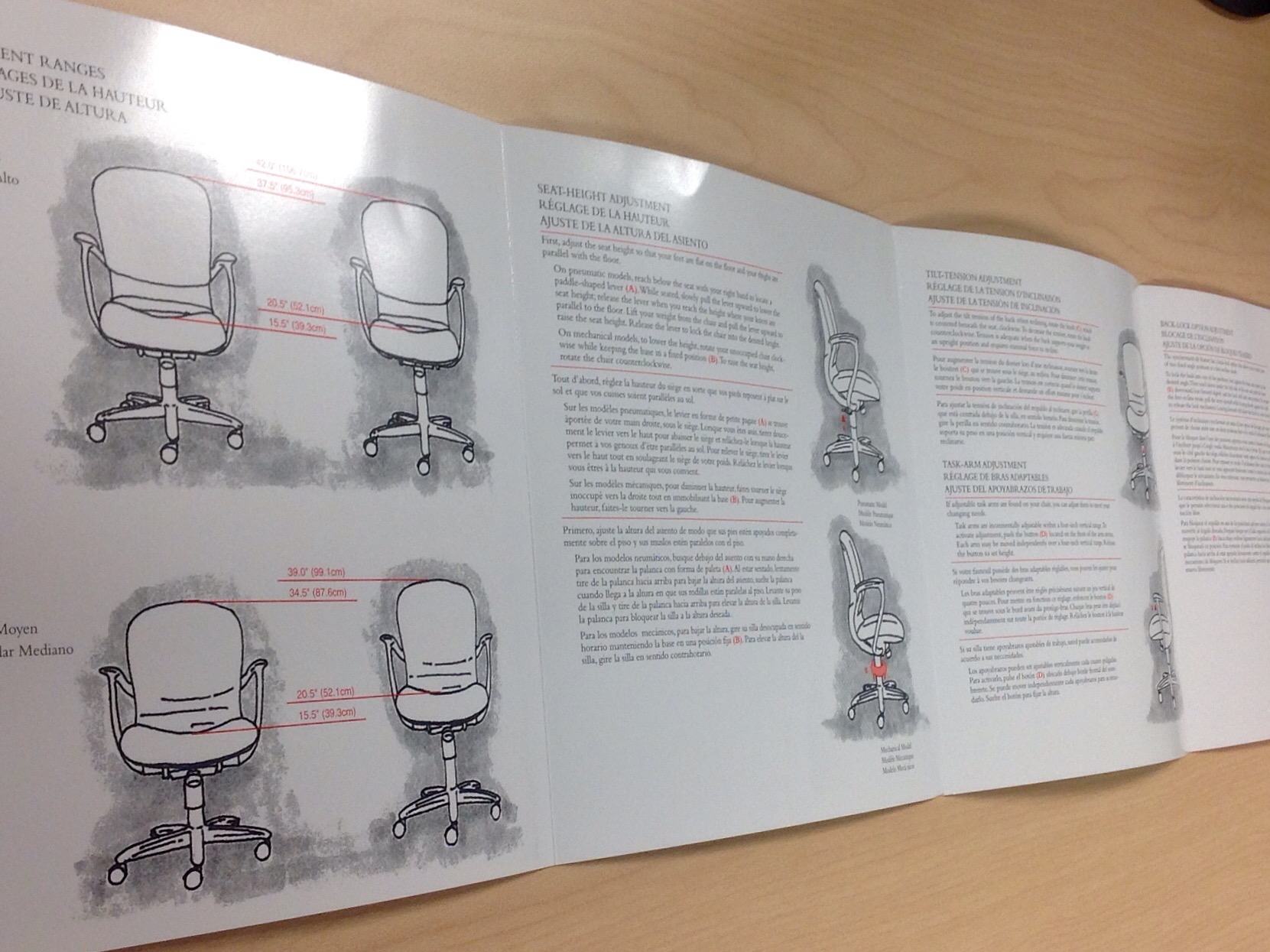
I had no idea. It was all very confusing. I understood very little. That could have been because I was reading the Spanish instructions. Eight pages and three different languages.
The back of the booklet provided care instructions.
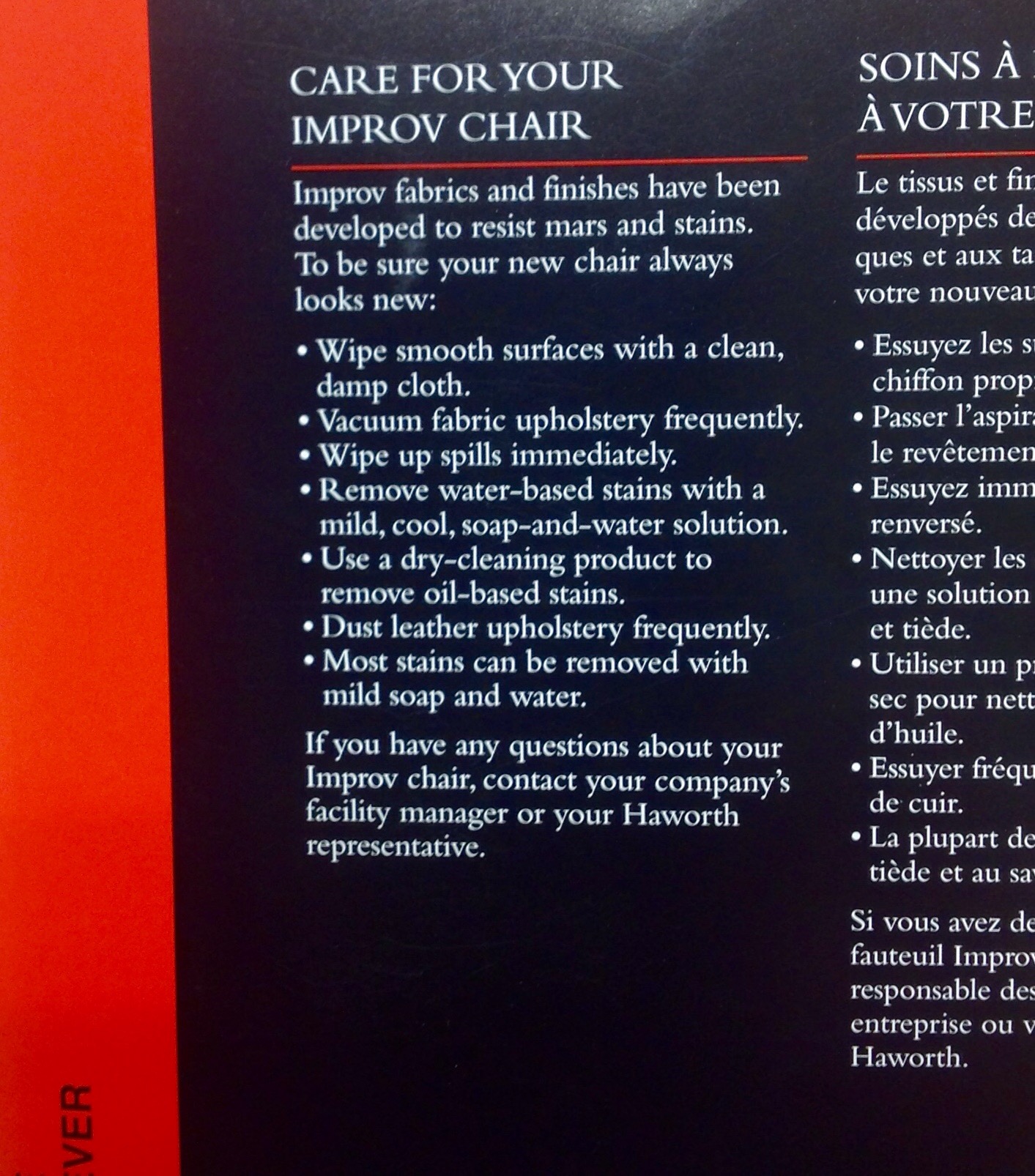
I thought the line about dry cleaning was especially interesting. Who owns dry cleaning products?
We got a good laugh out of it. However, on a more serious note, our call center has 500 seats in it.

That means not only did the Haworth company print an 8 page instruction book in 3 languages telling us how to use a chair. In our case, they gave us 500 of them. And it was all going to waste. We are not going to read a single one. A lot of trees went into making those 4000 pages of instruction on “chair mechanics 101.” At least if they had just printed them in English it would have only been 1333 wasted pages.
Think before you print. . .unless you are one of those who reads the instructions on use of a chair.
Rodney M Bliss is an author, columnist and IT Consultant. His blog updates every weekday at 7:00 AM Mountain Time. He lives in Pleasant Grove, UT with his lovely wife, thirteen children and one grandchild.
Follow him on
Twitter (@rodneymbliss)
Facebook (www.facebook.com/rbliss)
LinkedIn (www.LinkedIn.com/in/rbliss)
or email him at rbliss at msn dot com
Tell your friends about this!
I used to be a millionaire. There were a lot of us who used to be millionaires. I worked for Microsoft from 1994 to 2003. Those were the glory years. When I started at Microsoft the stock price was at the beginning of an incredible run. The price in today’s terms would be $3.14/share. Six years later, at it’s high point, the stock topped out at $58.72 in December of 1999.
I had a 401K heavily invested in Microsoft stock. I had thousands of stock options, many with a strike price in the single digits. I built a big house and thought that I had my financial house in order.
I didn’t.
The stock started falling at the beginning of 2000. A year later it was $23.22 in December, 2000. My options were “underwater” and worthless. I had to sell the house I could no longer afford, and the stock would take over a decade to claw it’s way back into the $40 dollar range.
I lost it all.
I not only lost all my Microsoft money, I eventually ended up broker than broke. (Starting Over At 40.)
But, this column is called “Survived.” And I did. Because it wasn’t about the money. It’s certainly important to have enough money to live. And there were a couple times where I fell below that line. But, that’s not the true measure of success.
During the time that Microsoft stock was in freefall, there were stories about people who had been merely foolish with their investments and those who had been downright stupid.
My mother was a licensed financial planner. She helped people make and keep lots of money. But, I was too smart for her. She told me to diversify. But, Microsoft was shooting up 20-30% per year. She was getting 10-15% returns. Why would I leave that 5%-15% on the table?
Why? Because when the market turned south, my mother’s clients lost a few percentage points. I lost it all. But, I ONLY lost it all. I was one of the merely foolish. There was another category of Microsoft employees who lost more than it all. Your broker will loan you money against your stock options. You can only borrow 50% of the value of your stock portfolio. A stock option isn’t a real thing. It’s only permission to buy stock at a particular price.
But, a few people treated their options like a bank account. They borrowed against it and just spent the money, vacation, fancy dinners, cars. When the stock tanked, the people who had borrowed against their options had a problem. They were way over leveraged. Their brokerage firm called in their note. The firm liquidated their holdings to pay their loan. The brokerage firm then went to the Microsoft people and said, “Your account value dropped so that you now owe us a bunch of money. We sold all your shares. And you owe the IRS lots of taxes.”
As I read about these people, I appreciated being merely foolish.
It’s tempting to look back on that time and think I blew a million dollars. I don’t do that. Not just because I’m by nature a positive person, but because I have “investments” from those days that no broker or stock market reversal can take.
I adopted 10 kids during this period. Adoptions are expensive. International adoptions even more so. I watch my kids growing up and I realize that not only did I survive the stock market crash of 2000, I thrived. The things I invested my money in can’t be measured in a spreadsheet. They are measured by seats at the dinner table. I lost a bunch of money, but I’ll make it back. Or, if I don’t it will be okay. Our best investments from those days pay off every day in hugs and kisses and cries of “Daddy’s home!”
Did I survive the crash? Ask the kids.
Rodney M Bliss is an author, columnist and IT Consultant. His blog updates every weekday at 7:00 AM Mountain Time. He lives in Pleasant Grove, UT with his lovely wife, thirteen children and one grandchild.
Follow him on
Twitter (@rodneymbliss)
Facebook (www.facebook.com/rbliss)
LinkedIn (www.LinkedIn.com/in/rbliss)
or email him at rbliss at msn dot com
Tell your friends about this!
I got this. Last time I was caught unprepared. This time I’m ready. I don’t want to hate Detroit. I don’t even spend much time there, but if I never have a connecting flight out of Detroit again, I’ll be happy.
A few weeks ago I ended up in Detroit at gate 22. I needed to leave from gate 78 twenty minutes later. (Cloud Computing. . Sort Of) I didn’t realize until I had walked from one end to the other that the Detroit terminal was a mile long. And I didn’t realize it had a train. Seriously, a train for a single building.
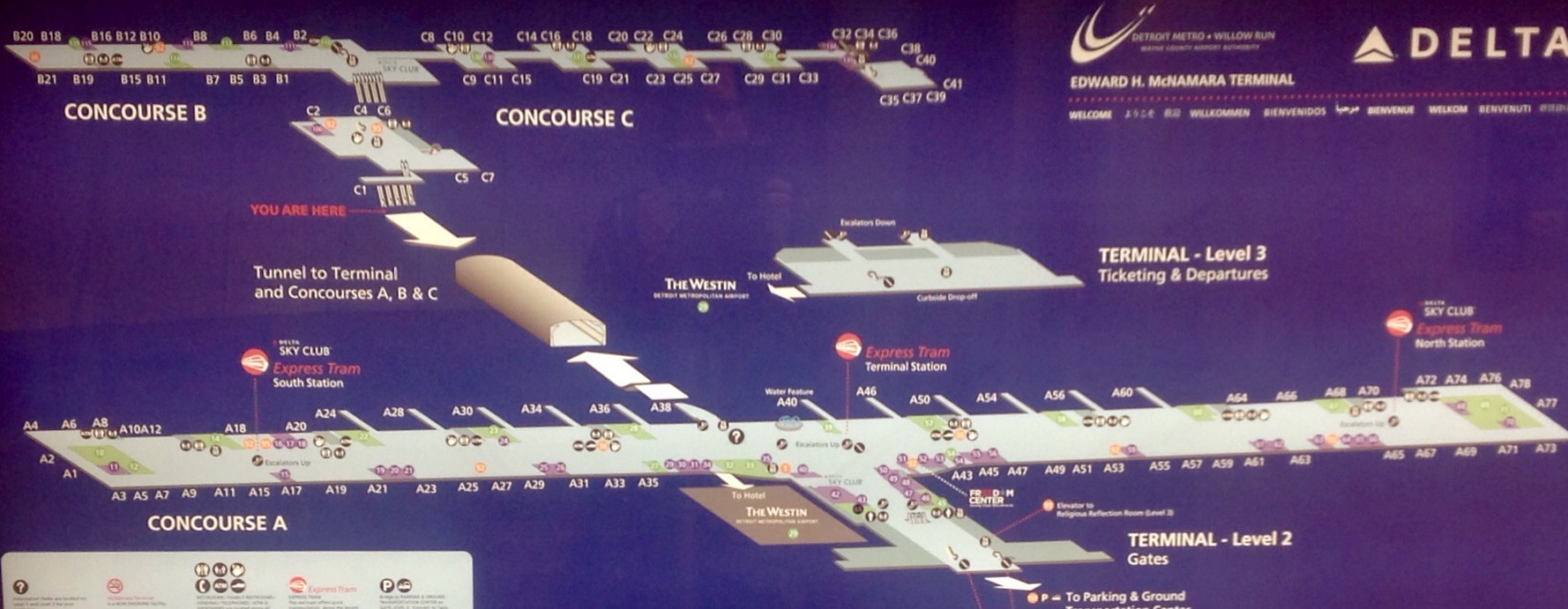
Anyway, I was headed back in Louisville this week and when I saw that I was routing through Detroit again, I figured I’d give the Motor City one more try. I admit I was annoyed last time. But, this time I knew about the train. And I didn’t think I was going to be as pressed for time.
As we touched down on a Sunday afternoon the captain announced we were arriving at gate A16. Being the experienced traveller that I was, I knew that A16 was even closer to the end of the terminal than I had been last time. I smiled smugly to myself. More time on the train.
I was happy as I walked off the plane. Really, I was. All the way up until I checked the departure boards. There was my flight, DL6164 headed to Louisville. Leaves at 3:30 from gate C15. Huh?
I didn’t even KNOW that Detroit’s airport had more than one terminal, and not just one more terminal, but two? I stumbled toward the train platform. And I started scanning for signs for the other terminals.
One stop.
That’s how far I got to ride that stupid train before I had to get off. Not surprisingly you get to Terminals B and C from the middle of Terminal A.
But, there will be a train surely. I mean if they have a train to haul people back and forth in a single terminal, there is surely going to be a train between terminals, right?
I wouldn’t think a building was even sentient, but this one was even playing mind games.
There was the sign for terminals B and C. It ominously pointed down. As underground tunnels go, it really was mildly pretty. You know what would have made it prettier? A TRAIN!


And after another mile walk the escalator brings me back out of the bowels of Detroit. . .or at least out of the bowels of the airport.
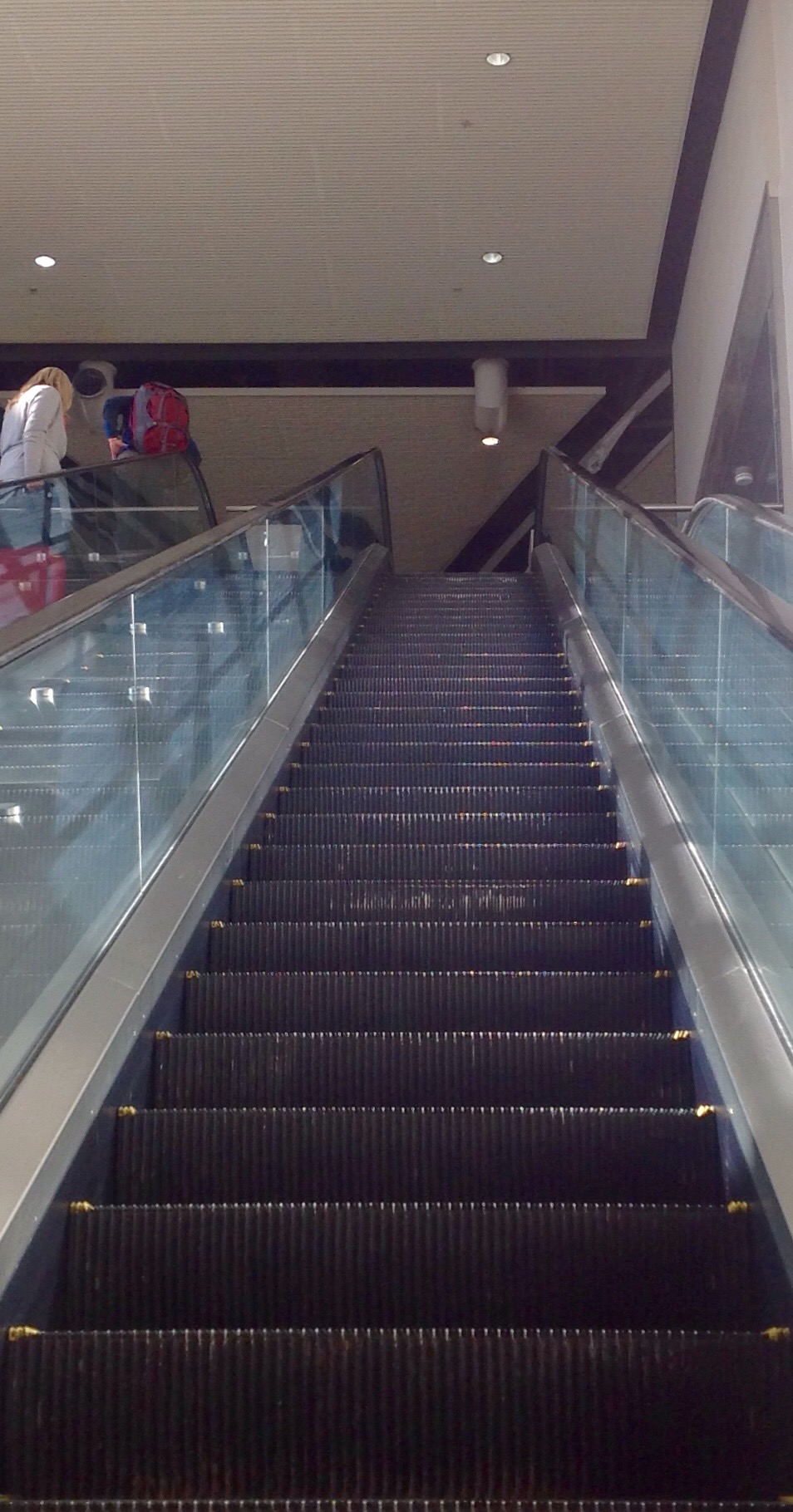
So, once again, the airport got me to exercise. This time I wasn’t pressed for time, but I still ended up walking farther than I had anticipated.
As the plane gathered speed for takeoff, the building seemed to be laughing at me.
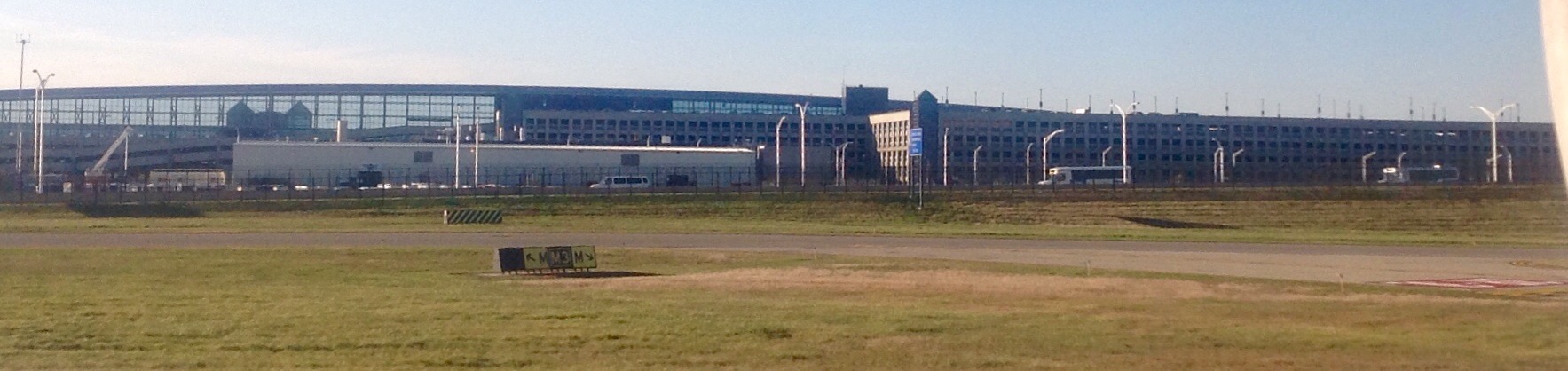
Well played Edward H. McNamara Terminal. Well played, and I think I hate you.
Rodney M Bliss is an author, columnist and IT Consultant. His blog updates every weekday at 7:00 AM Mountain Time. He lives in Pleasant Grove, UT with his lovely wife, thirteen children and one grandchild.
Follow him on
Twitter (@rodneymbliss)
Facebook (www.facebook.com/rbliss)
LinkedIn (www.LinkedIn.com/in/rbliss)
or email him at rbliss at msn dot com
Tell your friends about this!
Okay, try it now. Do you still get Page Not Found?
No. This time I get a login page.
Go ahead and try the login name and password I gave you.
Invalid name or password.
Okay, let me do some more checking.
I was pumped! I could barely contain my excitement. It was broken! Well, honestly, I wasn’t excited it was broken. I was excited that we could see that it was broken.
Do you ever get excited when something is broken? You should. That is if you are concerned about the journey as well as the destination. One of my favorite movies is “Captain Ron.” Kurt Russell plays an inept sailor hired by the Harvey family to help them get an antique boat from an island in the Caribbean to Miami. At one point, during a horrible storm he announces that they are nearing Puerto Rico.
How do you know this, Captain Ron?
Because when we left this morning, we had just enough fuel to reach San Juan. And we are OUT of fuel!
I sometimes feel like my projects follow a similar course.
As a project manager I track lots of issues. Tracking them isn’t as important as fixing them. And since there were rarely any issues that I could fix myself (The Day I Figured Out I Have No Skills), I was constantly asking other groups for help. And resolving this particular issue had been was worse than most. Our client needed to log into a tool that tracked our users. It’s the same tool that I have to use to request time off, or read mandatory company memos. Our client needed access so that they could track our agents better as they figured out how many calls to send us.
This isn’t a tough problem to solve. We have other 3rd Party vendors and customers who need access to our user system. The challenge was that the client didn’t like our setup. See, the user system is owned by a different group in my company. Whenever anyone in the USA group needs access to the tool, our request gets routed across a secure internet connection. All we had to do was give the customer access to this same link, right?
Wrong. The client insisted that none of their traffic go across the internet. We maintain long range high speed data links with our customer called MPLS circuits. The client wanted to use these secure connections to get to our user application. Like any project, I broke it into pieces
1) Build MPLS link between our site and client
2) Build MPLS link between our site and the location of User tool
3) Setup routes so that client request route over this new link
4) Setup the user application to accept connections from the client
5) Create user accounts for the client
Steps 1 and 2 were complete before we started. Step 3 was something that I could get our network team to do. Step 4 was the step we had been struggling with. The fact that our client could see a login screen, even if she didn’t have the proper credentials to log in, meant that step 4 was complete.
The fact that she could tell me it was broken meant we were only a step away from being done. I tempered my enthusiasm when talking to our client. After all, we were still not where we wanted to be. The solution was still broken. But, it was slightly less broken that it had been. And that was cause for a small celebration.
Rodney M Bliss is an author, columnist and IT Consultant. His blog updates every weekday at 7:00 AM Mountain Time. He lives in Pleasant Grove, UT with his lovely wife, thirteen children and one grandchild.
Follow him on
Twitter (@rodneymbliss)
Facebook (www.facebook.com/rbliss)
LinkedIn (www.LinkedIn.com/in/rbliss)
or email him at rbliss at msn dot com
Tell your friends about this!
In honor of Halloween, I share this scary story. I delivered it as a speech to my Toastmasters club last week.
=========================================================
Not far from here, but long ago lived and died a man alone. Oh the loneliness didn’t bother him for he had his books. He was mad for his books.
“Those books will kill you one day,” his friends would only half tease.
On the evening of his death came a knock on the door of his lonely cottage in the snowy woods.
“We’re off to town for an evening of drink and stories. Join us!” his friends entreated.
“No, I’ll not go out, for I have a vintage bottle I’ve been saving and the story has come to me. A book arrived today. It’s a new writer and they say his characters and scenes leap right off the page.”
“Suit yourself, but those books will kill you one day.” And with a promise to stop by on the marrow they turned their sleigh and headed off through the gathering storm.
The man built up a fire, lit a candle, poured himself the first glass of wine and settled down by the hearth. Oh, what a tale he read that night. One of danger and daggers. Assassins and angels. He read and he drank. And eventually he forgot to drink. But the story sucked him in. It told of one wild and stormy night, a victim stranded all alone in his lonely house in the snowy woods.
The cold seeped into his very bones. He huddled closer to the fire, tilting the book to read by the light from the candlestick.
The wind shrieking through the trees matched the scene on the page. The rattling windows were the thieves trying to break in and assault. Their TAP, TAP, TAPPING was all around him, on the window, the walls, the door and back to the window.
Which is worse the knowing that you are marked for death or approaching your untimely end blissfully unawares? He couldn’t tell. No longer knowing ear from eye. He read on. The thieves made their way through the blinding snow and howling wind. The snow crunching beneath their feet as they approached their unsuspecting victim. Now the thieves and murderers were right outside his door.
Suddenly their came a crash. A door? A window? A tree? Who was there outside in the storm?
Laying aside his book, he gathering up his candle and by its light he glanced around the shadows in the tiny room. How had it gotten so dark?
But, the crash and the incessant tapping at the door? He stepped gingerly across the room.
“Is someone there?” He no longer heard tapping, but on the the shriek of the wind answered him.
Was someone there, outside in the snow? Who could know? Again he called out, “Is anyone there?” only to be answered by the howling wind. Finally setting aside the candle, we went to open the door but a crack.
CRASH!
With the force of 20 men the wind ripped the door out of his hands and slammed him aside. The candle knocked from his hands went out as it clattered to the floor, plunging the room into semi darkness. Unseen fiends attacked the room scattering his papers. The fire flared up catching shadows dancing against the walls.
“Who are you?” The wind took his words, twisted them into knots and threw them back at him.
Catching hold of the door, he struggled against the unseen intruders. The howling wind pushed back. Finally, after a mighty shove he succeeded in locking whomever or whatever back outside. Bolting the door, he caught his breath. “What a fright I’ve given myself. Over nothing.”
He laughed a nervous laugh. “It was only the wind, of course.” He almost believed it himself.
In the darkness he fumbled to the desk beneath the window for a light. The match flared.
What was that? A face. At the window. Only for a moment. Peering in as he glanced out before he pulled the candle away.
Who would be out on a night like this? No sane man, surely. Only assassins and thieves, come to rob in this remote place where none could hear his cries for help.
His ailing heart raced. Despite the cold, sweat beaded his forehead. Never one to gain courage in the bottle, he no longed for another drink. But, here hiding beside the window, dare he dare it? Clutching his pistol in one hand, candle in the other, his fear finally overcoming his courage he darted past the window.
THERE!
For a brief moment he saw the man again. His face the mask of the insane. With trembling hands he raised the glass to his lips, but the wine turned to vinegar in his mouth. Still the fear ate at his gut. The pain in his arm, in his chest. His breath labored.
What to do? Sit and wait to be struck down in his bed? “If I am to die tonight. I’ll not go quietly.” With courage he did not feel, he caught up the candle and his pistol and stepped to the center of the room boldly faced his attacker through the glass.
Oh the hideousness. The horror, from him or of him he couldn’t say. The man, while dressed simply enough had the face of the deranged. Clearly mad. All sanity and reason fled. He also armed brought his weapon weapon to bear as each pointed the instruments of death at the other.
“WHAT FIEND FROM HELL ARE YOU TO COME TO TORMENT ME?” But his words and those of his assailant were lost in the shrieking of the wind.
“Leave me know or one of us will die this night!” But, the insane madman, shouting inaudible words, held his place.
The pain in his chest now nearly too much to bear. He determined he must kill or be killed. Not daring to look to the left or the right. His gaze locked into the that of his deranged killer. And those eyes. Oh, those eyes. All reason fled. All humanity bloated out.
His trembling finger found the trigger. A pause and a hold.
“LEAVE ME! LEAVE ME! LEAVE ME BE!” he pleaded to deaf ears.
Finally,
CRACK
A tree? A branch? Or a bullet? Who can say. The man slowly crumpled to the floor. Blackness settling around him. His only satisfaction knowing that his aim had been true, for he saw his killer also struck low.
It was thus that his friends found him in the morning. They had to break down the barred door. It’s a mystery to this day what killed him. For the door was barred, the windows shuttered. The undisturbed expanse of snow losing itself in the start and dead silent trees.
Him slumped on the floor with a pistol that had never been fired, a burnt out candle not far, and by the hearth his still open book: “Death By Candlelight.”
================================================
Rodney M Bliss is an author, columnist and IT Consultant. His blog updates every weekday at 7:00 AM Mountain Time. He lives in Pleasant Grove, UT with his lovely wife, thirteen children and one grandchild.
Follow him on
Twitter (@rodneymbliss)
Facebook (www.facebook.com/rbliss)
LinkedIn (www.LinkedIn.com/in/rbliss)
or email him at rbliss at msn dot com
Tell your friends about this!
You know Leslie, if you screw up the song, no one will remember it in a year. If I screw up the pictures, they will remember it forever.
You do realize I haven’t sung yet, right?
Oh. . .sorry. I’m sure you’ll do great.
We were at the wedding for my brother-in-law and his new bride Shannon. They were young and in love and poor. Otherwise they never would have asked me to be their wedding photographer. This was before digital cameras. I had a Pentax K1000, a nice flash and a couple of lenses. I bought some ASA25 film and prayed that I wouldn’t screw up too badly.
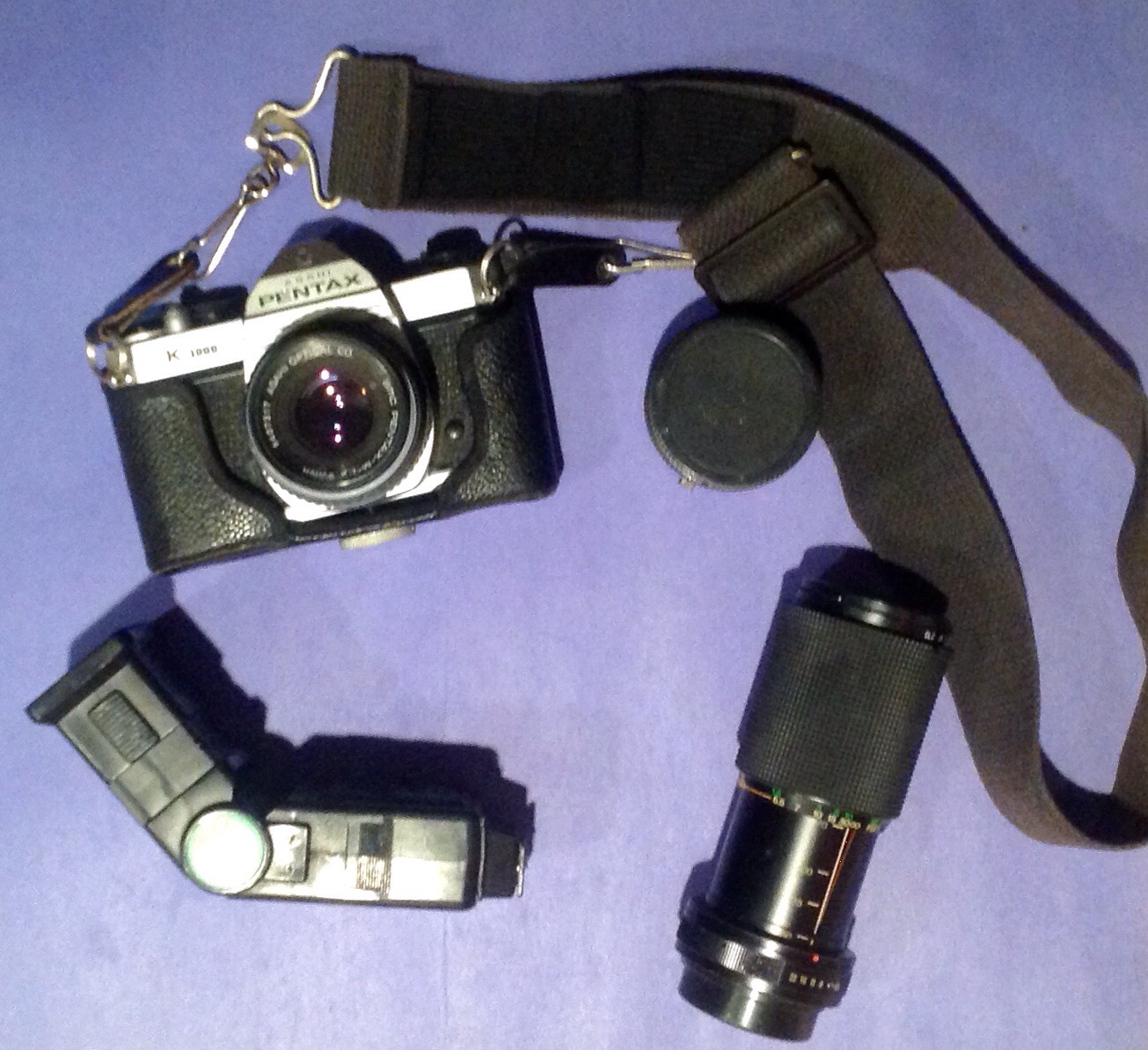
Years earlier, I had been the official photographer for my senior class. I knew how to develop my own black and white film. So, I did have some experience.
The wedding pictures turned out reasonably well. I know that not because I’m much of a judge, but Shannon later became a professional photographer. And given her critical eye and her love for her brother-in-law, I’m sure, she has announced that my pictures were well done. (Leslie did a marvelous job singing as well.)
But, the title of this post is “Writers Are Better.” So why am I talking about the time I was a photographer? Because those photographer experiences are what convinced me that when it comes to enjoying an event the writer’s experience far and away beats the photographer’s.
A while ago I wrote a post about the times where we are so busy trying to capture the moment on camera that we end up losing it. (The Greatest Picture I Never Took.) Monday night when I hosted the Haunting’s contest, (Do You Like A Scary Story?) I talked to Dana Johnson, the official photographer about how trying to capture the moment sometimes loses it.
I know what you mean Rodney. I photographed my daughter’s wedding. Fortunately there were two of us. But I have to remind myself to take a picture and then put the camera aside and enjoy the moment.
This is some of Dana’s work.
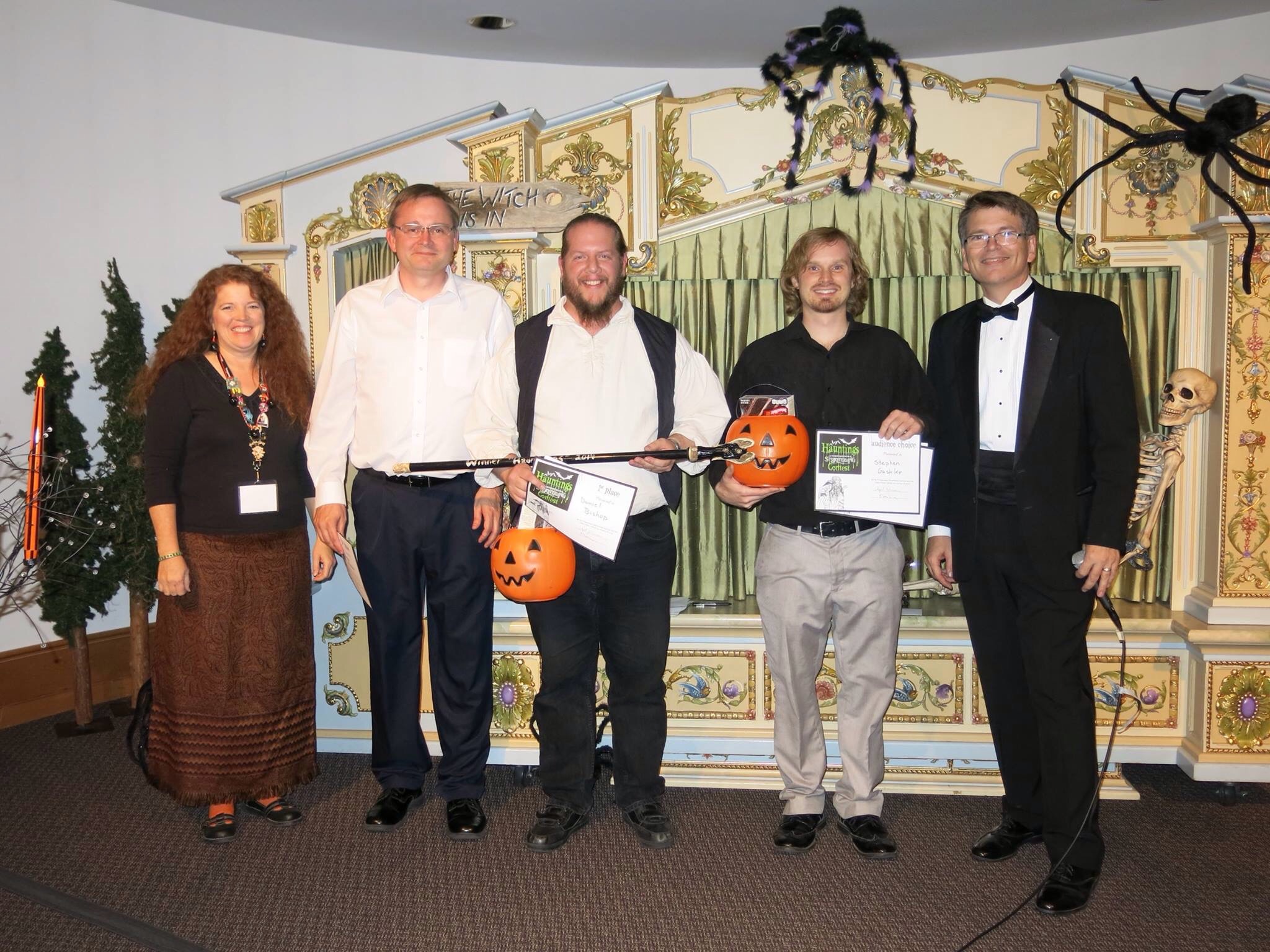
Founder April Johnson, 3rd place George McEwan, winner Daniel Bishop, 2nd place and people’s choice winner Stephen Gashler, and some guy who was overdressed.
(Photo Credit: Dana Johnson)
Looking back at my one gig as a wedding photographer, I remember being so concerned with getting the shot that I missed lots of the event. But, it was worth it to provide a wonderful gift to my brother-in-law and his bride.
So, why do writers have an advantage? After all, they can’t capture the detail that the photographer does. Their memory will fade, where the photographs will exist forever. It’s that memory fade that gives the writer the advantage.
Just as a photographer is always looking at the world through a lens, even if she doesn’t have a camera, a writer is always looking at the world from a storyteller’s viewpoint. A photographer is never more than an arm’s length from her camera. A writer is never without a pen and something to write on. And where a photographer needs to stay out of the shot, the writer gets to immerse himself in the experience completely.
As a writer I want to fully embrace an event. I want to see it, taste it, smell it, breath it. Because I know that I’m going to have to recreate the event from memory. So, I’m going to look for details and them commit them to memory. I’m going to talk to people. If I’m going to retell this experience as a personal story, I will pay attention to my own feelings. I’ll laugh or cry, be scared or excited.
Where a photographer creates crisp clean, picture-perfect images, a writer gets messy. We get to indulge in feelings, in imagination of what might be happening or what might have been.
And when the writer sits down to craft his story he has the entire experience to draw upon. Like a painter selecting his paints and brushes, the writer can pick and choose which details to include, which details to leave out. He can choose to ignore the weather, or draw parallels between the billowing clouds and the wedded couple’s blossoming love. He can look beyond what the guests are wearing and get into their heads and their hearts.
The father of the bride held both the sweet and the bittersweet in his heart as he walked her down the aisle and realized he was no longer the most important man in her life.
Yeah, that was me walking my oldest through the snow to a tent where the rest of her life was waiting to replace my arm with his.
As a writer, I revel in the freedom I have to transcend boundaries not only of physical location, but of time and even worlds. I can delve into the distant past or project myself into the far future. With nothing more than 26 letters arranged in various configuration on the page, I can build worlds without number, or linger over a single poignant moment. Yes, when it comes to recording the world around us, I definitely think the writers get the better deal.
(Just don’t tell my sister-in-law.)
Shannon Wilkinson Photography can be found here.
Rodney M Bliss is an author, columnist and IT Consultant. His blog updates every weekday at 7:00 AM Mountain Time. He lives in Pleasant Grove, UT with his lovely wife, thirteen children and one grandchild.
Follow him on
Twitter (@rodneymbliss)
Facebook (www.facebook.com/rbliss)
LinkedIn (www.LinkedIn.com/in/rbliss)
or email him at rbliss at msn dot com
Tell your friends about this!
Rodney, it looks like Dori isn’t going to make it today.
Yeah, I don’t see her.
She was one of our speakers.
Oh?
So, do you have a speech you can share with us to fill in?
Uh. . . .
It’s my own fault. I’ve been attending Toastmasters for over a year. I attended because I love to talk. And I always over prepare. They say to always come with a speech ready. And I did. Anytime someone wasn’t available, I had a speech ready. . .except today. I’m working on some speeches that are supposed to be 15-20 minutes long so they take more preparation. But, my club was used to being able to call on me last minute.
Now Jane was staring at me not so much with a questioning look, but a look of “Tell me the name of your speech.” It didn’t help that the meeting had already started.
Ah. . . I . . um. . .Oh wait! I have this speech that I wrote for the scary story contest. But, I haven’t really practiced it.
Great. You’ll go second.
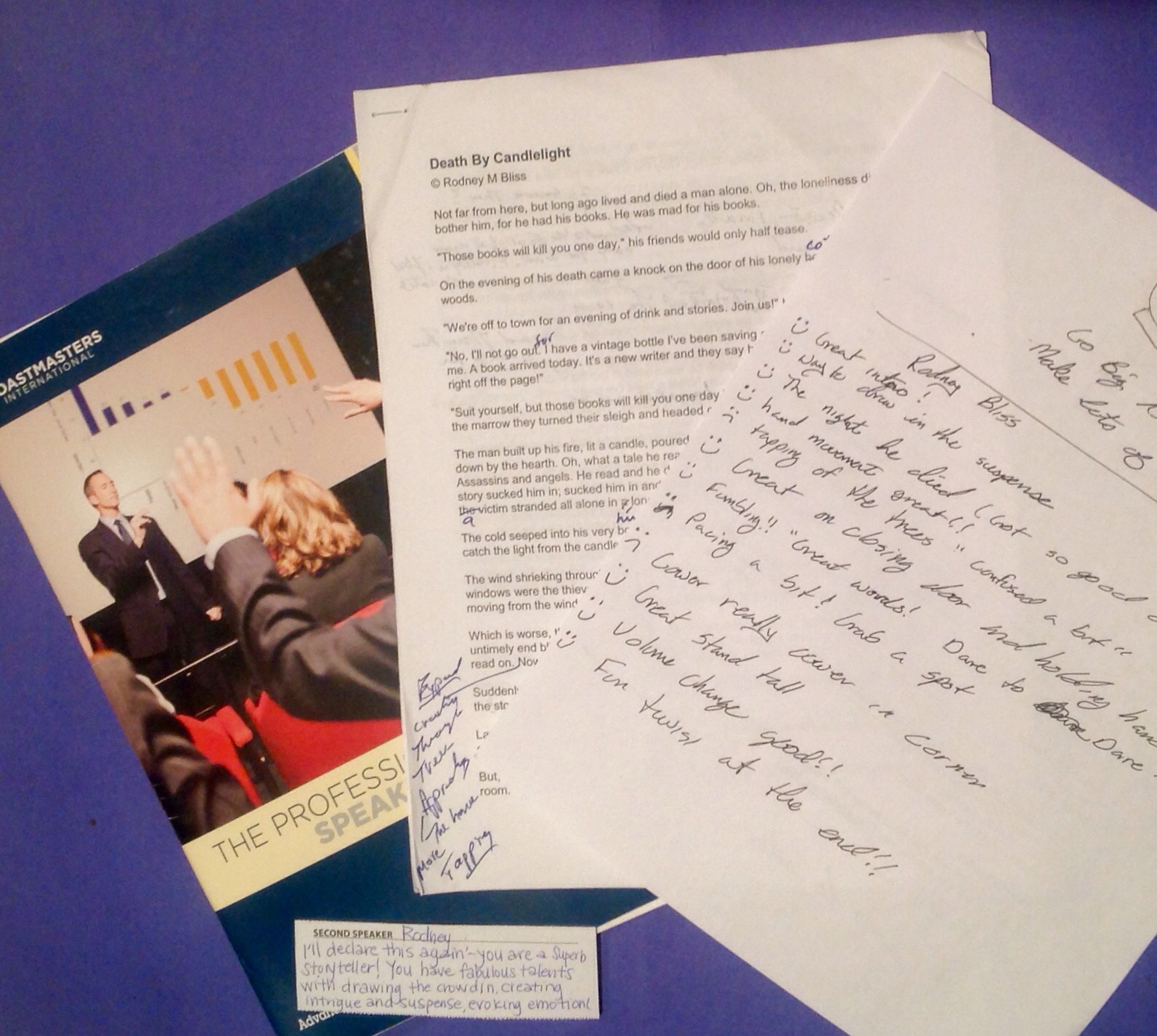
The reason I hadn’t presented this story at the Hauntings contest was that I didn’t feel I was ready. Now, I had maybe 15 minutes to prepare. The speech was about 10 minutes long. Fortunately, I had it typed out with all of my edits hand written in. I started reading through it.
There are several elements that go into a successful speech. The first, of course is content. I had to make sure I knew the content. Second, at least in Toastmasters is memorization, no notes. I paid particular attention to the transitions. Knowing that after I say THIS phrase, I need to pause and then say THAT phrase.
Third, is voice, inflection, tone, volume, etc. I was going to have to figure out most of that during the speech and hope I got it right the first time. And finally, for this speech, I needed to set up a scene; a fireplace over there, a door here, a window over here. The objects weren’t there, of course. But, I had to convince the audience they were. Blocking is the process of walking through a scene to get the movements right. Blocking was another piece I was going to have to do live.
The first speaker got up to tell what turned out to be a fascinating speech on how to recognize and avoid abuse. I had to keep reminding myself to read my story not look at Martha.
And our next presenter will be Rodney telling us a scary Halloween story.
I took my paper with me and put it on the podium just for moral support.
How long is your story, Rodney?
Ah. . .let’s say 8-10. But, really it’s going to be as long as it takes me to tell the story.
I hadn’t even been through it with a stop watch. I wasn’t sure how long it was.
I love storytelling. Since this was a story I had written myself, I “knew” the essence of the story. I got the hook set in the opening. I pulled the crowd with me into the little cottage nestled in the snowy woods. I conjured up a storm that blew through the top floor of the old American Fork city hall that we meet in. The conflict built along with the suspense. Just at the climax the timers green light came on telling me that I had 2 minutes left. Perfect! Right on track.
I brought my protagonist to the final conflict and the crowd came with me. I never hear the applause, so I can’t tell you how much they applauded, but the comments were all very positive.
I thought about the fact that when we act a particular way, people come to expect us to act that way. I’m in the middle of a crazy project at work. It’s got an incredibly tight schedule. But, then every time they hand us a project it has a crazy tight schedule. And every time we pull it off. So, management has come to expect that we will be able to pull together a 3 month project in 2 months.
I’ve talked with my technical team about it. We need to adopt the attitude that Mr. Scott from Star Trek has. We should tell them it’s going to take 5x as long as it actually takes and then we look like heroes for finishing early. Yeah, that never worked for us either.
But, as I once again had a story that I could pull out at the last minute, I realized there are worse traits to have than to be counted as dependable.
I just have to prep another speech before my next meeting. Fortunately I’ll miss the next couple so I’ve got a little time.
Always have a story ready, even if in your job “story” means being able to complete an extra project.
Look for my story “Death By Candlelight” on Halloween.
Rodney M Bliss is an author, columnist and IT Consultant. His blog updates every weekday at 7:00 AM Mountain Time. He lives in Pleasant Grove, UT with his lovely wife, thirteen children and one grandchild.
Follow him on
Twitter (@rodneymbliss)
Facebook (www.facebook.com/rbliss)
LinkedIn (www.LinkedIn.com/in/rbliss)
or email him at rbliss at msn dot com