“Rodney, this is Brock. I’m calling you rather than go in and wake up Sam for the third time this morning.”
I was President of RESMARK, a startup software company building a reservation system for the whitewater rafting industry. We were under a crunch to get version 1.0 our software built in time for Confluence, a rafting convention in Salt Lake City.
Brock not only ran one of the biggest rafting companies in the country, he was also my investor and the only source of income for our fledgling company. We had installed an Alpha version of our software in Brock’s offices in Salt Lake City and it was requiring more attention that we had expected to keep it up and running.
RESMARK, like many startups had big goals and dreams and a tiny budget. It didn’t seem tiny to Brock when he had to write the checks every month.
I’d recently brought Sam on as a project manager over Brock’s objections. The hope was that Sam would pick up the organizational aspect the project, and help us free up our developers, and especially our Development Director to focus on writing code. That was the plan.
In addition, Sam and I were to split time in Salt Lake at Brock’s office. We needed one manager in our Orem office, and the other could help hold the hands of the users in Salt Lake. Yeah, that was the plan.
Sam and I had been working on this plan for the past and today, was the first day we were trying it out. I knew there was tension between Sam and Brock, but hoped most of it would be directed at me since it was my decision to hire him. I did not expect Sam to fall asleep. . .three time. . .before lunch.
Brock and I talked a little more about it,
“The last time it was pretty tough to wake him up. It’s kind of freaking out the receptionists. This is your problem. I expect you to fix it.”
Okay, then.
“Say Dave, what would it do to the production schedule if we had to let Sam go?”
“Probably move it up by about a month.”
Double okay, then.
I had to call Sam’s phone twice before he picked up.
“Yeah, I know we agreed that you’d spend the day in Salt Lake, but something’s come up and I need to see you back here in the office. . .yeah, right away.”
Dave and I met with him in my office.
“I’m going to need your office keys. Today, in fact, right now is your last day.”
“Well, I’d like to know what I’m being let go for.”
“What the *&%$ were you thinking!?!”
“I didn’t fall asleep!”
“It doesn’t matter. The client, and our investor THINKS that you did.”
Had he offered any reasonable explanation, it might have been harder to let him go. If he’d owned up to his own actions, and recognized how those actions impacted the rest of his coworkers, we could have had a conversation. But, as it was, he had removed any possibility of salvaging the situation.
We didn’t gain a month in the schedule, but we did ship on time. Brock and his staff were somewhat mollified that Sam was no longer with us. And I learned a valuable lesson. As much as I want to protect my teams, there are times where the only solution is to let someone go.
Tell your friends about this!

“Hey Rodney. The Deskside support team just called. No one in Shipping can log in.”
“Is it just email, or the entire network?”
“Well, I can see their email accounts, but it looks like their Active Directory accounts were blown away.”
Uh oh.
It’s Monday morning, and I’m the manager of the Messaging team for a large non-profit organization. As any IT engineer can tell you, the most common day for network problems is Monday mornings. My team was in charge of email, but we often had to deal with network issues. No one cares if their AD account has a problem. What they DO care about is using that account to get to the applications. . .especially email.
My team started following the electronic trail of breadcrumbs to figure out what happened and I went to brief management. . .and inform the directory team.
Fifteen minutes later we regroup for a status update. (When an entire 100 person department can’t get on the network, management wants updates multiple times per hour.)
“So, what did you find out?”
“It looks like the entire department list was deleted on Friday at 5:45pm.”
“Who did it?”
There were some nervous looks around the room. No one wanted to throw a coworker under the bus, but I knew and they knew that senior management was going to ask.
“It looks like James was online at that time. And he’s been working with Shipping to cleanup their employee list.”
“He told me we were finished with that two weeks ago.”
No one wanted to meet my gaze.
“Where is he?”
“He flew out on Sunday for a two week Microsoft Exchange bootcamp in Redmond.”
“Okay, get with the backup and the directory teams and let’s start restoring their accounts. If we have to, we can recreate accounts, but they’ll lose their email.”
I had a phone call to make.
“Hello?”
“James, this is Rodney. Listen we’ve got a bit of a crisis here. Seems that all the accounts for the Shipping department got deleted last Friday at 5:45. We’re doing a restore, but we’re trying to figure exactly what happened. Sorry to bug you during training, but any insight you can provide could really help us get Shipping back on line.”
“Ah. . . that might have been me.”
“But didn’t you finish that project 2 weeks ago?”
“Well. . . mostly. But, I had a couple of things that I tried to finish up before this trip.”
Fifteen minutes later, I’m in my boss’s office briefing him so that he can go brief his boss.
“So, how did this happen?”
“Shipping sent us a file that included their entire employee list. We were supposed to delete the entries with a star in column A. It looks like we ended up missing that note and we deleted the entire file.”
(I try REALLY hard to protect my team, but I wasn’t sure I was going to manage it this time.)
“I told Bruce and the rest of the management team that we finished that work two weeks ago.”
“Yeah, I should not have told you we were finished. I thought James had finished it, but obviously I was wrong.”
“So, what are you going to do?”
“If I call him back from Microsoft, I think we would have to fire him.”
“I think you should.”
“I’d like to talk to him face-to-face before we go that far.”
“Well, he’s your employee. But, I think you’re going to have to fire him anyway.”
“James, you knew that you’re team had to scramble to clean up a problem you created. I’m a little surprised that we didn’t hear from you these past two weeks.”
“I was afraid I was going to lose my job.”
“Well, HIDING isn’t going to help! I’ve talked to HR and we’re going to set up a 90-day Performance Improvement Program.”
“Isn’t that just a formality before you can fire someone?”
“Yeah, it seems that way most times. But, here’s what I want you to do. I know you’re a good engineer. I think you have a problem focusing and that leads you to overcommit and under-deliver. So, for the next 90 days, every Monday morning, before 10:00 am I need you to send me an email with a list of the things you are planning to work on that week. Then, on Friday, before 3:00pm I need you to send me a list of the things you did that week.”
“What if stuff comes up during the week?”
“If someone shoulder-taps you, tell them that you are working on a project for me and they need to submit a service ticket. I don’t want to lose you. You’re important to the team. Hopefully, this will help. No one except you, me, my manager and HR knows about this PIP.”
For the next 45 days things went well. After six weeks James came to me.
“Rodney, can I talk to you?”
“Sure, what’s up?”
“I just want to say that the last thirty days have been the absolute best time I’ve had at this company. Thank you.”
I was shocked. I put him on a PIP and THAT time is the best in his career?
“I just never had a manager that was willing to coach me before.”
Too often we expect that our employees know not only WHAT to do, but HOW to do it.
This episode happened many years ago and James remains a valuable, and happier employer of that organization. Coaching doesn’t always work, but we owe it to our employees to actively manage them; not micro-manage. I specifically didn’t tell James what work to do. He already knew better than I did was needed to be done. I just helped me focus.
Tell your friends about this!
It’s not what you say about you, but what others say about you that makes a difference.
Never has this been more true. The good news is that with the advent of social media, there are more ways then ever for people to share their opinions of you. That’s also the bad news, of course.
Karl Maeser was the first president of what later became Brigham Young University. There’s a story told about Maeser.
I have been asked what I mean by “word of honor.” I will tell you. Place me behind prison walls—walls of stone ever so high, ever so thick, reaching ever so far into the ground—there is a possibility that in some way or another I might be able to escape; but stand me on the floor and draw a chalk line around me and have me give my word of honor never to cross it. Can I get out of that circle? No, never! I’d die first.
Before FICA scores and court-backed contracts, many agreements were conducted with a handshake. A person’s word was critical since often their reputation was the only thing you had to base a decision on.
Today, we have the opposite problem. You can find out nearly anything about anyone online. If I told you I’d played bass on Ren Street’s “Good Love” album, it wouldn’t take long to figure out that I was lying. Likewise, if I told you that I’d cowritten “Microsoft Exchange Connectivity Guide,” you could verify it easily.
So, if we can find out so much about each other, why would I say that a reputation is more important today than during Maeser’s day? Before Google and the ubiquitousness of information, repairing a damaged reputation was simply a matter of time and action.
There’s a story told of two brothers who in their young and foolish days stole a sheep. They were caught, and convicted. As punishment, they were forced to have the letters “ST,” for “sheep thief” branded on their forehead. (No it wasn’t in the US. It’s metaphor, just go with it.) The first brother was so devastated by the shame of it that he left his childhood home and wandered from town to town trying to hide his shame. The second brother stayed and worked to build his community. He repaid his debt and spent his life in helping and serving those less fortunate. When he was a very old man a young boy asked his father. “Why does that man have “ST” on his forehead?” His father replied, “I don’t know. I’ve never thought to ask him. But, I think it stands for “Saint.”
I once lived in a neighborhood where the neighbors were famous for helping each other and watching out for one another. After several months, I had the occasion to check the sex offenders registry. I was shocked to realize that a man who had become a good friend was on the registry. His offense had been many years before. As a result of his crimes, he would carry that designation as long as he lived.
Most of us will not need to deal with a past so damaging. But, as we live our lives online, we leave digital footprints for the world to see. Maybe it’s a facebook rant posted in a fit of frustration. Maybe it’s a photo at just the wrong time during a party. Maybe it’s a comment we make in a city council meeting. Maybe it’s an il-thought out blog post.
Virtually all employers and especially prospective employers now check online, and in my field, the IT world, not only do candidates expect employers to check online profiles, employers expect candidates to actually have online profiles.
LinkedIn is sort of like a facebook for business. They allow both recommendations and endorsements. An endorsement is someone saying that you know what you’re talking about. For example, some of the areas in which I’ve been endorsed by colleagues and team members are:
– Team Building
– Change Management
– Program Management
– Training
Recommendations are just what you would expect. It’s a short paragraph recommending people for the work they’ve done.
I no longer put “references” on my resume. I’ll provide specific names when a prospective employer wants it, but for the most part, I assume people are going to go read the recommendations on my LinkedIn page. Those are the same people I’d be pointing people to if they wanted to ask about my work.
So, why is this blog post called, “Coin of the Realm?” Because with the internet, reputation has really become the most precious commodity you have. An online reputation takes years to build and can be destroyed in a moment.
Not only will people know if we step outside Karl Maeser’s circle, people will know about it forever.
Tell your friends about this!
Any noun can be verbed.
One of the things I learned in a nearly 10 year career at Microsoft. A friend pointed out the obvious,
“Including the word “verb” apparently.”
That’s what makes it funny. But, it got me thinking about corporate culture and what makes it unique.
I worked for Microsoft from 1994 to 2003 and then again in 2008. The two periods were very different. For those of you who are interested in the history of the computer field, the change happened on April 3, 2000. That was the day US District Judge Thomas Penfield Jackson issued his famous ruling authorizing the breakup of Microsoft
If like me, you lost money in the market crash of 2000, you can blame Judge Jackson. His ruling was the pin that popped the Internet stock bubble.
We didn’t really know it at the time. I’d seen the Apple vs Microsoft case adjudicated. We lost that one too. That was the famous “Look and Feel” lawsuit, that claimed that Windows 95 stole Macintosh’s UI or User Interface. The jury decided, “YES, Microsoft stole your look and feel. Here’s $1 in damages.” Apple won the lawsuit and won a dollar. Actually, because of the nature of the challenge, the damages were automatically tripled. I think the Microsoft attorney paid up before he left the courtroom.
So, when Judge Jackson decided we should be split into an Operating side (Windows) and an application side (Microsoft Office) we weren’t too worried. The stock started to head down. Not something that you want to see when the bulk of your employees get stock options. And on a personal level, not something you want to see when you’ve ignored the advice from your mother the financial planner, and you’ve left all your assets in the Microsoft basket.
Sure, we expected a hit, but we also expected a correction to be followed by more growth. It went down like the Titanic.
At a company meeting months later I remember Steve Ballmer, always the high energy company cheerleader asking us if we thought the stock would stay at $40 or it would make it back up into the 80’s where it was before the ruling? We drank the kool-aide. We wanted to believe, and we needed it to come back. It never really did.
That period of Microsoft history is filled with tales of crashed fortunes. But, more than our bank accounts were hit.
It changed the company, and in turn I think it changed the entire industry. During the trial, Ballmer famously said, “We can put a ham sandwich into Windows if we want.” Microsoft was bold. We were brash. We were arrogant. But, we DESERVED to be arrogant. Only the best and brightest got to work in Redmond. Our past was littered with “industry leaders” who’d been either eliminated or neutered.
Borland
WordPerfect
Novell
Lotus
cc:Mail
Many of those names mean nothing to today’s IT employees. But each was once number one in their field. Microsoft had ground each into the dirt. Another Ballmer quote was,
“We may not get it right the first time. Or the second time. But by the time we get the third version we’re unstoppable.”
And Microsoft had the guts and the gold to afford to wait for the success that we all knew was inevitable.
There were setbacks (anyone remember Microsoft Bob?) But, for the most part, we were a machine; a money making machine for those of us on the gravy train, and a perpetual upgrade machine for our customers.
All that changed on that day in April. Some of the best and the brightest took their remaining riches and simply moved on to their next endeavor, whether that was travel, startups, philanthropy, or simply a house overlooking Puget Sound. Others of us lost our fat bank accounts, and realized that we’d just watched the end of something pretty cool.
What I learned was that company success is not inevitable. In fact, you could say that success, especially wildly lucrative success like Microsoft had, was the exception rather than the norm. Judge Jackson didn’t just rein in Microsoft, by taking the air out of the Internet bubble, he brought the entire industry down to earth. We became just another white collar business.
But for a few years, we were kings. Nothing lasts forever. That’s what I learned at Microsoft.
Well, that and the fact that any noun can be verbed.
Tell your friends about this!
Ever been in a discussion with someone who simply will not listen to reason? Any of us who have siblings, or parents, or children have probably had that conversation multiple times. The problem might not be with your logic, but with your emotions.
I spent two years as a missionary for the Mormon church. I had the opportunity to hold literally hundreds of religious discussions. I came to realize something. . .Mr Spock would NEVER join the Mormon church. Okay, I never actually had a conversation with THE Mr. Spock, or Leonard Nimoy for that matter, but it became obvious to me that logic and religion don’t mix. (Stay with me, here. It all comes back to business in a few minutes.)
The Bible explains that “Faith is the substance of things hope for, the evidence of things not seen.” (Paul’s epistle to the Hebrews, Chapter 11, verse 1.) I’m not a Bible scholar and I certainly would not argue anyone else’s interpretation of scripture, but what this meant to me was that “Faith” and “Fact” were NOT possible at the same time. In a simple example, if I show you a closed fist and tell you that there’s a coin inside, you have to, based on what you know of me decide if you believe. (I’m interchanging faith and belief.) But, if I open my hand and SHOW you the coin and then close my hand around it, and then tell you that I have a coin in my hand, you don’t have to have faith in me. You know what you saw.
If I were trying to build up your faith in me, showing you the coin first wouldn’t help that at all. However, if I showed you the closed fist first, you have to decide how much you trust me.
And faith and trust are emotions.
If I try to use logic to convince you that I have a coin in my hand, I’m probably going to fail.
And that’s the point. Using logic to convince someone of an emotional argument is doomed to failure.
I spent many years helping companies move their email systems between Microsoft Exchange, and Novell Groupwise. These discussions don’t evoke as much emotion any more, but there was a time where people arguing over email platforms was pretty intense.
I would often be brought in at the beginning of the negotiations, typically by someone who was championing a change, one way or the other. Our conversations would go something like this.
“I need you to give me ammunition so that I can convince my boss to switch to GroupWise. I’ve been trying for months with no success. I showed him that it’s faster and safer, and has more functionality.”
“What objection does your boss have to GroupWise?”
“He once heard Bill Gates speak at a trade show and is convinced that Microsoft is great.”
“No amount of charts and facts and figures is going to convince him to switch to GroupWise.”
See, the boss had an emotional attachment to Microsoft and just like trying to disprove the existence of God, there was no logic that was going to convince him otherwise.
I’ve also seen the conversation go the other way.
“I know the spreadsheets show that moving to Exchange makes financial sense, but we shouldn’t.”
“Why not?”
“Because Microsoft is evil!”
Back to my missionary experience, some of my fellow missionaries would seek out those with whom they could “Bible bash.” That’s where each side appeals to the Bible to prove their point. Don’t believe that God the Father and Jesus Christ are the same person? What about the first few scriptures of the Gospel of John? Oh you DO believe they are the same person? What about Jesus’s baptism where God the Father was in heaven, Jesus was in the water and the Holy Spirit descended in the form of a dove?
Those discussions never “proved” anything. Ultimately what you believe is based on faith, and no amount of “proof” will sway you.
The same thing is true for discussions that we have in business. If someone is convinced of something based on facts, then an appeal to emotion will fall on deaf ears. Likewise if they believe something based on emotion, no amount of Excel spreadsheets will convince them that Microsoft is NOT evil.
Properly match your responses to your opponent’s objections and you will greatly improve the effectiveness of your conversations.
Tell your friends about this!
Driving down a San Diego freeway with my brother, we were in his wife’s bright red Mustang convertible with the top down. He’d just picked me up from the airport and over the noise of the air whistling by us at 80 mph we were catching up on lives, careers and kids.
Coming around a curve we spotted a highway patrol motorcycle cop with a radar gun. (There are no 80 mph freeways in San Diego like there are here in Utah.) Before the cop even got his bike started, my brother was slowing down and moving toward the inside lanes to pull over to the shoulder.

To our surprise the motorcycle cop passed us on the left and turning around made a “follow me” motion with his hand. Then HE sped up. We were almost back to our original speed as we tried to keep up with him. I joked that it might be best to take one of the exits that were whipping by us. We were actually headed in the same direction as my brother’s house, not that we would run from a cop. . . not when he could see us anyway.
Finally, the motorcycle pulled behind a black SUV and flipped on his lights. The SUV pulled over at the next exit and parked on the shoulder. There we were, the three us lined up: SUV with what looked like a young mother at the wheel, next, the cop’s Harley Davidson with its flashing red and blue lights and then the red sportscar with the two middle-aged guys.
The policeman came back to our car first. Taking off his shiny sunglasses he asked, “Ever heard of that show ‘Let’s make a deal’?”
“Yeah, but you don’t look like Monty Hall,” my brother responded with a smile.
“Here’s the deal. I’m going to go write that woman a ticket, and I’m going to give you a warning. But, if I give you the warning first she’s going to be all upset. So, if you’ll sit here patiently while I write her ticket, I’ll let you off with a warning. How’s that deal sound”
“Ah. . .OK!”
Sure enough, he walked up to the lead car and after an animated conversation he handed the woman a ticket and she drove off.
We still weren’t sure we were going to get off scott free in this. (Well, HE was driving so I wasn’t worried anyway.) The policeman returned to our car and said, “Do you know why I’m not giving you a ticket? Because you didn’t make me chase you. You were going to pull over. You knew that you’d done wrong. That woman was right next to you on the freeway and she kept going. She made me chase her down. By the way, had you tried to turn off, I would have ignored her and gone after you. . .and it wouldn’t have been a small ticket. Have a nice day.”
I was dumbfounded. A cop sees two cars speeding. He gives the SUV-driving soccer mom a ticket and let’s the two middle-aged white guys in the candy-apple red convertible off with a warning? Even after thinking on it for several weeks, I still couldn’t figure out why.
Fast forward a few months and I’m driving through Lehi, a small town in Utah about 30 miles south of Salt Lake City. I’ve picked up a member of my team and we’re headed to pick up another member who lives nearby. While driving down Frontage Road, next to the freeway, my friend says, “That’s a cop up there.”
“What’s the speed limit on this road?”

“Twenty-five.”
I’d thought it was forty. I immediately slowed down, but if we could see him, he easily would have gotten us on radar. As we got closer I could see that there was a patrolman sitting in the car. I pulled in front of his car and stopped.
My friend gave me a strange look, like “Do you WANT to get a ticket?”
The policeman got out of his (still parked) car as I rolled down my window.
“Do you know how fast you were going?”
“No, Officer Boss honestly I don’t, but it was certainly higher than 25.” (His name really was “Officer Boss” it was on his name tag.)
“I clocked you going 49.”
“Well, I thought the speed limit was 40 so I guess I was speeding even by my estimate.”
After asking us about who we were and where we going, he went back to his car to run my license. My friend, belatedly told me about the number of people who drive too fast on this road. After a few minutes Officer Boss was back at my window.
“I’ll bet if I give you a warning, you’ll NEVER go 49 on this road again.”
“Officer Boss, if you give me a warning, I’ll never go FORTY on this road again!”
“Have a nice day.”
And I finally figured it out. I figured out why my brother didn’t get a ticket for doing 80 on a San Diego freeway and I figured out why I didn’t get a ticket for going nearly DOUBLE the speed limit on a residential street in Utah. It’s all about exceeding expectations.
Those officers were used to dealing with people who forced the police to chase them down. Forced the police to prove, maybe in court that they had been speeding. Basically, most people made the police really work hard. We didn’t. My brother knew he was speeding. I knew I was speeding. By being willing to own up to our mistakes we exceeded the officers’ expectations. We made their job EASY. And in return, they made our lives easy.
In business it’s important to own up to the fact that you’ve made a mistake. Owning your mistakes will achieve three important things:
1. You’ll be able to learn from them in a way that you can’t if you’re trying to find someone to pin them on.
2. You’ll surprise those around you. NO ONE owns their mistakes! Are you kidding?
3. When the time comes that your team is falsely accused of making a mistake, people will believe you when you explain that your team didn’t screw up.
When you own your mistakes you build credibility. None of us want to make mistakes, but we all know we all will. When it happens, own it. Learn from it. And then move on.
Oh, and watch your speed on Frontage Road in Lehi.
Tell your friends about this!
I am waiting for you, Vizzini. You told me to go back to the beginning. So I have. This is where we got the job. So it’s the beginning.
-Inigo Montoya
I’ve been in the computer, or the IT industry for over twenty-five years. I’ve travelled all over the world on business. I’ve written books. I’ve spoken to thousands of people. And yet, I live about 9 miles from where it all began.

This tiny nondescript building, tucked in between the power station and and the river, just outside the mouth of Provo Canyon is where it all began for me. While still a college student, I went to work for a young local company called WordPerfect. Many now have probably never heard of them. But, at one time they made the most popular wordprocessor in the world.
When I started in 1988 a copy of WordPerfect 4.2 sold for $495. If you account for inflation that’s $950 in today’s world. And that didn’t include a full Office suite. That was just the wordprocessor.
I started in the telephony office, installing phones. Eventually, I moved to support, because everyone worked in support. When I went to support, I also moved offices from the little shop by the river to Building G on what became known as WordPefect campus.

The trees were much smaller then. The land was originally an orchard and the trees on the campus now were spindly little things that looked like they might blow over in a the first stiff wind that came along. That pretty much describes some of the employees. It certainly describes me. I was a fresh faced 25 year old in my 3rd year of Computer Science, and they offered me the outrageous salary of $25,000 /year! And I got PAID HOLIDAYS! And they stocked the refrigerators with FREE SODA!
Very few people have heard of WordPerfect today. If you look close at the picture above, you can see Adobe‘s logo on Building G today.
The saga of WordPerfect has been told elsewhere by others who were more qualified than I to tell it. I want to focus a little on the lessons that we can learn from my brief 5 years there.
WordPerfect had a couple of things that contributed to it’s tremendous success. First, was it’s design. Before the days of Graphical User Interfaces (GUI.) You just had text on the screen. No pictures, no mouse. You typed. And used the Function Keys. (F7 anyone?)
WordPerfect hid nearly all of the formatting codes and commands. What you had was a soothing blue screen with white letters. I sometimes wonder if Microsoft didn’t pick their colors for the Blue Screen of Death because it was the default formatting colors for WordPerfect.
Second, WordPerfect offered the best support in the industry. Not, in my opinion, not in their opinion. They just were the best and everyone knew it. Microsoft couldn’t touch them in that department. And this support was important, because in the days before the Internet, (yes, we are going back to that time) you had two ways to learn a new program: Read the manual, which was often not very good, launching the careers of a slew of authors, or you asked your geeky computer friend.
WordPerfect changed all that. You could call an 800 number and ask anything you wanted, and you could talk as long as you wanted. (This was in the days when long distance phone calls were expensive.) I once saw a phone bill for WordPerfect that was $500,000 for a month. And ironically, the intern who was supposed to pay the bill forgot one month. So, next month’s bill showed up, just like yours does with a line that said, “Past due: $500,000, if you’ve already paid this, please disregard.”
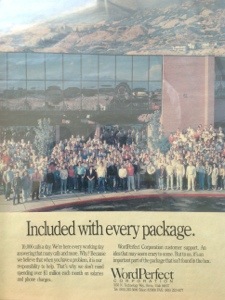
I’m in this picture about three rows back in the middle. (No, not that guy, the one next to him.) My brother Richard Bliss is standing just outside the doors and you can see his reflection in the glass above the door.
So, what happened? Why,with a great design and a staff of friendly phone operators waiting to answer the phone, did WordPerfect fail to keep it’s dominant position?
First, they failed to innovate. Microsoft had a wordprocessor, but it really wasn’t very good. It was certainly not as good as WordPerfect’s. But, Microsoft also was working on this operating system upgraded called Windows. Version 1.0 was a joke and everyone laughed at them. As far as I know there never was a version 2.0. Version 3.0 started to look better, and Version 3.11 was killer.
WordPerfect, like all companies that made software had to make a new version for each operating system. WordPerfect and Microsoft didn’t like each other very much. The WordPerfect executives decided that Windows was not all that important. So, instead they worked on a new version of WordPerfect for an operating system from IBM called OS/2. Has anyone heard of OS/2? No, I didn’t think so. OS/2 pretty much flopped and Windows? Well, we all know how that turned out.
WordPerfect for many reasons missed the next big thing. By the time they brought out a version for Windows over a year late, they had missed their window of opportunity and Microsoft never looked back.
Let’s look at the second thing they had going for them. WordPerfect still had all those support operators and they (we) were really, really good. I’ve worked for both Microsoft and WordPerfect support and while Microsoft support is world-class, WordPerfect was far and away the better customer experience. So, what happened?
Microsoft Office happened. Remember when I said that a copy of WordPerfect cost $495, $950 in today’s dollars? Microsoft started bundling not only their wordprocessor, but a spreadsheet program called Excel, and a presentations program called PowerPoint. Later they added an email client called Outlook. And they started selling this bundle for the same price or less than WordPerfect sold their wordprocessor alone.
In business the difference between your costs and your sale price is called your margin. And the margins quickly shrank. WordPerfect had over a thousand support people working in Building G and later Building H. And customers didn’t have to pay for support. They didn’t even have to pay for the call. As the ad above brags, support like that isn’t cheap.
WordPerfect’s business model was build around a particular price point. Can you imagine going to your boss and telling him you need $1000 per person JUST for their wordprocessor? At my last company I think our entire desktop image, including applications, operating system, virus protection, etc. cost less than that. When they could no longer sell at that level, they had to change.
So, what’s this mean for you and me? What lessons can we learn from WordPerfect?
First, you have to be a little bit of a fortune teller and try to predict the future. Right now the big “buzz” is around Cloud Computing. If you don’t at least know what it is, you should probably learn a little. If you are in the communications team, you should understand what BYOD means and more importantly what it means for your business. The people who get noticed and viewed as the thought leaders in an organization are those who bring the new ideas to management with a plan.
A few years ago when the big push was for virtualization, I was managing an email team. We researched virtualization and realized that it was not at a point where we wanted to move our email system to it. . .yet. I prepared a brief and took it to my manager with an explanation of why I was NOT recommending we virtualize our email system. It led to some crucial conversations, but my manager appreciated the fact that I was bringing him a plan. Even if it was a plan to NOT follow the herd.
The second thing to take from the WordPerfect story is the idea that you need to constantly be looking at reorganizing your organization. Today’s margins may change tomorrow. If they do, how are you going to adapt?
When I was working as a manager in a startup company, I went to my lead developer and said, “Give me a schedule and feature list if we had to cut our budget by 50% next month.” A few months later we lost a big client and had to cut back. We already had that plan on the drawing board.
It’s a cliche because it’s true: The only constant in business is change.