
Normally, I write about how to make you and your team better.
Today, I’d like to ask you to help make a young boy better.
My friend Dave Farland’s son, Ben Wolverton, age 16, was in a tragic long-boarding accident on Wednesday April 4th, 2013. He suffers from severe brain trauma, a cracked skull, broken pelvis and tail bone, burnt knees, bruised lungs, broken ear drums, road rash, pneumonia, and is currently in a coma. His family has no insurance.
Ben is the son of author David Farland, whose books have won multiple awards, and who is widely known as a mentor to many prominent authors, such as Brandon Sanderson, Stephenie Meyer, and Brandon Mull.
Dave and I have been friends for over 20 years. One of my prized possessions is an autographed 1st edition of his first book.
Costs for Ben’s treatment are expected to rise above $1,000,0000. To help raise money for Ben, we are having a book bomb (focused on Nightingale and Million Dollar Outlines) on behalf of Ben.
You can learn more about Ben’s condition, or simply donate to the Wolverton family here.
What is a Book Bomb?
For those that don’t know, a Book Bomb is an event where participants purchase a book on a specific day to support the author, or, in this case, a young person in serious need: Ben Wolverton. The Book Bomb is scheduled for this Wednesday, April 10th, 2013. If you are interested in either Nightingale or David Farland’s Million Dollar Outlines, either for yourself or as a gift, please consider helping us by buying them this Wednesday. (I’ve included all the necessary Amazon, Barnes and Noble and website links below.)
Nightingale
David Farland’s young adult fantasy thriller Nightingale has won seven awards, including the Grand Prize at the Hollywood Book Festival—beating out ALL books in ALL categories. It has been praised by authors such as James Dashner (The Maze Runner), Brandon Sanderson (Mistborn), and Paul Genesse (Iron Dragon series), and has received four and a half starts on Amazon. You can read reviews here.

____________________________________________________
Some people sing at night to drive back the darkness. Others sing to summon it. . . .Bron Jones was abandoned at birth. Thrown into foster care, he was rejected by one family after another, until he met Olivia, a gifted and devoted high-school teacher who recognized him for what he really was—what her people call a “nightingale.”
But Bron isn’t ready to learn the truth. There are secrets that have been hidden from mankind for hundreds of thousands of years, secrets that should remain hidden. Some things are too dangerous to know. Bron’s secret may be the most dangerous of all.
____________________________________________________
Nightingale is available as a hardcover, ebook, audio book, and enhanced novel for the iPad.
You can purchase it on Amazon, Barnes and Noble, on the Nightingale website, or you can get the enhanced version, complete with illustrations, interviews, animations, and its own soundtrack through iTunes.
David Farland’s Million Dollar Outlines
If you are a writer, you may want to consider purchasing David Farland’s Million Dollar Outlines instead. Both books are part of the book bomb. Million Dollar Outlines has been a bestseller on Amazon for over a month and is only $6.99.

____________________________________________________
As a bestselling author David Farland has taught dozens of writers who have gone on to staggering literary success, including such #1 New York Times Bestsellers as Brandon Mull (Fablehaven), Brandon Sanderson (Wheel of Time), James Dashner (The Maze Runner) and Stephenie Meyer (Twilight).In Million Dollar Outlines, Dave teaches how to analyze an audience and outline a novel so that it can appeal to a wide readership, giving it the potential to become a bestseller. The secrets found in his unconventional approach will help you understand why so many of his authors go on to prominence.
____________________________________________________
Get it on Amazon, or on Barnes and Noble.
Other Ways to Help
Would you like to just donate money? You can do that here:
If you can’t spare any money, but would still like to help, you can do so by telling others about Ben’s donation page, and/or this Book Bomb. Share it on facebook, twitter, pinterest, your blog—anywhere you can. We have an event page set up on facebook here:
Thank you!
Ben and his family greatly appreciate your support, and so do all who love and care about them.
Rodney
Tell your friends about this!



I had lunch last week with the Senior Vice President of a nationwide banking organization.
Working in the IT field, I always have to remind myself of the difference between computer networking and people networking. I’m asked at times “How do I start networking?”
I think that’s the wrong question.
I think the right question is, “What am I already doing that is networking?”
The lunch I had on Friday also included a Strategic Relationship Manager for a large non-profit, a professional draftsman, the guy who runs Live Your Legacy…Don’t Just Leave it Behind and a government archivist for the State of Utah. And, of course me, an IT Manager. You might ask yourself, what would bring a group that diverse together? That’s explained by our seventh lunch companion, a professional Scouter from the local BSA council.
It was our monthly meeting of our Eagle’s Nest LinkedIn group. My friend Marty, the guy behind Live Your Legacy, put it together. There’s 20 thousand members around the world. We get together on the first Friday of the month to have lunch at The Lion House in downtown Salt Lake City.
I’ve been part of the group since just after Marty set it over a year ago. But, I only started attending the lunches a few months ago.
And this is why I think asking, “How do I start networking?” is the wrong question. If we’re doing it right we’re always networking. And it’s a natural extension of our everyday life, at least it should be.
In some ways, I’ve been networking with this particular group of since I was 11 years old. Certainly since I received my Eagle Scout award in 1980.

At the time, of course, I had no idea that I’d be having lunch with this group of men, some of whom earned their Eagle long before I was born, and others who received it just a few years ago. And, if you’d tried to explain to that 11 year old Tenderfoot, all those years ago, how important networking was, I’d have been more interested in getting to the waterfront before all the sailboats were checked out.
We each have associations that bind us to the society around us. Maybe it’s a college fraternity, maybe it’s the local plumbers union, maybe it’s another group that I associate with, the Masons. Church, the PTA, even a neighbor BBQ, all of them are opportunities for networking.
But, the worst thing to do is think, “I’m going to go “network” at the lodge tonight.” If you’re approaching your interactions with people like that, they will very quickly see through you. Instead, get involved with an organization that you feel passionate about, or at least one that you enjoy the associating with the members, and let the networking happen as you lose yourself in promoting the organization’s goals.
In other words, network like a Boy Scout.
Tell your friends about this!


I changed my personal Internet Service Provider today. It made me think of two questions:
1. What motivated me to switch
2. Why switch now
They sound like the same question, but for me, anyway, they aren’t. The first question is the easiest for me.
What Motivated Me to Switch?
With Comcast, I was paying $67 a month for 7 Mbit down and 1.5 Mbit upload speeds. This new service, Miles Wireless is $49 per month for 10 Mbit down and 3 Mbit up. That seems pretty simple, higher speeds and a lower cost. Who WOULDN’T switch?
But, I’ve known about Miles Wireless for months. My neighbor Jonathan Shaw (him of the Smack It With a Hammer fame) has been after me to switch since last winter. Another neighbor has a Miles Wireless sign in his front yard.
And Miles Wireless is exactly the kind of company I like to support. It’s a local ISP. In fact, it is only available in my town of Pleasant Grove, UT. Kevin Miles, the guy behind it has less than 150 customers and runs it part time. I LOVE small local businesses.
Unlike cable, his system uses line-of-sight relays on the mountains. Not sure why this made me happy, but it was kind of cool.

Why Switch Now?
But, none of that was enough to get me to switch. For me, there’s has to be a Tipping Point to get me to change. It took me longer than it should have to get my home internet set up. I didn’t really want to touch it.
We moved into our house in March of 2012. Our Wireless setup wasn’t particular complex, but it took me longer than I felt it should have to get it fully set up. When we moved we also switched from DSL to Comcast cable modem. The price was slightly more, but we increased our bandwidth as well. I think we were at 4 Mbit on DSL.
The initial price for Comcast was about $50 per month. After a few months the price inched up to $55. We grumbled, but the speed was mostly good. . .It wasn’t 7 Mbit, but it was faster than DSL. A few months later the price inched up again to about $60. And then a couple months later to $67. Each time, it wasn’t really enough to make a difference. Really, are you going to rip out your home internet connection and replace it with something new for $5 a month? I’m not.
I looked at the final price increase and compared it to what we had started at. I tried to remind myself that it wasn’t a five dollar increase, it was seventeen dollars per month more. Add to that the fact that we could get better speeds, better service, cheaper prices, and support a local small business, and it was finally enough to push me over the tipping point.
It’s probably also the fact that spring has sprung in Utah. The weather is absolutely perfect. Spring time in the Rockies always inspires me to tackle those nagging projects that I’ve fretted over all winter.
Tell your friends about this!

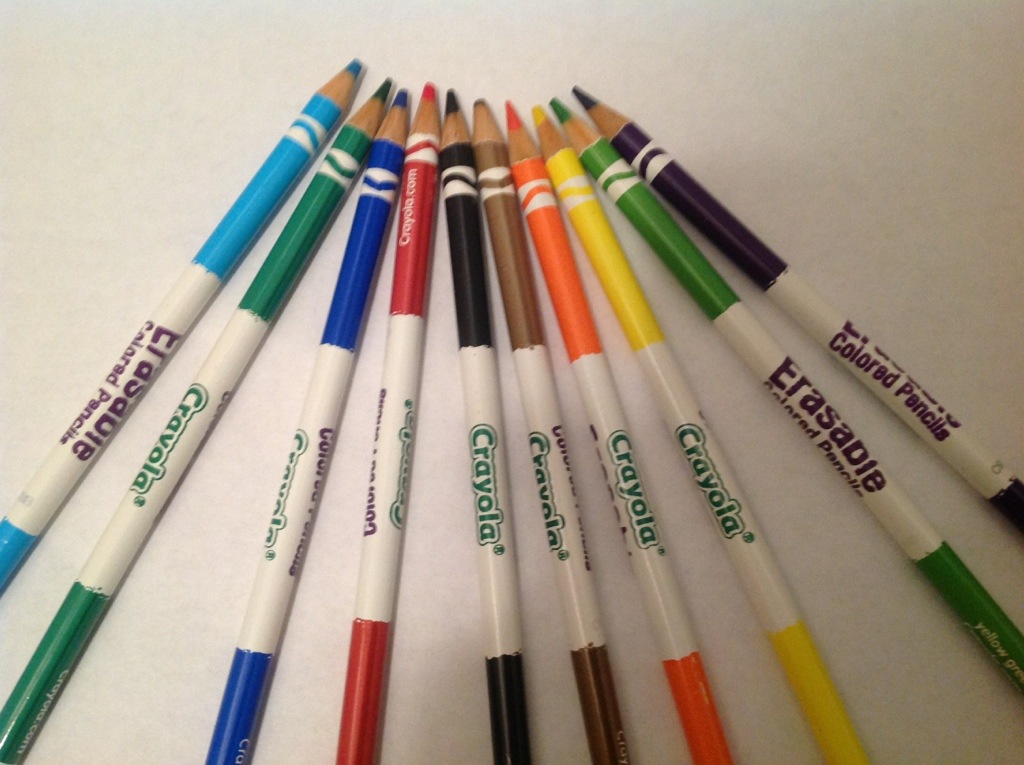
I’ve been a trainer or a teacher for most of my life. Even when my official job title was Program Manager, or Vice President, or Consultant, there was always an element of training to every job. Add in volunteer opportunities as a scoutmaster, missionary, and of course years as a father to a large family, and the teaching moments have been nearly constant. Fortunately, it’s one of my greatest joys in business; getting to train people.
I discovered there are really two critical rules to training. . .whether you are teaching four year olds in pre-school, or 50 year olds in a corporate training course.
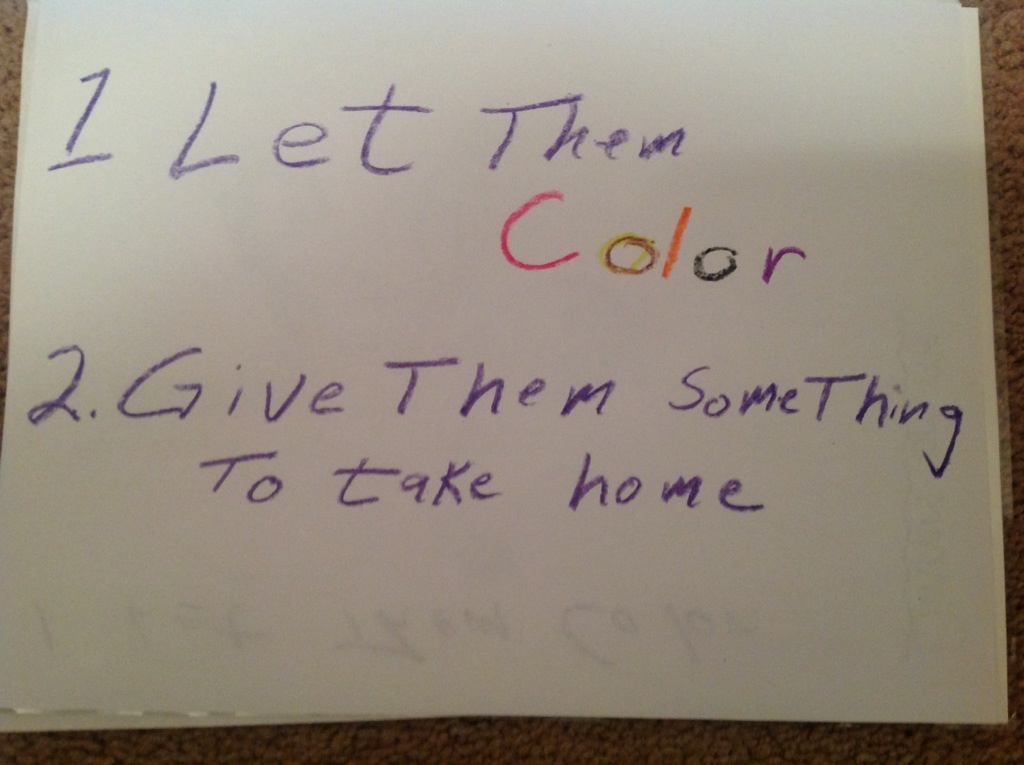
And with just a little bit of imagination, you can apply these lessons to virtually any training opportunity.
Let Them Color
Anyone who has taught a group of pre-teens for more than 15 minutes knows the value of crayons. “Okay, enough of the story. LET’S COLOR!”
Obviously, I’m not suggesting you bring crayons into your next team meeting. (Although, there are times when you should.) But, as a general rule, “professionals” feel like we’ve outgrown the crayon attraction.
I wrote training classes for Microsoft. These courses were often designed to be presented over anywhere from 3 to 10 days. However, even a one day training courses has to rely on more than a property-page crawl, or Death-by-PowerPoint. Typically in our courses we aimed for a 30/70 split. In other words, thirty percent lecture and seventy percent labs. (The labs are the “coloring” part.) It’s amazing how few courses follow this rule. If anything the percentages are often reversed, that’s if there’s a lab portion at all.
The most successful course I ever created taught Microsoft Support Engineers to decipher the network traffic between a computer running an email client (Microsoft Outlook) and an email server (Microsoft Exchange.) The course was three days long. We spent the first hour of the first day in PowerPoint and then abandoned it for good. The course was all about doing the labs.
One of my instructors would promise her class that they would LOVE to decipher network traces when they were done. She never once had anyone disagree. That’s the power of letting them color.
Give Them Something to Take Home
Anyone who has an elementary age child at home knows about “Refrigerator Art.” The masterpieces of aspiring artists. I once owned a refrigerator that was brushed aluminum on the front. It was gorgeous, but not practical since we had to resort to taping pictures to it since the magnets didn’t stick.


When I was writing courseware for Microsoft, most training courses include one or more oversized binders stuffed with the slides, and labs of the course. We dutifully lugged them back to our offices where they became shelfware.
Web-based training has saved entire forests of trees. And a Kindle or an iPad can hold more courseware than anyone could read in a lifetime. So, we no longer give students a coursebook to take home. Is that a problem?
I think, in some ways it is. Our society is geared toward certificates, trophies, documentation. It’s the reason that people spend hundreds of dollars to frame their university degrees. It’s also led to the unfortunate “everybody gets a trophy” syndrome permeating youth sports.
However, it’s simple to create a “Certificate of Completion” for a training course. The certificate will most likely end up in a file folder in the office. However, the act of handing someone (or emailing a .pdf if necessary) has a symbolic role. We’re a tactile society. Something that people can touch for some reason makes things more real than just pixels on a screen.
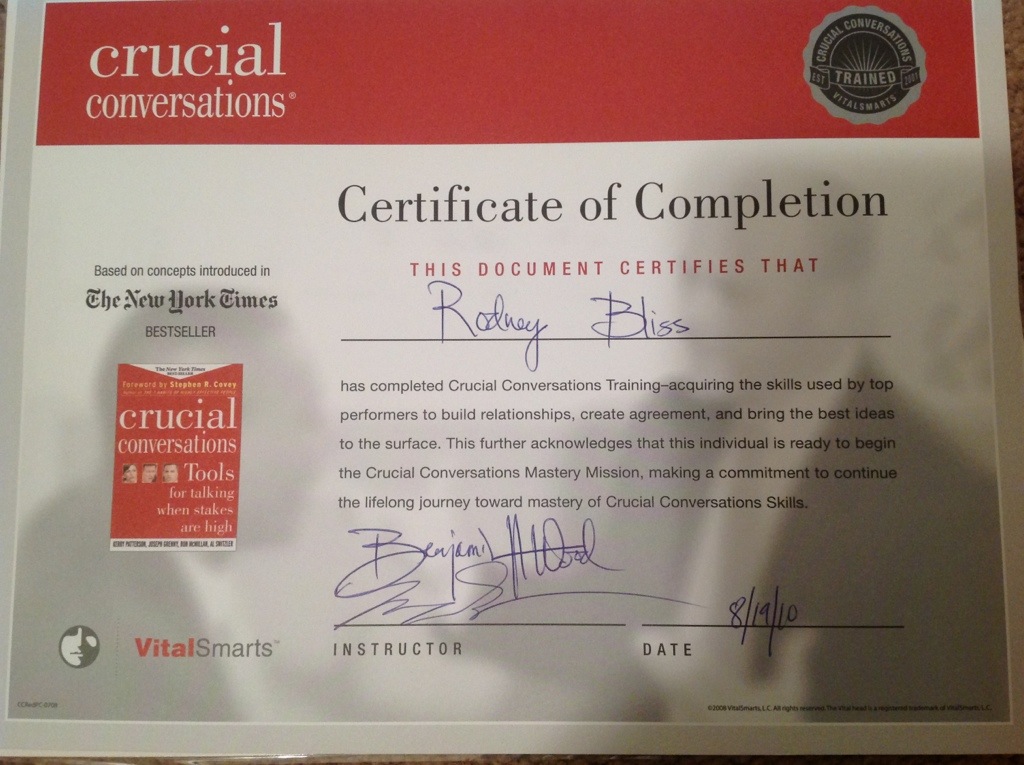
Also, it’s a clear mark to the end of the training. You’ve brought them on a journey. Don’t forget to give them the payoff.
Even meetings as simple as a team meeting can benefit from these simple concepts. A printed agenda and an opportunity to discuss their current assignments is enough to give people a sense of belonging that wouldn’t be there otherwise.
And, if you really want to shake up your team, bring crayons to your next team meeting.
Tell your friends about this!

“I’m worried what might happen if someone makes a change to the F5 load balancer during the change over.”
“Nothing’s gonna happen. We’ve done this a hundred times.”
“Yeah, but you guys are screw-ups.”
The conference room erupted in laughter. It was a funny line. Then the laughter was cut short as my new team realized what I had just said.
Awkward silence.
No one thought I was ACTUALLY insulting our new Principal Engineer and his team. But, we were both new enough to the team that they weren’t entirely sure.
I had inherited a project that required me to work with a large virtual team. I didn’t “own” any of the resources, but I needed them all to commit to helping me. Not only that, but the team had a reputation for lacking “engineering discipline.” They had a tendency to sometimes act rashly, without thinking through all the possible repercussions of their changes. They were all brilliant enough that this normally didn’t cause problems. . .normally.
Josh, the engineer that I had just called a screw-up was a classic example. He was brilliant, but had a tendency to create more of a “roadmap” for his work and deal with the details as they came up. My job was to try to get us to the point where we mapped out all the details before we started.
In the conference room, after the initial shock wore off, there were some smiles at Josh’s expense and we went on with the meeting. Afterward, I pulled Josh aside.
“Hey, that didn’t quite come out the way it sounded in my head.”
“No worries, Rodney.”
Hmm? We’ll see.
Humor is a risky thing in the work place. It’s especially dangerous if you attempt to use humor to cover an awkward situation. However, it can also be a very unifying Tool. It can help to bring a team together by making each member feel comfortable both being teased and teasing others. It remained to be seen what fruits my attempt would bring.
I did one other thing to try to emotionally enlist Josh in the mission and vision of the team.
Black liquorice. (That’s the Australian spelling of licorice.)

During our once a month all night maintenance windows, we provided food for our engineers. Josh and I were talking before our first all-nighter.
“I appreciate you being part of this, Josh.”
“Yeah, well, just make sure you bring black liquorice and I’m good.”
“Okay. . . ”
“And it’s gotta be that Australian style.”
I’d never heard of Australian style. If you’ve never had Australian Style black liquorice, you’ve never really had black licorice. However, he could have asked for fried pork rinds and I’d have provided it.
When I walked into the data center that first night I could see the questioning in his eyes. Was he going to bring it? I placed two bags next to his computer.
“Enjoy.”
We worked together for months. I realized that my efforts to get the engineers to do better planning were starting to pay off about six months later. Another team wanted to add something to our maintenance window just a few days before it was scheduled to start. It was Josh who objected the loudest.
“No way. We’ve spent months trying to build up a reputation of competence around these. There’s no way they’ll have time to test this enough before Friday. We’re not gonna let them come in and screw up our window because they don’t have a well tested change.”
Yeah, I’ll take a screw-up like that anytime!
Tell your friends about this!
I’m not talking about taking out the garbage, or cleaning the hallway closet. Those might be good tasks to volunteer for, but probably are not going to have a direct impact on your career.
But, in an organization don’t be hesitant to jump into a task that no one wants. There can be many benefits, and if you set the right expectations going in, the downside is pretty minimal.
I was working for a company that had two email systems. One was for 30,000 employees, and ran Microsoft Exchange. The other was for 60,000 volunteers and ran on a product called NetMail. The NetMail installation was old and plagued by service outages. But, it was cheap and there is generally not a huge budget to provide free services to volunteers.
I was new to the company and my team owned both email systems. My Program Manager came to me shortly after we’d completed the Exchange installation.
“I think the next project we tackle should be to replace NetMail.”
“I’ve heard that is the project from hell. It’s been tried multiple times, right?”
“Yes, but I never had a Messaging Team manager like you to work with before.”
He was smiling as he said it, but the implication was clear. He was appealing to my ego, and my sense of pride in accomplishing something that had stymied others.
I took the bait.
My coworkers and even my team were skeptical. They had seen one effort after another come and go and we still had this creaky old email system that everyone, especially our engineers hated.
I’ll leave the story of how we accomplished it for another day. I want to spend a few minutes on my reasons for signing on.
The PM controlled the budget, but he didn’t have any actual resources. I had control over the engineers on my team and I was under no obligation to devote those resources to any particular project. So, there was no risk for me in doing nothing. . . Well, there was the fact that my email system broke down every Monday morning and we had to fix it.
If I committed my team to this work, the worst that would happen is that our current project would fail like all the previous ones had. In fact, that’s exactly the results that everyone, including my boss, expected. So, there were very low expectations going in. That was the first key ingredient to my willingness to be involved.
Everyone loves a Cinderella team because they are not burdened with the expectations of success.
The second ingredient was the upside. It was HUGE. This was a problem that had plagued our organization for years. If I could bring off a successful upgrade, it would make my team, the PM and me look like rainmakers.
It was an incredibly difficult process. We opted for a privately branded version of a popular free email system. The contract negotiation alone took over 8 months. . .for a FREE service.
However, when we were done, the volunteers were thrilled. My team was absolutely beaming with pride. The PM got a promotion to run our entire department, and it didn’t hurt my career either.
You still need to exercise judgement, but if the expectations are low enough, and the potential payoff high enough, don’t be afraid to tackle the tasks that no one wants.
Tell your friends about this!
Several weeks ago I wrote a blog entry titled “The Four Most Exciting Words in Sports,” which are “Pitchers and Catchers Report.” Those words mark the start of Spring Training, and much more than the woefully incorrect groundhog, are the symbol that winter is finally coming to an end. Today, I want to talk about the Two Most Exciting Words in Sports.
Play ball!

If the start of Spring Training hints at the coming of Spring, Opening Day marks its arrival. Regardless what the calendar said, for millions of baseball fans, today is really the start of Spring. Continuing a tradition that goes back over 100 years, today is Opening Day, the official start of the 2013 baseball season.
If you know a baseball fan, you know they can get a little crazy about America’s favorite pass time, and especially about today. What other sport has a tradition of the president participating in the start of the season?
But, what makes Opening Day so special? A baseball season is 162 games long. The results from today’s games represent 0.6% of the entire season. In fact, over the past 10 years, the team that won the World Series, LOST on Opening Day 70% of the time. Shown another way, the Chicago Cubs have won on Opening Day 55 times in the last 104 years. And in all that time they’ve never won the World Series.
So, Opening Day results are not a good indicator for the rest of the season. What is it about this day that makes it special? (And what does that have to do with your teams?)
I think Opening Day has two special characteristics, and both are applicable to our teams, whether we lead a group of ballplayers, or a group of engineers.
STARTING POINT
First is the idea of a definitive starting point. No other sport has as long as season as baseball. Professional basketball plays 72 games in a regular season. (Of course, the playoffs, can be nearly that long as well.) Football plays 16 games. Baseball plays more than both put together. The middle part of the season is called “the dog days.” Those are the games in August when the trade deadline is past and the final push for the playoffs hasn’t started. Add in the fact that in some outdoor stadiums the temperature can get well into the triple digits and it becomes a bit of a slog, especially if you support a team who doesn’t have a shot at the playoffs.
Opening Day represents a new start. Every team is technically tied at the start of today’s games. My beloved Seattle Mariners might be out of it in August, but on Opening Day they have a shot at World Series glory. (Seattle remains the only major league city to never have their team attend the Fall Classic.) But, hope springs eternal.
In the IT world we often work on episodic projects. At one company we spent two years upgrading our data center. It was a long, long process. And we had our “dog day” moments. We worked to break the 24 month project up into smaller projects, each had it’s own set of deliverables a due date, and most importantly a kick off date. It wasn’t as spectacular as Opening Day, but it was just as important in my opinion.
Consistency, consistency, consistency
The second reason Opening Day is special is it gives a sense of consistency. The Cubs had their first Opening Day in 1876 when Al Spalding beat the Louisville Grays 4-0. And they’ve had an Opening Day every year since. Through wars and strikes, the World Series got cancelled once (1994) but Opening Day and the start of Spring have continued down through the years.
As a baseball fan, you can feel a connection to the millions of fans through the years, and of course to the players, managers, and owners. It’s what makes baseball unique in sports. It has a history that fans connect to on a personal level. Last year’s Hall of Fame ballot featured some of the most controversial figures in modern baseball; Barry Bonds, Roger Clemens and Sammy Sosa. Fans naturally have opinions on whether players connected with the “Steroid Era” should be allowed in. But, what makes baseball so magical is that those fans are just as passionate about whether Pete Rose, the all time hits leader who admits he bet on baseball while managing the Cincinnati Reds should ever be in the Hall of Fame (he’s not.) Or whether Ty Cobb, the person that Rose replaced as the hits leader, who was an avowed racist and one of the dirtiest players in the game should be in the Hall. (He is.)
And there’s still debate about whether Joe Jackson actually belongs. (He’s not in.)
These men played decades ago, and in the case of Jackson, nearly a century ago. But, baseball captures that sense of history and most of all the consistency. Opening Day brings its hopes and dreams every year.
In business, consistency is just as important. During this long maintenance process, we had meetings every Tuesday and Thursday morning for about 25 minutes. I didn’t need to send out appointments, and in fact didn’t. The team knew that if it was Tuesday or Thursday morning at 9:30, we had our project meeting. During the entire project we used the same MeetingPlace phone conference dial in numbers. I actually inherited the number 1245. I think someone picked it because of how easy it was to type on a telephone keypad. By maintaining consistency, it allowed both the engineers and the customers to develop a routine, but more importantly a confidence that the project was on schedule, and that the team was delivering.
In your own teams, consider the lessons of Opening Day. And I hope that sometime today you get to hear the two most exciting words in sports:
PLAY BALL!
Tell your friends about this!
Finding a friend who will agree with you is no great accomplishment. But, a friend who will disagree and remain your friend is rare indeed.
I call it the “echo chamber.” People who only want to associate with people who agree with them. It’s understandable. What sane person likes to argue?
Actually, now that I think about it, there are a lot of people on the internet who just appear to like to argue. I might have to reassess my definition of crazy. When you go to the comments section of a news story, or a facebook page that is clearly political, you can see thousands and thousands of comments from people who seem to like arguing.
I’ve never understood why once a comment thread gets to a few hundred comments with everyone simply shouting at each other, why anyone would bother to comment. You are throwing your words into the void at that point.
So, many people retreat the other way. They avoid those locations. They don’t talk politics on their wall and they unfriend those friends who are too political.
And then there’s a third group. The group that WANTS to talk politics, but only with people who agree with them. Whether they are for the donkey or the elephant, they don’t want to entertain ideas from those they disagree with.
A couple years ago, I ran into a friend of a friend who cultivated a healthy debate on his facebook page. Don invited people from all political stripes to come and share ideas and talk politics. He’s on the opposite side of the aisle from me politically, but we both enjoy a good civilized debate.
We teamed up and created a private facebook group and invited people who also liked a civilized political debate. Our group had a difference though. First, we actively recruited people from both sides. We specifically set out to avoid the echo chamber. And second, we set rules.
Actually, we only set one rule: No personal attacks.
And a pretty amazing thing happened. We talked. We debated. We argued, sometimes for hundreds of comments in a thread about every aspect of politics. And we did it without the usual rancor and venom found on most discussion boards.
Not everyone could handle abiding by our one rule. Occasionally, we’d invite someone and they felt that “Liberalism was a disease!” Or “Teabaggers were destroying the country.” But, those people didn’t last long. And as a moderator I was worried about the need to kick people out. But, in 90% of the cases, I didn’t have to. The people removed themselves.
And then I started to understand. There are some people who cannot stand the idea that those they disagree with can be good people too. Not only that, those people they disagree with might even sometimes be right. And most surprising of all, those people they disagree with might actually become friends.
It’s been an amazing experience to be part of.
So, what does this have to do with business?
Too often, we want to surround ourselves with “Yes men (and women.)” People who will agree with us and not make us challenge our ideas. Or, worse, we start to view people with whom we disagree as “the enemy,” or less intelligent, or somehow “bad.”
The most powerful leaders I’ve ever worked with encouraged dissent. They wanted their team to point out the weaknesses of a project, or a program. Because, they then could fix the problem before it hit the marketplace, or the senior manager roundtable.
As a leader, I’ve tried to hire people or recruit people to my team who were not only good at what they did, but willing to stand up for those beliefs.
Late one night we were dealing with a NetApp storage array. It was connected to the rest of the network via two redundant fabric interconnects. We were patching the B-side of the fabric interconnect and it wouldn’t come back online properly.
The NetApp appliance held about 80% of our network storage. Breaking the connection would have knocked all of our virtual machines into a read-only state. We would have to go through one by one and fix them. We’d done it before on accident and it took hours to recover. None of us were interested in doing it on purpose.
Cisco recommended that we reboot the A-side. Their logic was that once the working A-side disappeared, the B-side would realize it needed to become the primary device. However, there was a chance that we would lose all of our network connections in the interim.
As we were discussing the implications of this, a network engineer overheard our discussion.
“No! DO NOT reboot the A-side! You should reboot B instead.”
“This really isn’t your area. And the vendor recommended that we reboot A.”
“I DON’T CARE what the vendor said. If you reboot A, we’ll lose the connections to the network for hours. Rebooting B will fix it!”
Understand that this was about 2:00AM and we’d all been working all night on our maintenance tasks. The NetApp appliances were only one part of a bigger maintenance project. Also, the network engineer was not even assigned to the NetApp project. No one would have said a thing to him if he’d just kept his mouth shut.
We talked it over as a management team and decided to take his advice. This didn’t sit too well with some of our storage engineers who really wanted to follow the vendor’s advice.
We reboot B and everyone held their breath. Well, not really since it takes about 30 minutes to reboot. Finally, B came online and it’s status showed all green. The problem was solved and we did not have a network outage.
Had we recruited engineers who were interested in the echo chamber, that night would have been much longer.
Don’t be afraid to let people disagree with you, they will surprise you with the solutions they suggest.
Tell your friends about this!
“So what are you guys doing for scouts tonight?”
“We’re going snowshoeing up American Fork Canyon.”
“Really?”
“Yeah. Unless there’s not enough snow and then we’ll hike the G. Let’s go. We need to meet at 7:00″
My son was dressed in typical 12-year old uniform; t-shirt, jeans and tennis shoes.
“Don’t you think you should take a coat?”
“Nah. It’s pretty warm outside.”

This is the view from our front porch this morning. (Yeah, I know, I think that every morning.) The weather has been in the 60’s as spring has sprung.
“Don’t you think it will be colder up the canyon, and when the sun goes down?”

“I think you should take a coat, gloves and a hat.”
“What if it’s too warm?”
“You can always choose to not wear them if it’s too warm. Kind of hard to get them if you don’t bring them and it’s too cold.”
I want to talk about two lessons from this experience.
The first lesson here is one that every parent has had to deal with: “How do you teach your children to be prepared?” As people managers we are often in the role of “experienced.” I’ve rarely been able to tell my developers or engineers about how to write code or configure a piece of hardware. We have senior developers and architects to provide that level of training. What I have been expected to provide is information about “Organizational Agility.” In other words, how to get things done in a large organization.
Sometimes, it’s as simple as saying “We’re going in to brief management on our rollout schedule. They are going to want to know what things might delay the schedule.” I’ve found that engineers don’t think in worst case scenario. In fact, part of the reason I enjoy working with engineers is they are invariably optimists. They are always confident in their ability to bring the project in on the best case schedule. (Part of the reason you don’t want your engineer briefing senior management by themselves.)
In one role, I was responsible for all changes to our data center during the monthly maintenance window. My role involved pushing the engineers to think about what other systems might be impacted? What was our rollback plan? How long would it take to rollback? I never actually told an engineer to take their coat, gloves and a hat, but I was thinking it.
My son eventually decided he’d take a light jacket, knit gloves and skipped the hat. I would have taken a winter coat, ski gloves and a stocking cap.
And here’s where the management training needs to kick in. Sometimes your engineers will not prepare as much as you would. If they are not in danger of dying. . .let them. They will learn more by being slightly unprepared than they will if they always do it exactly the way the manager wants.
In my son’s case, he was glad he took the jacket and the gloves, and was plenty warm enough.
The second point has to do with individual preparedness. As an Eagle Scout, I practiced the Boy Scout motto, “Be Prepared.” In business there have been cases where I forgot that early lesson.
I worked for a large non-profit in the IT department. I assumed that I was going to stay in this role for the rest of my career. I worked very hard to be successful. . .inside the company. I passed up opportunities to get outside training or industry certifications. Those certs didn’t really do much for me inside the company, and I didn’t want to take time away from the office, away from home, and sleep in a hotel for a week to attend a cert training that I didn’t need.
Well, even non-profits do layoffs. I found myself on the job market without my coat, gloves and hat.
Five miles up American Fork Canyon it looks like this.


At that point it would be a little late to go looking for your coat, gloves and hat.
That was the position I found myself in. I shivered for awhile as I worked on getting my skills and certifications back up to where my peers were at. Had I achieved them while I was working, I could have done just what I told my son, “Just set them to one side if you don’t need them at the moment.”
So, mom was right. When you go out take your coat, gloves and hat.
Here are a couple of other pictures of American Fork Canyon that I took this morning. These are the Rocky Mountains, this specific group is called the Wasatch Range.



Tell your friends about this!
There’s an old joke about a hotel owner in Buffalo, NY whose furnace went out in the middle of the winter. He called the repairman who came over and went down into the basement. He carefully measured a certain distance down the ductwork ,then he opened his toolbox, pulled a huge hammer and smacked the side of the duct.
“Try it now.”
To the hotel owner’s amazement, the furnace came on.
Today, I also got to be amazed, except mine was with a car, not a furnace. My wife drives a 15 passenger van. (If you had 13 kids, you’d understand.) She called me from work.
“The van won’t start again.”
Now, I know three things about cars. I know how to use jumper cables. I know how to change the windshield wipers and I have my mechanic’s phone number on speed dial.
I drove our family’s small car, the Chevy Suburban, the five miles to the school where she works. Over the past few weeks the van had periodically refused to start. It wouldn’t even turn over. It would just “click.” In the past, jumper cables did the trick. Not today.
I moved on to my second troubleshooting step and checked the windshield wipers, which appeared in good working order and then pulled out my phone. My mechanic’s shop is about 25 miles away. But he’s a really, really good mechanic.
As I prepared to dial, I turned to my wife, “You know, our neighbor is pretty good with cars. Today’s his day off. Maybe he could look at it first?”
Neither one of us really wanted the time or expense with having our van towed.
So, back home and a short walk across the street and Jonathan Shaw and I were on our way back to school. Jonathan is a brilliant computer engineer, but also loves to fix cars. He checked the battery level. Listened to the “click” of the ignition. Assured me that the windshield wipers were fine and pronounced sentence:
“You need a new starter. Fortunately, we can fix that. You know, before we tow it back behind my van, let me try one more thing.”
With that, he opened his tool box and pulled out a huge hammer. Then, he climbed under the car, I assume he measured a certain distance down the ductwork, smacked the side of the starter a few times and said, “Try it now.”
Like I said, amazement.
The joke goes on to say that the furnace repairman sent a bill for $10,000. The hotel operator who had watched the entire thing was naturally upset.
“I want an itemized bill!”
The bill came back:
Hitting with the hammer………………………………..$5
KNOWING where to hit with the hammer…..$9,995
———————————————————-
$10,000
We sometimes tend to discount things that others make easy. The most common example is discussions about professional athletes. The logic goes, why should we pay them millions of dollars to play a game that most grown men would play for free?
It’s because they have a unique set of skills that makes them very, very good at what they do.
I have been interviewing with a company for a position as an Instructional Designer. An ID writes training courses. It’s something I did for many years at Microsoft and I absolutely love it. I haven’t done it for many years. The company informed me today that in looking at my career history, they just don’t think their budget can support paying the ID at a level that they assume I’ve been making.
It’s a great company and we’ll continue to work together to try to find a good fit. But, it reminded me that as much as we may enjoy doing something, a position is worth a particular amount to a company.
My neighbor did not charge me $10,000 for knowing where to hit the starter. He, and his two sons not only replaced the starter, they replaced the front brake pads, fixed the radio and found and fixed a short that was making my tail lights unusually dim; all for the cost of parts.
Yeah, good neighbors are like that.