Suppose a computer virus wanted to take over the traffic signals in Los Angeles. What’s the worst that could happen?
The scenario is not as far fetched as you might think. Los Angeles announced last month that they have now synchronized all 4500 of their traffic signals all across the city. The first major city in the world to do so.
Conceivably, a computer virus could be written to attack the software that controls the lights. If the system was compromised, what is the worst that could happen?
I just finished reading Daniel Suarez’s excellent novel “Daemon.”
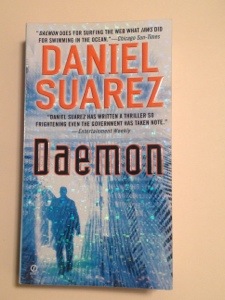
It’s about a computer program that gains sentience and plots to take over the world. As a technologist, I enjoyed it because Suarez gets the computer stuff correct. Of course, he has to invent some technology that doesn’t exist yet, like sentient computer daemons. But, overall it’s a frightening look at one possible future as we continue to automate our systems. Suarez’s daemon uses much of our existing technology against the humans who are trying to contain it.
I finished the book about the same time I noticed the LA traffic light story.
So, what’s the worst that could happen?
You might think that the worst thing the computer virus could do would be to turn all the lights to red, or maybe simply turn them off entirely.
But, the more I thought about it, the more I realized that rather than turn the lights all red, the worst thing the virus could do is turn them all green instead. If the light is red, we all stop. Eventually, we’d figure out it’s not turning green for anyone and we’d treat it like a 4-way stop sign. The city would grind to a halt.
On the other hand, if the lights all turned green, we’d speed through an intersection and get t-boned by someone coming the other way. Every intersection would become a pile of twisted wrecks.
Because I’m a manager, I immediately thought of LA’s traffic lights as a metaphor for our projects. One of the recent positions I worked at, our portfolio, or department had about 40 active projects at any one time. We were constantly spinning up new projects, finishing existing projects and evaluating the burn rate of current projects. If you announced a freeze on all our projects (turn the lights to red) we’d have a whole lot of folks sitting around with nothing to do. But, we’d be able to reevaluate and restart projects as needed. We would blow our schedules, but we would not blow our budgets. On the other hand, if you came into our portfolio and green lighted every project on the board, we’d quickly run out of money, and we would run out of resources. We’d have a whole bunch of collisions as projects that should be done in sequence were all of a sudden started in parallel.
Our company had a very conservative leadership structure. It was a non-profit and the members of the board were not technologists. One of them came and spoke to the IT department one time.
“We understand that you want to push the technology forward. Please understand that we are forcing a slower pace on purpose. As an organization we have to be more conservative than you would like.”
So, the next time you are frustrated by upper management delaying a project, think of LA. The worst thing that could happen would not be turning all the lights red. The worst thing would be to turn them all green.
Tell your friends about this!

“So, after the band is done, I just thank everyone and send them home, right?”
“Yeah, pretty much.”
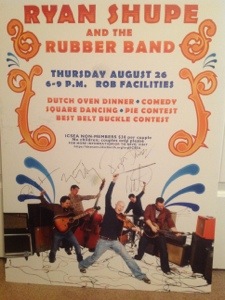
Ryan Shupe and the Rubberband were playing our company party and I was the MC. The band had been good, but I was frustrated. I knew a little bit about schedules and how to put a schedule together. A lot of what Program Managers did was balance the resource, schedule and feature triangle.
Our schedule tonight had been pretty set. Arrive at 6:00pm. Dinner at 6:30pm. I start introducing the program at 6:45. The Band comes on at 7:00 and plays for 90 minutes or so, and we send everyone home by 9:00; late enough that the babysitter has put the kids in bed, but early enough that there’s still time to catch The Office.
That was the schedule I’d been handed, and I was comfortable with it. I figured I’d have plenty of time while introducing the band to share some of the corny jokes I’d written that poked fun at some of the executives.
I arrived about 5:30pm and immediately found Kent, the guy in charge of setting up the annual Employee Association appreciation dinner, next to a table full of laptop bags, pens, notebooks and other trade-show faire.
“So, what’s all this?”
“Oh, these are the door prizes.”
“How are they going to be given out?”
“Any way you want.”
I watched the buffer in my schedule start to evaporate.
“There’s a lot of stuff here. How many prizes are there?”
“About 30, but these gift certificates go to the winners of the pie eating contest and the best belt buckle. Figured it would fit with the western theme. Oh, and we’re asking the band to give out these iTunes cards.”
“So, how will I know who wins the belt buckle contest?”
“Totally up to you. However you want to choose it is fine.”
And there went the last of my schedule and then some.
“So, am I judging the pie eating contest too?”
“Oh no, we didn’t want to put too much on you so we’re having the band do that.”
Do you have any idea how long it takes to give out 30 door prizes? At least 30-45 seconds each. And that’s being fast about it. And not only did I have to find the time to hold the belt buckle contest, but I had to think up the rules on the spot. Don’t think I was going to just randomly pick someone. Our CIO was entered.
The result was the crowd voted someone other than the CIO best belt buckle, we managed to get all the door prizes given out in a reasonably equitable manner, the band went on about 20 minutes late, and I got to deliver less than 2 minutes of the jokes I’d practices. I was eating my lasagna and trying to let the band lift me out of feeling annoyed.
I had succeeded in masking my displeasure from Kent. After all, he’d been planning this for months and put in a lot more time than I had.
“Yeah, once the band is done, just thank everyone, remind them to drive safe and send them home.”
“Got it.”
They are a very talented group. It was easy to be enthusiastic about thanking them for the entertainment. As I was wrapping up, wondering if I had time to slip in a joke a two, Kent emerged from the door to the green room and joined me on stage.
“And let’s have a nice round of applause for Kent and his committee and the hard work they put in!”
“We have just a few more prizes to give away.”
“Excuse me?”
The iTunes cards. The band decided they didn’t want to interrupt their act to take the time to try to give them out. I didn’t blame them.
“Ah. . .What do you have in mind, Kent?”
“Trivia! Who knows what year Ryan Shupe and the Rubber Band first performed?”
Okay, maybe a bit obscure, but he’s got a plan, I’ll let him go with it. After finding a winner he turned and handed me the rest of the cards.
“That’s the only one I know.”
At least I had some warning on the belt buckle thing. Two hundred people staring at me, wanting to leave but too polite to go home, even though we were already 45 minutes late, and I’ve got nine more prizes to give out.
I asked some random question about company leadership, mostly just to buy time to think of more questions. That’s one down. Eventually, I seize on geography.
“Who lives the closest?”
“Farthest?”
Two more down, Six to go.
“Who’s worked here the shortest?”
“Longest?”
Oh good, a tie. Three more down, only three to go.
“Who has held the most different titles?”
Give me a break, I was running out of ideas. Finally a tentative guess from the back. Great! You win. Two left.
“Whose name appears earliest in the Address Book? . . .Last name, not first.”
“And whose name is at the end?”
“Great. Thanks for coming. See you on Monday!”
And we are out!
There were two big mistakes here. One by me, one by our committee. My mistake was that I didn’t engage early enough. I assumed I knew the schedule and whatever I didn’t know I could handle on the fly. I did, but it was pretty frustrating.
The second mistake was the committee, and it’s a common mistake. They wanted to give door prizes. That’s a good thing. But, they didn’t consider that EVERYTHING has a cost. In a sense they wanted to put more features into our project. And just like a development project, if you add features, you are going to end up blowing your schedule.
It’s hard to say no to good features. But, as a project or a program manager, you have to manage the tradeoff between features and schedules. And at some point, you have to cut off the features and say, “THIS is what we are shipping.”
If you want to learn from my experience, it’s never a good idea to try to cut features in front of your customers.
Tell your friends about this!
“The Master Domain will control the entire organization. An email system never has more than a single Master.”
“So, where do the user accounts reside?”
“They all go into various Slave Domains. You can have as many Slaves as you want.”
Dead silence. . .
“What?”
Masters and Slaves
The year was 1989 and along with other members of WordPerfect’s elite email support team, I was being briefed on the architecture of the next version of our email program. (WordPerfect Office 3.0.) The developer who was explaining the design to us honestly had no idea why we were stunned to silence. At WordPerfect, like many software companies, programmers didn’t talk to customers. That was the job of Support.
In software development, especially in the late 1980’s a “master/slave” relationship was well understood and really not noteworthy. It simply defined a one-to-many relationship, where the “one” was the dominate system. However, what the developer was explaining was not just the architecture, but the nomenclature that our customers would need to define. He was suggesting that we tell our customers to create a system that they would see as resembling the Antebellum South.
It was actually Richard Bliss, who readers may remember as the one who told me “Now Would Be a Great Time to Shut Up,” who came up with the terms that ultimately got adopted.
Master => Primary
Slave => Secondary
It conveyed the same relationship without risking alienating our customers, and inviting lawsuits.
Assaulting eMail Servers
An insensitivity to racially charged terms wasn’t our programmers’ only gaffe. Once we got the system set up and running in our lab we noticed that the Connection Server (CS), a kind of “traffic cop” for routing email was committing lewd acts on our other servers. The CS had to check if a destination server was online before it attempted to move files. Naturally it “probed.” And it had to log this information to the screen.
That may not sound bad until you realize that email administrators often gave their servers personalized names, such as cartoon characters. So, the CS log screen showed
>>Probing Bambi
Again, this might not have been catastrophic if the CS server didn’t try to restart an offline mail server.
>>Probing Bambi

<< Bambi is down

>>Upping Bambi
I don’t remember what we got them to change it to. I think it might have been
>>Checking Bambi

>>Restarting Bambi
You can read an excellent history of GroupWise, written by my friend Willem Bagchus here. I’m not sure Willem ever forgave me for leaving WordPerfect and going to work for Microsoft.
I love working with developers and engineers, but they do sometimes need a filter between them and customers. That filter is supposed to be the Program Managers. But, even PMs can be guilty of picking the wrong name.
Microsoft’s Beavis & Butt-head?
After leaving WordPerfect in 1992, I went to Microsoft to support Microsoft Mail as they readied the first version of Microsoft Exchange. Microsoft, like most software companies, uses codenames for their products while they are in development. Apple, for example is famous for naming their new versions after big cats. Microsoft has been through many themes. “Chicago” was the code name for Microsoft Windows 95, for example.
The PM typically gets to pick the name. Microsoft Exchange server and the email client were codenamed “Beavis” and “Butt-head, of MTV fame. Developers could talk about working on “Butt-head.” Testers could report, “I’ve got a problem when Beavis loads and there’s not enough memory.”
The concept worked great. . .
. . .
. . .You know there’s a punchline here, right?
The concept worked great until we got close to the release date. Microsoft invited in the IT world press to show them the early versions of their new email program. They naturally wanted to showcase the cool stuff that the product would provide and keep people from switching to Lotus Notes, or WordPerfect Office (shortly before it was renamed Novell GroupWise.)
Imagine their embarrassment when they had to endure press stories talking about Microsoft’s new email system “Beavis and Butt-head.” (Not surprisingly I cannot find links to any of those old stories. This was before the Internet really took off, and Microsoft, I’m sure would be happy if that chapter never makes it to the net.)
That was the last time PM’s got to pick their own names. Microsoft designed an internal tool that all product names had to be vetted through. But, the damage had been done.
The real lesson is don’t let the developers name things customers will read and always vette your codenames.
“Temporary” names seldom are.
Tell your friends about this!

This is a picture of more than 4,000 5th graders from Pleasant Grove, Provo, Orem, American Fork and other towns in Utah County. The event is called Hope of America. It’s held every year in April. We’ve been coming to see our kids perform for five years. I have an 11 year old in that crowd somewhere. We have one more year, as my two youngest look forward to participating next year.
Obviously it is a HUGE undertaking. Admission is free. Four thousand kids means eight thousand parents.
Throw in Utah’s traditional large families , and you pretty much fill the BYU Marriott Center.

Why do it?
Because there are people willing to dare big things. In this case it is Kathy MacDonald. Eighteen years ago she envisioned a program to honor our nation’s veterans and involve gradeschool kids. Now, 18 years later, it’s grown to two nights. (The same number of kids will be there tomorrow night.) And it’s part of the Provo Freedom Festival.
Kathy had to make a pretty big leap of faith.
I’m a firm believer that the way to accomplish big things is to be good at accomplishing small things. Eat the elephant one bite at a time. But, there is a point at which the incremental approach starts to break down.
The Wright brothers first flight might have been short, but it represented a quantum leap. Alexander Graham Bell’s telephone wasn’t just a slightly better telegraph. When John Glenn climbed into the Gemini capsule, he was not taking his place as the first American in orbit by flying a slightly faster plane.
I worked for Microsoft in 1995 when the infamous “Internet Memo” went out. It’s easy to think of the Internet as having always existed. Sure, we all know that it was invented back in the 1960’s and was mostly for research. (Okay, maybe it’s geeky IT folks who know that.) However, in 1995, the Internet as we know it today really started taking shape.
Microsoft bet big on the Internet. Interestingly, they were considered too late. Netscape had the browser market locked up. Microsoft had Office products and they had the desktop, but they really were too late to get into the Internet.
And then Microsoft bet big. They put everything they had into pivoting the company to becoming an Internet company. There was no guarantee that it was going to work. If it didn’t the computer world would look much different today.
For small businesses, those type of big bets typically involve deciding to hire their first full-time employee. Prior to that, a sole proprietor can make incremental changes. But, bringing on a full time employee can be a frightening experience.
I remember talking to Alan Ashton, the co-founder and president of WordPerfect corporation about making the jump from a partnership to hiring full time employees.
“I remember it was at a Christmas party, and one of our developers came up and said, ‘Alan, I just closed on a house!’ He was very excited, but my stomach tightened up and I thought, ‘We’ve GOT to make payroll.'”
What makes those moments so challenging and stressful is the knowledge that things could go wrong.
I had a chance at one point in my career to leave the IT industry and go into partnership in the whitewater rafting business. It was a huge gamble. I took the bet. The venture failed.
I learned a ton from the experience.
So, failure is an ever present specter, waiting like a wolf circling a herd, for any sign of weakness.
But, being able to make that jump is essential to growth. And sometimes you’ll discover something magical.
The final number for the Hope of America is called “We Can Be a Light.” They turn down the lights in the arena and all the kids pull out flashlights.
The results are pretty spectacular.

Dare to Do Big Things
Tell your friends about this!
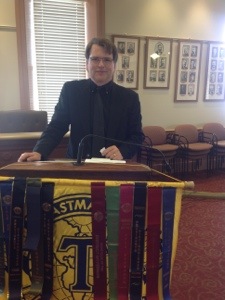
I’m a member of the Olympic Orators Toastmasters Club of American Fork, UT. This is a speech I gave recently.
I’ve had friends ask why I joined Toastmasters? After all, I was a corporate trainer for Microsoft for years, presenting classes all around the world. I also trained other trainers. I’ve run companies where I had to make presentations to my investors and my customers. I’ve held senior manager positions where I needed to regularly present to upper management. I’m not what you’d call shy and I do a reasonable job of presenting.
There are two reasons I joined Toastmasters.
Lifetime Learning
I’m comfortable presenting, but there are certainly things I can learn. It would be pretty arrogant for me to suggest that I’m a good enough speaker that I can’t learn more.
Networking, Networking, Networking
I enjoy the opportunity to meet fellow businesspeople from my town. We meet at noon on Tuesdays to give people an opportunity to come during their lunch hour. I don’t need anything from my fellow members, but I want to be more aware of what’s happening in my town. And, most of the people I work with on a daily or weekly basis are in the IT industry. Not a single member of my Toastmasters club is an IT person. It gives me a great opportunity to talk to people in other industries.
So, here’s a link to the YouTube video of my recent speech. The theme was to deliver an “inspiring” speech. I commented on Martin Luther King’s August 28, 1963 “I have a Dream” speech. (Oh, volume alert, the applause is WAY louder than the rest of it. You should adjust your volume accordingly.)
Here’s the text.
————————————————————————————————————–
Introduction
Rodney Bliss is the father of 13 children, seven of them are Black, three are white and three are Asian. In his third speech, “From Dream to Reality” he will spend 5-7 minutes attempting to inspire us via references to a famous speech and explain specifically what that speech means for his own family. Please help me welcome, Rodney Bliss.
From Dream to Reality
(April 16, 2013 – Rodney M Bliss)
I want to take you back to August 28, 1963. It was a brutally hot summer that year. A summer that seethed not just with the heat of high temperatures, but high tensions. A summer wracked not just with conflicted politics, but with conflicted people.
On this day the national mall in Washington DC is crowded to overflowing. A crowd a quarter million strong, predominately Black, have come to Washington today. Come to hear a speech that will define not just a movement, but a generation.
Come with me for a few minutes to revisit that pivotal day and the remarkable speech that forever defines it.
A young Black preacher steps to the microphone,
“I am happy to join with you today in what will go down in history as the greatest demonstration for freedom in the history of our nation. “
He speaks for nearly 20 minutes and I have only 5 to 7. And my poor efforts pale next to his soaring oratory. He shares both his condemning view of our past and his prophetic hopeful vision for our future.
His voice spans the nation, telling us to
“Let freedom ring from the prodigious hilltops of New Hampshire.”
“Let freedom ring from the mighty mountains of New York.”
“Let freedom ring from the heightening Alleghenies of Pennsylvania.”
“Let freedom ring from the snowcapped Rockies of Colorado”
“Let freedom ring from the curvaceous slopes of California. Not only that, but let freedom ring from Stone Mountain of Georgia and Lookout Mountain of Tennessee.”
He tells us
“the Negro will never be satisfied, as long as our bodies, heavy with the fatigue of travel cannot gain lodging in the motels of the highways and the hotels of the cities. We cannot be satisfied as long as the Negro’s basic mobility is from a smaller ghetto to a larger one. We can never be satisfied as long as a Negro in Mississippi cannot vote and the Negro in New York believe he has nothing for which to vote. No, no, we are not satisfied, and we will not be satisfied until justice rolls down like waters and righteousness like a mighty stream.”
He has no way of knowing about a young Black boy growing up in Honolulu, Hawaii. A little boy who had just celebrated his 2nd birthday. The son of a white mother and a Black father. A boy who would someday not only gain lodging in the motels of the highways and the hotels of the cities, but would gain lodging to a house that while less than a mile from the spot where he stood, must have felt as inaccessible to that preacher as the surface of the moon.
Rather than walk the streets of slums, this boy will tread the halls of power. Rather than question for what to vote, he will be the one for whom they vote.
For over 150 years the Blacks had waited for the nation to honor the promissory note that all men are created equal. But less than 50 years later, the first Black president would stand on the shoulders of these giants to reach the heights of achievement. Dream indeed.
You are no doubt familiar with the most famous lines from the speech that day,
“I have a dream that my four little children will one day live in a nation where they will not be judged by the color of their skin, but by the content of their character.
I have a dream today.”
Great as this sentiment is, it’s the next paragraph that makes this speech particularly personal, poignant and inspirational for me.
“I have a dream that one day the state of Alabama, whose governor’s lips are presently dripping with the words of interposition and nullification, will be transformed into a situation where little black boys and black girls will be able to join hands with little white boys and white girls and walk together as sisters and brothers.
I have a dream today.”
Each night as I look at the faces of my children gathered around our dinner table, or kneeling with their heads bowed to pray, I’m grateful that my little Black boys and black girls can join hands with my little white boy and white girls, as well as little Asian boys and Asian girl and walk together as sisters and brothers. Dream indeed.
We still have a long way to go as a nation to recognize and realize Dr. King’s dream. But for me and my family, his dream has become my reality.
Thank you
Tell your friends about this!

There are certain locations that you just know to avoid:
1) WalMart on Christmas Eve
2) Disneyland during Spring Break
3) The Post Office on April 15th
These are deadlines that you know of well in advance. You can start planning in order to avoid these just about as early as you need to. My wife makes sure I avoid the first one. My kids help me avoid the second one and my CPA helps me avoid the third one.
So, what am I doing in line at the Post Office on April 15th?

Clearly today represents a failure in planning. As a Program Manager, I can give you all sorts of techniques for keeping your plan on schedule. I can help you strategize ways to build a buffer into your schedule to allow you to deliver on time and under budget.
But, what about when the “best laid plans” go awry?
Let me explain what brought me to the Post Office and then I’ll talk about what it means for your projects.
I live in Utah and my CPA, Bliss & Skeen is based in Olympia, Washington. With email and efile, it’s not much more difficult to work remotely. Occasionally we need to scan and email a document, but John Skeen has been my CPA for almost 20 years. He’s got all my information from previous years and generally my taxes go smoothly.
I sent my tax info off in the first week of February and John got them eFiled and a copy back to me a few weeks ago. We generally don’t sweat the schedule much since I nearly always get a refund (did I mention I have 13 kids?) and even if we end up a day or two late, the IRS doesn’t really care if you are late so long as you don’t owe them money. This year, as I was reviewing my copy of the return, I realized my tax situation had changed last year but John had completed my return with the previous years numbers. It was my error in not telling him about the change.
Well, now I’ve got a problem. The IRS already sent me my refund, but my amended return means they gave me too much. Now I owe them money. A couple of urgent phone calls and I got the amended return this afternoon. I printed it, waited for my wife to get home to sign it and ended up standing in line with those people who didn’t plan as well as I did.
What?
Yes, as project managers we have to acknowledge that sometimes things change. In this case it was my fault, but I couldn’t fix it. I had to go back to my CPA on his busiest day of the year and ask for more of his time. It was at this point that the 20 year history comes into play. Imagine if I were to walk in off the street and say, “Hey, does your senior partner have time to sit down and talk about some issues with my return?”
It’s important to be nice. That, in my opinion is the essence of Dale Carnegie’s “How to Win Friends and Influence People,” one of my favorite business books. Not only will your life be easier, and it’s generally a good thing to do, but there are times when you will need a favor. It’s impossible to build a relationship of trust during your crisis. Today’s mix up just meant that I had to spend some time hanging out in the Post Office. But, there are times where an equipment provider may have an unexpected breakdown, or the database team may deny your request long after they promised to fulfill it. I’m sure you can come up with any number of “what ifs” that can knock your schedule off line.
If you have to delay your milestones, so be it. But, the ability to absorb this type of a setback and still deliver on time is what separates extraordinary PMs from simply good ones. So, do your best to anticipate delays and mitigate those, but realize that somedays even your best plans are going to be knocked off track. Those are the times you need to draw on your other skills and relationships to get things back on track.
Tell your friends about this!

I got to do one of my favorite activities on Saturday; I got to attend a baseball game with two of my daughters. I watched the Utah Valley University Wolverines come up just short against the Houston Baptist Huskies, 4-3.
What made this day particularly enjoyable, was that my 16 year old daughter really wanted to know about the game. At the start she didn’t even understand the concept of an inning. By the end she was counting balls and strikes and asking why they left the pitcher in who’d just given up 2 runs. My 14 year old daughter, on the other hand was just there for the food. Both of them found the pictures of college athletes highlighted on the video screen VERY interesting.
I had to keep checking the scorecard to remember the name of the opposing team: Houston Baptist University Huskies. 
It made me think about the importance of names. The scoreboard showed “Wolverines vs Huskies.” We can simply mention names like Cubs, Yankees, Mariners or Dodgers and it brings to mind, for a baseball fan, images of team colors, uniforms, players, and memories of plays, games we attended. In 1957 the Dodgers moved from Brooklyn to Los Angeles. But, the name stayed the same and provided consistency. The records, the names, the history travelled with the team. It was still the same team.
In 2008 the Seattle Sonics became the Oklahoma City Thunder. In this case the records, the name and the history stayed in Seattle. Even though the players are the same, it’s now a different team.
It’s very possible that the Sacramento Kings will relocate to Seattle before next season. At that point they will be rebranded the Sonics, and adopt the history of the 1979 World Championship, the signature green and gold colors, the legacy of Gary Payton, Lenny Wilkins, Jack Sikma, Shawn Kemp and “Downtown” Freddy Brown. Again, it’s the name.
Identity
A team name provides an identity. Last summer I attended Woodbadge training. It’s basically like scout camp for adults. Attendees are randomly assigned to one of 10 patrols, Beaver, Bobwhite, Eagles, Foxes, Owl, Bears, Buffalo, and Antelope. There’s no real rhyme or reason to which patrol you are assigned to. I was assigned the Fox patrol. And yet, no matter what else I do in scouting I will forever be a Fox, and proud of it.

Organization
A team name also fills a practical purpose. It’s simply easier to refer to a group by a unique name. My friend, Howard Tayler recently talked about this in his award winning comic Schlock Mercenary.
 ((c) Tayler Corporation. Used with Permission)
I’ve previously talked about naming “The Biggest Team I Never Led,” the Redshirts. I came up with the name at the point I needed to create an email distribution list for them. Up until that point I simply went to an old email that included everyone’s address and reused it.
Pick the Right Name
Redshirts was not my first choice. It lacked any sense of history. It did imply a certain level of technical competence. After all, it was based on Star Trek’s Mr. Scott, the greatest miracle worker in cinematic history. But, it also conjured images of Redshirts dying in the first 15 minutes of the episode to show how serious the situation was.
My original choice was “Screw-ups.” This was a name that had history. The team completely understood it and took pride in their non-conformist reputation. Several of the team members encouraged me to use that as the team name.
Ultimately I didn’t use it. The team would have understood it, but anyone else that happened to see that name on an email wouldn’t understand. They would assume I was insulting my team.
I ran into the same problem when I managed the “Messaging and Collaboration” team. My team maintained the Microsoft Exchange and SharePoint installations. I named my team the “MAC Team.” It was a simple name. It was pronounceable. It was also a terrible name. We supported Window and Linux, but the one desktop OS that we did not support was MACs. So, having a team named “MAC” led to huge amounts of confusion. After a couple of weeks we switched it to the “CAM Team.” The SharePoint guys were happy to finally get top billing!
Teams inspire a sense of collectiveness that is difficult to achieve other ways. As a corporate trainer, one of the exercises that I use to personalize introductions is to ask people to give their name, their department and their high school mascot. Even 60 year old senior computer managers remember that they were a Knight, or a Blazer, or a Tornado.
This technique works great except when I teach in Europe. While Europe has high schools, the schools do not have mascots.
Names are an important way to build loyalty, and to uniquely brand your team. Just make sure you pick the right name. And if you don’t support Macintosh, don’t name your team “The MAC Team.”
Tell your friends about this!

“What do you think you’re doing?”
“Ah. . .What do you mean?”
We were on a break during a presentation to a large software company in Provo, Utah. I’d recently left Microsoft to try private consulting and my brother, VP of Marketing for an anti-virus company had invited me to tag along for his presentation.
“I thought you wanted me to . . .”
“Now would be a great time for you to shut up.”
Okay, he probably worded it more politely than that. He is in marketing, after all. But, the message was clear. Sit down, shut up and stop embarrassing me.
The problem was I didn’t know what I’d done wrong. Clearly, it was something serious. I spent the rest of the meeting shutting up, and reviewing what I could have screwed up. I finally narrowed it down to a discussion about email administrators.
Someone suggested that an email administrator would switch email servers if management made the decision. I disagreed. Most email administrators I knew, were passionate about the product they were running and I suggested they would put up a fight if management tried to force them to switch. The thing was, I was sure I was right. Even now, years later, I’m convinced I was right.
It didn’t matter.
After the meeting my brother pulled me aside.
“You embarrassed that VP in front of his entire staff!”
“Huh? How?”
“You basically said that he was wrong about his customers.”
“But, he WAS wrong.”
“It doesn’t matter. All anyone’s going to remember about that meeting is that you aren’t smart enough to avoid insulting a senior manager!”
I had just run into a major Culture Wall. I’d face palmed into it actually. I’d made two fatal assumptions. I’d assumed that I understood the culture. And, I’d misunderstood my role. I wasn’t there as some sort of expert witness. I was there as a FAVOR from my brother. He didn’t need me, but I needed him, and I screwed it up.
I’d just come from a decade at Microsoft which has a much different culture than this Provo company. At Microsoft, if you are in a meeting with senior management and you have information they don’t, you are expected to speak up. Even if it’s Bill Gates himself that you are disagreeing with. If you can’t handle that level of confrontation, you went to work for the wrong company.
This company in Provo had a much more traditional power structure where you were expected to show a certain deference to those in leadership positions.
I should have known better. I’d seen the same thing in reverse while at Microsoft. I worked on a team, writing training materials for Microsoft Exchange. We hired a new team manager. Julie had previously worked for Boeing, which has a much different corporate culture than Microsoft.
One of the first things our new manager wanted to do was take several hours and create a team “Mission Statement.” She led us through several iterations of writing one of those long complicated sentences that tries to capture everything without a pause for breath. We didn’t see much value in it.
“Tell you what, Julie, let’s just make it ‘We’ll Learn Ya’ and call that good?”
And with that, the il-fated “mission statement” writing exercise was done. Rather than try to learn the Microsoft culture, she had assumed that what had worked at Boeing would work at Microsoft.
It’s generally a good idea to spend time listening before you start to talk. That, or risk being told to shut up.
Tell your friends about this!
It’s sounds crazy, but I once worked for a company where they lost the keys to a conference room. I’m not sure why they had a lock on the conference room anyway, but someone locked it and no one could find the key.
We simply scheduled around it, shifting meetings to a conference on the second floor. I was new to the company. I think I’d been there about a week, as manager of the Exchange and SharePoint engineering team.
I assumed that someone, somewhere had a key and eventually we’d have access to our conference room again. But days turned into weeks. I would occasionally check in with our Administrative Assistant. But each time got the same answer, “They’re still looking.”
No one wanted to hire a locksmith to try to pick a lock for a conference room so there we sat.
One day our team meeting conflicted with another meeting in the overbooked 2nd floor conference room.
“Hey Ed, let’s hold our team meeting in the 1st floor conference room.”
My lead engineer just stared at me.
“That’s the conference room that’s locked.”
“Yeah, I know. Grab one of those tall stools from the break room and meet me outside of the conference room.”
Ed was about 6’4″. We needed height.
A few minutes later he arrived outside the conference room with the stool. After making sure that there were no witnesses I explained my plan.
“I’m probably breaking a bunch of OSHA rules by asking you to do this, but I want you to climb up on this stool, pop the acoustic ceiling tile and use the loop I’ve formed in this mouse cord to snag the door handle from the inside and pull it up.”
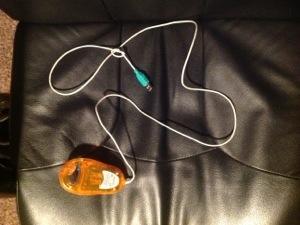
And just like that, Engineering had our conference room back.
Our Admin was naturally curious when I told her that the locked conference room was now available.
“Who unlocked it?”
“I have no idea.”
Our company was big on rules, process and procedures. There was no way I was going to expose one of my engineers to any possible reaction.
Now, you’re probably saying, “Rodney, that’s stupid. Who would really care so long as the work got done?”
Trust me. People care.
Many years before the mouse in the conference room, as a new engineer at Microsoft my team was moving from a cube farm on the 5th floor to a cube farm on the 6th floor. As anyone who’s spent time in a cubicle can tell you, there’s a big difference having your desk at 28″ or 32″ or even a stand-up desk at 48″.
As we were settling into our new digs, we all started adjusting the modular furniture, and the height of the desks. You had to remove a couple of screws and then move the desk sections. We’d all done it multiple times, and just got busy making the changes.
Everyone except Stan. Stan instead decided to email the maintenance group and ask them to come adjust his desk. This was the proper procedure, but it also could take days to get a response. Stan knew it might be a while so he ended his email with this:
“If you cannot get to this request in the next 24 hours, I’ll just go ahead and make the adjustments myself.”
Forty-eight hours later two large maintenance guys showed up and explained to Stan that it was a violation of company policy for anyone except authorized maintenance personal to adjust the desks.
They looked at the rest of us and said, “Who adjusted these other desks?”
“We have no idea. . .They were like this when we arrived.”
Just because you find an engineering solution doesn’t mean that you have to advertise the fact.
Tell your friends about this!

Microsoft Sales Guy: “We think Microsoft Exchange 4.0 will work great for Australia Telecom.”
Australia Telecom: “You first.”
Back in the 1994, Microsoft was getting ready to release their newest email program, Microsoft Exchange 4.0. Interestingly there was no Microsoft Exchange 1.0, 2.0 or 3.0. But, there was a Microsoft Mail 3.0 program. And it wasn’t very good. I should know, I had to support it. In fact it was so bad that at Microsoft, we didn’t run it ourselves.
We ran something called Xenix mail. Considering that we were trying to sell Microsoft Mail, the company didn’t really advertise the fact that we didn’t use our own product. Even internally, it wasn’t well know. At one point in 1993 a guy in Support wrote a book on how to use Microsoft Mail. The problem was he used his corporate account for all his screenshots. We were pretty surprised when support started getting calls asking how to access the features that only existed in our corporate system.
We had a chance to sell Aussie Telecom on Exchange. They were a huge account. One of their stipulations was that Microsoft go first. We had a rapid internal rollout to get everyone on the new email system before the date the contract was supposed to be signed.
So, what’s it have to do with dog food?  The phrase “eat your own dog food” means to use your own products.
Generally this makes sense. If Microsoft won’t run their business on their products, why should you?
Similarly, when Pepsi officials travelled to Redmond to discuss adopting Exchange with the development teams, Microsoft removed the Coke machines from every breakroom in the building.
This lesson applies to each of us as well.
My daughter manages a Standard Optical store in Orem, UT. If you need glasses, contacts, or LASIK, stop by and ask for Ila. You’ll notice she’s wearing glasses. She has perfect vision. But, if you want to sell people eyeglasses, you better be willing to eat your own dog food.
When I was in my local Macey’s store, I passed a guy in a WinCo shirt. WinCo is another local grocery store. His basket was full of food. . .there was no dog food.
Many years ago, WordPerfect adopted M&M candies as their snack food of choice. The sales guys handed them out like candy during presentations to clients. . .we didn’t get the Nestle account. The story is that the presentation was going great until he started tossing packages of M&M’s, manufactured by Mars Candies, to the Nestle employees.
Whether it’s your own company, not wearing a logo shirt when frequenting your competitors or not handing out competitors product, remember the concept of eating your own dog food.
(David Madison contributed to this report!)
