“In theory, theory and practice are the same.
In practice, they are not.
– Albert Einstein”
In theory, it made perfect sense. We were moving into a new building. One where the cube-farm had been specifically designed for us. Each floor was divided into clusters of six to eight cubicles. Two clusters shared a common team conference room. The team room literally had a door on each side that opened into the cluster of cubicles. In addition we had large conference rooms located elsewhere on the floor. This meant that the ratio of conference rooms to people was close to 1:10. If you’ve ever worked in a cube farm, you know this is a low ratio, and that’s a good thing.
Each team room was for the exclusive use of the two teams who shared it. As a team manager, this was great, especially since the managers didn’t have offices. In order to prevent team rooms from getting “hijacked” they were specifically NOT schedulable. All we had to do was coordinate with the team on the other side of the team room.
I managed the Messaging and Collaboration engineering team. We were going to share a team room with the Messaging Program Management team. Brian, the PM manager and I got along really well as we were rolling out the new Microsoft Exchange system. Our teams were two of the first to move into the new building.
In practice, our theory started to break down. Problems started almost at once. My first team meeting was Tuesday at 10:00am. At 9:55 I noticed that Brian had plotter paper spread across the conference table and was in the middle of an animated discussion with his team.
“Hey, Brian. . .ah. . .are you guys gonna be long?”
“Well, we’re trying to put together next year’s project plan. It’s probably going to be a while.”
“No problem.”
And with that we promptly hijacked one of the team rooms that was not yet assigned. Clearly if Brian and I, who got along really well, couldn’t share a room, other teams who were not as in sync with each other would have a worse time.
“Brian, I want to make the team rooms schedulable.”
“But the CIO expressly said they were NOT going to schedulable.”
“Yeah, I need your help to change his mind.”
The CIO had delegated the coordination for the move to his chief-of-staff, Jerry. Brian and I spent a couple of days working out the details of the plan. We decided that we would make the rooms schedulable, but limit the permissions to just the teams who were sitting next to that team room. We also made everyone who could schedule a team room an owner of that team room. That way, they could grant additional people access. Finally, we made the Administrative Assistants and me owners of every team room so that we could also grant access.
Jerry understood the problem immediately and we got his approval for our plan. My team created the team rooms as resources and then I spent a couple days with the seating chart adding everyone into the rooms they were assigned to; Eight Hundred people. Finally, I created a SharePoint site with instructions on how to schedule team rooms.
I completed this just as the bulk of the teams were moving in. Everyone loved our plan. They agreed that our new plan still allowed the teams to get the advantages of the team room, but also made it workable.
Everyone except, Matthew. Matthew was a director, meaning he had his own office and he did NOT like the fact that his team rooms were now schedulable. I talked to him about the problems we had encountered. He didn’t care.
I explained that I’d talked to members of his division and his engineers were requesting it. (Actually, they promised to give me their first born child if I made the rooms schedulable. The engineers REALLY wanted to be able to schedule the rooms.) He didn’t care.
He wanted me to remove “his” team rooms from the address book.
You are probably thinking, “Rodney, you had the chief-of-staff’s approval. Use that!” That’s the thing about political air cover, it’s important to have, but you never, EVER want to use it. I really didn’t want to get into an “escalation.” Remember that originally NONE of the team rooms were schedulable. While I didn’t think Matthew would get the entire building policy reversed, as a team manager, I didn’t want to force the CIO to choose between my plan and a director. It wasn’t worth the cost.
Matthew would not relent. He was convinced that the original plan to make the rooms not schedulable was the right course. Finally, it became obvious that he was willing to take his objections as high as necessary.
What would you do?
I punted. My final email to Matthew said,
“Since your team members are owners of the rooms, any of them can restrict access to the team room in the Calendar program. Simply go in and remove everyone’s name from the permissions list. The team room will stay in the address list, but anytime someone tries to schedule it, they will get a message saying, “You do not have permission to schedule this room.” Hopefully, this works for you.”
I had to go back to the engineers in his division and explain that their team rooms would no longer be schedulable. They knew that I’d pushed hard on their behalf, and appreciate my efforts.
We each have a certain amount of political capital to use in our jobs. In this case I decided getting 90% of the rooms schedulable was the most I was going to get. I didn’t want my plan to go from being a positive for my career to a negative. And, I’m pretty sure that his team eventually made him change his mind.
Tell your friends about this!


“I don’t understand why you can’t have your team pic-nic on a Saturday?”
“Mostly because I WANT people to attend.”
“It’s your team, do it your way. But, I still don’t get it.”
I enjoyed working for Mark. Even when he didn’t agree, he was the kind of boss who allowed his managers to run our teams the way we felt was right. In this case, I was explaining to him that my team was going to have a pic-nic on a Wednesday afternoon in June.
Like many organizations, our company set aside a certain amount of money each year for “morale.” This was about $50 per team member. Most managers, (including mine) used the money to take the team to dinner at Christmas time. I’m not sure where this tradition originated, but it was certainly not started by someone with a houseful of kids and trouble finding babysitters.
Don’t get me wrong. I think it was awesome that the company set aside money for the managers to do something nice with their teams during the year. We all put a lot into our jobs and it’s great when the company recognizes that and tries to give something back.
The problem with the company Christmas dinner was that it was not convenient. In fact, it was often a stressful event in the middle of stressful season. Scheduling was always a challenge. Finding an evening during the holiday season when everyone was free was impossible. The best that you could do was pick a day that inconvenienced the least number of people.
Our organization was staffed mostly with people who had families. So, now we also forced our employees to find a babysitter. When your family is as big as mine, that’s the work of several days, if not weeks to line up a sitter, or sometimes two.
We would normally have dinner at a restaurant somewhere. Figure there are 8-10 people on a team, add in spouses and you are booking a reservation for 15-20 people. That’s not a huge issue. We knew the dates well in advance. The problem is that when you sit down at a table with 18 other people, you are realistically going to be able to talk to 5 or 6 of them. If your boss and his wife are seated at one end and you are at the other, you can do little more than wave when you arrive and offer a quick, “Thanks for inviting us” as you leave.
Additional stresses were “How expensive an entree should you order?” The boss is at the other end, so you can’t really see what he’s getting. My company was all non-drinkers, but if you have alcohol, do you order a glass of wine? What if the boss orders a couple of bottles after you’ve ordered? And then there’s the challenge of “How long do you need to stay?” Long enough to be polite, but short enough that you aren’t taking the babysitter home at 2:00am.
Like I said, it’s a stressful event in the middle of stressful season.
I took a different approach.
Around Christmas time, I would take my immediate team out to a movie. One year we saw “Avatar” in 3D. We’d take a long lunch and everyone had a good time, and no one was expected to make conversation. (Yes my team was entirely men, how did you know?) I do the movie for two reasons. First, I want to make sure my team has a December event. For those who feel it’s required to do SOMETHING in December, this fits the criteria. Second, budgets get cut at odd times, and I want to make sure I’m spending at least some of my morale money the same time of year as everyone else.
But, the big event is planned for the summer. We take a Wednesday afternoon and find a local park. Everyone’s kids are out of school, so scheduling is not really an issue. We do it early enough that it’s not going to conflict with summer vacation plans.
I use the rest of the morale money to buy hotdogs, hamburger patties, brawts: whatever the team wants. We assign out the drinks, and salads and condiments. We bring softball equipment, frisbees, and even some golf clubs one time.
Unlike the Christmas dinner where you spend the evening talking to 4 or 5 people, the pic-nic allows you to mingle, to hold causal conversations with team members, their spouses and kids. The schedule is pretty relaxed too. We eat, and after that, people can come and go as they please.
My one rule is NO ONE is allowed to go back to the office. It’s a “work from home” day the rest of the afternoon.
The worry that my boss had about our pic-nic was that by scheduling it during the work day, we would be unavailable to handle any emergency issues.
Instead, my team all had cell phones and they occasionally had to take calls. They simply stepped away from the kids softball game and helped the customer. If there was ever a major emergency, the park was close to work. We could have been back in less than 10 minutes.
I don’t remember many of the Christmas dinners that I went to over the years, but even now, years later, my teams still talk about the pic-nics. And isn’t that what morale money is for?
Tell your friends about this!

“February is ribs.”
“Is Joel making them again?”
“Yeah, with that apricot sauce.”
“Awesome. We’re moving our router upgrades to February!”
This was a conversation that I had with one of my engineers. . . in NOVEMBER. We decided early on, that if we were going to ask engineers to come down to the datacenter and work all night, the least we could do was feed them.
Part of the reason was practical. Engineers started arriving at the datacenter between 5:00pm and 6:00pm for our 8 o’clock start. And we would often be there until 6:00am or later. And given the fact that our datacenter was at an undisclosed location on a university campus, and EVERYTHING within 3 miles was closed, we kind of had to take care of food and drinks.
But, there was another reason. People, especially engineers do weird stuff for food. My teenage boys will attend a church meeting that they have no interest in if there’s food. They lamented that they didn’t get to go to the kick off meeting for Girl’s Camp when their sisters came home with cookies and brownies. I often see similarities between my engineers and my teenage sons.
Planning the food menu was a fun exercise that was a diversion from our normal discussions of databases and load balancers. We tried to make sure that there was something for everyone. For one engineer it was Australian licorice. (“Yeah, But You Guys Are Screwups.“) And we had plenty of soda, chips, candy and beef jerky. But, the main course was where we tried to really show the engineers we cared about them. Pizza, sub sandwhiches, Chinese food; we mixed it up every month.
But, by far the best was ribs that one of our engineers would make. We typically had them about every six months. Joel, the chef/engineer asked me about it one time.
“Yeah, they’re pretty expensive. I guess you have to kind of limit it?”
“Not at all. I just know how much work it is for you to put it together.”
“But, they are pretty expensive. I mean it’s about $500.”
“Joel, how many people are we expecting in February?”
“I don’t know. . .50?”
“Probably closer to 60. We have to bill projects for everyone’s time. Let’s suppose everyone’s there the full 10 hours. That’s 600 hours. We bill our time to projects at $70/hour. So, our cost to projects for that night is $42,000. Five hundred dollars doesn’t even hardly show up.”
As I explained in “The Biggest Raise I Ever Received,” food, or in that case soda, is one of the cheapest incentives.
My friend Howard Tayler describes this idea as Maxim 7 of the “The Seventy Maxims of Maximally Effective Mercenaries“:
“If the food is good enough, the grunts will stop complaining about the incoming fire.”
My daughter, the soldier swears this is absolutely true.
In planning these maintenance windows, often my only influence over the engineers was based on mutual respect. Many of them didn’t have to schedule their tasks during my window. So, food was one of the ways I tried to motivate them.
It almost backfired on me one time. We had a minor maintenance window scheduled for one of our smaller datacenters. During our planning meetings, we realized that the entire window would only be a few hours and we’d only need a few engineers.
“Do we need to have food if we’re starting at 8:00 and we’ll be done by midnight?”
I THOUGHT I had agreement. A few weeks later we were gathered for the maintenance. It was me, and about 5 engineers. At about 9:00pm Gus asked one of the other engineers,
“Hey Brandon, wanna go in on a pizza? I’ll chip in half.”
I was surprised.
“Gus, why don’t you just order pizza and bill it to the project?”
“Oh, no they told us that we couldn’t order food for this one.”
“Gus, *I* am the THEY! If you want pizza, order pizza. I’ll approve it.”
And the engineers were thrilled. Best $50 I ever spent.
Tell your friends about this!
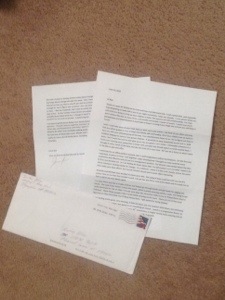
A man was complaining to his brother that his son in college never wrote him letters.
“I’lll bet you $100 that I can get him to write me a letter.”
“You’re on.”
Two weeks later the man showed his brother an envelope addressed from his nephew.
“How did you get him to write you? And so soon?”
“Simple. I wrote him a letter explaining that I understood college was expensive and I wanted to help him out by sending him $100.”
“So, he wrote back to thank you?”
“No, he wrote back to tell me I forgot to include the money.”
Is there anyone who likes email any more? If you’re in business, you probably set aside an hour or more per day just to sort through your email. My inbox has been as high as 1000 unopened emails. Anytime it’s below 50 I count myself successful. But, barring the occasional email from Mom typically
TYPED IN ALL CAPS ALTHOUGH SHE’S NOT ANGRY OR YELLING, BUT PLEASE CALL YOUR BROTHER,
who looks forward to that? Your coworkers probably text you if they need something quickly. Don’t get me wrong, email is an important business tool. But, as a way of communicating, it leaves a lot to be desired. That’s why I like letters. Regular typed, or better yet hand written, stick it in an envelope, put a stamp on it, and wait three days, letters.
I like to receive them, and you have to send them to get them. I have a group of friends and family that I’ve known for 30 years or more. They span a range of locations and professions. One is president of a television studio in California. Another is a pod caster in San Francisco. One runs his family’s garage in Spanaway, WA. Another is a software tester in Seattle. We don’t have a schedule, and sometimes we’ll go months without sending a letter. But, nothing brightens my day like finding a letter from one of them in my mailbox. . .my REAL mailbox, the one with the little red flag on the side.
Letters are inefficient. They take days rather than minutes to arrive. You have to pay $0.46, plus the cost of the envelope. They take longer to write.
Those are exactly the reasons I like them. When someone sends me a letter I know that they cared enough about me, about our friendship to go to all that trouble. In a day and age where I have 588 Facebook “friends,” many of whom I’ve never met, and over 500 LinkedIn! connections, it’s good to be reminded of people who I have a physical connection to and a history with.
And when I sit down to write a letter, I put more thought into it. I like to write by hand on a yellow legal pad. 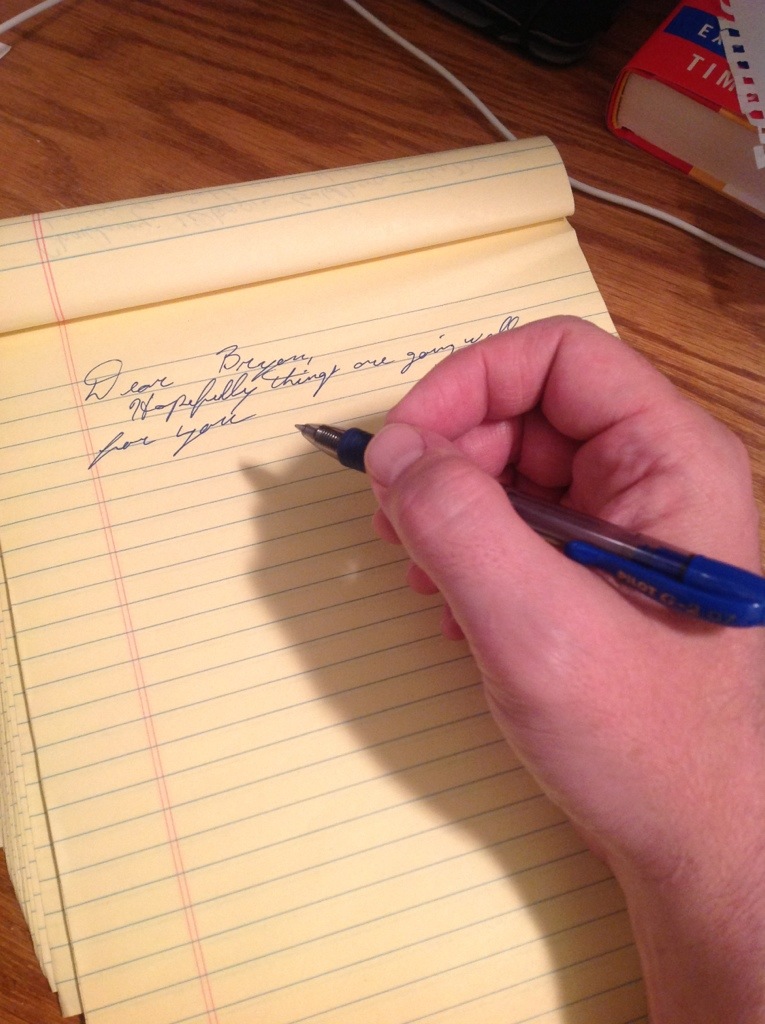 My handwriting has never been great so I have to slow down and focus to make my missives legible. Again, it helps me to slow down and think through what I want to say.
One of the funnest part of letter writing is to write to someone who I haven’t written to before. They are always shocked. I’ve gotten letters and phone calls talking about what an event it was to get a letter.
And it goes without saying that sending a handwritten note after an interview leaves a much more lasting impression than a quick email. Although, if you can’t find a stamp, send the email rather than doing nothing.
So, write your mother!
Tell your friends about this!


Sure, I want it both ways. Yesterday I explained to you “Why I’ve Abandoned Physical Media.” And yet the day before I wrote a post explaining “Why I Still Use Physical Media.” I’ll admit that I’m not even consistent, since I talked about books, especially our family Bible, being something that should be physical and then I talked about books being some of the things I’ve started using digital versions of.
So, it’s not about the media. It’s about
– What’s the content?
– What’s the purpose?
– How long is the content valuable?
So, it’s how we use the information that determines the media, not the other way around.
What’s the Content?
I’ve talked about the fact that I love books. But, unless it’s an autographed copy, I’d just as soon have it on the Kindle or the iPad. Encyclopedias? I don’t know if libraries even have them much any more. Google and Wikipedia not only have more content, but are constantly updated. It brings up the authentication dilemma, of course. When I wrote my first book, Microsoft Exchange Connectivity Guide, it was published by Microsoft Press. We had editors and tech reviewers. MSPress wanted to make sure that the information was complete.
The book I’m currently working on will be published online. I’ll release it through Caledonia. Danita, the publisher will expect that I know what I’m talking about. I’ll be responsible for tech reviews. It will most likely be an eBook and if it sells well, we’ll consider bringing out a print edition. Even then, gone are the days of a 10,000 copy print runs. We’ll do print-on-demand.
I love to write. Much of what I write is online, of course, but occasionally I also write for me.
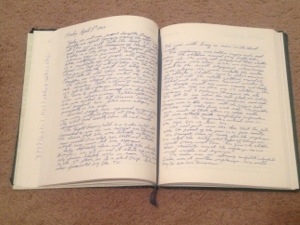
There’s something therapeutic to taking pen in hand and recording the news of the day. I don’t always write as often as I should. Whenever I travel, I take this journal and write at least a single page from whatever location I’m at.
What’s the purpose?
And that leads to the second question. Why? For what purpose are you creating or using this content?
This is why I don’t mind moving to virtual media for music. The purpose is to listen to the music. Putting all the music online, means it’s that much more accessible. . .if I’m online. I still have CDs in my truck since it doesn’t have a Bluetooth, or an input jack. The White Album is still going to be the same whether you listen to it on vinyl, cassette, CD or streaming. Oh sure, there are those purists who will talk about the snaps and pops of the old phonographs. Great. If that’s the reason you are listening, then go ahead. For most of us, we just want to know what happens to Rocky Raccoon, and exactly why Gideon left his bible.
Unless I’m buying a book to be autographed, I just want to read the story. There are some books I have both on my Kindle and in paperback. I read the Kindle. The form is better. Even the Bible, I read on my iPad much more than I do the hard copy version. The LDS Church recently updated their version of the scriptures. I know that sounds weird. They didn’t change the actual scriptures. They updated the chapter headings and some of the footnotes. Not only did the iPad update, I didn’t realize it until we were reading the book of Exodus as a family and my chapter heading was different.
Most of our pictures fit the same category. I used to be a reasonably good photographer. I had a Pentax K1000 and shot hundreds of shots through it. I had to adjust the focus, the f-stop and the shutter speed manually.

Now? I take pictures with my iPad. The resolution isn’t great, especially in low light. There’s no way to adjust the f-stop or shutter speed, as far as I know. These pictures don’t look nearly as good as the pictures I took with my old Pentax. But, what’s my purpose? I’m not trying to create art. I just want a snapshot of my kid opening their Christmas present.
How long will you keep this content?
Answering the final question is less clear cut. That snapshot of my kid at Christmas? Yeah, I probably want to keep that. My Beatles songs? I don’t really care. I’ll probably end up buying them at least a couple more times.
But, those family Bibles, both mine and my wife’s? Yeah. We want to keep those for a long time. My journal? I’ll want to keep that, and hope that my kids find value in it after I’m gone. My autographed book collection? I doubt anyone will really care about it after I’m gone, but for me, it’s valuable.
And there is content that is important, or at least desirable in multiple media. I’ve talked before about my friend Howard Tayler, and his award winning comic Schlock Mercenary. I’ve joked to Howard that he’s the only man I know whose business plan is to draw a comic everyday and give it way for free on the Internet. All 12 years of his stories are available in the archives. Clearly that doesn’t provide much of a return on investment for him. However, I also buy the collections he releases in book form.
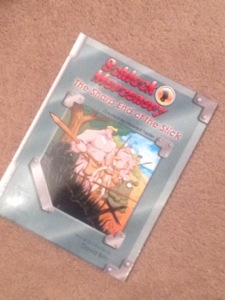
It’s the same story, with an added bonus to incent me to buy it.
So, while I’m a technologist at heart and more than happy to store much of my life in digital form, I’ll always have a library full of books, and for certain things, I’ll stay old school.
Tell your friends about this!

“Looks like I’m gonna have to buy The White Album again.”
– Kay
Yesterday, I explained “Why I Still Use Physical Media.” Today, I want to turn the tables and explain why I’ve abandoned physical media.
Music
I love music. Growing up, our house was always full of music. My parents split up when I was very young and I remember my mother dating country music musicians. She dated Buck Owens a couple of times. But, I learned to love all genres. I was introduced to The White Album via my brother’s record collection. I still remember the day I dropped one of the records and it created an irreparable scratch across one side.
I don’t have any of those anymore, but I do still have a few of these.

This is the Hitchhiker’s Guide To the Galaxy radio program. (Probably why I still have them.) In high school I had stacks of these, including The White Album. I skipped the 8-track phase, but eventually, along with everyone else I moved on to CD’s. Where I again bought The White Album. Fortunately, I now had more income and I at one point owned over 500 CD’s.

My tastes as you can see in this picture of a few of the cases, range from Classic Country to Quiet Riot. I owned the entire Beatles catalog and everything that Billy Joel ever recorded. And I do mean EVERYTHING. (BTW, The Hassles? Terrible. Trust me!)
I don’t use these much anymore and if it weren’t more trouble than letting them sit in a box, I’d go sell them at E.F.Y while they still hold some value. I put all of those CDs and dozens more on this.

And I’ve got room for movies and plenty more songs. Now that I’ve moved to an iPad, all the music has followed me to the new platform. I haven’t moved to Rhapsody yet, but that’s probably coming soon.
Books
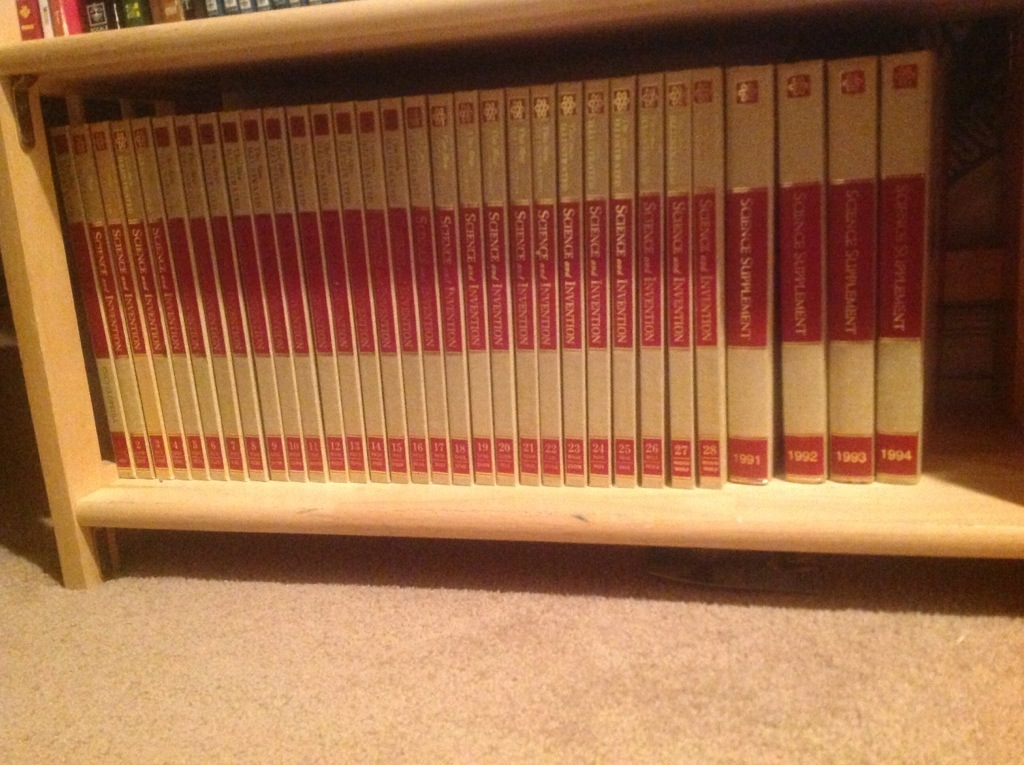
Yesterday you saw some of our library and we love books. We don’t open these much anymore.
Even my Kindle is starting to look a little old fashioned.
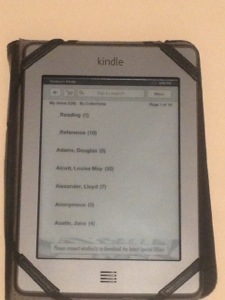
For reference, no bookshelf in the world can hold even a fraction of what is available on www.google.com. And even for novels, I can take my iPad or Kindle and have more books than I could read in a hundred hour plane trip, or a month long vacation spent lolling by the pool.
Movies
We can tell a similar tale with movies. We invested a lot in VHS tapes when the kids were young. We still have a couple hundred titles. Here are just a few.
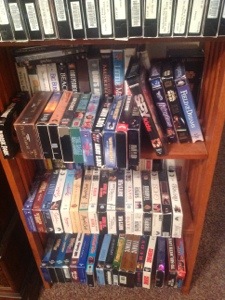
We moved to DVD, along with the rest of the world.
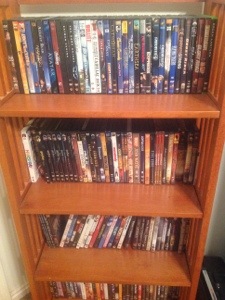
We will most likely skip the BlueRay format. It’s just too expensive to try to replace our library when Netflix is $8/month. Last month we upgraded our internet connection to 50MB, (Why Did You Switch and What Took You So Long?) At that speed, we can stream movies as conveniently as playing the disk. And for less than the cost of a single DVD we can have access to thousands.
Pictures
We have stacks of pictures.
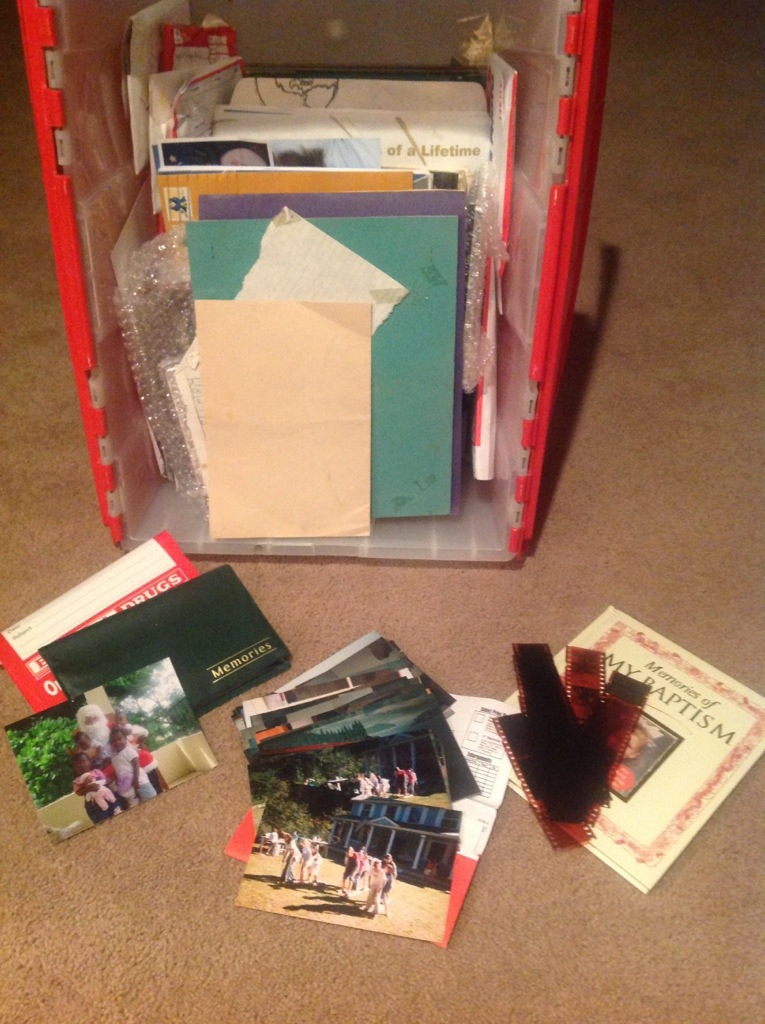
Most of them haven’t been unpacked in the last three or four moves. See those brown strips? Yeah, back when you had to use film, you had to consider a picture carefully. Was it worth the cost of developing? And to think that we had to wait for days to find out that someone had photobombed our picture of that cool girl at school.
Today, instead of boxes of prints and negatives, I carry this.
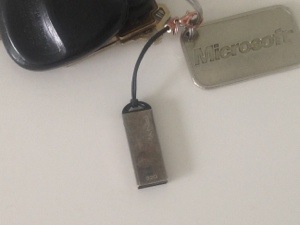
It’s 32GB and holds many times more pictures than are in that bin. Sharing a picture with the kids’ grandmother is as simple as sending an email. Making a backup of every picture is as simple as dragging and dropping to a new folder. And rather than be stingy with exactly which photos to take, we take dozens and simply delete the ones that got photobombed too badly. One other benefit is that it won’t be long before all photos will be tagging people automatically. No more wondering who that person with the lamp shade on their head was. Well, so long as they don’t wear it over their face.
So, while some things should be on physical media, there are definitely items that work best in a virtual form.
Tomorrow, I’ll talk about what makes the difference.
Tell your friends about this!
I love physical media. There, I’ve said it. I’m not ashamed. There are times where I really, really like the dead tree editions.
This Bible was published sometime in the 1800’s.

It’s been in my wife’s family for generations. In fact, it was originally given to her grandmother, for whom she was named. My home library is evidence that books in general are a big part of life at our house. These are just a few of the dozen or more bookshelves that adorn every room in our house.

There’s a certain visceral attraction for me to books. Especially old books. The idea that there is some innate value in a volume that I can gain and in turn others after me will likewise gain helps me see my place in the universe.
We don’t use this Bible for everyday use, of course. We pull it out on Christmas Eve to read the story of Christ’s birth, and on Easter to read the story of His death. In fact it’s not a particularly useful book. In addition to the King James Version of the Old and New Testaments, it includes a “new” translation and some explanatory information about 19th Century religious sects. Nearly all the commentary is out of date.
My iPad includes a version of the scriptures that are cross indexed, hyperlinked to multiple references and maps.

This is the latest iPad with 64 gig of memory and Retina display. It was the best you could get when I bought it three months ago. However, it will lose it’s spot as the premier iPad as early as this summer. In five years will I even still have it? (Possibly, I still have some old Pentiums that my kids use for arcade games.)
But, most likely, no one will be impressed with it. Ten years? It will be quaint. Twenty years? There will be no software for it and probably no power adaptors will work for it. Fifty years? Not a chance. One Hundred and fifty years? It might be valuable as an antique, but somehow I doubt it.
But, look forward 150 years and my wife’s family bible will be even more valuable. It will be over a quarter millennia in age. With proper care, it might still be used to read the Christmas and Easter stories.
The Bible has one other feature that makes it nearly worthless as an antique, but priceless for our family. This is the list of births and deaths. The earliest is Wilson Martin who was born on March 15, 1851. The last entry is Fay (Martin) Cooley who passed away on January 24, 1984. My wife’s father’s name and birthdate is recorded here. A scanned picture of these pages would convey all the same information, but lose all of the history.
This is a copy of my Family Bible.

Had I known I was going to have so many kids I would have written smaller. . and neater. I’ve recorded my kids birthdays, adoption days, and my oldest daughter’s wedding information.
I have no idea if it will last 150 years. Obviously I’ll be long gone. But, if it is still in possession of some Bliss descendant, it won’t matter what the current USB interface is. It won’t matter if we are still plugging devices into the wall, or we’ve mastered charging through the air, this book and this format will still work.
For some things, I still use physical media, and always will.
Tell your friends about this!

It’s not as easy as you would think. There’s five areas you need to consider.
1. Story Craft/Development: Was the story a good lie? Did it begin as apparently truthful and plausible, and then at some point become obviously impossible and bald-faced?
2. Originality: Is it unique? Is it based on a familiar tale, told with an original flair?
3. Effectiveness: Were the listeners entertained? Did they get caught up in the lie? Could this lie be told anywhere in the English-speaking world and anybody would recognize the trnasition from plausible to preposterous?
4. Presentation: Was the lie well told? Were the characters distinctly recognizable and consistently represented through? Did the teller’s use of voice, gesture, facial expression, and eye contact contribute well to the lie?
5. Time Limit: Did the lie stay at 6 minutes or below?
These are the judging criteria for Utah’s Biggest Liar’s Contest, part of the world famous Timpanogos Storytelling Festival. This year, like the last two years, I was invited to be a judge. It’s a chance to reunite with friends and hear some fantastic storytellers. I’m pretty good at public speaking, but I lack the ability to lie convincingly. . .or entertainingly.
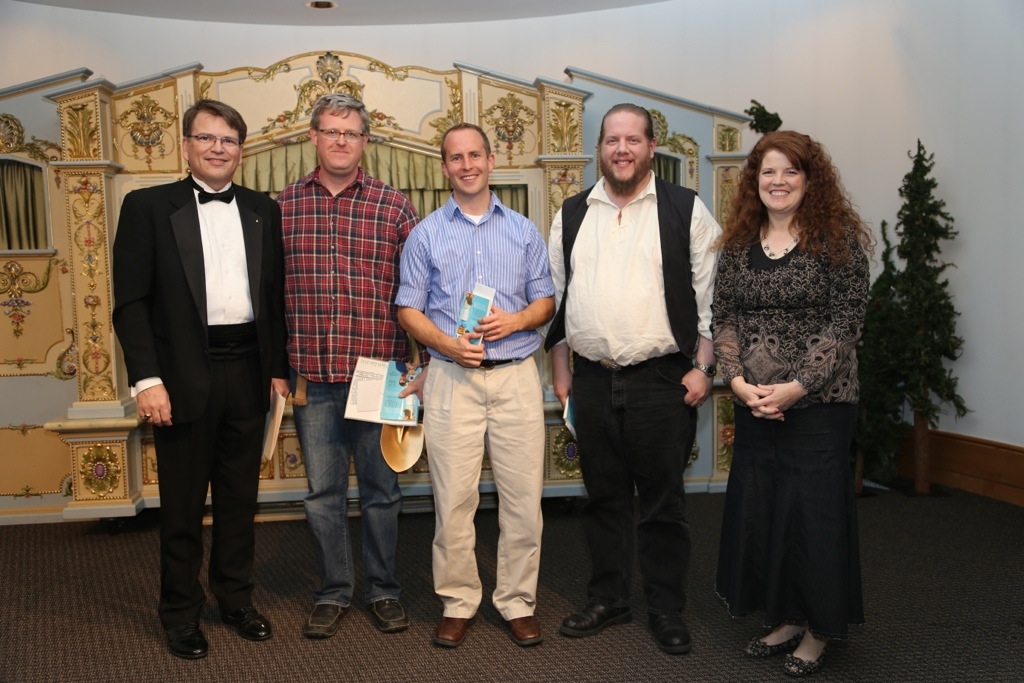
Here we see, a guy on the left who is obviously overdressed. Vance Mellen (2013 Best Liar), holding the coveted “Golden Shovel”, Adam Ashton (Runner Up), Daniel Bishop (3rd place), April Johnson (MC and founder of the Utah’s Biggest Liars Contest.)
The winner, Vance Mellen of Lindon, UT explained exactly how to catch Bigfoot. (Reese’s Pieces and Hershey’s Kisses are helpful.)
There’a also a children’s category. Lily Walker did a truly masterful job of explaining how The Force helps with Junior High.
In this setting, of course, telling the best lie is something to aspire to. However, I could not come up with a single instance where telling a lie, and certainly not telling the best lie, was good business practice.
There have been some high profile liars in the past few years. Jayson Blair plagiarized his New York Times articles. James Frey wrote “A Million Little Pieces” and had to later admit to Oprah that large parts of it were made up. David Simpson was inducted into the Oklahoma Cartoonist’s Hall of Fame and was later found to have plagiarized many of his political cartoons.
But, what about the small acts of larceny? After all, wasn’t that an idea that was presented in a brainstorming meeting? How can we say who actually thought it up? And didn’t we sort of come up with that idea during a conversation where we were both contributing ideas?
While at Microsoft, I worked on a team with John, a guy who had written a couple of books. It quickly became obvious that John was most interested in John. At one point I was talking to him about an idea I had for how to restructure the team. John and I were team members, but Microsoft has a very democratic management structure in many ways. I hadn’t finalized my idea, but I wanted John’s opinion on it.
About a week later, I said,
“I had another thought on that team reorg.”
“Oh, don’t bother. I already suggested it to management and they shot it down.”
Sure it wasn’t a big deal. It was a pretty minor subject in the whole scheme of things. So, why do I still remember it 15 years later? Maybe it’s because I’m still upset. But, I think it was the blatantness of it. Had the idea been accepted, John would have been quick to claim credit. If I were to later try to tell people the truth, I’d look like I was trying to steal HIS idea.
It changed our relationship. I no longer shared ideas with John. I started questioning ideas that he presented. Were they his own idea, or was he taking credit for someone else’s work? It also made me consider my conversations with others. Especially when I got into a management role, I made a point of making sure that I gave credit where it was due. As a result, my teams were always comfortable sharing ideas for improvement. As we implemented them and the team did better, we all looked better.
Truth is always the best policy. Leave lying to the professionals.
Tell your friends about this!

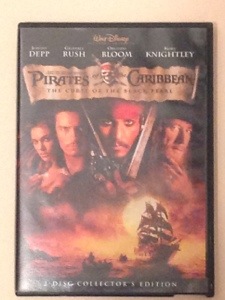
“Dad, can I watch a movie?”
“Sure.”
“Can I watch Pirates of the Caribbean? Mom said I’d be able to watch it at some point.”
“Ah. . .okay, I guess.”
“Can I stay up past my bedtime to finish it? There’s no school tomorrow.”
“Ah. . . all right. . .”
“Can I eat ice cream in the living room while I’m watching it?”
Maybe it’s just my kids who do this, but they won’t take YES for an answer. They tend to continue asking until I’ve hit the limit and finally say,
“No! You cannot eat ice cream in the living room!”
I’ve got a bunch of kids. My oldest is 23 and the youngest are 10. They’ve been following this pattern for nearly two decades. It makes me as a parent just want to tell them no earlier. After all, if I’m going to have to say no eventually, let’s just get the negativeness over with as soon as possible.
I’ve worked with these type of people as well. They are typically the ones who consider themselves expert negotiators. There’s an obscure movie called “Johnny Lingo.”
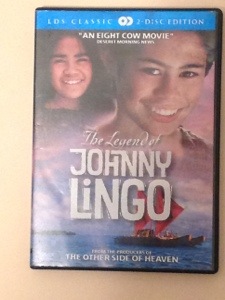
The main character in this polynesian period piece is set to bargain for a wife.
“If the girl’s father asks for two cows, Johnny will settle for one. If he asks for one cow, Johnny will settle for the hooves and the tail. He’s the best trader in the islands.”
And yet, when the time comes to negotiate, the girl’s father asks for the outrageous price of three cows! The crowd is shocked. This is far more than the expected dowry for a girl of her background.
“Three cows is many. But, not enough for Mahana. I will offer EIGHT cows.”
The obvious lesson is that something is worth what you pay for it. Mahana became the most prestigious woman on the island where worth was measured by how much their husbands paid in a dowry.
But, there’s another message. Too often negotiations become an “us vs them” struggle. When you get to the salary negotiation portion of the job offer, you are trying to get as much as possible and the employer is trying to pay as little as possible. At least that’s what we are told is the way to approach it.
I prefer instead, to approach a financial negotiation with two numbers: The minimum I will accept and the maximum I will give up. Once I hit one or the other, we’re done. So, if my minimum is $80,000/year, and the employer’s opening offer is $81,000, the negotiation is over and we have a deal.
“But Rodney,” people will say, “you’re leaving money on the table.”
Yep. If I’ve done my homework and I understand my worth to the company and the value of the position, then my numbers will represent an accurate reflection of my financial worth. And the beauty of this process is that the employer feels like she also got a good deal.
However, if my minimum is $80,000 and I’m offered $79,000, it’s really easy to say,
“I need at least $80K.”
“I’m sorry, $79,000 is as high as we can go.”
“I understand you have make decisions based on your company’s situation. I wish you luck in filling your position.”
Likewise, if I’m the employer and the most I can afford for a position is $85,000, and a candidate asks for $83,000, we’ve got a deal. If instead they say,
“Well, I really need $90,000 to make this work.”
“I’m sorry we weren’t able to reach an agreement. I wish you the best of luck in your job search.”
Of course, the process of negotiating a position involves much more than the salary and there are often other considerations that cause the salary requirements to be adjusted. In addition, salary is just one area where we negotiate.
But, the real point is that you should strive to get to the point where you take yes for an answer.
And no ice cream in the living room! Ever!
Tell your friends about this!


“Hey Tony, what’s with the suit? Got a dentist appointment?”
The words drifted across the cubicle wall and caught me by surprise. They took me back nearly a quarter century and I started laughing.
“Rodney, it’s not THAT funny.”
“Any idea where that reference comes from, Sam?”
“You mean calling a potential job interview a dentist appointment? Not really.”
As most readers know, I started my career with WordPerfect Corporation in 1988. “That’s Where It All Began.” I was 23, newly married with a baby on the way. At the time, WordPerfect was one of the biggest software companies in the world. Sure, I was a support engineer, but this was a real job. I got paid holidays! And health insurance; dental even. And I might even get business cards if I got picked to attend a trade show.
I first started working when I was 15 years old, as a stable boy. I’ve been a delivery boy (where I got “The Biggest Raise I Ever Received.”) I’ve been a telephone technician, gopher in a custom cabinet making shop and done my time in fast food. But, WordPerfect was a career. It was a REAL job.
I started going by Rodney rather than Rod, as my friends and family still call me. And even though WordPerfect’s dress code was casual, I wore a tie, even with blue jeans for the first six months I worked there. I desperately wanted to be seen as a businessman, rather than a kid.
During my college years at BYU I’d signed up for the college health plan. But, the Health Center didn’t do dental work. It’s a given that if you don’t have health insurance you don’t go to the doctor and if you don’t have dental insurance you don’t go to the dentist. Your teeth can take a lot of abuse before they get to the point that you HAVE to take care of them. A friend told me that most people in the Middle Ages eventually died of teeth related issues. Not sure if it’s true, but I do know that my teeth were in bad shape.
One of the first things I did after signing my WordPerfect employment contract was to search out a dentist. Remember, that I really craved to be seen as a professional. I scheduled my dentist appointment for Wednesday afternoon, after my shift on phones was done. I decided to wear a suit. Not for my coworkers, but with the hope that it would improve the dentist’s impression of me.
“So, Rodney, what’s with the suit?”
“I have a dentist appointment.”
“No, really, you can tell me. Are you applying for a job in testing?”
“No, really, I have a dentist appointment.”
“Uh huh. Okay. You don’t want to tell me, I understand.”
In some ways WordPerfect corporate culture was weird and one of the ways it was weird was that you never, NEVER told anyone you were interested in a job. I knew several people who lost jobs because their manager or a coworker found out they were applying. So, the idea that I would hide my job interview with a dentist appointment was not surprising. Except, of course, I really DID have a dentist appointment.
The news from the dentist wasn’t good: Multiple cavities on both sides of my mouth and two root canals.
“We’re going to be seeing a lot of each other, Mr. Bliss.”
Did you see that? He called me MISTER Bliss!
“We’ll see you back here next Wednesday to get started on the cavities. Figure on the next two to three weeks and then we’ll schedule the root canals. Because they are on opposite sides of your mouth, we’ll have to do them on separate days.”
The following Wednesday, I showed up to work in a suit.
“Hey Rodney, another ‘dentist appointment’ this afternoon?”
Many hiring managers schedule follow-up interviews a week apart.
And so it went. For the next two months I showed up to work in a suit at least once every couple of weeks. By now, people on other teams were trying to figure out what was going on as well. People were watching as I left to see if I headed for my car or whether I headed up the hill to the development and testing buildings.
No one, not even my own brother, believed that I was actually spending that much time at the dentist. NO ONE has teeth that bad. They were all waiting to catch me slipping up.
Except that since I really was going to the dentist all those days, I never changed my story. And since I remained in my support job, they assumed I must have failed the interview. I have to admit, by the end I was enjoying the truthful deception.
Fast forward to 2013. I spent much of my career outside of Utah. However, I’ve moved back and this current company has a lot of people from WordPerfect and from Novell which bought WordPerfect shortly after I left in 1993. In many ways, Utah is still a small-town type of state.
I laughed to think that my poor teeth 25 years ago had spawned an entry in the Utah urban dictionary.
I still wear a suit every time I have a dentist appointment.
