
That was how my friend Paul found out he was laid off. Novell is a different company today than they were 20 years ago. In the summer of 1992, Novell bought WordPerfect. I had left WordPerfect six months earlier (Leaving WordPerfect And Going To Microsoft.) WordPerfect did their own layoffs prior to the “merger.” But, there was still a lot of duplication.
Paul was a manager at WordPerfect and much of his team stayed intact though the move. However, not too many months after Novell bought WordPerfect Paul’s team and several other teams in the department were called into a meeting.
We need to make some changes to the organization. This is the new org chart. As you can see we’ve consolidated several of the teams and greatly streamlined our processes. We really think this is going to allow our department to be more effective and help the employees as we remove duplication between teams.
Excuse me? I don’t see my name on that chart and there are several other managers who don’t appear on the chart. What’s our new role going to be?
If your name does not appear on this slide, you no longer work for this company. Security will be available after the meeting to escort you out. Now, this next slide shows how our department goals map to the corporate initiatives.
At that point, Paul collected his notes, stood up and walked out of the meeting. He was the only one who thought to take the initiative and just leave. What did he care what the department goals were?
This is probably the worst layoff story I’ve ever heard. Why is it that companies who are so good at recruiting and retaining people completely blow it when it comes time to fire people?
I’m gonna have to let some people go.
Why do you say let them go? They don’t WANT to go. Why don’t you just say fire them?
Because it sounds better.
Not to the person getting fired it doesn’t.
(In Good Company (2004))
If you work in the technology field long enough, you’re going to go through a layoff, or a Reduction in Force, or RIF. We love TLAs, or three-letter-acronyms in IT, even when we are no longer going to be in IT.
WordPerfect did layoffs, that I managed to just escape. Microsoft did layoffs. Novell was famous for doing layoffs right before Christmas. They didn’t do this to be mean, they just needed to clear people off the books before the end of the year.
And the terrible thing about a layoff, especially around Christmas, for example, is that it impacts your entire company, even those who are staying. No one wants to go spend a bunch of money for toys when they aren’t sure if they are going to need that money for food.
Did you know that consultants teach managers how to fire people? Wednesday. That’s the day to announce layoffs. There’s a logic to it, of course. If you lay them off on Friday, which is what most managers would prefer, your staff, you know the ones you want to keep, go home not knowing who got let go. They will come back on Monday morning and spend hours or days talking about who is no longer here.
If you do it on Mondays, then you pretty much destroy the entire week. People will spend all week talking about it, worrying about it, obsessing about it. So, pick Wednesday. You get two days of productivity. Wednesday will be shot. But, by Friday, the shock has worn off and by the following Monday everyone is back to normal. Well, except for the people who got “let go.” Their Monday is gonna suck.
Not all layoffs have to be terrible experiences. I went through one layoff where the department director personally met with each person to thank them. The company offered six months severance and a full year of cobra coverage. They tried to make the people feel important and realize that it’s nothing personal, it’s just business.
But, more common is the horror story. The head of WordPerfect Support once got let go while he was out of town. His boss fired him over the phone.
In 2004 I was headed to Fargo, ND to do some migration work. The initial customer meeting was me, another consultant and the sales guy. On the day of the meeting, the sales guy called in on a conference call.
I can’t be there. My boss called an emergency meeting. You guys get to know each other and I’ll be out there tomorrow. I have to go, the meeting is starting.
You guessed it. He was being let go.
What are some of the worst layoff stories you’ve had to deal with? And is there a right way to let people go?
Rodney M Bliss is an author, columnist and IT Consultant. He lives in Pleasant Grove, UT with his lovely wife and thirteen children.
Follow him on
Twitter (@rodneymbliss)
Facebook (www.facebook.com/rbliss)
LinkedIn (www.LinkedIn.com/in/rbliss)
or contact him at (rbliss at msn dot com)
Tell your friends about this!

The definition of a $10,000 Friend is someone whom you could call and the entire conversation would be:
I can’t explain right now. But, I need you to get $10,000 and meet me in Bogota, Colombia. I’ll explain when you get here.
And then you hang up. A $10,000 Friend will somehow show up in Bogota and say
Okay, why do I have a suitcase full of cash and what are we doing in Bogota, Colombia?
But, despite the name, it’s not about money. It’s about trust and accepting responsibility for someone else. I’ve always been intrigued by the idea of godparents. I didn’t grow up in a culture that valued godparents. I never had godparents and my children have none. But, I have friends who pick godparents for their kids.
So, what’s a godparent do?
If anything happens to me, the godparents agree to look after their godchild. They commit to be a resource for them. To help them.
Tammi and I dated a couple of times in high school. we’ve stayed friends overthe years. she got into a bad marriage. Her husband abused her to the point she was disabled. Then he took the kids, moved across the country and left her destitute and alone in a house she couldn’t afford and couldn’t sell.
Tammi tried to do it all herself, the legal wranglings over custody across two states, the allegations of abuse, trying to get the house ready to sell. She lived thousands of miles from me, so all I could do was offer encouragement and prayers.
Eventually her daughter’s godfather found out what was happening. He was like a sunrise after a stormy night. He stepped in and cleaned up the mess. He paid for a top notch lawyer. He provided her and her kids a safe place to live while she healed. She’s not out of the woods, but when the godfather stepped in, things started getting better in a hurry.
Like I said, I don’t have godparents. But, I have been blessed with a $10,000 Friend two in fact. During the move to Wisconsin that turned out so badly (Read the five part series here) I called my friends. The first one lives in Scotland. The second lives in Redmond, WA. Neither one was in a position where they actually had $10,000 at the time. One of them offered to cash out their stock holdings at a tremendous loss.
The money is yours if you need it.
The other drained his savings and sent me a check.
A few days ago I talked about loaning money to friends (How Important Is $1000 To You?) What’s funny is that family might not be $10,000 Friends. I love my family and they have helped me out countless times, as I’ve helped them. But, if I called my mother and said, “Mom, I need you to get a suitcase full of money and meet me in Colombia, I’m not sure she’d be on a plane. Although, I’m sure she’d want to help.
It’s unfortunate that we use money to gauge relationships. Not everyone is cut out to be a $10,000 Friend. I was telling the $10,000 Friend story to a person I’d known and worked with for years. We have become pretty close.
You could call me for $10,000. I think I’m that kind of a friend.
Months later we had a minor crisis and I talked to him again. Turns out his wife was not a $10,000 Friend. And I guess that’s the difference between $10,000 Friends and godparents. You cannot have a $10,000 Friend unless you are willing to be a $10,000 Friend. Both my friend in Redmond and my friend in Scotland know that they could call me in the middle of the night and say,
I can’t explain right now, but I need you to get $10,000 and meet me in Bogota, Colombia. I’ll explain when you get here.
And I’d do whatever I needed to do to get the money together and get on a plane. After all, they’d do the same for me.
Rodney M Bliss is an author, columnist and IT Consultant. He lives in Pleasant Grove, UT with his lovely wife and thirteen children.
Follow him on
Twitter (@rodneymbliss)
Facebook (www.facebook.com/rbliss)
LinkedIn (www.LinkedIn.com/in/rbliss)
or contact him at (rbliss at msn dot com)
Tell your friends about this!

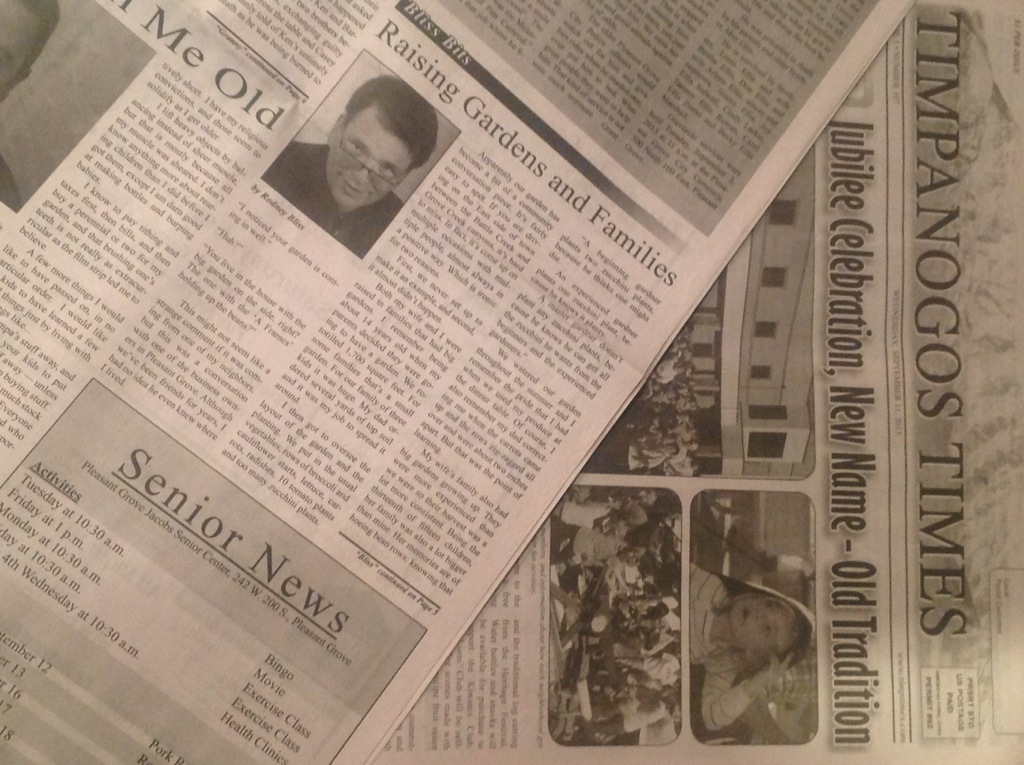
This is a reprint of a column I wrote for the Timpanogos Times, my local newspaper here in Pleasant Grove, UT. It’s a bit of a departure from my normal topics of business, leadership and personal development, but I thought you might enjoy it. I’ll return to more exciting topics of money and business tomorrow.
This appeared in the Wednesday September 11, 2013 edition. There is no online version. It’s very old school, in that respect.
Bliss Bits: Raising Gardens And Families
By Rodney M. Bliss

I noticed your garden is coming in well.
Huh?
You live in the house with the big garden on the side, right? The one with the “A Frames” holding up the beans?
This might not seem like a strange comment if it was coming from one of my neighbors, but this was a conversation with one of the business owners in Pleasant Grove. Although we’ve been friends for years, I had no idea he even knew where I lived.
Apparently our garden had become a bit of a community conversation piece. It’s fairly easy to spot. If you are driving on the East side of town between the Battle Creek and Grove Creek canyons, it’s hard to miss. In fact, it’s come up on multiple occasions with multiple people, almost always in a positive way. Which is ironic for two reasons.
First, we never set out to make it an example, and second, it almost didn’t happen.
Both my wife and I were raised in families that had big gardens. I remember being about 14 when my parents decided they were going to have a garden. We rototilled 1700 square feet. For some families that’s a small garden. For our family of three kids it was huge. My dad ordered several yards of top soil and it was my job to spread it around.
I then got to oversee the layout of the garden and the planting. We put in the usual vegetables; rows of broccoli and cauliflower starts, lettuce, carrots, radishes, 10 tomato plants and too many zucchini plants.
A beginning gardner plants two zucchini plants, because he thinks one might die.
An experienced gardner plants one zucchini plant, because he knows it’s plenty.
A master gardner doesn’t plant any zucchini plants, because he knows he can get all the zucchini he wants from the beginners and the experienced gardeners.
We watered our garden throughout the summer and I remember the pride that I had when we used my produce at the dinner table. Of course, I also remember my dad correcting me when the carrots came up and the rows zig-zagged all over and were at times about 2 inches apart. But that was the point of learning.
My wife’s family also had big gardens growing up. They were more experienced than we were so their harvest was a lot more consistent. Being the thirteenth of fifteen children, her family was also a lot bigger than mine. Her memories are of hoeing bean rows; knowing that you couldn’t go swimming until the beans were done.
So, when we recently moved into the house that we live in, we knew that at one point we wanted a garden. This year wasn’t going to be the year. Finances were tight and we didn’t know if we could afford a garden this year. It’s my experience that the first few years you pay the garden. It’s only after that when the garden starts to pay you.
It was June when we finally decided one day that we would simply do the best we could. We had the land. The garden would get hit by the lawn sprinklers anyway. And we had seed left over from previous years.
So, we got the kids out with shovels and hoes and we cut the sod off our garden spot and used it to make a wall around the garden. We turned over the dirt with shovels. I built some A-frames to sting wire on for pole beans, we planted beans, peas, lettuce, carrots, watermelon, corn, a few tomato plants, and one zucchini plant. (Okay, we actually planted two, but with 8 kids at home we knew we’d eat that much.) And then we prayed over our little garden and waited to see what our efforts would yield.
We were pleasantly surprised when despite not roto-tilling, and no fertilizer, and just some regular watering, the plants started to grow. Because of our late start we’re not sure we’ll get any of the watermelon, but the bean are ready, we’ve eaten peas, and squash from our garden.
But, we’ve been surprised at the reaction of the neighbors. We live in a great neighborhood and we get along with everyone, but the garden became a bit of a landmark. Neighbors commented that “You Bliss’s seem to be able to grow anything.” As I mentioned, people in the community would bring it up, “I noticed your beans are starting to grow.” And one other thing happened, our kids got a reputation.
Because the garden is in such a prominent spot, when we were out cutting the sod, or planting, or weeding, people driving by would notice not only the garden, but our kids out there working. Since my wife and I both grew up taking care of gardens, we didn’t think anything of having our kids out working in the garden on a Saturday. But, some of our neighbors were impressed that the kids were out there. It led to several summer jobs as people invited my teenagers over to their houses to do yard work, or cleaning or occasionally gardening.
Just as our garden was an accidental example to people around us, our family has been the same way. We have thirteen children. While that’s a big family even by Utah standards, what makes us stand out is the fact that ten of our children are adopted. We’ve adopted from all over the world, so we have white kids, Black kids and Asian kids.
And like the garden, we never set out to be an example and our family almost didn’t happen this way. Twenty-five years ago when we got married, we certainly didn’t plan on having this family.
Like all young couples considering marriage, we talked about kids. Coming from a big family, my wife thought she would want 4-5 kids. I was thinking more in the 2-3 range. Apparently we multiplied my 3 with her 4 and added an extra for good measure.
As we were considering the birth of our third child, we first made the decision to adopt. Our first adoption was domestic and he was three days old when he was placed with us. Over the next 10 years, we found ourselves drawn to India and China, Haiti and Colombia. We adopted infants, and toddlers, and older kids that were school age.
We put a lot more thought into adoption than we did into planting a garden, of course. And now that our oldest daughter is expecting our first grandchild, we are excited to move on to “grand”parenting. But, I’ve often thought about the similarities between our garden and our kids.
Having a multi-ethnic family in Utah is not unique, but it’s still unusual. I am, at times reminded of the fact that my kids look different than I do. Almost always it’s done in a positive way. It’s the questioning look on a clerk’s face, “Is this your son?” Yes. Yes, this is my son, my daughter and my family.
We all have times in our lives when we make decisions for us and our families but those decisions are visible to those around us. We never really know when those decisions and choices will become an example to our friends and neighbors just like my garden and my children.
Rodney M Bliss is an author, columnist and IT Consultant. He lives in Pleasant Grove, UT with his lovely wife and thirteen children.
Follow him on
Twitter (@rodneymbliss)
Facebook (www.facebook.com/rbliss)
LinkedIn (www.LinkedIn.com/in/rbliss)
or contact him at (rbliss at msn dot com)
Tell your friends about this!


Rodney, you didn’t need to hang out with me today.
Yeah, I know. But, who knows when we’ll see each other again. I hope she’s worth it. North Carolina is a long way from Redmond.
Yeah, I hope so too. Come on, I just need to close out my bank account here and we’ll grab some lunch.
We walked into the Credit Union where my best friend went through the process of closing out his bank account with the teller.
How would you like the money?
A cashier’s check for the whole amount is good. Wait! Rodney, how much did you loan me for rent back when Natashia and I split up?
A thousand dollars.
That was what? Three years ago?
I guess.
Did I ever pay you back?
No.
Okay, I’m gonna need a $1000 in cash and the rest in a cashier’s check.
You might think it odd that my best friend forgot that he owed me $1000. There are many people who are quick to forget they owe you anything. But, typically your best friend isn’t one of them. So, why did he completely forget about it?
Partly because I didn’t remind him. Ever.
How many relationships have you seen destroyed by a few hundred dollars of debt. . .or less? I’m a very competitive person. I’ve talked at times in this column about my brother (You’re Not Part of This Conversation, Now Would Be a Great Time To Shut Up!, I Had It First.) Most of the time growing up we only had each other to play with.
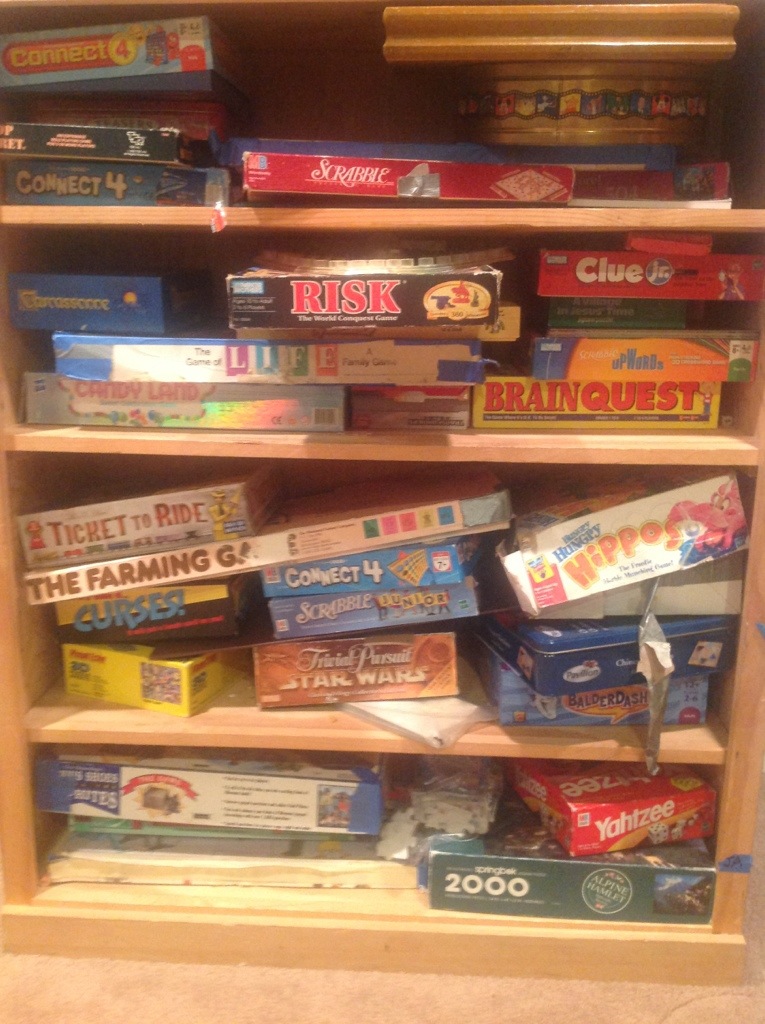
We played every game you can imagine; Dungeons & Dragons, Squad Leader, Monopoly, Risk, Stratego even Diplomacy.
We came out of childhood with a killer instinct, and a desire to “win.” We’ve tempered it as adults by going into different fields. But, we’ve also had to evaluate our contacts with other people in a game strategy. I should say, I’ve had to do that. My brother is much better adjusted than I am.
But, you know what? Keeping score in a game is important. Keeping score in life is a terrible idea. We’ve all worked with those people, right? The people who knows exactly how many favors they’ve done for you and how many you’ve done for them. The person who is happy to take turns picking up the lunch check, but just wants to point out that you’re meal was $2.59 more than their meal and don’t be surprised when they order something a little more expensive next week.
Is that really the relationship you want with your friends? Or your relatives? Okay, maybe there are some relatives you need that. But, your friends? What’s a friend for if you (or they) are constantly weighing your friendship. Might there come a day that the balance tips too far to one side or the other and they decide that “you’re just no longer worth it?”
I’ve tried to value my friends a little more than that.
If I didn’t remember that loan you would have let me fly to the other side of the country and never mentioned it wouldn’t you?
Well. . .yeah. Probably.
Why?
My dad taught me don’t loan what you can’t afford to give. And when you loan someone money, pretend you gave it to them. That way if they never pay you back, you’re not disappointed, and if they do, you’re pleasantly surprised.
Lunch is on me.
If you want genuine friends, you need to be a genuine friend. If you want to be a genuine friend, don’t put a monetary value on your friendship. Because frankly, whatever value you picked, it would be too low for a true friendship.
Incidentally, my friend married the girl he moved to North Caroline for. They have three beautiful boys and we remain best of friends to this day. . .I couldn’t tell you if he owes me money. I honestly don’t remember.
Rodney M Bliss is an author, columnist and IT Consultant. He lives in Pleasant Grove, UT with his lovely wife and thirteen children.
Follow him on
Twitter (@rodneymbliss)
Facebook (www.facebook.com/rbliss)
LinkedIn (www.LinkedIn.com/in/rbliss)
or contact him at (rbliss at msn dot com)
Tell your friends about this!

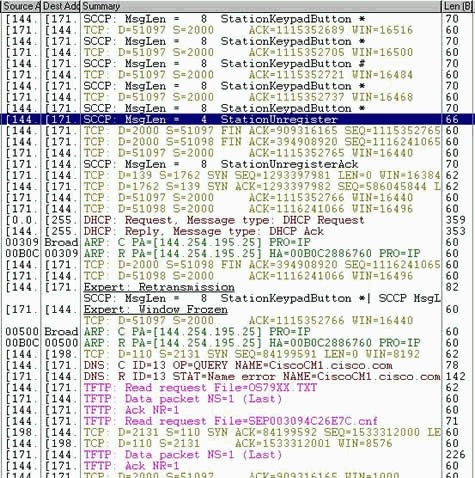
(Photo credit: cisco.com)
Dave, would it be possible to cache our SQL database queries so we could work in an offline mode?
Nope. We designed the system to expect a persistent connection to the data. We’d have to completely redesign the communication module. I’m not even sure we could make it work anyway.
Okay, I was just curious.
Programmers, or developers as they are more commonly referred to in the software world, are typically really smart. But, they tend to view the world very black and white. I think it has to do with the fact that at its heart a computer really only understands “on” and “off.” It’s why we refer to them as binary devices. (Well, some of us refer to them that way.)
Your computer, or your smart phone, or your tablet, stores programs and data and all those pictures of your cat on a hard drive. A hard drive is made up of literally billions of memory locations called bytes. In fact, “giga” mean “billion.”
kilobyte == a thousand bytes
Megabyte == a thousand kilobytes, or a million bytes
Gigabyte == a thousand megabytes, or a billion bytes
The sizes continue.
Terabyte == a thousand gigabytes, or a trillion bytes
Petabyte == a thousand terabytes or a quadrillion bytes
Exabyte == a thousand petabytes or a quintillion bytes
Zettabyte == a thousand exabytes or a sextillion bytes. That’s 10^21, or
1,000,000,000,000,000,000,000 bytes.
It is estimated that in 2011 there was about 300 exabytes of data stored in the world. Today there is more than a zettabyte. Large companies like eBay, Google, Microsoft or the NSA have datacenters capable of storing zettabytes of data.
But, back to programmers. A “byte” is made up of eight “bits.” A bit can either be “on” or “off.” Programmers will refer to a bit being set to 0 (off) or 1 (on.) For example, to express the number 114 in binary code, you would record 0111010. Most programmers write in high level languages that don’t require them to set the bits in a byte individually. But, when it comes down to it, your computer is all 1’s and 0’s.
What’s this have to do with programmers? Just that to a programmer, often things are “on” or “off.” When I approached Dave with the question about our software, I didn’t expect a response. Well, I did, but I expected him to say it couldn’t be done.
Why? Because we hadn’t done it. The program worked the way that it worked and anything else was a “no.” Essentially, the zero.
However, I’ve worked with programmers a long time and in addition to being very binary, programmers are naturally curious. My whole point in going to Dave was to plant the idea. I knew that he’d take my question and start thinking about it. He’d think about it on his way home. He’d think about at random times when he was eating breakfast, or about to go to sleep. And after letting it stew for a couple of days, Dave would come find me.
Rodney? I’ve been thinking about that question you asked about caching SQL queries. We can’t cache the actual SQL query, but we have a module that evaluates the query string before we hand it off to the communication module. I think all we would have to do is add a single interrupt call to that module.
Okay. . .
We’d make the evaluation module check for a valid connection before handing it off. If we couldn’t ping the server, we’d hold the query until the connection came back. We could even store it so you could turn the remote client off.
So, you’re saying. . .
Look. Your question was wrong. We can’t cache the SQL code, but I’ve figured out a way to give you what you really want!
And with that Dave would grumble about trying to talk to non-programmers and he’d head back to his desk to code up the solution. What was ironic about this exchange was not just that I did it on purpose, but that in the past, I told Dave I did it on purpose. I explained to him how I got him to spend his free time thinking about how to solve these clever use cases. And the fact that he knew what I was doing didn’t change the fact that it worked.
Had I gone to him and said, “I need you to modify our software to work in offline mode,” I would have had a huge fight as Dave spent hours explaining why it couldn’t be done. By presenting it as a question, and implicitly a challenge, I appealed to his natural curiosity. In the end, he had to convince me of the soundness of his strategy.
Occasionally, Dave got annoyed that he ended up convincing me of the things I wanted in the first place. But, he couldn’t get too upset. After all, it was his idea.
Sometimes you just need to understand how to speak their language, and think about those computer bits.
Rodney M Bliss is an author, blogger and IT Consultant. He lives in Pleasant Grove, UT with his lovely wife and thirteen children.
Follow him on
Twitter (@rodneymbliss)
Facebook (www.facebook.com/rbliss)
LinkedIn (www.LinkedIn.com/in/rbliss)
or contact him at (rbliss at msn dot com)
Tell your friends about this!

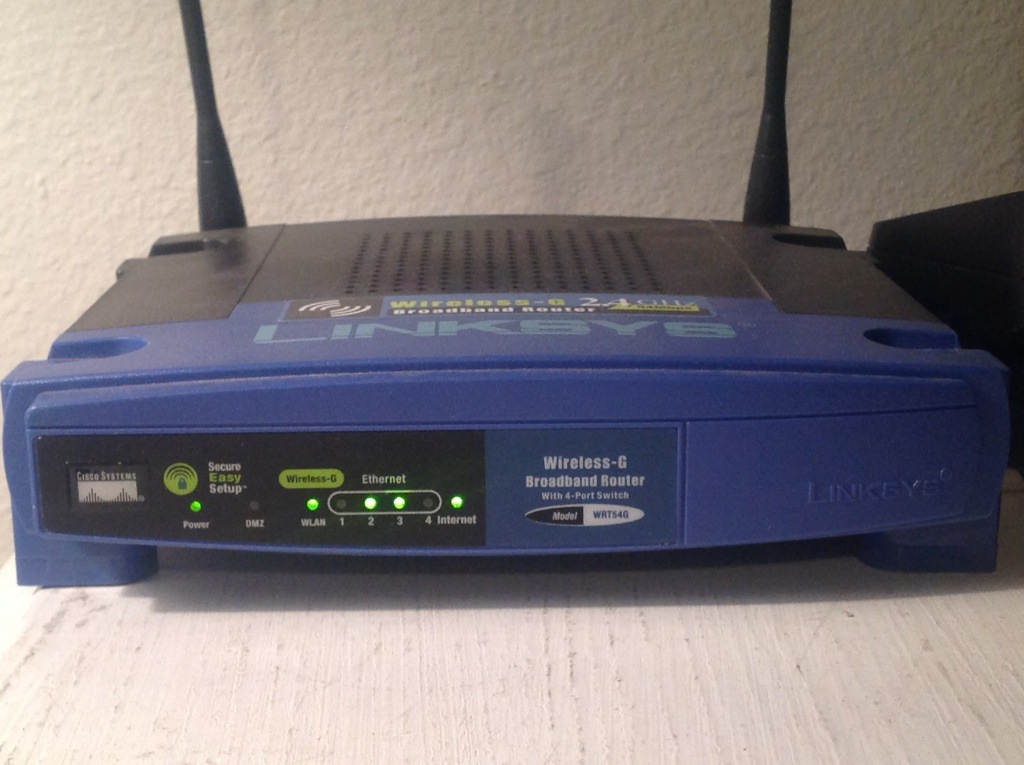
TJ, the Salt Palace wants to charge us $200 to set up a wifi hotspot. I don’t think it’s reasonable. It’s not like we’re reselling it to other presenters. But, I’d like you to set up a wifi connection for our team.
Okay. What happens if the Salt Palace finds it?
There’s probably a big fine. But, if you can’t manage to hide a wifi signal you’re not as good as we thought you were.
We were at the Outdoor Retailer Show. RESMARK had been working on our reservation software for three years and we were finally ready to roll it out. I had a marketing plan that was designed to “Steal The Show.” But, I needed a wifi signal, and I couldn’t see paying the Salt Palace for Internet twice. I was already paying for a hardwire connection to the Internet. I didn’t want to pay a wifi fee as well.
We were the most high tech booth at the show. Most of the show was vendors selling rafts, and trips and kayaks, and camping gear. It was a former boy scout’s dream show.
Our big give away were remote control Hummers.

We did a drawing to give one away each day. For attendees, we handed out custom mice. The mice were a really big expense, but it was a perfect giveaway. Years later I remember walking into a rafting company in Colorado and seeing them using a RESMARK mouse at their front counter.


As we started our countdown to the start of the show, TJ pulled me aside.
Did you get the wifi setup?
Yeah.
And you don’t think the Salt Palace guys are going to find it?
I don’t even think they’ll notice.
Really? What did you name it?
SALT_PALACE_15
I laughed every time I connected to it.
Sometimes the best way to hide is to act like you belong. TJ did it with a wifi signal, but all of us find ourselves in situations where we aren’t quite sure we belong. It’s amazing how few people will question you if you look like you know what you’re doing and just be confident.
Rodney M Bliss is an author, blogger and IT Consultant. He lives in Pleasant Grove, UT with his lovely wife and thirteen children.
Follow him on
Twitter (@rodneymbliss)
Facebook (www.facebook.com/rbliss)
LinkedIn (www.LinkedIn.com/in/rbliss)
or contact him at (rbliss at msn dot com)
Tell your friends about this!

Michael Osterman offers some excellent advice on the hidden dangers of bad bosses in your organization.
Tell your friends about this!
What do you think you’re doing?
What? What did I do?
Rodney, that was the VP of one of my biggest suppliers!
I know, you said that when you introduced me.
If you can’t figure out when you’re not part of a conversation you need to just be silent!
I was really confused. I was talking to my brother who was the VP of Marketing for a mid-sized computer company. In fact, we were in his booth at Brainshare. I had recently left Microsoft and I was at Brainshare to network and work on lining up consulting contracts. I honestly had no idea what had bothered my brother so much. Long time readers of this column may remember that this was the same brother who told me Now Would Be a Great Time To Shut Up!
Eventually, I realized what the problem was. While talking to me my brother wasn’t in VP mode. I was with his brother and we were talking as brothers do. When the VP from his supplier walked up, he switched into business mode. I didn’t notice the switch and I kept talking just as we had been. Not that we had been saying anything inappropriate or rude, but my brother was there to work. Once a business contact joined the conversation, our purposes were no longer the same.
I was there to meet people and sell them on Rodney M Bliss, either as a business contact, or a potential hire or a potential consultant. His purpose was to sell his company’s software and image. And with his biggest supplier, image was really important.
Fast forward from that meeting 10 years ago, to last week. We are again in the Salt Palace, the location of Brainshare. This time we are there for Comic Con (Why I Love Conventions.) And instead of my brother, I was there at the invitation of Howard Tayler, creator of Schlock Mercenary.

The vendor floor was scheduled to open at 3:00pm. After putting the finishing touches on the booth, we headed to lunch; Howard and his wife Sandra and a friend of Howard’s who was also an illustrator and his wife. My mind went back to that conversation so many years ago.
It quickly became apparent that this was a business lunch. Howard and his friend discussed Convention strategies. Both of them worked for themselves and since Salt Lake Comic Con was a new show, neither one knew exactly what to expect. Because I don’t generally work in the Comic Con space, I had no idea how much an independent artist relies on revenue from shows.
The lunch was a fascinating education for me. And I did very little talking. In fact, each time I had something that I thought about adding to the conversation, I ran it through multiple filters to decide if it added value to the conversation, and if it was appropriate. Often the time I spent filtering it meant that the moment for saying something had passed and I simply remained silent.
I reflected on it afterward, that this was exactly what my brother was talking about all those years ago. I’m much better at reading a conversation and realizing what each person wants out it. Often I’ll be a major participant. After all, we all know I love to talk. But, it’s important to realize when I’m not really a participant, or shouldn’t speak as much. But, an ironic thing happens when you allow others to do most of the talking. They leave the conversation thinking you are brilliant.
Try it, next time you have the chance to engage a stranger in conversation, either on a plane, or at a convention. Ask a couple of leading questions and let the other person talk. You’ll be amazed how much you learn and how smart they will think you are.
And if you get invited to take part in someone else’s conversation with a business associate, remember that you are probably not really part of that conversation.
Rodney M Bliss is an author, blogger and IT Consultant. He lives in Pleasant Grove, UT with his lovely wife and thirteen children.
Follow him on
Twitter (@rodneymbliss)
Facebook (www.facebook.com/rbliss)
LinkedIn (www.LinkedIn.com/in/rbliss)
or contact him at (rbliss at msn dot com)
Tell your friends about this!

(Photo credit: rideuta.com)
Have you ever ridden the train? There’s a kind of peacefulness that always comes to me when I’m on a train, even a commuter train. I especially enjoy the image of the train rolling past farmland, cows, fresh cut alfalfa, a meandering river. I got to ride the Utah Frontrunner train from American Fork to Salt Lake City twice last week.
So, if a train ride is so enjoyable, why don’t we ride the train more often? Every city in the world wishes that it could get more people out of their cars and onto the trains (and busses.) I think the answer lies in two variables: money and time. And, of the two, time is the more critical.
Money
It cost me $9.60 for a round trip ticket. That’s a pretty good deal. The train drops me off at the Salt Lake Central Station. From this station, you can catch Amtrak, Greyhound, the city busses and Trax, the city light rail train. Trax and the busses are free in the downtown area, so my entire cost of the trip was simply the price of the train.
I also had to drive to Salt Lake twice last week. My Suburban gets 18 miles per gallon. It costs me about $0.25 /mile. It’s 90 miles round trip. So, driving to SLC and back cost me $22.50 per day, plus $5 for parking, compared to less than half that for the train. At those rates, why did I drive?
I had to carry a Suburban-load of show materials to Salt Lake Comic Con on Wednesday. Then, I had to bring them back on Saturday. (Convention Report: Comic Con Salt Lake.) But, if I had to choose between driving and riding the train, it makes economic sense to take the train. . .unless. . .If I had one additional passenger, then it starts to break even. If I have two people, it’s more economical to drive.
Time
But, I don’t think people are primarily motivated by the economics of the commute. Sure, it figures into part of it, but I think mostly people are interested in time. If I can save time, or more importantly, control the time I come and go, I will often drive instead of take the train. Salt Lake City, like many big cities has terrible traffic at rush hour. At that time of the day, it can take 60-90 minutes to make the 45 mile trip from my house to downtown. The train is a consistent 40 minutes from terminal to terminal. However, if the bus and train do not get me to where I need to go at the times I need to get there, it doesn’t really matter if they are cheaper.
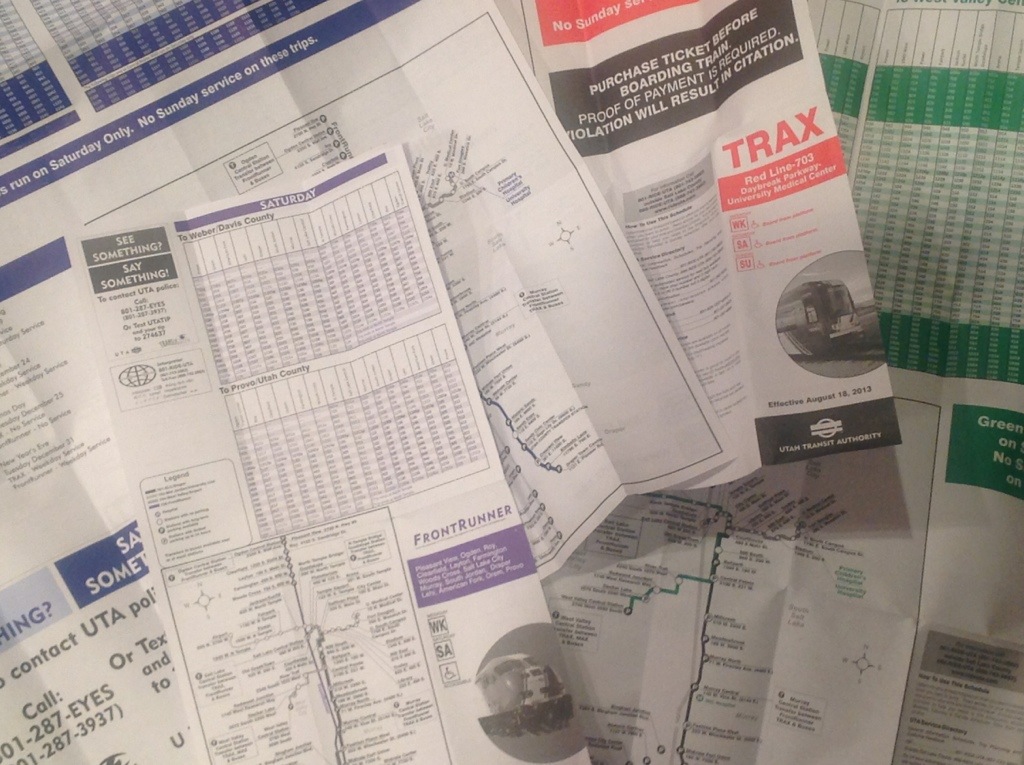
Utah Transit Authority does a great job of making it as convenient as possible for the commuters. The trains run every hour, every half hour during morning and evening commute times. When it gets to downtown, the light rail surface trains leave 5 minutes later.
In fact, on Saturday I knew that I would not be able to park anywhere near the Salt Palace. So, I picked a parking lot within the free fare zone. I hopped on Trax to the Convention Center and then at the end of the night rode it back to my car and drove the 8 blocks to the Salt Palace.
Several years ago I worked downtown. After a couple years, my company moved our offices to Riverton, about 20 miles closer.
Isn’t it nicer to be closer to home?
Not really. I could get on the commuter bus 2 blocks from my house and it dropped me in front of my office downtown. Now, I have to drive everyday.
When we were downtown, it wasn’t uncommon to hear someone wandering through the office at about 4:00pm looking for a “carpool” buddy so that they could use the carpool lanes on the way home.
Public transportation was much less convenient at our new building. One day one of the guys I carpooled with decided to take the bus and train from his house in Utah county to our new building in Riverton. He just wanted to see what the difference would be.
Two hours later than normal he walked off the bus and into work.
So, how was the bus and train?
Care for a carpool buddy?
That bad, huh?
Money and time and time is the most critical.
Rodney M Bliss is an author, blogger and IT Consultant. He lives in Pleasant Grove, UT with his lovely wife and thirteen children. The Suburban is his family’s “small” car.
Follow him on
Twitter (@rodneymbliss)
Facebook (www.facebook.com/rbliss)
LinkedIn (www.LinkedIn.com/in/rbliss)
or contact him at (rbliss at msn dot com)
Tell your friends about this!


Okay, this is the register system. It’s basically point and click. It lists everything we have for sale in the booth. It looks like it might be just you the first day, so pay attention.
Sandra Tayler, the Business Manager for Tayler Corporation, creators of Schlock Mercenary now had my complete attention. She was showing me their point-of-sale system that ran on her iPad. I’m pretty good with technology. You pretty much have to be if you want to be in the IT field, but strange as it might seem, I’ve never been in retail. Never. Not in high school, not in college. The fact that I was going to be running the cash register was . . .scary.
So, what are some of the things that could go wrong?
Well, not much. I suppose there’s the possibility that a price is wrong, or I guess I might have missed something. The iPad is currently using wifi and going through our mifi system. We call her KAREN. We’re not sure if the signal might be overwhelmed when there’s ten thousand cell phones in here. If the mifi goes offline, you can switch the iPad over to cellular, but hopefully you won’t need to do that. There’s a separate process for refunding a credit card, so hopefully you won’t have to deal with that. Oh, and whatever happens, don’t bug Howard. He’ll be busy dealing with customers.
In this case more information was just making me more worried. It was Wednesday, the setup day for Salt Lake City Comic Con. My official title was “minion.” Fortunately, I’d helped Howard and Sandra in the past (Giving Your Product Away For Free Is a Business Model?) I think part of the reason I got the job of minion was that my Suburban was big enough to haul the show materials. The Con was happening at the Salt Palace in Salt Lake City.
Wednesday
We loaded up the Suburban with boxes of books, coins, display materials, hand trucks and various pieces that are needed to set up a booth.
It’s about an hour from my house in Pleasant Grove, UT to down town SLC. We timed it so that we could arrive at 10:00. That was the earliest we were allowed to start setting up. Sandra rode up with me so we got to use the carpool lanes the whole way.
I’d done shows at the Salt Palace in the past so I was very familiar with the loading dock. As we pulled up to give our name to the guard, he said, “You’re not allowed in until 10:00AM!” (My dashboard clock said 9:57.) This is an important point. I might have been tempted to complain. To tell the self-important security guard that it WAS 10:00. But, you have to decide what you want. Did I want to be right? No. Did I want to get in and setup our booth as soon as possible? Yes.
How much before 10:00 is it by your clock?
About 5 minutes.
Could we stay right here for the next 5 minutes?
Oh, hell no! Because in a few minutes there’s gonna be 30 cars right behind you wanting to do the same thing. You’ll need to pull over there across the street. They’ve got free 2 hour parking. Then in 5 minutes you come back here and we’ll let you in.
At this point he was joined by another security guard who apparently understood that the point of security was to ensure that only authorized vendors entered the loading dock.
It’s two minutes till. Let em in. Don’t make it so stressful!
We pulled to the top of one of the ramps and unloaded all of our gear onto a cart. I threw in a half case of bottled water. Sandra went to take it in as I parked my car. As I walked the half block back to the loading gate entrance, it was with satisfaction that I noted the lack of a 30 car line to enter the loading dock.
Setup went pretty smoothly. There was one small problem. We didn’t realize that vendors were allowed to drive in until we nearly got clipped by a car inside the convention center. Since they had just done the World Con in Texas, Sandra was missing many of her normal items for her “booth box.” We managed to get the booth setup and took a bunch of pictures so that Howard could review it later.
Thursday
I took the train. Look for a column tomorrow on why this is a very cool option.
As I came walking into the vendor floor, I noticed that the Schlock Booth was completely rearranged. Different banners, different location for everything on the tables. But, what was most important was that Howard liked the new setup. As I was to find out, he made a significant difference between sales and the booth being slow. Most importantly, Sandra was there. My fears about screwing up the cash register were put to rest.
If you’ve never been to a Comic convention, there’s really no description that fits. I’ve been to conventions (Why I Love Conventions.) Some of them were even in the Salt Palace, but this was nothing like those. The costumes were amazing. Darth Vader, Chewbacca, Browncoats, Thor, and tons more I didn’t recognize. At one point, a storm trooper went by pulling a cage that held the “slave girl” Princess Leia. The effect was somewhat spoiled by the fact that Batman held the other side of the cage.
I figured out the point-of-sale program after about 30 minutes. There were some hiccups, like when an item was the wrong price, but nothing too complicated. We did a pretty good business. As readers of this column have probably figured out, I like to talk. And I like Schlock Mercenary. It was very easy for me to engage people in conversation, and sell them stuff.
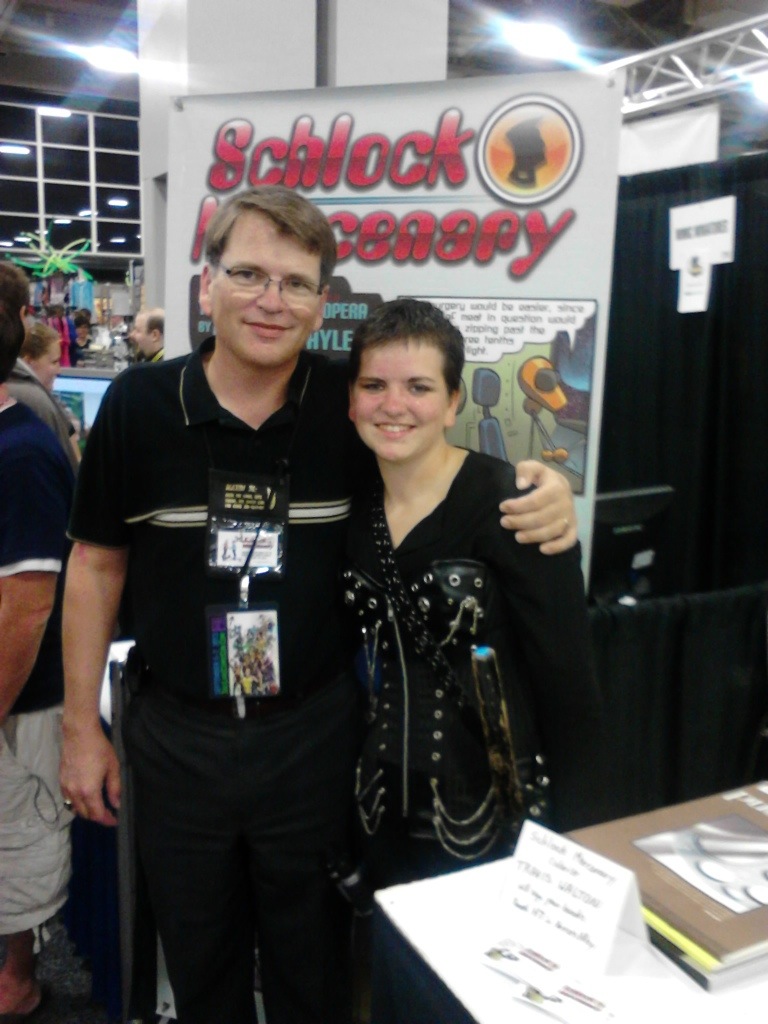
A stylish steampunk pirate.
The biggest problem of the show happened on Thursday night. The vendor floor was scheduled to close at 8:00pm. At 7:50pm we heard an announcement:Due to the overwhelming popularity of Comic Con we are extending the vendor floor hours until 9:00pm. Thank you. The vendors were not pleased. We figured that there were still people in line who had been waiting for hours and the Comic Con organizers were more willing to endure angry vendors than a crowd of angry fans armed with light sabers, blasters, swords and really big hammers who couldn’t get in.
Friday
I took the train again. Very cool. More on this tomorrow.
The biggest difference between Thursday and Friday was the size of the crowds. They were crushing. At times we got to talk to some people simply because they were at our booth when the traffic jam happened. They couldn’t go forward, they couldn’t go back.
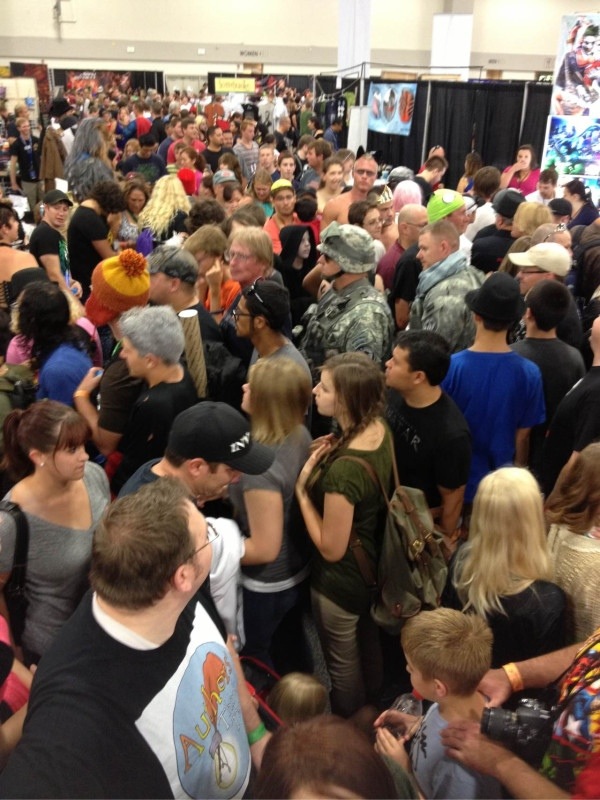
(Photo credit: Howard Tayler)
So, do you read Schlock Mercenary?
Standing inside the booth was like being in a boat in the middle of a raging river of humanity. . .and elves. . and superheroes. Traffic seemed brisk. I shared booth duty with Chad. Chad is much more up on comic characters than I am. Much of the day when we weren’t selling things was him explaining the various costumes to me.
Challenge Coins
I’ve written in this space before about Challenge Coins. They are commemorative coins, some of which live in the Schlock Universe, some which don’t. What Howard discovered at World Con was that the shininess of the coins attracted people and they asked a lot of questions, but would not end up buying them.
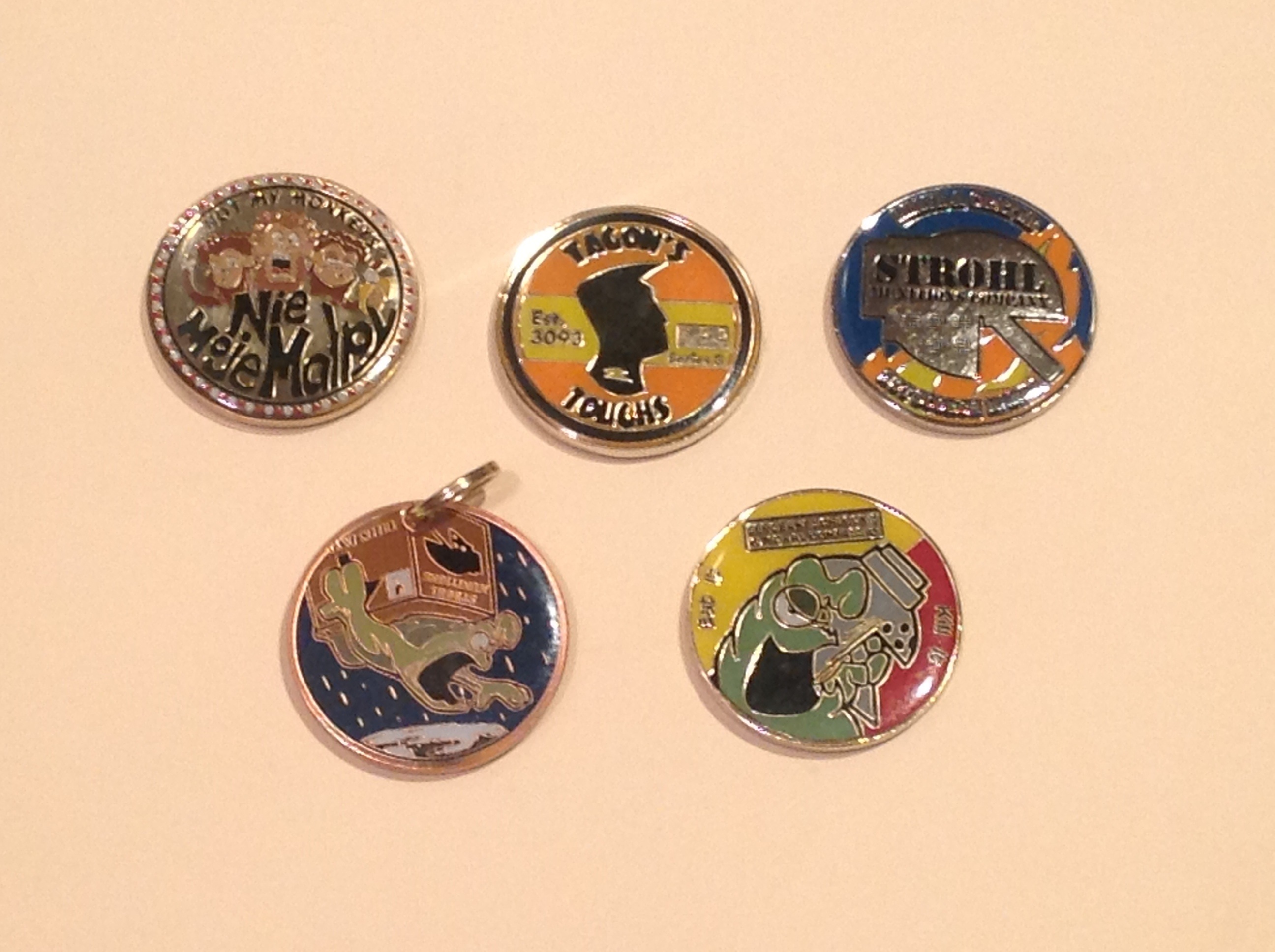
Chad and I decided the best way to handle them was to keep them under the counter. When someone came up who was already a Schlock fan, we’d say, “We also have Challenge coins. Would you like to see them?”
At that point, we’d pull out the bag of sample coins and watch fans’ eyes light up. We’d offer a few explanations, like the fact that the numbered Tagon’s Tough coins were only available at conventions. And then, we’d sit back and let the fans sell themselves.
Saturday
I had a commitment Saturday morning, so it wasn’t until 3:00pm that I got the Salt Palace. I parked a couple miles away and took the light rail. Getting off the train I could see that there was easily 500-1000 people in line. It was an amazing sight.

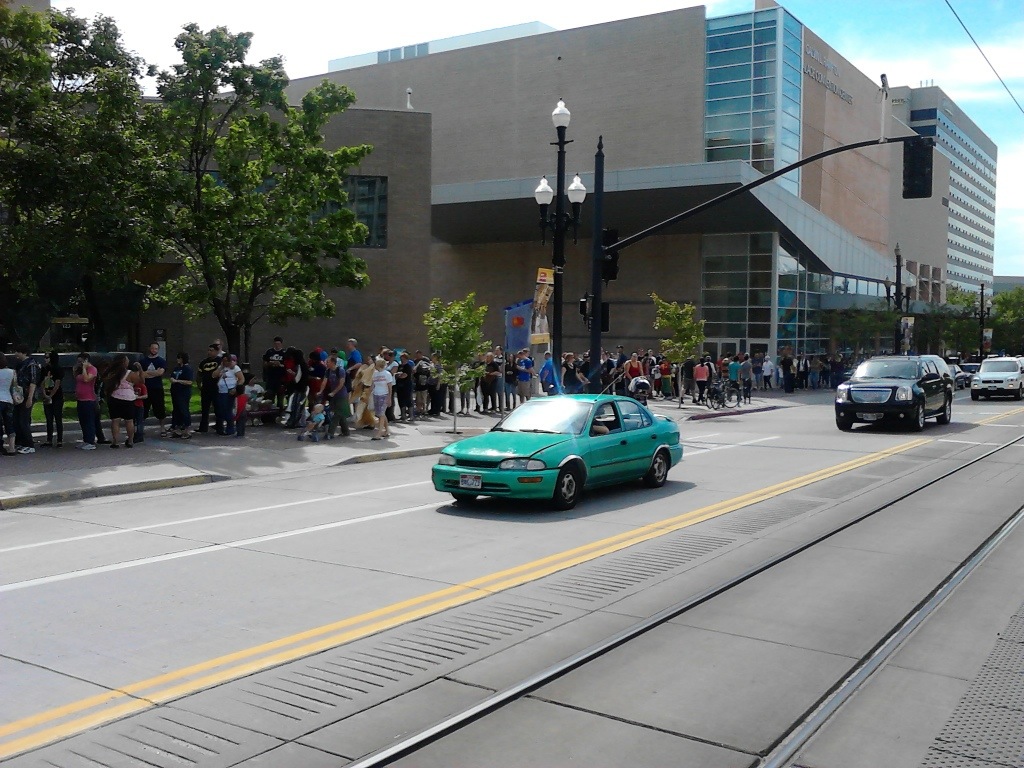
I, of course walked around the back and ducked in the vendor entrance.
The Salt Palace vendor floor holds about 13,000 people. Comic Con was originally planning to sell 30,000 tickets. Instead, they sold nearly 50,000. The fire marshall was keeping strict crowd control on the convention floor. The lines were crazy.
As the convention wound down, I headed out to get my car. There were considerably fewer boxes to take back. As a minion, I had no idea how well the sales were for the show, and I had nothing to compare them to anyway. From my standpoint, the opportunity to help out a friend, and to people watch some of the most amazing costumes was well worth it.
Comic Con will be back next year, and given the opportunity, so will I. Plus, Howard promoted me from minion to “Trusted 1st Lieutenant.” Clearly I’m moving up!
Rodney M Bliss is an author, blogger, IT Consultant, and Trusted 1st Lieutenant. He lives in Pleasant Grove, UT with his lovely wife and thirteen children.
Follow him on
Twitter (@rodneymbliss)
Facebook (www.facebook.com/rbliss)
LinkedIn (www.LinkedIn.com/in/rbliss)
or contact him at (rbliss at msn dot com)
