Rodney, can you get into email?
No. You?
No. They upgraded the servers last night.
We’d better figure it out quick. People are going to start showing up to ask us!
I was working in the WordPerfect Office support team. Development had just upgraded our corporate email system from WordPerfect Office 2.0, which was a single server version to Office 3.0 which was multiple server. We were excited to use the new product, if we could just figure out how to get into the new mailboxes.
WordPerfect Office 2.0, despite the version number was a first generation email system. It was released on August 8, 1988, 8/8/88. WordPerfect Office (now sold as Novell GroupWise) turned 25 years old this year. The developers were pretty proud of that original release date. The first update was shipped two months later on 10/10/88.
This was in the days before the internet. Before any external email systems. It was not possible to send an email to anyone outside of your company. And when you have a single server product, every person who wants to send email has to log into that server to send and receive email. The problem was that we were running a version of Novell NetWare that limited the number of concurrent connections to the server. I think it was 512 connections. There were nearly 5,000 people working for WordPerfect at the time. So, as soon as 512 people were in looking at email, no one else could check their email.
The corporate solution was that they would limit the amount of time you could be connected. When you connected, a timer started. When the timer ran out, you got kicked off. But, it was considered polite to log yourself off. And if you logged in and then left the connection open but didn’t do anything on the server (they could see if you were accessing files) the IT guys would kick you off and you’d get a visit from your manager.
Anyway, today all of that was going to be fixed. WordPerfect Office 3.0 would run on multiple servers and the Connection Servers would route email between the servers. This was the situation when Batman Nearly Got Me Fired.
We were not caught off guard by the change. As the support team, we had been heavily involved in the testing. (Racist Programs and Assaulting Servers.) We had been gearing up for today. But, no matter what we tried we couldn’t figure out how to log into the new system. Finally, Mark called one of the testers.
Sydney, this is Mark in Support.
Mark, how’s the new email system look?
I have no idea, we can’t seem to get into it and other teams are asking us.
Didn’t you get the instructions? We wrote an entire step by step guide on how to log in the first time and change your password.
No, we haven’t seen them. Where can I get a copy?
Well, we emailed them to everyone.
Yep. They emailed us the instructions on how to access the new email system. I’ve mentioned before that WordPerfect could have used more Program Managers to be that bridge between developers and customers. Sydney gave Mark the instructions over the phone. Once he got logged in, there was a single email.
Instructions For Accessing The New Email System
It actually worked out well for our support team. We printed out the instructions and when other teams came to us because we were the Office support team, we looked like we knew what was going on. . .almost. I still laugh about that day. Over the past 25 years I’ve had the opportunity to migrate thousands of users either from an older version of Office to GroupWise, or from GroupWise to Microsoft Exchange or the other way around. Everytime we sit down to plan the actual cutover day we make sure that the instructions for how to access the new system are sent out well in advance and are also printed out. But invariably, every member of the migration team has experienced the frustration of having the instructions for the new system emailed to them. But, only once. Once you’ve been through it, you’ll remember that step forever.
Rodney M Bliss is an author, columnist and IT Consultant. He lives in Pleasant Grove, UT with his lovely wife and thirteen children.
Follow him on
Twitter (@rodneymbliss)
Facebook (www.facebook.com/rbliss)
LinkedIn (www.LinkedIn.com/in/rbliss)
or contact him at (rbliss at msn dot com)
Tell your friends about this!


(Photo credit: peakcare.blogspot.com)
Derek, I wanted to talk to about a potential security flaw one of our support engineers worked out.
Yeah?
Well, they realized that we are storing the user passwords in an unencrypted format. We’ve just XOR’d the data. But, that’s simply security through obscurity. If our engineers could figure it out so can someone else.
Did they document this?
Sure, in fact they build a simple program. Just point it at a postoffice and it will list the user name, alias, system password and then a personal password if they set one up.
Go back and tell the support operator that this is a VERY bad thing he’s done. He should delete all copies of the program and the original program files for it. If HR finds out who he was, he could be fired. YOU didn’t help write it did you?
Not the response I was expecting. Forget you ever knew how to do this? Pretend it didn’t happen? Stick your head back in the sand?
I was working for WordPerfect in Orem, UT. I was supporting WordPerfect’s email program, called WordPerfect Office. The password hack program was written by Trevor.
Rodney, got a minute?
Sure, Trevor.
You’re on Post Office 14, right?
Yeah.
You’re email alias is RODNEYB, your system assigned password is X14J7B and you set a personal password of fluffythedog?
He was a childhood pet. But, that’s really cool. How did you do it?
Pretty simple really. Just an XOR filter.
You should tell development about it.
No. I don’t think they would appreciate it.
I don’t know. I’ll talk to them.
Don’t tell them it was me.
Obviously Trevor had a better feel for office politics than I did. But, this was an example of a core deficiency that WordPerfect Corporation had. Not just the password issue. It was 1990. NO ONE had strong security. But, the idea that rather than discuss and address weaknesses, they should be hidden and that the company would go to lengths to keep them hidden.
I guess their thought was, this was SUCH a big security hole that telling anyone about it would drive people away from Office toward our competitors. But, the idea that they wanted support people to also be in the dark was troubling and fairly typical. WordPerfect had an arrogance that was mostly undeserved.
I once had a Vice President tell me, “We don’t want to hire people who have an MBA. We will teach you everything you need to know about the software industry.” And while the industry was still really young, about 10 years after the release of the IBM PC, software development wasn’t new.
But, WordPerfect would rather reinvent the wheel than adopt industry standards. After a decade at Microsoft I remember thinking how few Program Managers WordPerfect had. They had programmers, and they had testers, and they had support. They didn’t really have the “mostly” techy guys who were there to translate “tech-talk” into real world experience. I think this was due to the fact the company was founded by a Computer Science professor and a Computer Science major. And then they caught the market wave perfectly and were suddenly the biggest word processor company in the world.
The problem was that the WordPerfect guys thought they were successful mostly because they were so smart and partly because of luck. In actuality, it was the other way around.
So, I went back to Support and assured Trevor that I hadn’t told anyone his name, but that development wanted him to delete all copies of the program. In fact, I think I got an email from the head of Office development asking if I had verified that all copies, including printouts were destroyed.
Yeah. We stuck our heads back in the sand. But I’m not sure that’s a workable long term strategy. Less than 5 years later, WordPerfect no longer existed as a company.
Rodney M Bliss is an author, columnist and IT Consultant. He lives in Pleasant Grove, UT with his lovely wife and thirteen children.
Follow him on
Twitter (@rodneymbliss)
Facebook (www.facebook.com/rbliss)
LinkedIn (www.LinkedIn.com/in/rbliss)
or contact him at (rbliss at msn dot com)
Tell your friends about this!

The email was pretty innocuous.
TO: Vera Critchfield (verac)

FROM: Bruce Wayne (DarkNight)

SUBJECT: Phone Schedule for next week
Rodney asked me if I ask you what next weeks phone schedule is. I need his help on Friday. So, he's hoping he can be done by 5:00 pm.
Batman

It was a valid email message dutifully delivered by our corporate WordPerfect Office 3.0 Connection Server. Of course, it wasn’t from Bruce Wayne and he never signs his emails “Batman” anyway. I was exploiting a “feature” of the Office 3.0 system.
Vera, my manager, was not amused.
Did you know that abusing the corporate email system was grounds for termination?
Ah. . .
And impersonating another person on the email system is also grounds for dimissal.
Okay. . .
Don’t do it again!
Sorry, it was just a joke. I wasn’t trying to pretend to be anyone else.
Wow. You’d think some people would have more of a sense of humor. Vera was the team manager for the WordPerfect Office support team. I was a support engineer supporting our new email system. The flaw I’d exploited was very simple. WP Office was what was called a store and forward email system. And it was file based. That meant that when you sent an email, it got created as a file and then placed in a special directory or folder on the server. There was a program, called the Connection Server who’s job it was to poll that directory every couple of seconds and if it found a message, it would look at the TO: address and route it accordingly.
In order to have Bruce Wayne email my manager, I did two things. First, I installed Office on my local computer. Then, I went in and created two post offices. One was WAYNEMANOR, the other was the post office my manager was on. I created an account for Bruce at WAYNEMANOR and one for Vera on her post office. Then, I logged in as Bruce and composed the message and hit send.
The email got created and dropped into the outgoing mail folder. Kind of like putting the flag on the mailbox up. However, rather than run the Connection Server, I copied the file to our corporate folder and the next time the corporate Connection Server came by, it picked up the email and delivered it.
Those of us in support didn’t consider it a big deal. In fact, we had been sending emails to one another from Mickey Mouse, Thor, and the 1980’s equivalent of Miley Cyrus.

(Photo credit: Starcrush.com)
Management wasn’t in on the joke, nor were they interested in finding out just how vulnerable the system was to spoofing. Their reaction tended to be “Don’t do that again. . .and forget how you did it this time.” I’ll write more on that philosophy tomorrow.
This experience with Vera was a real wakeup call for me. It was the first time I started to see the difference between “us” and “them.” I thought we were all an “us.” We weren’t. And most likely neither are you.
When I became a manager, I resolved to not overreact when my staff pulled a prank. In fact, while taking over one team, in my first team meeting, I announced,
Messing with someone else’s unlocked computer. . .
Ah man, here it comes!
. . .is now an official team policy.
Really?
Don’t leave your computer unlocked or someone might sent out an email from you describing your love for sheep!

(Photo credit: angelcatuk.blogspot.com)
Interesting thing, that team started locking their computers more. Trust your staff and they will trust you.
Rodney M Bliss is an author, columnist and IT Consultant. He lives in Pleasant Grove, UT with his lovely wife and thirteen children.
Follow him on
Twitter (@rodneymbliss)
Facebook (www.facebook.com/rbliss)
LinkedIn (www.LinkedIn.com/in/rbliss)
or contact him at (rbliss at msn dot com)
Tell your friends about this!

CRACK!
My heart sank.
Not again!
I spent last weekend listening to BYU lose to their rival University of Utah for the fourth time in a row and canning tomato and pear sauce. (GIGO: Garbage In Garbage Out.) This weekend, BYU beat up on a way overmatched Mid Tennessee State team and I was canning grape juice. And it was breaking my heart.
Ever had to fire someone? Someone you worked with and mentored and did everything possible to help succeed? Or, maybe you didn’t fire them. Maybe you did everything right, trained them, gave them opportunities to grow, praised and corrected them when needed and they left to go to your competitor.
Either way, there’s a real sense of loss when a valuable team member is no longer with you. The reason it’s so hard to let those people go is that we have invested so much of ourselves in them. I had to fire a system administrator that everyone in the office loved working with. Unfortunately, after months of mentoring and training, he just couldn’t do the job. (You’re Fired! Fireworks in 3…2…1)
This is what made the crack sound.

It’s a broken jar. It broke during the very last phase of the canning process. It took a quart of the sweetest Concord grape juice you’re now never going to taste, with it. And my heart really did sink when I heard it break. See, this isn’t just a quart of grape juice gone, it’s hours and hours of work that now means absolutely nothing. No sense getting mad. It wouldn’t do any good anyway. But, I am very disappointed over it.
Come with me for a brief recap of what went into this broken jar.
Every year my aunt, who lives in Salt Lake City invites us to come up from Utah county and pick grapes. Last Saturday the weather was perfect. About 45 degrees when we left our house, but quickly warming up to a nice comfortable 68. Six of my children aged 10 to 13 went with me. We spent about 3 hours and harvested about 6 bushels of grapes.

(Not all of them are in this picture)
The grapes were ripe enough that they were falling off the stems as we picked.

We lost about 20% before they made it into the bins.

At this ripeness, they wouldn’t last very long before they started to mold. (No, they don’t ferment without a bunch more work, and I don’t drink wine so that wasn’t attractive anyway.)
The first step in the canning process is to wash them.
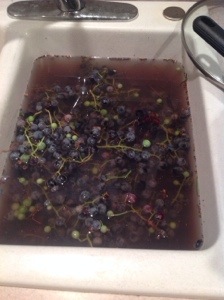
Next, you load them into a steamer.

And then they take about an hour to process. From that, you get about a gallon of juice.
Next, it goes into jars and gets lids and rings, and then into the canner.

Once the canner gets a head of steam then it’s another 14 minutes of processing.
Then, they are set out to cool.

Finally, you remove the rings, pack them in boxes and put them in the storeroom for special occasions throughout the year.

So, when that jar broke, it wasn’t just the 14 minutes of processing that was wasted. It was also the hour of juicing, the washing, the hauling, the trip to Salt Lake and back, and the time for the 7 of us to pick them. Those six bushels of grapes will yield about 60 quarts of juice, or about 15 gallons. That might sound like a lot, but consider my kids love it and I have 8 kids at home and two adult daughters who still like to raid their parents’ pantry.
The real point is that when we put a lot of work into something, it’s that much more disappointing when it doesn’t turn out.
Honestly, I’m much more upset, even years later, about having to fire our system administrator than I am over a few (4 so far) quarts of juice going to waste. And just like I do every time I fire someone, I can’t help but think about what I might have done differently. Since 7 quarts go into the canner, and the juicer only produces 4 quarts per cycle, some of the jars end up sitting for an hour. They cool and then when put into the canner with hot jars, the temperature change is too great.
At least that’s what I think is happening. I’ll make a few changes and see if I can eliminate the failures. I think that’s what we have to do as managers, as well. I’m still not completely convinced of what I could have done differently with the system administrator either.
Rodney M Bliss is an author, columnist and IT Consultant. He lives in Pleasant Grove, UT with his lovely wife and thirteen children.
Follow him on
Twitter (@rodneymbliss)
Facebook (www.facebook.com/rbliss)
LinkedIn (www.LinkedIn.com/in/rbliss)
or contact him at (rbliss at msn dot com)
Tell your friends about this!


Houston, we’ve had a problem.
On April 13, 1970 at approximately 10pm Eastern Time, 200,000 miles from earth an oxygen tank blew up on a small metal capsule flying through space. What happened next has become the stuff of space legend. Three astronauts in space and countless engineers on earth worked tirelessly for the next three days to bring the crippled spacecraft and it’s crew around the moon and back again.
In the 1995 film “Apollo 13” Ed Harris playing real life flight director Gene Kranz is talking to the director of NASA.

NASA Director: This could be the worst disaster NASA’s ever faced.
Gene Kranz: With all due respect, sir, I believe this is gonna be our finest hour.
I want to focus on Kranz’s response from a training standpoint.
Have you ever done the impossible? Or at least something really really hard? No doubt you had to first convince yourself you could do it. I once ran so hard I thought I was going to die. (Staring Into The Abyss.) I had to convince myself that no matter what else happened, I could keep running.
I love baseball. Jamie Moyer was one of the most successful pitchers in Seattle Mariners history.

(Photo credit: Seattle Mariners)
He holds the record for most wins by a Seattle pitcher, (145 wins against 87 losses.) He later won a World Series with the Phillies. What’s amazing about Moyer is that he throws very slow. In baseball terms, it nearly “rainbows” on the way to the plate. Guys who throw slow are typically not good Major League pitchers.
I heard an interview he did recently where he explained that early in his career when he was pitching and the catcher would call for a particular pitch, say a curveball, “I’d think, ‘I hope I can throw this for a strike.’ And of course, then I wouldn’t.”
The point was that until Moyer convinced himself he could throw strikes, there was no way he was going to convince anyone else. BTW, he figured it out. In fact, at 50 years old he was the oldest pitcher in Major League history to win a baseball game.
The key is often not what we can do, but what we think we can do.
Very early in my training career I took a class on how to be a trainer. Of course, we each had to get up and teach the rest of the trainers. One woman got up and started her presentation by saying, “This concept is kind of difficult to understand.” The instructor stopped her before she continued.
If you tell them it’s hard it will be.
My most successful course was on reading network traces. I’ve talked about it in this space before. (What Would It Take To Make You Love What You Hate?) Network traces are scary. Even to technical people, the traces are pretty dense and not easy to work with. But, the course didn’t focus on that. In fact, we barely even acknowledged it. Instead we focused on how much the students were going to love reading network traces when they finished the course.
More than once students took the course simply to try to be the example of a student who still hated traces after the course. None of them were. By first believing in the students, we convinced them to believe in themselves.
Jamie Moyer convinced himself that he was going to throw his pitches for strikes, and then he did it.
Gene Kranz convinced the Apollo 13 crew and support staff that they were going to be brilliant, and they were.
The late Steve Jobs, the founder of Apple told the developers of the Macintosh to make it “Insanely Great.”
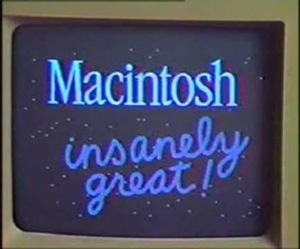
And they did.
We have to first believe in ourselves and then convince our students to believe in themselves. If you can do that for your classes, you will help them find their own finest hour.
Rodney M Bliss is an author, columnist and IT Consultant. He lives in Pleasant Grove, UT with his lovely wife and thirteen children.
Follow him on
Twitter (@rodneymbliss)
Facebook (www.facebook.com/rbliss)
LinkedIn (www.LinkedIn.com/in/rbliss)
or contact him at (rbliss at msn dot com)
Tell your friends about this!
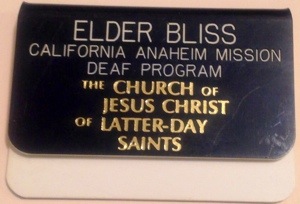
Brakes are something that you tend to take for granted. . .until that day you push the pedal to the floor and your car refuses to stop. Let me tell you, gets the blood pumping.
Today, I’m going to talk about when systems fail. What do you do when you not only blow your budget but you REALLY blow it?
It was January, 1986 and I was working as a missionary for the LDS Church in Orange County, California. Mormon missionaries are those guys you see riding around on bikes with white shirts and ties.

(Photo credit: Reubenscube.net)
Except that my missionary companion, Elder Stevens and I had a car. Elder Stevens was deaf and we worked with the deaf community in the greater Anaheim, CA area. We took turns driving. Elder Stevens actually preferred driving and I preferred to not drive. You would think this was a great arrangement. And it would have been had he been a better driver. A belief in guardian angels was definitely helpful when he got on the freeway.
I don’t remember which of us was driving when the brakes finally failed completely. We managed to get the car safely to our apartment and called the man in charge of the missionaries in Anaheim, President Van Allen.
President, we’ve got a problem. The brakes on our car have failed.
Are you elders okay?
Yeah, we’re at our apartment. What do we do about the car?
Can you get it to the garage by the mission home? We have two elders who maintain our cars.
Yeah, it’s only a few miles with no freeways. I think we can make it.
I’ll let them know to expect you.
No way was I letting Elder Stevens drive. I’d often downshifted to slow down, the problem was our car was an automatic. Sure, I should have called a tow truck. But, at 20 years old, you’re indestructible. In this case we arrived safely.
Everything about an LDS missionary’s life is tracked, from the time you get up (6:30am) to the number of hours you spend proselyting (60 was the goal.) So, you also had to track your milage. Each car had a limited number of miles you could drive each month. When you ran out of miles for the month, you walked.
Yeah, President said you guys could fix the brakes?
Not today. Leave it here and it will probably be at least a week. We have to figure out the problem, and then order parts before we can do the repairs.
So. . . what do we do for a car in the mean time?
We have a loaner car.
Miles stay with the car right?
Yep. The loaner has it’s own 1200 miles for the month.
Sweet. We took the loaner car and had another 1200 miles to use. A week later, our car was done and we swapped back.
The miles reset at the beginning of each month. In February, we got a new set of miles. . .and a new car problem. This time it was the ignition switch. So, we were back to the maintenance elders. Another week of a loaner car with it’s 1200 miles.
When March rolled around, we reset our allowable miles. . .and we got a new car problem. This time the transmission went out. There was no driving it to the maintenance elders this month. A tow truck and another week of the loaner car.
The following month, our scheduled time was complete and Elder Stevens was transferred to North Carolina, and I was assigned to work with some English speaking elders for a few weeks until my 2 year mission was complete.
During our 3 months as companions, Elder Stevens and I estimated that we had racked up over $1500 in car repairs, over $500 per month. There was a goal for monthly car maintenance. (I mentioned that everything was tracked. . .and most of it had a goal associated with it.) The mission goal was $7 / month in maintenance per car. The mission had about 20 cars assigned to it. We covered all of Orange County. So, we had singlehandedly spent about double the budget for the entire fleet.
What’s this have to do with the IT business? Project managers are really good at making estimates. We estimate schedules. We talk to engineers and programmers who offer optimistic projections and the PM figures out what kind of a buffer to assign and he makes estimates for their time. So, what do you do when your estimates are so far off that they start spilling over and sucking resources from other areas?
In our missionary example, there was not really another car available. We had to keep using the Lemon. But, in business generally you hit a point where you make a decision. You can either increase the budget, cut features, throw people at it, or you simply pull the plug.
When I make a schedule and a project estimate, like most PMs I include two buffers, one that I tell people about, and one that I don’t. Always keep a little bit of wiggle room in your back pocket. But, when a project is clearly headed off a cliff, it’s the PMs job to rein it back in, get management to expand the budget, or pull the plug. Projects have a life of their own, and it’s disappointing to have to kill one. However, better that than to put an entire portfolio at risk. Because the resources have to come from somewhere.
The night before I was supposed to fly home from my mission, the Mission President met with the group of us who had completed our service and were being released.
Elders and Sisters, it’s customary for the Mission President to offer some words of advice as you complete this portion of your life and move on to the college or jobs or whatever the next phase will be. The best possible advice I can offer you is NEVER buy a Renault Alliance car!

It’s advice I’ve followed to this day.
Rodney M Bliss is an author, columnist and IT Consultant. He lives in Pleasant Grove, UT with his lovely wife and thirteen children.
Follow him on
Twitter (@rodneymbliss)
Facebook (www.facebook.com/rbliss)
LinkedIn (www.LinkedIn.com/in/rbliss)
or contact him at (rbliss at msn dot com)
Tell your friends about this!


Rodney, I don’t get it.
What?
You go to all this work to build a cohesive team and then you let Dave sort of blow it up.
Well, he’s the Prima Donna.
Yeah, no kidding!
No, you don’t understand. I LIKE Prima Donnas.
No one is supposed to like a Prima Donna. How could you? Here’s a popular online dictionary definition of a Prima Donna.
1. a first or principal female singer of an opera company.

2. a temperamental person; a person who takes adulation and privileged treatment as a right and reacts with petulance to criticism or inconvenience.
Clearly I wasn’t putting on an opera, so given the second definition, why would I, why would anyone for that matter, actively hire a Prima Donna?
Why? Because in order to be a Prima Donna, you have to be a great programmer. Not just a good programmer. You have to be fantastic. Because here’s what happens. If you have a rotten personality. If you take adulation and privileged treatment as a right and react with petulance to criticism and you are NOT a great programmer, you will be an unemployed programmer. No one is going to put up with your terrible attitude. But, if you are a fantastic coder, people are willing to put up with an attitude.
Prima Donnas, especially software code monkeys often don’t know they are acting like a Prima Donna. They have two overriding characteristics that permeate their work relationships. First, they don’t see themselves as arrogant, because, let’s face it, they really are smarter, or at least a better coder than everyone else. So, they lack self awareness. But, they have mounds of confidence. They are fearless, willing to tackle the most complex coding challenge, because they are just that good.
I remember hearing Bill Gates speak, early in my Microsoft career. Windows 95 had suffered yet another delay and someone asked Bill how he was handling the stress.
Well, sometimes I’m tempted to take the code base home and rewrite the entire thing over the weekend.
He was only half joking. Prima Donna’s would charge hell with a bucket.
At this point some of you are shaking your heads and thinking, “This time Rodney’s gone too far. I’ve worked with Prima Donnas and they are a pain in the butt! No one would recruit them!”
It’s an excellent point. Hey, I understand reality. I would love to have the programmer equivalent of Captain America or Superman. They are guys who are brilliant at programming and just really swell guys too! But, those guys are all working in Hollywood. So, given the choice of a brilliant Prima Donna or a slightly above-average Regular Joe, I’ll take the Prima Donna every time. I’m not hiring people who need to go out and represent the company in public. I don’t want “well rounded” individuals. I want guys who are completely off the charts in the area that’s important to me, such as programming, and I don’t really care about their other characteristics. Sure, it would nice to have someone who’s going to be nice, but it’s not a requirement.
It’s a somewhat foreign concept, I’ll admit. But, look around your office. If you don’t have a Prima Donna engineer or programmer, or sales gal, or graphic artist, ask yourself why. I’ve had managers who built teams out of well rounded individuals. Those teams were adequate, but rarely were they spectacular.
But, as I said in the title, you can’t have two or they’ll fight. I discovered this by accident. RESMARK was chugging along, but many pieces, especially the online version were way behind schedule. As we came off a software Sprint, I pulled Dave out of the feature work he was doing and teamed him with Jason to work on the online version of the software. Jason was working for me for the summer, but was already a fantastic developer.
I congratulated myself on a brilliant management move. If one brilliant coder was good for a project, two would be outstanding. After the first 2 week Sprint I sat down with Dave.
How’s it coming?
Slow.
What’s the problem?
Jason won’t do anything I tell him.
Interestingly Jason had the same complaint about Dave. What I realized was that if you put two Alpha dogs together, they are going to fight. It’s natural and it was my fault. I reassigned Jason and thinks went a lot smoother. So, take a look around your team. Are they the very best at what they do? Or, did you hire a the women who was not quite the best programmer, or support person, or dog catcher. Or hire a guy who is “good enough?”
We’d all like the Prima Donna to be nice. But, unless you are in the business of handing out sunshine and lollipops, appreciate the Prima Donna among you. (But, remember, just one otherwise they fight!)
Rodney M Bliss is an author, columnist and IT Consultant. He lives in Pleasant Grove, UT with his lovely wife and thirteen children.
Follow him on
Twitter (@rodneymbliss)
Facebook (www.facebook.com/rbliss)
LinkedIn (www.LinkedIn.com/in/rbliss)
or contact him at (rbliss at msn dot com)
Tell your friends about this!

Why did I take this job? Why did I take a pittance of a salary a tiny slice of ownership so that I could come and be this stressed every day?
I admit it, I was feeling a little sorry for myself. I was trying to drive our company RESMARK to a successful product launch. If you’ve never been through the process of releasing a product, there comes a point where you doubt if you can actually make it. Your schedule is shot, customers are clamoring for new features and you don’t even have time to include the features you promised them, and the investors are questioning every time you buy a package of bic pens. “Don’t they write code on the computer? Why are office supply costs so high?”
I came into the office to find yet another yellow sticky note on my monitor. Now what could go wrong?
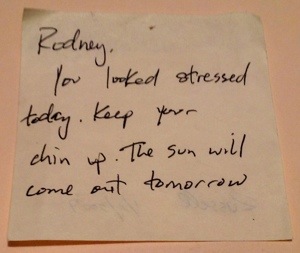
The note took me by surprise. It was written by our office manager, Randy. It was what I needed, that day and lots of days. Randy probably didn’t realize it. . .I don’t know, maybe he did, he was a really, really good office manager. . .but he provided me with a memory that I would carry with me for years. That picture above was easy to find. I pulled the 7 year old note out of my desk drawer.
The sentiments are helpful, but more important was the idea that someone at work was looking out for me. It’s important to help your employees feel connected to the company and let them know that they are valued.
Like many people, I have some personal mementoes on my desk in my home office. The one that sits on a shelf directly in front of me at eye level is a collection of pocket watches.
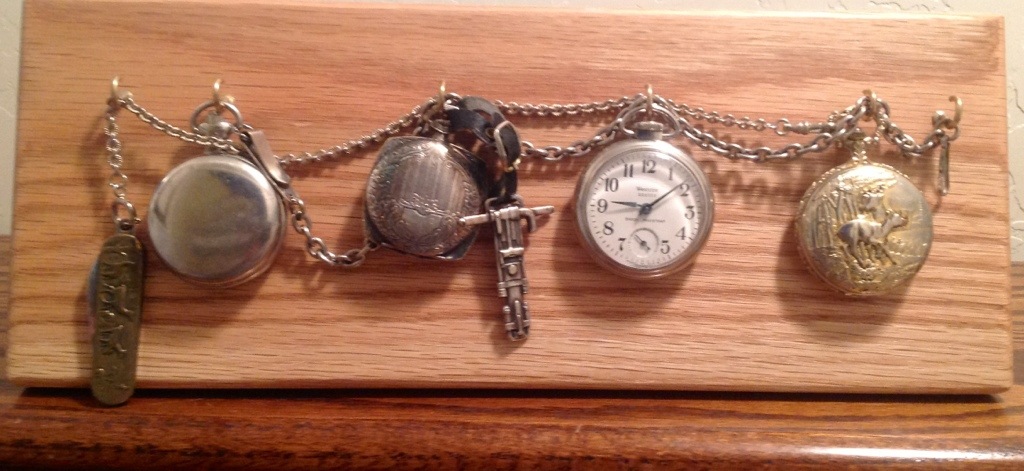
I like pocket watches. The watch on the right was a gift from my wife. The watch second from the right belonged to my dad’s father. The original watch probably cost $4. I had to recently replace the face and it was $20 just for the glass and the jeweler said he was lucky to find a used one. The watch on the far left was the most recent one I bought to carry everyday, before I ditched it for my cell phone. The one second from the left is special to me.
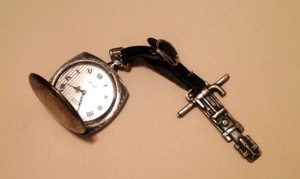
The watch was a gift from my mother to my late father. It has his initials on the front and an inscription inside. The watch fob belonged to my mother’s father. Most people are challenged to try to identify it. My grandfather was a dam builder. It’s a miniature jackhammer.

(Photo Credit: Wikipedia)
Oh, and the board they are attached to was a Father’s Day gift from one of my daughters.
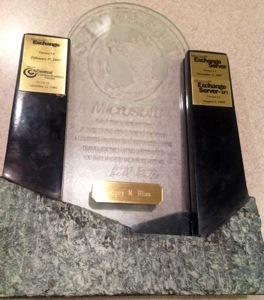
The reason I keep this prominently displayed is to remind me of who I am and where I came from. It helps me keep perspective on what’s really important. There are ways to give employees this same opportunity. Microsoft was brilliant at this. They had awards for everything. This is an official Microsoft Ship It award. You got one when you were part of a product that shipped.
Here’s a jacket that our training org gave employees.
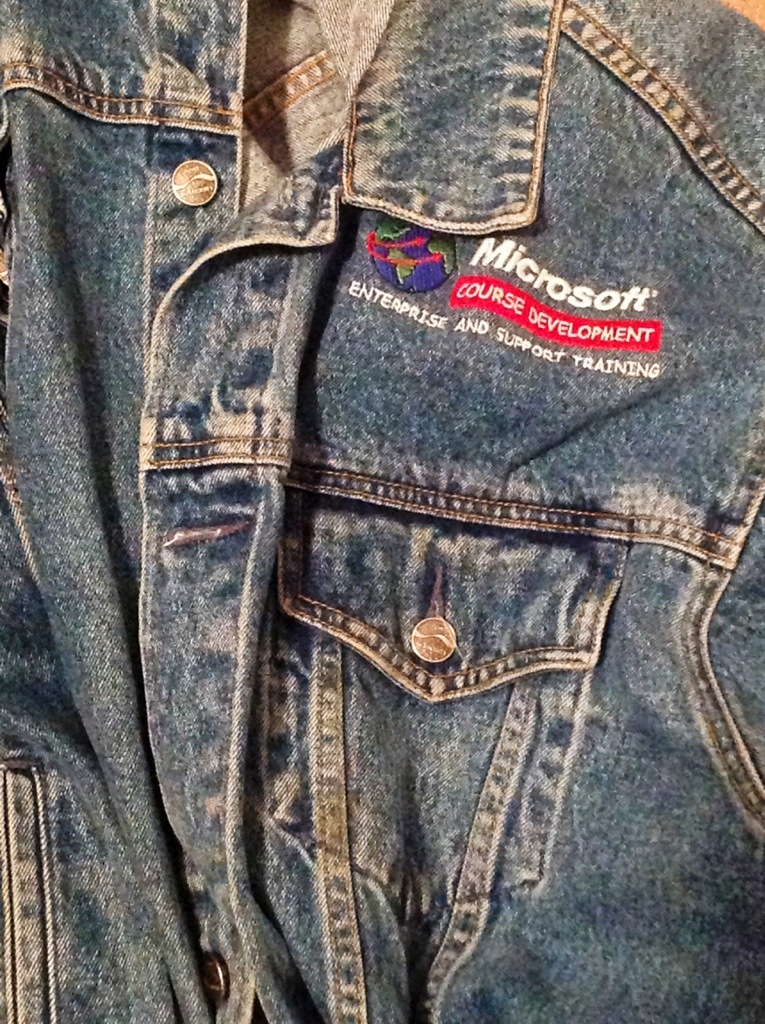
Even years later, I still have some of the t-shirts, and other bits of Microsoft SWAG. Some of them I keep for sentimental reasons, like the Ship It award. Others I keep because they haven’t worn out yet, like the jacket. However, those awards and trinkets lack an important element to make them lasting. They lack a personal touch. Here’s another note that was left on my monitor. It’s probably about sixteen years old.
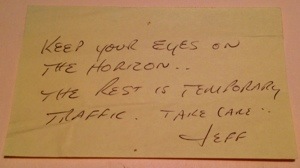
If I had to keep only one, the trophy or the note, I would probably choose the note. Thousands of people helped ship Microsoft Exchange server and got those trophies. But, that note was unique. In a world of mass production, uniqueness is something. . .well, unique. So, try writing a note for an employee or a coworker. It sounds corny, but you will be surprised how many times it literally makes a memory. If you’ve ever left a note for someone, or someone has left you a note, let me know in the comments.
Rodney M Bliss is an author, columnist and IT Consultant. He lives in Pleasant Grove, UT with his lovely wife and thirteen children who leave him lovely notes on a regular basis.
Follow him on
Twitter (@rodneymbliss)
Facebook (www.facebook.com/rbliss)
LinkedIn (www.LinkedIn.com/in/rbliss)
or contact him at (rbliss at msn dot com)
Tell your friends about this!
It’s a software phrase. It means that if you put bad data into a system, you’ll get bad data out. And it applies to people, and canning too. I’ve been in the computer industry for 25 years. When I started at WordPerfect (Back To Where It All Began) a century ago if you knew how to type, you could get a job. That literally was the screening process. If you could touch type, WordPerfect would hire you to work in their support department.
Times, have changed, but it didn’t take 25 years. When I went I left WordPerfect and went to Microsoft I was shocked at the level of education Microsoft support engineers had. Becky Winn, the person I cowrote my first book with had a masters, and our manager (Rodney, are you working or are you screwing around?) had an MBA.
The requirements for entry have continued to climb. Especially if you are looking at something other than an entry level position, companies have figured out they can be extremely picky. In many cases they decide to simply promote an internal candidate and teach her what they need to know.
At my last company I managed the SharePoint team. This was about 5 years ago and SharePoint expertise was extremely hard to find. Now, it’s merely difficult to find. Both of my senior SharePoint engineers got hired away. I was stuck with a SharePoint installation and no one to manage it. We looked briefly at searching for external candidates, but I knew the state of the industry and knew that at what we could afford to pay, we wouldn’t get anyone. We identified an internal candidate, Kent and tried to persuade him to apply for the position.
Kent was reasonably technical, but most importantly he was teachable. At least that’s what my technical screeners said. I remember interviewing Kent. Since my background is messaging, I asked him to describe the process of getting an email from your laptop to the destination desktop outside our company. Kent knew a few terms like DNS, and TCP/IP. But, he had no real clue how DNS entries got accessed. He fumbled and bumbled his way through the interview, constantly telling us that he was sure he’d failed it. Afterward, I talked to my senior messaging engineer who had conducted the interview with me.
What do you think?
I think we should offer it to him.
He missed nearly every question we asked him.
Yeah, but he was willing to say “I don’t know.” And that type of a person is willing to learn.
We offered it to him and he did an outstanding job.
So, as you look at your staff, you have to decide if they are teachable. Are you giving them opportunities to grow? Are you pigeon-holing them because they started out in another role?
I spent my weekend canning. Yeah, I know, kind of weird. I did 28 quarts of tomato sauce and 21 quarts of pear sauce.

And there’s what made me think of GIGO. The tomatoes weren’t hard, but it takes a lot of work to turn pears into pear sauce. You have to wash them, then blanch them (scald them in hot water) and then douse them in cold water so you can remove the skins. Then, you have to core them. Then, you have to turn them from pear slices into sauce. I used a blender. Then you have to put them in the jars, put the lids on, put the jars into the canner, let it get up a head of steam and then cook them for 38 minutes. (It’s normally 30, but I’m 4,000 feet above sea level, so they need the extra 8 minutes.)
It’s a lot less work to just go buy a can of pears. And yet, there’s a certain satisfaction in taking a pear, or a tomato and turning it into food. Similarly, it’s satisfying to take an employee, maybe one who’s stagnated in their current role, or one who simply is the best fit for your SharePoint team and train them in a new role. And just like my pears, there’s lots that can go wrong. I could start with spoiled fruit. I could screw up the canning process. It’s take a lot of attention to detail to get them to come out just the way I want them to.
The same thing applies to our staff. Start with good raw product, give it adequate attention and when you get done you have a product that will last a long time.
Rodney M Bliss is an author, columnist and IT Consultant. He lives in Pleasant Grove, UT with his lovely wife and thirteen children. In the next two weeks he will can dozens of quarts of applesauce and gallons of the most delicious Concord grape juice you have ever tasted. And he’ll explain how it relates to business.
Follow him on
Twitter (@rodneymbliss)
Facebook (www.facebook.com/rbliss)
LinkedIn (www.LinkedIn.com/in/rbliss)
or contact him at (rbliss at msn dot com)
Tell your friends about this!

There’s a little football game going to be played here in Utah tomorrow. The teams are not in the same conference. They won’t play each other again until 2016, but for both schools, it’s probably the most important game of the year. It will pit my alma mater, the Brigham Young University cougars against their rivals, the Utes of University of Utah. It’s referred to as The Holy War, although it’s neither a war nor particularly holy.
I was introduced to The Holy War on November 18, 1989 when my new bride and I sat in Cougar stadium in Provo and watched BYU crush Utah, 70-31. It’s not that BYU was trying to run up the score. Utah just wasn’t very good. I think BYU suited up their cheerleaders to play in the fourth quarter.
Rivalries are great in sports. They drive interest. They get the fans talking and involved.
Rivalries are terrible in families. I work very hard to keep my kids from feeling like they have to compete with each other. We do all that new age parenting stuff like validating feelings, identifying unique and special traits about each child. (It really is valuable and important.)
So, what about in business? Are rivalries between departments more like sports or more like families? Are rivalries good? Useful? Harmful?
Rivalries can be a huge asset in business. They accomplish three important objectives.

Team Unity
Nothing pulls your team together like a common opponent. Hopefully the team hasn’t decided that as the manager, you are that common enemy. But, just as a sports team pulls together when they are facing a rival, a “rival” can help your team pull together. What you are really doing by finding a rival is that you are focusing your team on a common goal. The rival team is just a surrogate for what you actually are trying to accomplish. You will know that the team is “getting” it when they start to look at how to help each other improve. In one team I was a leader of, we got text alerts when a system failed. There was one guy on call. Because our team was pulling for each other, when an alert went out, the rest of the team would contact the on-call engineer if they didn’t see a timely response posted. They realized that what affected one of them really impacted all of them. It was a really strong team in that respect.
Improved Performance
And that brings up the second objective of picking a rival. You will see improved performance. One of the management mantras is “That which gets measured, improves.” In this case it’s true. When I managed an email team, we had two important metrics that management watched closely: availability and priority outages. We started competing with the Server team on availabiltity. Now, it was no longer good enough to achieve our stated availability goal of 99.5% (Yes, my official baseline was “two nines.”) Now, the team wanted to exceed whatever availability the server team achieved.
Cross Team Unity
And that’s the third item that finding a rivalry does for you. It forces you to work closer with another team. It might appear counterproductive to say that competing with another team will draw the two teams together. BYU and Utah have played each other 94 times and Utah leads the series 56–34–4. But, playing each other for over a hundred years hasn’t drawn the schools closer together. They two teams hate each other as much as ever. So why should a rivalry pull the server team and the Exchange Server team closer together? Because unlike sports, in business you can BOTH win. We wanted to have the higher availability percentage, but we wanted the server team to also meet their stated goal. . .we just didn’t want them to beat us. It also forced us to communicate with them on a semi-regular basis. Communication strengthens relationships.
You typically have to have something you are competing for. I like to design some useless but symbolic “trophy.” The team who hold the trophy gets bragging rights.

So, rivalries are a good thing. . .except when they aren’t.
Down Side
A rivalry between two teams can totally screw up your organization, if not done well. As a manager you need to keep in mind the ultimate goal. It’s not the silly trophy, although you really want to win it. The ultimate goal is to make the system stronger. I’ve seen teams take rivalries too far. They actively sabotage their rivals. So, rather than help their team, they focus on hurting the other team. That’s not going to be productive long term.
Also, you shouldn’t roll everything about your team into the rivalry. In other words, don’t make your entire team’s tasks dependent on rivalry tasks. You need to keep the normal work not only going forward, but thriving as well.
In the role I mentioned above where we challenged the server team, we started that rivalry with both teams distrusting each other. John, the Server Team Manager and I spent several meetings trying to get to know each other and understand each other’s organizations. Ultimately the two teams became two of the strongest and closest teams in our entire portfolio.
On Saturday here in Utah two schools will meet who not only have one of the longest rivalries in college sports but are also phyically closer than any other rival schools in the nation. BYU is in Provo, and The University of Utah is 40 miles away in Salt Lake City.

So, don’t be afraid of rivalries, but manage them carefully and make sure you are using them to motivate your team and push for greater accountability and performance, and not simply as another way of bashing a team that you already have conflicts with.
Rodney M Bliss attended BYU and is an author, columnist and IT Consultant. He lives in Pleasant Grove, UT with his lovely wife and thirteen children, one of whom attended the University of Utah, one of whom attends Utah State and the others who haven’t chosen sides yet.
Follow him on
Twitter (@rodneymbliss)
Facebook (www.facebook.com/rbliss)
LinkedIn (www.LinkedIn.com/in/rbliss)
or contact him at (rbliss at msn dot com)
