
Several readers yesterday took me to task for not showing enough love to Elm trees. (Planting For The Future.) One friend described a majestic 75 year old Elm that graces his yard in Chicago’s Norther suburbs.
I’ll admit that I don’t know a lot about trees. I was a scout leader for 20 years, so I can tell you the basics; Oak, Elm, Maple, Cottonwood, Pine, Fir, Hemlock, Cedar, Dogwood, Willow, cherry, apple, peach. . .maybe I do know a little about trees. But, the point is that after you get past the main type “Maple” or “Elm,” I’m not great at telling a Silver Maple from a Sugar Maple.
But, I can tell you that the Elms here in Utah are NOT majestic. Apparently there are different types of Elms, just like there are different types of pines, or Maples. Elms were much more prevalent in the past. Back before Freddy Kruger made us all afraid of Elm Street. But, they got hit with a disease. And many of them died off.
At that point, having killed our own native stuff, we imported stuff from China. I think our Elms might be Chinese Elms. The point is, a Utah Elm tree looks like this.

I took the picture yesterday. Here’s a Maple about a block from my house, also taken yesterday.

And here’s a maple directly across the street. Looking out our kitchen window, this is the color we get to enjoy.
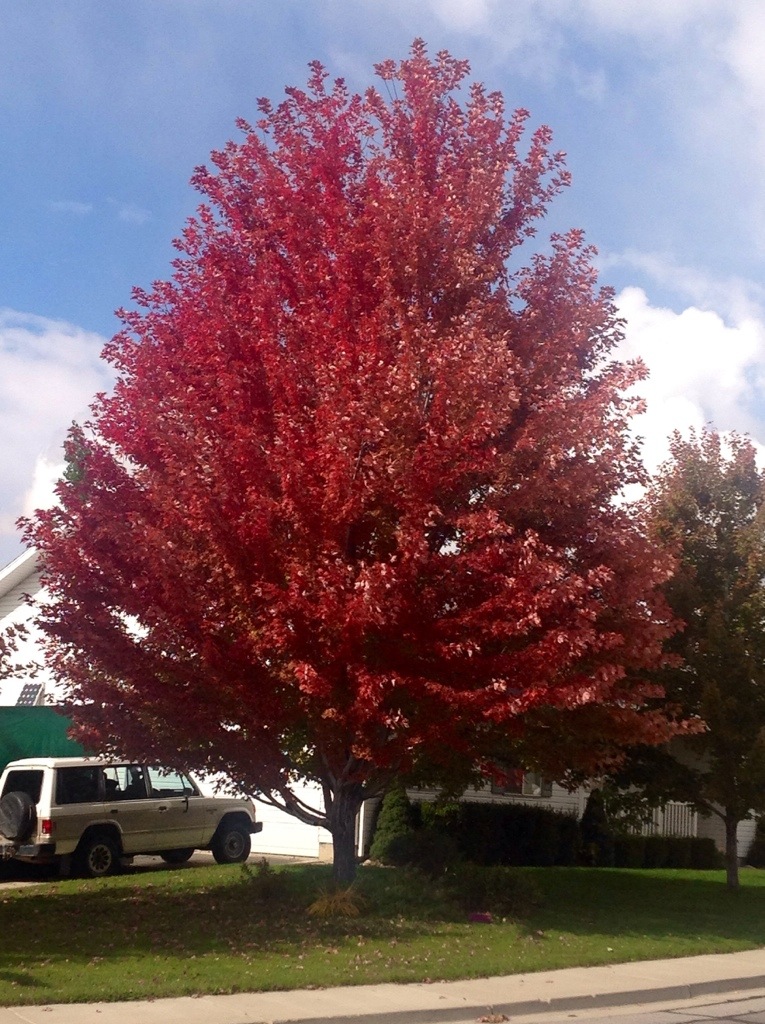
And of course, this is one of my Maple trees.

In a few years I expect it will look like my neighbors’ trees. That would be fine with me. I just don’t want it to look like that scraggly Elm.
Rodney M Bliss is an author, columnist and IT Consultant. He lives in Pleasant Grove, UT with his lovely wife and thirteen children.
Follow him on
Twitter (@rodneymbliss)
Facebook (www.facebook.com/rbliss)
LinkedIn (www.LinkedIn.com/in/rbliss)
or contact him at (rbliss at msn dot com)
Tell your friends about this!

Dad, will we be able to climb these trees?
Well, your kids will be able to climb them.
Oh man! I hate delayed gratification!
My 13 year old son was helping me plant trees in our yard. We ordered 10 bare root maple trees. I’ve never really planted trees before. My neighbor has a beautiful yard, so I asked him.
It’s hard to say with bare root trees. I would plan on losing at least three quarters of them.
We read up on planting trees on the internet. My neighbor said soak the roots in a 5 gallon bucket for 48 hours. The internet said absolutely do not soak them for more than an hour. Summer schedules being weird, we ended up soaking them for 72 hours.
All nine of the maples grew. We’re now headed into the Utah winter. If they survive the winter I think we’re in good shape. We picked maples for the shade, but also for the leaf colors. 
And even at 3 feet high, they are not disappointing.
So, what does planting trees have to do with business and careers?
It struck me that even though we plan to stay in this house for years, we are really planting the trees for an uncertain future. Every time we’ve put down roots someplace, a job or some other factor has forced us to move. Right now the trees are not providing a bit of shade. Even next year and the year after that, they won’t be much more than spindly bean poles. It will probably be 4 our 5 years before they start to provide shade from the blistering Utah summer sun that beats on our South and West facing walls.
Is it worth planting them now, even knowing that we might not get to enjoy the results?
I recently started taking a PMP course. PMP stands for Project Manager Professional.


I’ve been working on projects for over 20 years. But, I never took the time to sit down and take the course and the exam. The course represents an investment of thousands of dollars. And just like with my trees, there is no guarantee that I’ll get to use the results of that training and certification.
However, just like my hope for my trees, I have hopes and plans that will be made easier with a PMP certification. I think most training, from a bachelors degree to certification training falls into this category. Training and education is planting for the future. It’s possible I’ll end up moving before my trees are big enough to provide the shade I planted them for. But, the effort will not have been wasted. The house will be more attractive (and cheaper to cool.) And if we do stay, someday my son may bring my grandkids here and say, “I helped your grandfather plant this tree.” At that point, I will get the payoff for planting for the future.

Incidentally, I said we planted ten trees and all nine maples grew. Turns out the 10th was an elm. Trust me, you do NOT want to cultivate elms in your yard.
Rodney M Bliss is an author, columnist and IT Consultant. He lives in Pleasant Grove, UT with his lovely wife and thirteen children.
Follow him on
Twitter (@rodneymbliss)
Facebook (www.facebook.com/rbliss)
LinkedIn (www.LinkedIn.com/in/rbliss)
or contact him at (rbliss at msn dot com)
Tell your friends about this!

(Image Credit: Sago via blenderartists.org)
Frank had worked there about 4 years and in all that time, the Big Red Button had literally hung over his head. It was suspended from a pipe in the middle of the cubicles. Just high enough that no one would bump their head, but within easy reach. And in those four years, Frank had always wanted to push it, just to see what would happen. But, he never had. Today, was going to be different. Today, he decided, he was going to push the Big Red Button.
Frank worked at the same large non profit corporation that I did. He worked on the 6th floor of a large office building. At one point in the distant past, the 6th floor had been a data center. Strange as it might seem, the corporation had decided to locate their servers not in some concrete bunker buried in the ground somewhere, but in prime office space in the corporate office building. When the floor had been filled with rows and rows of servers in racks, the Big Red Button had been in the center of the room. Clearly, it had been important to the operation of the data center. The vision Frank had was of a sort of fuel shutoff button at a gas station. But, of course, there was no gasoline in a data center. Most likely it was the trigger for the fire suppression systems.
Datacenters are fragile things. As I talked about in Data Center CSI: The Day The Servers Died, there are many things that can harm a data center, moisture, dust, but one of the worst is fire. A fire in your data center is one of the worst case scenarios. And a normal sprinkler system won’t work. It would put out the fire, but all that water would kill whatever servers survived the fire. Most data centers us Halon. It’s a gas that is almost breathable. But, the point is that it sucks all the oxygen out of the room and the fire gets suffocated.
That was Frank’s best guess. That back when the floor had been a data center the Big Red Button was the kill switch to release the Halon gas. If that was case, there was no longer any need for it, and he could safely press it, right? Unless they left the Halon hooked up. Then, he and his coworkers would have terrible headaches and have to evacuate before they too suffocated. Better to leave it. As a programmer, Frank was familiar with the history of the floor and understood enough about data centers to not want to be the guy who triggered the alarm.
Eventually, the organization moved most of the servers to a dedicated data center in some concrete bunker buried in the ground somewhere. The rest of the servers were moved into closets and the space was refurbished with cubicles. . .except for that Big Red Button. It was a reminder that at one point the room had been used for a very different purpose.
But, today was going to be different. The time had come to remodel the floor again. And this time they were stripping it down to bare walls and building actual offices. They were gutting the entire floor. Frank’s team was being relocated elsewhere in the building. In fact, today was moving day. They were taking their personal items, and tonight the movers would come in and move their computers and phones before disassembling the cubicles and ripping up the carpet. Whatever purpose the Big Red Button had served in a previous life, it would be ripped out along with everything else.
Frank realized he might never see the Big Red Button again. The Big Red Button that had hung over his head like the Sword of Damocles for the past four years. He was pretty sure nothing would happen, but one way or another, he was going to find out today.
Don’t do it, Frank. There’s no telling what it might do.
Come on. We’ve sat here for four years staring at it and it’s done nothing. I’m pretty sure they disconnected it years ago.
I wouldn’t if I were you Frank.
Yeah? That’s because you aren’t brave like me!
Whatever.
And with that, Frank pushed the Big Red Button. . . and nothing happened. . . for about 30 seconds. And then the stairwell door burst open and 8 guys from the IT department came literally sprinting through the floor headed for the maintenance closet. The four that could cram into the closet watched the power indicator lights start to wink back on as the servers governing the phones and network routers for the entire building attempted to recover from their unexpected shutdown.
With a sinking feeling, Frank listened to them as his coworker suddenly found somewhere else to be.
I don’t know! It was like we had a complete power failure for like 2 seconds.
Did we lose the entire building?
No, just this closet. The desktop machines are fine, but the phones are all rebooting and we lost all network communication.
I’m not even sure where to start trying to track this down.
Frank’s mouth was suddenly dry and it was hard to get any sound out.
Ah. . .I think I can help with that.
Sometimes, it’s better to resist the urge and just leave your curiosity unfulfilled. Incidentally, Frank did not get fired. Our organization didn’t really do that sort of thing. But, he was pretty relentlessly mocked. And he NEVER EVER again pushed a Big Red Button.
(Josh Gret contributed to this column.)
Rodney M Bliss is an author, columnist and IT Consultant. He lives in Pleasant Grove, UT with his lovely wife and thirteen children.
Follow him on
Twitter (@rodneymbliss)
Facebook (www.facebook.com/rbliss)
LinkedIn (www.LinkedIn.com/in/rbliss)
or contact him at (rbliss at msn dot com)
Tell your friends about this!

The email went to all 800 employees on the WordPerfect Office system. The subject was “I’m the father of Murphy Brown’s Baby,” and it said it was from Dan Quayle.
It was one of the oddest calls I ever got as a member of WordPerfect’s SWAT team. They were a government department and their upper management was NOT amused. They wanted us to figure out who sent it and how to prevent it in the future.
A little pop culture history for some of my younger readers. Murphy Brown was a character on a TV show of the same name in the 1980’s. Murphy was single and decided to have a baby. This was pretty scandalous in the George HW Bush years. This would have been just one more storyline in a sitcom if it weren’t for the Vice President of the United States, Dan Quayle.

(Photo Credit: Department of Defense)
Quayle’s career was marked by several verbal gaffes, not unlike our current Vice President. Quayle was most famous for misspelling the word “potatoe” in front of a TV camera.
Anyway, Vice President Quayle felt the need to weigh in on the country’s declining morals as expressed on the Murphy Brown show. Greener’s Law reminds you to
Never pick a fight with people who buy ink by the barrel.
This was the 20th century equivalent. See Murphy Brown was a comedy about politics. So, the writers wrote an “in show” response to the VP. Someone should have explained to the VP that you cannot win an argument with a person who literally gets to create their own reality! How could you think that was a good idea? Anyway, as you might expect, the VP looked like an idiot and the TV show saw their ratings skyrocket.
As we started to investigate the customer’s site, we discovered that our investigation was hampered by a couple of WordPerfect Office “features.” First, of course, it wasn’t really Dan Quayle, but who was it? We didn’t know. No one actually saw the email. They saw the pop up notification. The pop up had
- Subject

- Display Name
And that was it. Users could freely change their Display Name. The Display Name showed in the pop up notification and it appeared on the FROM: line followed by the user’s alias. So, everyone saw the notification, but where was the actual message, that would presumably have the user’s actual alias? It was gone.
One of the best features of WordPerfect Office was the MESSAGE RECALL ability. That was a feature where you could send someone an email and then retract it. We called it the “save your job” feature. You know, when it’s 2:00am and it seems like a great idea to tell the boss what you think of her in an email rant? And then the next morning you realize that you actually need your job to pay for stuff you want. Stuff like food and rent. Message Recall let you get it back and the boss never knew it was there. And that was our problem. “Dan Quayle” had sent the email and then immediately recalled it. So, no one got to see the actual email.
Some of my younger readers, those who needed to be told who Murphy Brown was, are probably thinking “What about the versions that went to smart phones?” Nope. This was way before smart phones. All the email lived and died in this one system. We had to tell the customer that there was really no way to figure out who had sent the email.
Can you prevent it from happening again? Or at least help us catch the person if they try it again?
This was the kind of problem that engineers love. How to set a trap that would overcome the Message Recall feature? The trick we came up with was Gateways. Gateways were links between email systems. We don’t really think of them as much more than a feature anymore, but at one point if you wanted to send email to someone outside your company, you had to set up a gateway linking your company email to their company email.
So, we went in and configured a gateway, but we didn’t connect it to anything on the other end. In hacker terms, this would be called a honey pot. We then updated the company Global Address List and added a name for someone whose address was through our honey pot.
The idea was that the Vice President would go into the address book and send an email to everyone, just as he had before. Then, he would immediately recall the message. But, he wouldn’t be able to pull it back through the gateway. At this point WordPerfect Office was still file based, as I mentioned in The Day Batman Almost Got Me Fired.
So, the original message would get placed in the Gateway folder. Then, the message recall, which was really just another file that the email client used to track down the message to be delete, would also get placed in that folder. Since it’s a honey pot, stuff goes IN, but doesn’t come OUT. When the customer noticed another system wide broadcast from the veep, they could zip up the contents of the Gateway folder and we’d decipher the files to find the name of the sender.
Sadly, Dan Quayle quit posting on their network. My guess is that our Vice Presidential impersonator was actually in the IT department. He probably was one of the people helping us set the trap. And given that he could probably correctly spell potato, he wasn’t about to allow himself to be caught that easily.
Modern email programs are completely redesigned from these early days, but, it’s always good to remember that no matter how sophisticated or simple our tools, there are still people behind the keyboards. Sometimes they make good choices, sometimes they claim to have fathered a child on a TV sitcom.
Rodney M Bliss is an author, columnist and IT Consultant. He lives in Pleasant Grove, UT with his lovely wife and thirteen children.
Follow him on
Twitter (@rodneymbliss)
Facebook (www.facebook.com/rbliss)
LinkedIn (www.LinkedIn.com/in/rbliss)
or contact him at (rbliss at msn dot com)
Tell your friends about this!

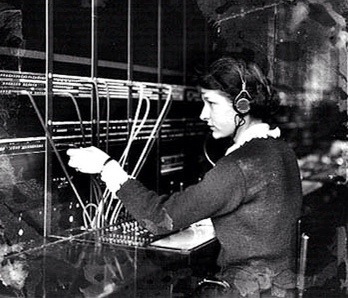
(Photo credit: kbslenglishg.wikispaces.com)
Thanks for calling Microsoft support. How can I help you today?
I’m getting an error message when I try to use Outlook Web Access.
When you use what?
You know, the web based client. I’m getting an “unknown user” error when I try to log in.
I’m sorry sir, that’s not actually a Microsoft product.
What do you mean it’s not a Microsoft product? You shipped it in the box!
Yeah, but we didn’t expect people to use it in production. It’s a demo of what you can build on Microsoft Exchange’s application platform.
I don’t really care why you shipped it. My users need to be able to log into Exchange from the web and this product lets them do that. . .mostly. As soon as I get this authentication issue resolved.
The year was 1996 and Microsoft had finally ditched their antiquated MSMail product and released Microsoft Exchange 4.0. There was no Exchange version 1-3. Exchange 4.0 did some very innovative things. It was finally a grown up client/server application. Meaning that it was no longer file based and subject to the flaws of file based email systems. (The Day Batman Almost Got Me Fired.) And it had this whole new application support functionality.
Today, we assume that every email system should be accessible via the Internet. But 1996 was still the age of the dinosaurs.

(Photo credit: Universal Pictures)
Everything ran as a separate program. And people weren’t really sure this whole “internet” thing was going to take off. (Seriously, there were people who doubted the Internet would survive.) Anyway, one of Microsoft’s biggest competitors was Lotus Notes. What set Notes apart was that programmers could write cool applications for Notes that would combine email and other applications. For example, you could have a program that automatically sent a document to a list of people for approval. Once everyone had approved it, Notes could send it on to the manager. It was all very cutting edge 17 years ago.
So, while building Microsoft Exchange, Microsoft added the ability for customers to write programs that would interact with their email like Notes. However, they were stuck with a chicken and egg problem. How do you get people to write programs for an email system that has no programs written for it? You include some examples. Outlook Web Access was one of those examples. It literally was created by a programmer in his spare time who wanted to see if he could do it. It worked so they included it in the SAMPLES folder.
The problem was that people wanted to actually use it. In support we were not sure what to do. None us knew how to debug an HTML based program. We’d never been trained on it. It turned into a little bit of a PR nightmare. At first we were told,
It’s labeled “Use at your own risk.” We don’t support it.
However, cooler heads soon prevailed and the Exchange Program Managers realized they had stumbled into a valuable new product. They assigned a developer to update it, gave Support some training on it, and updated the feature list on the back of the box.
The important lesson was that customers will tell you what they want if you just listen to them. I’ve seen Program Managers on other products who insisted that customers were using the product wrong. It might not be how they designed it, but it’s how the customers, the paying customers want to use it. Don’t be afraid to let the customers influence your product. They will be pretty blunt about what they want and what they don’t. Today OWA is probably used more than any other client for accessing a mailbox.
Microsoft never did make much of a dent in Notes marketshare.
Rodney M Bliss is an author, columnist and IT Consultant. He lives in Pleasant Grove, UT with his lovely wife and thirteen children.
Follow him on
Twitter (@rodneymbliss)
Facebook (www.facebook.com/rbliss)
LinkedIn (www.LinkedIn.com/in/rbliss)
or contact him at (rbliss at msn dot com)
Tell your friends about this!

I think we have time for a few questions. Yes, you there in the third row.
I’ve heard that when we move to the new building next month the company might change the dress code.
Thunderous applause from about half the room of 1000 people.
Oh please. The guy at the front of the room was the guy in charge of our entire non-profit organization. He had thousands of people working for him. And when someone gets a chance to ask a question they go with a dress code question? We were a very conservative non-profit organization. And we had a dress code. White shirts and ties with slacks for men. Dresses for women.
Yes we are thinking of changing the dress code.
More applause from the same half of the crowd.
We are considering making you dress up more.
Now applause from the rest of us. Clever response.
The real issue though was the idea that when they asked for questions some people actually thought that meant they could ask questions. Maybe I’m just cynical, but in 25 years of the computer business, it’s my experience that if you work for a company that feels the need to express their support of an open door policy it is generally not a good idea to test them.

WordPerfect had an “open door” policy. That’s why I sent my comments on their stupid sick leave policy anonymously. (How To Turn Honest Employees Into Dishonest Ones.)
And don’t be fooled by the “anonymous” online surveys. If they are hosting the survey in house, they know who you are. SharePoint has a survey feature. I actually laughed out loud when my manager suggested we could use it to do anonymous surveys.
Sure, so long as you don’t mind the fact that we collect everyone’s username by default. It can’t be helped. We’d have to intentionally throw it away after the fact.
Regular readers of this column know that I’m not one of those anti-management zealots. Why would I be cynical about the idea of management taking criticism from employees? Probably because I’ve sat through too many manager meetings. We wanted employees who could think for themselves, but we did not want 1000 people second guessing and worse complaining about every decision they didn’t agree with.
I learned early in my career to separate my personal validation from my career. I absolutely want to do a fantastic job for my employer. It leads to many great things; more autonomy, first pick on interesting projects, raises, promotions, etc. But, if the company makes a decision that I disagree with? Once the discussion period is over, I’m going to do it the new way. If you want to make your manager happy, figure out how to make his job easier. And complaining employees do not a happy boss make.
So, do a great job at your work. When the day is over go home and do the things that give you validation. And at work, once the discussion period is over, just wear the white shirt and tie without complaint. It’s not a bad uniform as far as uniforms go.
Rodney M Bliss is an author, columnist and IT Consultant. He lives in Pleasant Grove, UT with his lovely wife and thirteen children.
Follow him on
Twitter (@rodneymbliss)
Facebook (www.facebook.com/rbliss)
LinkedIn (www.LinkedIn.com/in/rbliss)
or contact him at (rbliss at msn dot com)
Tell your friends about this!
FROM: John Cartwright

TO: Desktop Operations Team

Subject: I REALLY Like Sheep!!
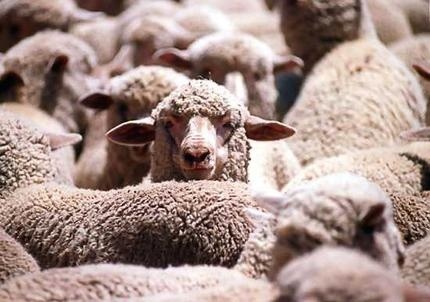
Well, that was the last of them. The only one left was me. It would be a long wait before the team “sheeped” me. Not only did I normally keep my laptop with me, I religiously locked it even to step away for a minute and even if I didn’t, the screensaver lock was set at 2 minutes. I was curious how they had gotten to John, though.
I was manager of the Desktop Operations Team for a large non profit organization. I had been handed the DOT team for two reasons. First was that due to some reorganizations, we were short one team leader. And second, the Operations Team was not particularly functional. The engineers ranged from very good to brilliant. But, the were a bunch of individuals. There was no cross training. Everyone did their own work but didn’t really step up to help when a coworker was unavailable.
My task was to build them into a team. You know that saying,
There’s no “I” in team
Well, you can’t spell TEAM without “ME!”
My philosophy on building team unity has always been that by appealing to everyone’s self interest, you paradoxically get them to pull together. But, you have to be genuine. And you have to let the team know that as the manager, you expect a lot from them. . .AND. . .you are willing to give a lot back.
John was a perfect example. He was one of the guys who was brilliant. But he was also young. I think he was about 25. And while I Like Prima Donnas, still you would like your Prima Donna to also be a leader. John also loved to play jokes on his coworkers. Jokes are a really hard thing to gauge. If the manager totally squashes them it sucks all the life out of the team. If the manager allows too many, especially if team unity is a little shaky already, it can create bad feelings and potentially harassment issues. I knew that if I was going to pull the DOT team together, it all had to start with John.
I addressed it in my first team meeting. John was sitting in one corner with his feet up. (Not gonna fight that battle right now.)
Some of you have asked me about the company policy of locking your desktops. I understand it’s inconvenient to constantly have to unlock them. That’s why I’m implementing a policy that messing with another team member’s machine. . .
Oh, man. Here it comes!
. . .is now an official policy.
Huh? What?
If you find a coworker’s machine unlocked, you have my permission to mess with it.
Are you serious?
Absolutely. However, we don’t need to embarrass the person outside our own team, so if you find someone’s machine unlocked, send an email from that person to the team with the subject line: I Like Sheep. We’ll know.
Oh man, this is gonna be GREAT!
John’s feet were no longer on the conference table. He was leaning forward and engaged. So far, so good.
Two things happened almost immediately. First, the team got much better about locking their machines. And second, we started to get “Sheep” messages. Typically, the person who found an open machine only had enough time to shoot off a quick email. Not to worry, the rest of the team soon found a collection of sheep pictures off the internet and would bombard the victim with sheep messages.
And as the team started watching out for each other, they started watching out for each other. You could feel it in the team meetings and the tone of the kidding that happened in the cubicles started to change.
John, was the most enthusiastic about trying to catch his coworkers. But he knew that as the weeks went by, he was becoming more and more of a target himself. He was very careful. The harder his coworkers worked, the more careful John became. I should say that it was at this point we had to implement a rule that you could not hack into a coworker’s computer to send a “Sheep” message.
So, finally seeing the “I Like Sheep” message from John was surprising. Bill sat across the cubicle wall from Joe.
So, how’d you guys finally get John?
Well, it took a couple of us. I distracted him by asking him about some registry entries or something. To talk to me over the wall he had to turn his back to his computer. While his back was turned, Chris snuck into his cubicle and sent the message.
That’s cold.
Yeah, it was great!
Yes. Yes it was, in more ways than one.
Rodney M Bliss is an author, columnist and IT Consultant. He lives in Pleasant Grove, UT with his lovely wife and thirteen children. He is not fond of sheep.
Follow him on
Twitter (@rodneymbliss)
Facebook (www.facebook.com/rbliss)
LinkedIn (www.LinkedIn.com/in/rbliss)
or contact him at (rbliss at msn dot com)
Tell your friends about this!

The trip to the orphanage was the high point of our adoption trip. Afterward we were looking at pictures with our new daughters.
This group of boys really seemed to like getting their picture taken.
Yes. They do it for hope.
Hope?
They hope you will share your pictures and maybe one of your friends will see them and will want to adopt them. Those boys are almost too old to stay at the orphanage any longer.
Adoption is obviously very important to me. Ten of my thirteen children are adopted, from Colombia, Haiti, China, India and the United States. We have been blessed with the opportunity to have a large family. But, compared to the need in the world, it’s tiny. There are literally millions of orphans, or as is more often the case, children whose parents simply do not have enough to care for them.
My lovely wife and I never set out to have a family this big. Another day I’ll tell the story of exactly how we ended up at 13. We certainly didn’t do it to save the world. Maybe that sounds harsh. Of course, we understand the needs that are out there, and we do as much as we can to contribute to organizations who DO attempt to save the world. For us, we simply wanted a bigger family. On each adoption trip, we were thrilled to see and be united with “our” kids. But, we had to emotionally steel ourselves from the brutal reality that many of the other kids would probably never be adopted. Our kids won the adoption lottery. Their former classmates understood, better even than we did the harsh realities waiting for those who didn’t get adopted.
So why not do more? What? What is there to do? Everytime we visited an orphanage we brought suitcases full of donated clothes, diapers and formula. But, those are pretty temporary fixes.
The fact was, there was nothing we could do. And we had a choice. We could either accept the cruelties of fate, or we could let ourselves be crushed under the weight of despair and helplessness for those we could not save.
So, what’s this have to do with business?
You have people in your organization who are probably doing a perfectly adequate job. But, they feel stuck in their position. I had an engineer named Mike, who worked for me. Mike despaired of ever getting promoted. He was a good solid engineer. Like many engineers, he was great with computers, but not so much with people.
Mike had never figured out how to self promote. He was happy to provide feedback to the managers when asked, but his spelling was pretty bad.
As Mike’s manager, it was my responsibility to help guide his career.
It’s been three years and I’m not even sure how to get started being promoted. Maybe I need to transfer to a different department to make it happen.
I’m still pretty new. Have you talked to your previous managers about it?
Yeah. . .sorta. I talked to Jacob, the previous manager, but I’m not sure he was doing anything to help.
Did he give you any advice on what specifically to do?
He said ‘work harder.’
Mark was stuck in the job orphanage. He was being fed, clothed, and kept from the rain, but he was really stuck. I worked with him on specific actions he could take to raise his profile and better showcase his skills. A few months later I was in the manager meeting where my peers and I decide what two people from the entire department get promoted. When they ran the analysis Mark’s name now came in first.
Here’s where the orphanage comparison comes in. There were lots of engineers on the promotion list. we could only take the top two. Didn’t those other engineers deserve to be promoted just as much as Mark? Did he win some sort of employment lottery to have me as his manager, who was willing to coach him on how to be promoted? Yes. There were other engineers just as deserving But, they didn’t work for me. Now, don’t get me wrong. Mark had earned the promotion. I wasn’t simply trying to look out for my own at the expense of others.
However, since they were ALL deserving, I wanted to do everything I could to make sure that my team was taken care of. Maybe that sounds harsh. Maybe it sounds like an “I’m gonna get mine, and too bad for everyone else.” It’s not. But, just as you can’t adopt every child in the orphanage, you are grateful that YOUR child is getting a chance.
Here in Utah the nights are now turning colder. There’s snow on the mountains and rain storms are becoming a daily occurrence. In addition to the other things I’ve been doing this week, I’ve been canning, as you know (GIGO – Garbage In Garbage Out and The Broken Jar.)
This year peaches have been very plentiful. So plentiful in fact that some local farmers have opened the gates to their orchards and invited in one and all to pick whatever is left after the commercial pickers get done.
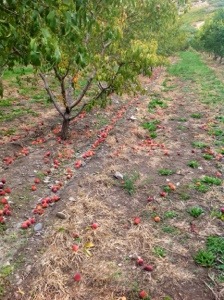
Peaches are often one of the most expensive fruits. To get them free? Outstanding. We’ve picked 6 bushels, and might get one more. While picking at the orchard I was struck by the same thought as I’ve touched on with adoption and employees. You can’t save everyone. We had a windstorm last night. Today, this is what the orchard looked like.
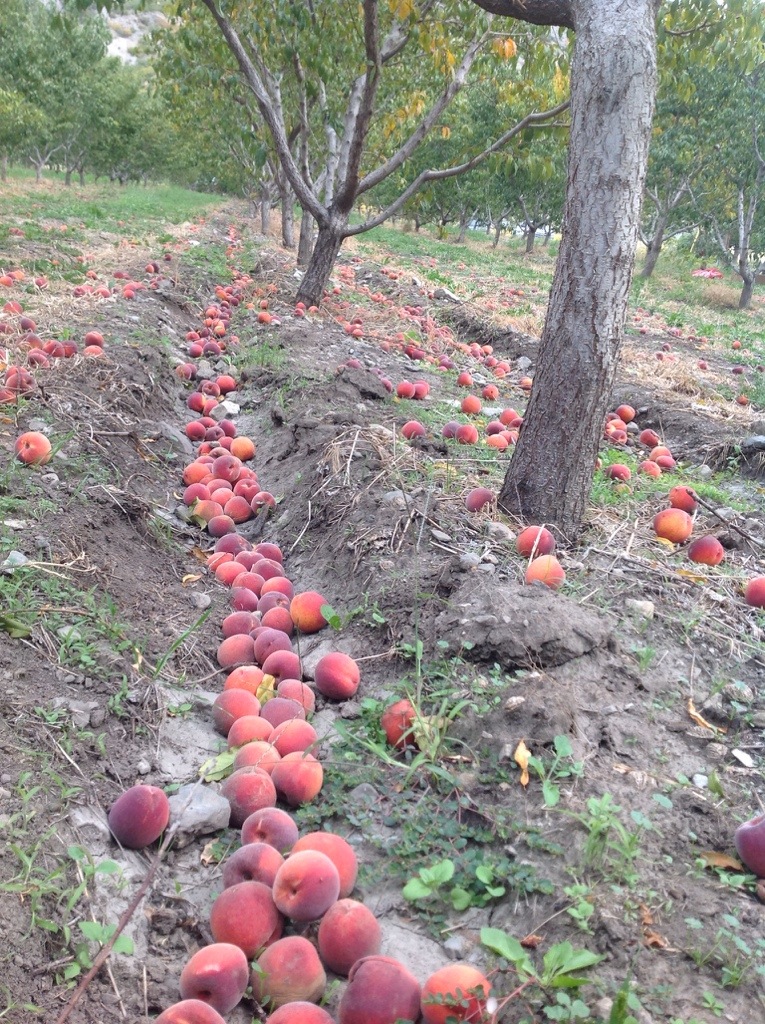
Many of those peaches are perfectly fine, but none of them are going to be eaten or canned. People want the peaches on the tree, like these.

In fact, while picking the peaches off the tree, it was impossible at times to not step on other peaches. I was struck by the idea that just like the orphanage, we could take what we need, but there was still going to be a lot that is wasted. Wind blown peaches are nothing compared to a child’s life, of course. But, still it is hard to watch something that you would normally value, go to waste.

We took what we knew we could use.

And it looks great.

I’ll leave you with the “Star Thrower” originally by Loren Eiseley, but more familiar in the adapted version. This one is written by Joel Barker.
And remember that just because you can’t do everything doesn’t mean that you shouldn’t do something.
The Star Thrower
Once upon a time, there was a wise man, much like Eiseley himself, who used to go to the ocean to do his writing. He had a habit of walking on the beach before he began his work. One day he was walking along the shore. As he looked down the beach, he saw a human figure moving like a dancer. He smiled to himself to think of someone who would dance to the day. So he began to walk faster to catch up. As he got closer, he saw that it was a young man and the young man wasn’t dancing, but instead he was reaching down to the shore, picking up something and very gently throwing it into the ocean.
As he got closer, he called out, “Good morning! What are you doing?” The young man paused, looked up and replied “Throwing starfish into the ocean.”
“I guess I should have asked, Why are you throwing starfish into the ocean?”
“The sun is up and the tide is going out. And if I don’t throw them in they’ll die.”
“But young man, don’t you realize that there are miles and miles of beach and starfish all along it. You can’t possibly make a difference!”
The young man listened politely. Then bent down, picked up another starfish and threw it into the sea, past the breaking waves. “It made a difference for that one!”
Rodney M Bliss is an author, columnist and IT Consultant. He lives in Pleasant Grove, UT with his lovely wife and thirteen children.
Follow him on
Twitter (@rodneymbliss)
Facebook (www.facebook.com/rbliss)
LinkedIn (www.LinkedIn.com/in/rbliss)
or contact him at (rbliss at msn dot com)
