
(Photo Credit: timesantos88.blogspot.com)
Daddy, will you teach me to ride a bike?
Sure sweetie. Climb on your bike. Just balance there a minute. Keep your feet on the pedals. I’m going to let go.
Won’t I fall over?
Yes. Trust me.
And that’s how I taught my oldest daughter to ride a bike. We were in the park next to our house. The park was also a baseball field. The grass was thick and lush. . .

(Photo credit: absolutepestco.com)
. . . and soft. I knew the biggest fear that my daughter had was that she would fall off. By getting the worst case scenario out of the way first, it removed a lot of the fear. She was riding in no time.
But, how does that relate to business? No one wants to fail. And if you told a new hire that you were giving them an assignment so that would fail and “get it over with,” it would definitely be over, probably along with your career. But, the concept stays the same. We know that at times employees are going to fail at tasks. For that matter, we know that we, as managers are going to occasionally fail at tasks.
So, how do you remove the fear?
I do it with advice I call “In the absence of orders: Attack!” It’s the first “rule” I explain to my teams. The saying is attributed to Edwin Rommel, the German General. I first heard it as a young cadet in BYU’s ROTC program. Regardless of where it comes from, the concept is if you don’t know what to do. . do something. I explain it to my teams this way,
There will come a point where a decision needs to be made that I would normally be asked to make, but I’m not going to be available. When that time comes, I want you to go ahead and make the call. If you will promise to honestly use your best judgement, I will back you, even if it turns out to be the wrong decision.
I’ve used this rule for more than 10 years. In all that time, I can count on one hand the number of times that an employee made the wrong decision. And none of those were serious. One time the issue was with my favorite employee, Dave (www.heartmindcode.com.) We had RESMARK installed in a beta site in Moab, UT about 3 hours south of our offices in Orem, UT. Dave announced one morning that the beta servers were not responding. And they couldn’t remotely log into them to tell them to reboot. (Our standard troubleshooting technique.)
Someone has to go manually reboot them.
Can’t we have one of the employees at the client location do that?
No. The servers are up and running they just won’t respond. I want to know what it says on the screen and figure out why we can’t remote into them.
So, my day was put on hold and I headed to Moab. It’s actually a beautiful drive down Spanish Fork Canyon and through Price and finally into the Green River country. It’s dry, but beautiful mountain desert.

(Photo Credit: menupix.com)
Two and a half hours later (pretty sure “speed patrolled by aircraft” doesn’t work well down some of those canyons) I walked into the client’s location to see the power button on our Dell servers blinking blue. When a power button is blinking blue, it means, “I’ve shut myself down and if you want me to wake up, just push the power button.” So, I pushed the power button. One of our client’s employees was standing there watching me,
Did you really have to drive down from Orem? Couldn’t we do that?
Yeah. . .yeah, you could.
Well, there are some other, ah, pieces of the software I needed to check on, and stuff.
The server came up clean and I got in my car and did two and a half hours back to Orem.
We had a short debrief with a couple of the developers. As we were wrapping up, I asked Dave to stay behind a minute.
That was a mistake. Let’s try to not make that one again.
And with that he walked out of my office.
You don’t need to set your employees up for failure, but make sure that they know that screw ups are okay. Screw ups are opportunities to learn. And like I told Dave, try not to make the same one twice.
Rodney M Bliss is an author, columnist and IT Consultant. He lives in Pleasant Grove, UT with his lovely wife and thirteen children.
Follow him on
Twitter (@rodneymbliss)
Facebook (www.facebook.com/rbliss)
LinkedIn (www.LinkedIn.com/in/rbliss)
or email him at rbliss at msn dot com
Tell your friends about this!

Hey, everybody, gather around. Bruce, as the software development lead here at Agile Studios, you have a very important job. We’ve got some important deadlines coming up, a big one for RESMARK, but also for some of our other projects. It’s your role to crack the whip, so I stopped by the tack store and bought this whip.
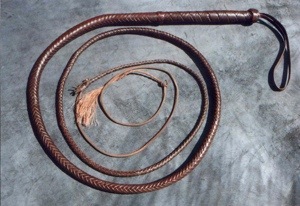
(Photo credit: www.aussiewhipmaker.com)
There is a certain skill to cracking a 12 foot bullwhip. If you do it correctly, you get a satisfying CRACK, as the end of the whip literally breaks the sound barrier. If you do it wrong, you get numerous holes in the acoustical tile ceiling in our bullpen.
As the Executive Vice President, my role was to do everything the president didn’t want to do. I did sales, contract negotiation, oversaw hiring and firing. But, what I didn’t do was actually assign and track the work the programmers were doing. In Agile programming parlance, I was a chicken, not a pig. Bruce was the scrum master. He was responsible for getting the work done. . .and it wasn’t getting done quickly enough.
In fairness to the rest of the developers, Bruce was a big part of the problem. He was getting ready for a vacation out of state. He was constantly telling us about the finer aspects of how to choose a good hotel. He obsessed over how to shave a few dollars off the price of his airline tickets.
I never do anything at work without a reason. The whip was a motivational technique. I probably couldn’t have done it at a larger company, but we were about 15 people. My hope was that Bruce would see the whip and cracking the whip as a metaphor for more actively managing the engineers. And that by being more active in THEIR work, his own work output would increase.
It didn’t work.
Oh, he loved the whip. (Unexpected gifts are kind of cool.) But, he continued to be more focused on his vacation than our looming deadlines. You are probably thinking, “If you were the EVP, why didn’t you use your position to influence him?” Because power in an organization typically flows from the top. Bruce was close friends with the company president, Bryce. I would have long talks with Bryce about my concerns, but it was Bryce’s company. If he wanted to leave Bruce in that role, all I could do was attempt to find ways to motivate him.
Eventually, we did some reorganization and Dave (www.heartmindcode.com) was given responsibility for the RESMARK project. Dave is a great coder, and one of the hardest working people I’ve ever worked with. And although he was doing a great job, I decided I wanted to provide him with a physical representation of his role and the need for him to lead our development team to accomplish some pretty ambitious goals. I couldn’t give him a whip. Bruce was still part of the company and it would a very bad signal to give Dave the same tool I gave Bruce. People would compare them and regardless of who came out best in the comparison I would have an unhappy employee. And possibly they would BOTH be unhappy.
So, I got Dave a sword. It was a short sword and it came with a cool wall hanger.

(Photo credit: www.thefind.com)
I instructed him,
You are only allowed to hit employees with the flat of the blade. NEVER the sharp edge!
He later pointed out that I hadn’t forbade him from using the pointy end. I’ve talked before about non-monetary motivation, including Dave’s diet Coke habit. The sword was something that I believe Dave has to this day. It cost $50, but even it had been $100 or more, it would have been worth it.
In order to ship RESMARK on time, Dave was going to have to put in way more work than I could afford to pay him for. He was salary, so I didn’t have to worry about overtime. But, I needed him to feel as accepted and appreciated at work as he felt at home, or Church. And I told him that was the reason for the sword.
I also needed the staff to know that Dave had my full 100% backing. He directed their day-to-day tasks. It had to be clear that while I might be the Vice President, and later the president, Dave got to run the development in the way that he saw fit.
Can’t imagine what HR would have said had I tried the same thing at a large company. . .Guess that’s why I never tried it there.
Rodney M Bliss is an author, columnist and IT Consultant. He lives in Pleasant Grove, UT with his lovely wife and thirteen children.
Follow him on
Twitter (@rodneymbliss)
Facebook (www.facebook.com/rbliss)
LinkedIn (www.LinkedIn.com/in/rbliss)
or email him at rbliss at msn dot com
Tell your friends about this!
Did you write all the green lines?
I wrote all the lines. . .the black ones were tougher.
We were at RESMARK offices in Orem. Brock, and Brad, the investors had decided that as a way of jumpstarting our product, we would buy a rival reservation system. This was small one written by one guy in California. We were in the process of vetting his code. He was in Utah showing us how his product worked. In addition to a traditional demo where he installed his application, he was also going into the code to show our programmers how he had built various pieces of the application.
Brad’s wife, as a shareholder for our sponsoring company was also at the briefing. At one point she interrupted the programmer with the question above. None of us would have thought to ask this question. The reason is that the green lines were comments. The black lines were the actual code that had to be written and tested. The green lines could include anything. I’ve used the comment lines, at times to add notes to myself explaining why I did something.
This episode has stuck with me for two reasons. First is the programmer’s response was delivered with a completely straight face. The rest of the programmers in the room were dying, trying to not laugh out loud. But, our guest didn’t even crack a smile.
But, the second and more important lesson was that to those unfamiliar with an area, it looks simple. The hard parts look as simple or as complex as the truly hard parts.
I attended a workshop a couple weeks ago with a world famous author who talked about writers who decide to switch genres because they think “writing trashy romance novels will be easy.” Or, dashing off a Young Adult novell should be simple. They invariably fail.
I’ve always tried to acknowledge the areas that I don’t understand and accept the fact that they could be really really difficult. I’ll typically tell my teams that
Everything I know about management, I learned from Dilbert’s Pointed-Haired Boss. So, anything I don’t understand must be simple!
They laugh and know that I get the fact that what they are doing is hard, and it’s probably harder to explain it to me than it would for them to do what they need to, and for me to trust them.
The ability to recognize how difficult all jobs are is especially important when you are dealing with other teams. Like the PHB, we tend to think that the other team’s job must be easier. And if they don’t give us what we want, it can’t be for a technical reason. It must be because they don’t want to help us.
That’s a dangerous idea. Better is to acknowledge that even though you don’t know why they didn’t give you an 8 GB mailbox even though you think they could, trust them on it. Remember that when you are looking at someone else’s code, it’s hard to tell the black lines from the green ones.
Rodney M Bliss is an author, columnist and IT Consultant. He lives in Pleasant Grove, UT with his lovely wife and thirteen children.
Follow him on
Twitter (@rodneymbliss)
Facebook (www.facebook.com/rbliss)
LinkedIn (www.LinkedIn.com/in/rbliss)
or email him at rbliss at msn dot com
Tell your friends about this!

(Photo credit: aquaparkequipment.com)
Where’s David?
Well, he’s somewhere between Ann over there, and Rose over there.
There’s gotta be 70 kids in that pool. How can you be so sure?
Because those two are the end points. The rest of the kids are somewhere in between. Not sure exactly where, but they haven’t gone past Ann or Rose.
People often ask me if it’s true that I have thirteen children. Not only is it true, but they are all within 12 years of each other and the youngest 8 are within 4 years of each other. After assuring people that I really have that many kids, the next question is often “How do you manage that?”
The truthful answer is that I get up and go to work everyday, that’s how *I* handle it. My lovely wife, on the other hand is brilliant at managing kids. But, I’ll share one of the techniques we use and show you how it relates to project management.
When we had one child, watching her wasn’t an issue. We could even trade off. When we added a second child a few years later, it was still pretty easy to keep track of them. You each watch one, or if you’re by yourself, hold one in each hand and you’re covered. However, numbers three and four arrived within a couple of months of each other. Now, we started to get into issues of being outnumbered. Over the next few years we added 9 more. And like all parents we worried about keeping track of our kids. So, we developed a technique to keep track of them in a public area, like a playground or a pool, since it is impossible to track 13 kids at the same time.
I would find my kid who was furthest to the left and the kid who was furthest to the right. I only had to watch those two. Now, if some kid in the middle fell off a swing or started kicking his sister, I would naturally deal with the exception. But, for the normal “everyone is playing nicely” times, I only had to keep track of my end points.
When my wife and I would take the kids somewhere like a hike in the mountains, or a walk through a crowded mall, one of us would be the leader and the other was the sweeper. The rule was “Everyone has to be in front of me and behind Mom.” Again, we didn’t worry too much about the issues in the middle. We watched the end points.
In many ways, project management is like our family. Most projects involve lots of moving parts. There are assignments, subprojects, milestones and deadlines. Trying to keep all the details straight can be a daunting task for one person. So, I typically try to make sure I’m giving my team very clear instructions at the beginning on what I want accomplished. I then leave it up to them to figure out how to accomplish it. I’m concerned with the endpoints. I want to know the project is starting on time and I will produce the desired result at the end. The middle? I’m going to ignore that unless there’s a problem. If a team members gets stuck, either because they’ve hit a roadblock, or they are unsure of how to move forward, I’ll step in and help them solve the problem. Then, I go right back to watching the end points.
I’ve known a lot of managers who just can’t stand the idea that their team members might be doing a task differently than they themselves would do it. My thought is “I certainly HOPE they are doing it differently.” I try to hire people who are really good. . .I mean stellar at what they do. (I Want The Jacks Not The Balls) They should be much better than me at managing SharePoint, or configuring Microsoft Exchange. I don’t have their expertise, so I expect they will do it differently than I would. And do it better. And generally they do.
So, on your next project, take a lesson from my 13 kids. Keep a close eye on the end points (start and end) and only get in the middle if one of the team members starts kicking his sister.
Rodney M Bliss is an author, columnist and IT Consultant. He lives in Pleasant Grove, UT with his lovely wife and thirteen children.
Follow him on
Twitter (@rodneymbliss)
Facebook (www.facebook.com/rbliss)
LinkedIn (www.LinkedIn.com/in/rbliss)
or email him at rbliss at msn dot com
Tell your friends about this!
Rodney, could you come to our office in Salt Lake tomorrow?
Sure, what’s up? (I knew very well what was up)
Oh, we’d just like to go over the latest feature lists. (Boy, was HE a rotten liar!)
Oh? So, should I bring Dave, our head of development? (Yeah, like they are going to let him come!)
No. I think we just need the three of us. (Ah. . .so, there will be a witness.)
Okay, great. I’ll see you in the morning.
Six weeks earlier Brock, my investor had started to ask for a whole bunch of reports. As president of RESMARK, I was also the chief sales guy, Marketing Director, equipment procurer, and just about everything else that didn’t involve writing code. The reports covered all of it. He wanted a monthly breakdown of our budget. He wanted number of customer contacts. He wanted to know what software we were buying; how much we were paying contractors. We had an office manager, but no secretary. To complete all the paperwork, I would be spending more time writing reports than actually running the company.
Dave was convinced that there was a more sinister motive.
You’re gonna get fired.
Oh, I don’t know. . .
We are sucking all the Christmas bonus money from Brock’s company. Those board members are used to getting big fat checks at Christmas. They don’t get them this year. They are putting pressure on Brock. He’s gonna fire you and the reports are just the paper trail.
I had to admit that Dave had a point. And having been through over a dozen companies in the past 10 years, he was an expert on choosing to leave or getting fired from a company.
Start up companies are hard to run. There’s a reason most don’t make it five years. I had to admit, other than being slightly too interested in adding features, our investor had given us pretty good autonomy. There were a couple of times where I had made decisions that he disagreed with. (He Also Deserved To Be Fired.) But, overall we mostly shared the vision of where RESMARK needed to go.
The difference was that Brock was a rafting guy, not a software guy. He continued to get the User Interface, which is what the program looked like, and the actual functionality confused. Brock assumed that adding a field was as simple as drawing it onto the UI. He understood nothing of the data mapping and validation that had to happen on the back end.
If I was going to get fired, the real reason was that Brock didn’t want his company to be second fiddle. We had ten beta customers. But, aside from the $5,000 deposit each had put down, the other 9 didn’t provide any financial support. Our burn rate was about $30,000/month. Which for a company of 10 people, was pretty lean. But still, after we shipped in Sept, it became obvious that Brock’s requests had to be evaluated in light of the other 9 companies. I’m guessing this was a very hard sell for Brock to try to convince his Board of Directors.
Wait. We’re paying 100% of the costs but we don’t get our features implemented first? That’s messed up!
Okay, their board was made up of guys in their 60’s and 70’s. They probably didn’t say, “messaged up.” They might even have uttered a cross word.
Well, the next day I headed up I-15 from our offices in Orem 40 miles north to Brock’s office in South Salt Lake City. I walked straight into the conference room where Brock and his chief lieutenant, Brad waited.
Rodney, thanks for coming on such short notice. Have a seat.
I sat down at the chair that had a blue folder full of papers on the conference table in front of it. I’d been through this before and knew that it was a negotiation. Like most negotiations, it was a good idea to avoid talking unless you had something to say. I folded my hands and calmly looked from one to the other. No way was I going to make this easier for them. Brock was in charge and with some glances at Brad he started his pitch.
We don’t actually want to talk about new RESMARK features. When we started RESMARK we all hoped it would be successful. The Board is concerned that it’s not showing the returns that they would like to see.
He just sort of ran out of gas at that point. Apparently Brad got the tag and jumped in. I liked Brad, I like Brock for that matter. But, this was about business at this point.
Ah. . .yeah, like Brock said, we feel. . .well, the Board feels like, we should pull RESMARK back in house. Have the programmers became our employees. That way we can ensure that our own needs are being met by RESMARK.
He paused and looked at Brock for reassurance. Since I hadn’t been asked a question, I still sat there calmly looking from one to the other.
If we’ve got RESMARK in house. . .well, Brock is already the president and we don’t really see a need, or a role for you. We understand that it will take some time for you to find a new position. We’re offering you one month salary and benefits as a severance package. . .so, how does that sound?
Having been asked a question, and more importantly seeing what their offer was, it was now my turn. Honestly, I thought their offer was insulting. I’d already been working for about 1/3 of what industry would have paid. I was the lowest paid RESMARK employee. My office manager made more than I did.
I appreciate your offer, but I don’t think a month is going to be long enough. Finding a senior manager position typically takes several months. My suggestion is that you go ahead with pulling the programmers in. We can close down the Orem office and you can give them desks here. I will commit to finding another job as soon as possible. In the mean time, let’s keep me on the payroll and insurance. If we do this transition correctly, I think we can keep most of the programmers on board and keep most of the beta sites committed.
What do you mean, “If we do this correctly?”
You just fired me, Brad. What do YOU think it means? We’re holding $50,000 from the Beta Sites.
You wouldn’t call the beta sites would you?
If you kick my butt to the curb, you better believe it. But, no one wants that. I’ll let the Beta Sites know that we’re making this change and that I’m convinced it will be in the best interest of the product and they won’t see any interruptions. If I let them know it has my blessing, I think most of them will stay on board.
The meeting pretty much broke up after that. They were stunned. And I was disappointed. I’d really hoped that RESMARK would be successful as a company. The fact that the investors were essentially buying it out represented a failure to me. Maybe it never really had a chance. Maybe, if the person in charge had been a better manager, or a better salesman, or a better president, it might have made it. The product still exists today and while the number of customers in no way matches the pro forma that I spun to the Board when we were trying to set it up, it is none-the-less a good reservation system and one that the programmers and contractors can be proud to have worked on.
When I got back to the office in Orem, I called a staff meeting and informed the programmers of what was coming. I also drafted an email to the Beta Sites expressing my utmost confidence in Brock and his plan.
Dave had called it. It was six weeks almost to the day. And he had a new job lined up by the end of the day. It helped salve the wound a little to know that the much of the staff, despite my best efforts, and they truly were sincere efforts, didn’t want to remain with the company if I left. We lost two beta sites, but I’m pretty sure that Brock was hoping to cut down the number of customers competing for features anyway.
Dave and I talked in my office at the end of the day.
Dude, you are amazing!
How do you mean?
You are the only person I know who walked into a meeting to get fired and walked out with a better deal than he had when he went in. No more reports. No more nasty meetings with Brock. You are still getting paid the same amount and you now have ZERO responsibilities. That is fantastic!
Maybe he had a point, but I still couldn’t shake the feeling that I’d failed.
This is the fifth in a five part series about the birth and death of RESMARK, describing my time as president. Here’s how the rest of the week will look.
– Monday: My Brother Wouldn’t Lie For Me
– Yesterday: I Want The Jacks Not the Balls, How I assembled our team and managed to not screw up their careers too badly
– Wednesday: We’d Lost Before We Ever Started, how we launched the program to incredible good press
– Thursday: Being a Management Sandwich, When your customer is also your investor
– Today: You Can’t Fire Me, I’ll Quit. . .When I’m Good and Ready, know how many bullets are in your gun before you go in
Rodney M Bliss is an author, columnist and IT Consultant. He lives in Pleasant Grove, UT with his lovely wife and thirteen children.
Follow him on
Twitter (@rodneymbliss)
Facebook (www.facebook.com/rbliss)
LinkedIn (www.LinkedIn.com/in/rbliss)
Tell your friends about this!
We spent two years building it. We’d just had a brilliant rollout at Confluence Salt Lake City. We had ten companies who were signed up wanting to use our software for the coming year. Surely our products troubles were were mostly behind it, right?
Not exactly.
RESMARK started because a rafting company wanted some reservation software that didn’t exist. So, they went shopping for a programming house. They found Agile Studios with with me as the Executive Vice President. They paid us a lot of money to write this software. After a couple years, we spun off RESMARK as it’s own company. We hired programmers. We bought a domain name.
But, every month, it was the investor company paying the freight. The technical term is Angel Investors. But, these angels wanted their product.
When we finally shipped RESMARK on September 1st, 2006, I had ten customers in ten different areas around the country who were my customers. Some did mostly short trips. Some did multiple day trips through the Grand Canyon. Some had lodging. Some had train rides. The point was they all had different needs.
Anyone who’s ever built software can tell you that it is ALWAYS a tradeoff. You never get to include all the features you want. You have to prioritize each feature and figure out which ones to build first. And that was my problem. Once we shipped and I had ten customers, I had to balance their needs. The problem was that only one customer was paying me every month. My Angel Investor felt that since he was putting up the money to actually pay the programmers and keep the lights on, that he had some call on HIS features getting priority. And we tried to accommodate him, we really did. But, it quickly became obvious that if RESMARK was going to be a viable company, that the Angel Investor would need to go to HIS board of directors and tell them that they’d put a million dollars into this product and it couldn’t do what they wanted it to.
That’s not a conversation anyone likes to have. The Investor was a second generation owner, so there was no danger of him being fired, but I’m sure Christmas wasn’t too fun that year.
So, Dave’s prediction appeared to be accurate. The investor pulled me aside at our show and told me that they needed to make a change after the holidays. Now MY Christmas was kind of tense.
Ironically, I was the lowest paid employee at RESMARK. I was making $3,000 per month plus health benefits. I had a family of 13 kids at the time. Fortunately, I was able to do some consulting as well to make up the difference.
However, just because I was making peanuts didn’t mean I had no influence. I started preparing for my probable exit interview just as I would an interview to get a job. It remained to be seen if my investors were doing the same amount of preparation.
This is the fourth in a five part series about the birth and death of RESMARK, describing my time as president. Here’s how the rest of the week will look.
– Monday: My Brother Wouldn’t Lie For Me
– Yesterday: I Want The Jacks Not the Balls, How I assembled our team and managed to not screw up their careers too badly
– Wednesday: We’d Lost Before We Ever Started, how we launched the program to incredible good press
– Today: Being a Management Sandwich, When your customer is also your investor
– Friday: You Can’t Fire Me, I’ll Quit. . .When I’m Good and Ready, know how many bullets are in your gun before you go in
Rodney M Bliss is an author, columnist and IT Consultant. He lives in Pleasant Grove, UT with his lovely wife and thirteen children.
Follow him on
Twitter (@rodneymbliss)
Facebook (www.facebook.com/rbliss)
LinkedIn (www.LinkedIn.com/in/rbliss)
Tell your friends about this!
Rodney, you were at Confluence in Reno last year right?
Yeah.
What kind of SWAG do they give away at a rafting conference? Anything cool?
Not a bit. The most exciting thing was hard candy.
Well, that sucks. Are we planning something similar for this year?
Oh, no. Those rafting guys aren’t going to know what hit them.
Most people think of computer guys as geeky, nerdy, introverts who don’t get many dates. Despite that being true, one thing that computer guys are really good at is holding parties. We call them conventions so that the corporate accountants will sign off on our expense reports, but they are typically a week long party with some training thrown in.
Comdex, Network World, Interop, Brainshare, Lotushere, Microsoft Exchange Conference, VMWorld, Mac World. Ask a computer guy his favorite and he’ll regal you with stories of the pub crawls in Dallas at Network World back in the 90’s. Or the insane cab lines at Comdex in Vegas. It will quickly become obvious why computer guys don’t get many dates.
But, the conventions are great. And my favorite part is the vendor floor. I didn’t have to buy stocking stuffers for over a decade when I was attending conventions regularly. Not only do companies give away cool stuff like t-shirts, and laser pointers, and knives and iPods (I won one at Brainshare a few years ago), they also put on shows. The point is to get people to stop and look at your booth. Often, you can simply walk up to a booth and ask, “You guys giving away anything interesting?” Get your spiff and leave.
So, as we prepared for Confluence 2006, I really wanted to make an impression. This would be RESMARK’S coming out party. After working on this product for over two years we were finally ready to show it to the world. Confluence was held in the Salt Palace Convention Center in Salt Lake City. If you’ve ever been part of a booth crew, you know how incredibly expensive a booth can be. You pay for everything. You pay for the space, of course, and then you pay extra for electricity, and for internet connections, and for extra chairs and anything else they think they can stick you for.
While we were setting up, a Salt Palace contractor came by.
You know you can’t plug your computers in yourself.
But, I thought the contract said that we just have to let you guys connect our power strip and we could plug whatever we wanted into it?
No. You have to have us plug in anything that’s electrical. Oh, and it’s $75 per device.
He had us over a barrel. At least I’m assuming he thought he did. We were scrambling to get our booth setup and didn’t really have time to go do lawyer-speak with some supervisor somewhere. But, what the contractor didn’t know was, he didn’t know about Connie. Connie is my cousin and works as one of only two female riggers in Utah, at least at that time. Fortunately, I had her number in my phone. She picked up on the second ring.
Hey, Cuz how ya doing?
Say, listen, we’re down here setting up at the Salt Palace and this guy. . .What’s your name?
Bill.
. . .this guy Bill tells me that I have to pay him $75 per computer to plug in my computers.
Put him on the phone.
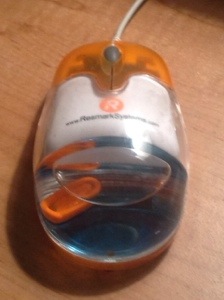
And that was the last we saw of Bill. Anyway, the setup and the show went great. I’ve talked before about the mice we gave away.
And we did a drawing for a free RC car each of the three days. 
By the end of the show, we had accomplished all our goals. Everyone knew about us and everyone had a good opinion of us.
The attendees at the show were rafting companies. They were my customers and I couldn’t wait to start installing RESMARK into the businesses. On the third day, my investor Brock and his chief lieutenant pulled me aside.
So, what did you guys think of the show?
It was great. Everything you said it would be. Listen, we are going to be making a change at RESMARK. We aren’t ready to announce it to the employees, but we wanted you to know.
So, what are the changes?
Well, we’ll provide more information after the holidays.
This couldn’t be good. Dave’s prediction that I was getting fired within 6 weeks. was issued in mid November. Nothing like some job uncertainty to spice up the holidays.
This is the third in a five part series about the birth and death of RESMARK, describing my time as president. Here’s how the rest of the week will look.
– Monday: My Brother Wouldn’t Lie For Me
– Yesterday: I Want The Jacks Not the Balls, How I assembled our team and managed to not screw up their careers too badly
– Today: Stealing The Show, how we launched the program to incredible good press
– Thursday Being a Management Sandwich, When your customer is also your investor
– Friday: You Can’t Fire Me, I’ll Quit. . .When I’m Good and Ready, know how many bullets are in your gun before you go in
Rodney M Bliss is an author, columnist and IT Consultant. He lives in Pleasant Grove, UT with his lovely wife and thirteen children.
Follow him on
Twitter (@rodneymbliss)
Facebook (www.facebook.com/rbliss)
LinkedIn (www.LinkedIn.com/in/rbliss)
Tell your friends about this!
The best developer to ever work for me did not come highly recommended. Sure, he was recommended, but frankly the recommendation came with a caveat, “Great developer, spotty work history.” The fact was he had never stayed at a company for longer than a few months. I think his shortest stint was actually measured in hours.
Dave (www.heartmindcode.com) came to work for me when I was the Executive Vice President of Agile Studios. RESMARK was our biggest client, but we did lots of other projects as well. We had a President, I was the EVP and we had a guy, Bob, in charge of the developers. Dave was hired as a code monkey. He jumped in and started making a difference right away. I started pulling him more toward the RESMARK development. Now, technically Bob was in charge of all our development projects, but Bob was a little distracted.
Actually, he was a lot distracted. We were committed to rolling out the Beta for RESMARK in January. We’d worked on the project for more than a year. I think we picked January because it was the rafting industry’s slow period. I would never willingly schedule a release for January. It screws up the holidays too much. Anyway, anyone who has ever been involved in a development project knows that things get really tense and busy right before a release. This was no exception. As we pushed to get the code stable enough to roll out to our customer, I spent many late nights and then weekends at the office. And Dave was right beside me.
Bob? He had scheduled a vacation and didn’t want to change his plans. I think he was in Boston.
Dave and I were putting in 12 to 14 hour days. He was coding, I was testing and writing bugs and some documentation. We worked Christmas Eve. Christmas Day we spent the morning with our families and then came into work around noon. We eventually got the code stable and made our beta date in the first week of January.
The reason I tell that story is that it reminds me that you should hire people for the skills you actually want. Likewise you should evaluate people on the skills you want and care about. I call this concept “Jacks and Balls” for the childhood game of jacks.
I’ve been in plenty of big companies in my career. Most of them have very similar evaluation processes.
Rodney, you’re communication skills are excellent and your technical skills are good. You’re a little lacking in your organization. I’d like you to work on that this next quarter. Set some goals around it. Maybe take a Steven Covey course or something.
That sounds reasonable doesn’t it? Who doesn’t want to be more organized? Well, possibly ME. It depends on my job responsibilities. Is organization a core piece of what I do? Should I ignore the things I do well so that I can focus on the thing I do poorly? Or should I simply ignore the parts I don’t do well and focus on what I was hired to do? This effort to form a “well rounded” employee is what I call “the ball.” Everyone wants you to be the ball. But, to be the ball, you often have to literally ignore the things you are good at and focus on the stuff you aren’t.

(Photo Credit: relationshipplaybook.com)
Instead, I want the jacks. You know, the miniature caltrops. Police agencies could use those things instead of spike strips. I want employees that are good, great, the very best at what they do. Like the pointy end of a jack, I want the things they do to be done very well. If I’m hiring programmers, I want the very best Java developer I can find. I’m less concerned if they have a degree, or social skills, or own an alarm clock.
When we spun RESMARK off as its own company, I asked Dave to come with me. I asked all of Agile’s best programmers. . . Well, that’s not true. I didn’t ask Bob. Bob was a good coder, but he wasn’t great and he didn’t have the killer instinct that said, “I’m going to finish the project on time even if I have to work Christmas!” But, I recruited the rest of the best developers. Dave was a tough draw.
What’s the issue? I can actually offer you more money if you join RESMARK.
It’s not the money. They’ve made me Director of Development and my mom really likes the fact that I have a title now.
Seriously? That’s it? You can call yourself the Grand Poobah for all I care. Pick your own title.
Dave joined me.
The team worked together really well. We were convinced that we were changing the world. I hadn’t realized yet that I’d lied on the Pro Forma (My Brother Wouldn’t Lie for Me.) Dave thought he understood the Jacks and Balls concept. He told me he got it, but I wasn’t sure.
Rodney, I need some management help.
Hey, the programmers are yours.
Yeah, I know. It’s Mindy. I can’t get her to be on time for our morning Scrum meeting?
Okay.
I told here we are having it at 10:00am, but she consistently comes in at 10:30. It’s really causing some problems with the team.
Does she leave early?
No. She’s here until 7 or 8 every night.
She’s a good developer, right?
Yeah. She’s probably the best we have besides me.
The solution seems pretty obvious.
Really? What is it?
Move scrum to 10:30. Do you want someone who’s punctual, or do you want someone who’s a fantastic coder? Jacks and Balls.
I can’t believe I didn’t see that.
Dave moved Scrum to 10:30 and the problem was solved.
We worked through the summer cramming everything we had into trying to meet a September 1st ship date. My biggest concern was that our investor kept adding features. My weekly meetings with him were becoming more and more contentious. After our beta in January we had 9 customers who signed up to be part of the Beta. Each put down half the $10,000 purchase price to be part of the Beta program.
We had to make quite a few compromises but it looked like we were going to come very close to meeting our ship date. You’d think that I’d be excited. Not really. The stress of working with the investors was starting to get to me. We had a trade show coming up that would be our coming out party.
Just when things were at their busiest, our investor started asking for weekly reports: How many customer contacts? How many hours put in on different parts of the business.
Dave saw it as an ominous sign:
Dude, you’re going to get fired. . .within 6 weeks probably.
He was just being paranoid. . .I hoped.
This is the second in a five part series about the birth and death of RESMARK, describing my time as president. Here’s how the rest of the week will look.
– Yesterday: My Brother Wouldn’t Lie For Me
– Today: I Want The Jacks Not the Balls, How I assembled our team and managed to not screw up their careers too badly
– Wednesday: Stealing The Show, how we launched the program to incredible good press
– Thursday Being a Management Sandwich, When your customer is also your investor
– Friday: You Can’t Fire Me, I’ll Quit. . .When I’m Good and Ready, know how many bullets are in your gun before you go in
Rodney M Bliss is an author, columnist and IT Consultant. He lives in Pleasant Grove, UT with his lovely wife and thirteen children.
Follow him on
Twitter (@rodneymbliss)
Facebook (www.facebook.com/rbliss)
LinkedIn (www.LinkedIn.com/in/rbliss)
Tell your friends about this!
John, we are spinning RESMARK off as its own company and they’ve asked me to be the president.
Congratulations. That’s great.
Thanks. I need some CPA advice. We are meeting with the investors next week and I was hoping you’d help me work up a pro forma.
No.
Well, I mean if you’re really busy. . .
It’s our slow period. I’ve got plenty of time. I just have an aversion to lying.
Ah. . .
And that should have been my first clue. But, hey, someone told me they wanted me to run their company! It was a bit of a heady experience and I didn’t take his advice.
I created the pro forma anyway.
pro forma: financial statements prepared in advance of a planned transaction, such as a new capital investment. The pro forma models the anticipated results, with particular emphasis on the projected cash flows and net revenues.
Essentially, you create it as a way of saying, “Here’s what we think our business will generate.” And since it’s normally going to investors or the board of directors and the person preparing it (me in this case) REALLY wants the money, the pro forma will often show whatever the person preparing it wants it to say.
As a CPA, my brother understood that. He understood that most established businesses have trouble forecasting the next year, let alone 5 years into the future, as our pro forma did.
I didn’t lie. At least not intentionally. I did my research. RESMARK was a reservation system aimed at the rafting industry. We had two competitors, and I’d seen their products. I thought we had a good chance of beating them. I also looked at the rafting business in the US and other countries.
You might be saying, “I’ve been whitewater rafting. Why on earth would a rafting company want a computer based reservation system? Really, how hard is it to write, “Bliss, party of 15, Saturday July 12th 10:00am”?
It’s not.
But, the problem is that despite the size of my family, any rafting company that wanted to stay in business needed a lot more customers than just Rodney and his 13 kids. The rafting season typically starts on Memorial Day and runs through Labor Day, about 100 days. During that 100 days, the busiest companies on the Arkansas River in Colorado will serve 25,000 guests on as many as 10 different routes and attractions. Many of the rafting companies also provided lodging and food. They employed 15-25 guides whose schedules had to be coordinated. It was a huge undertaking. And through it all they had to be able to handle walk in guests, changes and cancellations.
There was a huge market for our product. And I recorded all of that on my pro forma. I estimated that within 5 years we could capture 60% of the market. And by the third or fourth year, I expected we’d be going after international business as well. Costa Rica has some great whitewater rafting. There are companies that will take you rafting in the Andes. There are companies all over the world, and they needed our services too.
So, I put them down too.
I showed how we’d be cash flow positive in three years and we’d be paying back our investors in years four and five.
And it was all a lie. The problem was I believed it. And I’m a pretty good salesman. I convinced our investors of it. As we walked out of the meeting with the investors, Brent, the president of the company we were spinning RESMARK off from pulled me aside.
Rodney, that was fantastic. I more convinced than ever that we made the right choice.
I should have felt horrible. I had just spent 90 minutes lying to him too. Instead, since I believed my own lies, I was elated. I couldn’t wait to get back and let the team know that we had the green light from the investors and we could start changing the world.
It was probably best that I still believed my sales pitch. If I’d had any hint of what was coming, I wouldn’t have been nearly as convincing.
This is the first in a five part series about the birth and death of RESMARK, describing my time as president. Here’s how the rest of the week will look.
– Tuesday: I Want The Jacks Not the Balls, How I assembled our team and managed to not screw up their careers too badly
– Wednesday: Stealing The Show, how we launched the program to incredible good press
– Thursday Being a Management Sandwich, When your customer is also your investor
– Friday: You Can’t Fire Me, I’ll Quit. . .When I’m Good and Ready, know how many bullets are in your gun before you go in
Rodney M Bliss is an author, columnist and IT Consultant. He lives in Pleasant Grove, UT with his lovely wife and thirteen children.
Follow him on
Twitter (@rodneymbliss)
Facebook (www.facebook.com/rbliss)
LinkedIn (www.LinkedIn.com/in/rbliss)
Tell your friends about this!
I received a contract offer to write a book yesterday. I wouldn’t normally mention this if it weren’t for something my best friend said. I told him that I finally feel like I deserve the title of “writer.”
We’ve been friends for more than a decade. I’ve been telling you for all that time that you are a great writer. But, you’ve been running away from that writer for as long as I’ve known you. Glad you finally let him catch you.
Made me think.
When do you “become” the thing you are working on? I’ve written for as long as I can remember. At WordPerfect (Back to Where It All Began) I worked with a group that created the first WordPerfect Office course. It wasn’t our “real” job, we were SWAT team members, flying around the country solving customer problems. (How I Saved The EPA, Sometimes You Just Get Lucky.) At this same time, I wrote two books, one of which was published. (WordPerfect 6.0 SuperBook as Milan Keeney.)
At Microsoft, I worked in Support and while there wrote another book. (Microsoft Exchange Connectivity Guide.) From support I went to a team where my job was to do write ups of Microsoft customer company configurations. I did about 50 of them. I actually hated that job. During the initial interview my future boss threatened to fire me.
Anyone who doesn’t pull their weight won’t be on this team for long.
Yes, he said that in the initial interview. And by the end, firing seemed like an attractive option. It took me many years to forgive that manager and apologize for my behavior. (Finally Putting Down The Rock.)
My next position was to write training materials for Microsoft Exchange. I created dozens of courses that were literally thousands of pages long. . .and I had a BLAST doing it. It was the best job I’ve ever had.
I’ve written for magazines. I’ve written comedy. I’ve written speeches.
And yet. . .and yet. . .there was always this doubt. This idea that maybe, just maybe I’ve been fooling them. Maybe on my next writing project “they” will show up and tell me that they’ve figured out that I’m a fraud. That’s what we fear isn’t it?
We fear that our success is an illusion. That we don’t really deserve it
I think part of my problem is that writing comes easy to me. I remember one night I was working late at Microsoft writing a report on a company and listening to the radio. The DJ was a young women who lived in a tent. . .I didn’t ask. Anyway, she had spent the day with the drummer from the band Lone Star several years earlier and the band was coming to Seattle and she was trying to figure out how to reconnect with him without sounding like a dorky fan girl.
I called the station and talked to her for just a few minutes.
I’ll write your letter. Give me about 30 minutes.
And I created a letter that touched on the past, and let her express her interest without being too corny or sounding like a fan. Apparently musicians want to date real people rather than fans.
Even when I started this blog, one of my close friends who was helping me craft a focus and find my voice asked
Are you in danger of running out of stuff to write about?
Not so far. I have a file of blog topics. It’s longer today than it was when I started.
Maybe it’s the image of “writer.” None of us have to be unemployed if we want to call ourselves a “writer.” They are often the exact same thing, just the writer occasionally thinks about putting words on paper. There are thousands of waiters in LA who want to be actors. The writers are typically too introverted to take the waiter jobs.
The last few months as I’ve considered my writing history and future career I’ve often come back to writers in movies. Chaucer, as played by Paul Bethany in “A Knight’s Tale” has been an inspiration.
A what? A writer. I write with pen and parchment. You’ve probably read my book, “Book of the Duchess.” No? Well it was allegorical.
You want to know the most amazing part? I LOVE being a writer. I just have a hard time giving myself permission to embrace that writer. As my friend said, I’ve been running from him for decades. Today, I let him catch up. We’re going to spend some time together with a keyboard.
Rodney M Bliss is an author, columnist and IT Consultant, and he’s a writer. He lives in Pleasant Grove, UT with his lovely wife and thirteen children.
Follow him on
Twitter (@rodneymbliss)
Facebook (www.facebook.com/rbliss)
LinkedIn (www.LinkedIn.com/in/rbliss)