The Church of Jesus Christ of Latter-day Saints
That’s the official name of the Mormon Church. It’s often abbreviated as the LDS Church, or, of course the Mormon Church. To the members, it’s often just “The Church.”
I once had occasion to see a portion of the directory of the employees of the Church. I attended church with the guy who was responsible for maintaining the directory of Church employees. There were several thousand names in their directory. Much of the directory information was autofilled. However, the field for employer was entered by the employees. They could type in whatever they wanted.
You wouldn’t believe the variations they came up with.
You mean like LDS Church, or Mormon Church?
Well yeah, but they also misspelled every word in the name except “the” and “of.” They misspelled the name of the savior.
Which one?
Both.
He said the employer field had over 100 different entries. He said that some of the mistakes were obviously simply a mistyped word like “chruch.” But, the surprising ones were “ladder” for “latter,” or “Crutch” instead of “Church.”
So, I asked him,
Why didn’t you fix it? Obviously, you knew what the right value was?
I didn’t own the data.
What do you mean?
Our policy stated that if a field is configurable by the user, then only the user can change that field. I knew the values were wrong, and my engineers could have easily solved it. But, corporate policy prevented us from fixing.
Yup, he identified a problem. He even identified the solution. It would have taken about 30 minutes for one of his engineers to write a script and update that field to the correct spelling. But, policy prevented it.
So, the “right” answer was to leave the “wrong” data.
I suggested that perhaps policy was being misapplied if it insisted that you leave bad data in your system.
He didn’t disagree.
Rodney M Bliss is an author, columnist and IT Consultant. He lives in Pleasant Grove, UT with his lovely wife and thirteen children.
Follow him on
Twitter (@rodneymbliss)
Facebook (www.facebook.com/rbliss)
LinkedIn (www.LinkedIn.com/in/rbliss)
or email him at rbliss at msn dot com
Tell your friends about this!

Elder Bliss! Elder Bliss, wake up! This guy has a question.
The Chicago city bus belched it’s way up Halstead avenue. Jolted out of my nap, I turned to find myself face-to-face with a very angry Native American.
I was 20 years old and a missionary for the Church of Jesus Christ of Latter-Day Saints, the Mormons. I was one of those guys you see in the white shirts and ties with name tags that all say “Elder.” We always travelled in pairs. I worked specifically with deaf people. My companion, Elder Rice was deaf, but he could talk and read lips. He’d been having a “conversation” with the angry Native American and it hadn’t gone well. He woke me up to translate. If I didn’t die in the attempt, I intended to kill Elder Rice afterward!
I want to talk about conflict and deescalating conflicts. Often, as managers we are forced to step in and play referee. I have to do this with my kids all the time. However, as a manager, you can’t treat your employees, or your coworkers like kids. . .no matter how much they might act like one.
Listen
The first thing to do in this type of tense conflict is listen. Often people simply want to be heard. Managing a team, or running a company is not a democracy. Sometimes you take a vote, but even after the votes are counted, as the manager you occasionally have to make the final call. If you take the time to make sure you listen to each person’s point of view, they still may not like the decision you make. They may not agree with it. They might even decide they need to leave the team over it, but at least they won’t be angry because they think you ignored them.
In my case on the bus all those years ago, I started off by listening. It didn’t help a lot, but as near as I could tell the man’s complaint is that we (presumably white people) took his land and he was not happy about it.
Listen Reflectively
Reflective listening is the process of taking what you’ve heard and repeating it back to the person you are talking to.
So, it sounds like your main objection to our teamroom scheduling policy is that it might prevent your team from using the room when they need it, is that right?
By reflective listening, you do three things. First, you reinforce to the person you are talking to that you really do understand their concern. Second, it gets the other person saying “Yes.” As any sales guy will tell you, the more you can get to “Yes” the easier it is to make a sale. And you really want to sell the person you are talking to on either a solution, or a project, or simply on the fact you understand their problem. And that’s the third benefit. By reflective listening you make sure that you understand the real issue.
I tried it with my Native American friend who was getting angrier by the minute.
So, you’re upset that your land was taken?
His response was unprintable.
A Soft Answer Turneth Away Wrath
Sometimes none of that works. Sometimes the situation is volatile enough that no amount of listening and talking will resolve it. We all learned this as kids, but it’s worth repeating, yelling doesn’t help. Getting angry, of course is worse.
The person who can control his temper in a discuss has a distinct advantage over the person who can’t.
When no amount of discussion and listening will deescalate the situation, sometimes the best course of actions to take yourself out of the discussion.
Sorry you feel that way, Bob. I think I understand your concerns. But, I’ve decided that we are going forward with this project. I don’t think further discussion is really going to get us past this.
And then, you end it. As the other person presses the point, you simply refuse to engage.
We’re not going to discuss this any more.
With my Native American friend that was the point we got to. As I tried to talk and listen my way out, I used every technique I could think of to get out of the conversation. He kept getting madder and madder. Finally, he pulled out a locking blade knife. It was probably like this one and only a couple inches long.
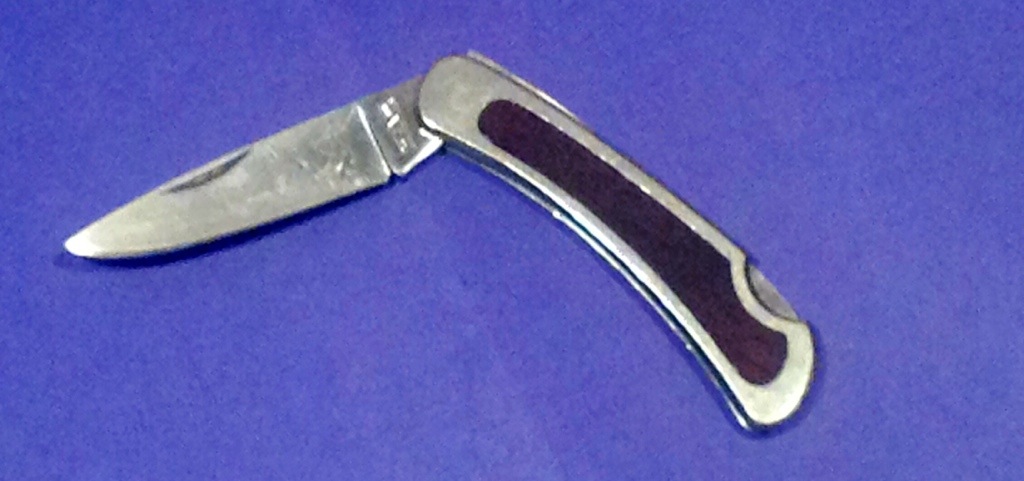
But, waving 18 inches from nose, it looked like a sword. I knew the conversation was over. What to do? I opted for the soft answer route.
Look, I don’t want to fight you.
And I turned away from him to face the front of the bus, my body tensed for an attack. Behind me I heard a movement. Out of the corner of my eye I saw him get up. . .and move back to the next row of seats.
I continued to stare forward.
FWAP!
A sweatshirt lashed out at me from the seat two rows back. I kept my attention forward shooting daggers at my companion who sat in the seat next to me.
I didn’t breath easy until we reached our stop and I was safely off the bus. Before I had a “discussion” with my companion, I turned on the other four LDS missionaries that had been on the bus with us.
What happened to you guys?
It looked like you were handling it.
If he’d killed me, at least they would have been there to identify the body.
Rodney M Bliss is an author, columnist and IT Consultant. He lives in Pleasant Grove, UT with his lovely wife and thirteen children.
Follow him on
Twitter (@rodneymbliss)
Facebook (www.facebook.com/rbliss)
LinkedIn (www.LinkedIn.com/in/rbliss)
or email him at rbliss at msn dot com
Tell your friends about this!
Why do you work?
For most of us the answer to that question is tied to money. Sure, I’ve known people who were set financially who chose to continue working because they loved what they were doing. I’ve known people who “retired” only to work twice as hard at a second career.
But, for most of us, we put in forty hours a week for a paycheck. So, it stands to reason, you would think, that increasing your paycheck would improve your motivation.
Doesn’t happen that way.
I’ve told this story before (The Biggest Raise I Ever Received), but it bears repeating here. I had a developer who worked for me named Dave (Heart, Mind, Code.) Our office provided free drinks to our staff. One day my office manager came to me,
I don’t get it
What?
I don’t see the value of giving people free soda. For example, Dave drinks a lot of soda. How is that cost effective?
Dave makes $80,000 per year and he’s on salary. Suppose he drank $100 worth of soda per month. If I don’t provide it, he’s going to walk down to the Maverick convenience store on the corner every day. And he’s going to still be on the clock.
Okay. . .
Suppose that trip to the store takes 15 minutes. That’s about 5 hours per month that he will be not working but getting paid. At his salary that’s about $200 worth of time wasted. If I spend half that on free soda, I come out ahead.
Now, I get it. But, why not just give him the $100?
Because it wouldn’t mean anything to him.
And it wouldn’t. At $80,000 per years, an extra $100 per month is about 1.5%. Who gets excited about a 1.5% raise? And more importantly, if I gave him that raise, it would quickly be forgotten. Instead, he is reminded of how much he likes his company everyday when he goes and gets his free drinks. The soda means a lot more than it’s value in money.
Even people who say they are only motivated by money are actually motivated by non-monetary incentives. Microsoft was famous for giving employees stuff; shirts, jackets, hats, mugs, I once got a kazoo, ship it awards. All sorts of stuff that doesn’t really cost them that much, but employees will keep for years.
I’ve seen programmers who had empty offices except on one lonely shelf is their Ship-It award.
…But Only If You Have Enough
There’s a counterpoint to this rule. Money is a lousy motivator, but only if you have enough. If your monthly expenses are $5000 per month and your current household income is $4750, then nothing matters except that missing $250. If you offer that employee free soda, they would really rather have the $0.50 per can. If they have access to $100 worth of soda per month, they look at the value and think, “Sure would be nice to have that $100. Then I’m only $150 way from breaking even.
But once they cross over that threshold where they can pay their bills? Then money becomes a much less valuable motivator.
Rodney M Bliss is an author, columnist and IT Consultant. He lives in Pleasant Grove, UT with his lovely wife and thirteen children.
Follow him on
Twitter (@rodneymbliss)
Facebook (www.facebook.com/rbliss)
LinkedIn (www.LinkedIn.com/in/rbliss)
or email him at rbliss at msn dot com
Tell your friends about this!
Ideas are cheap.
Execution is hard.
I was talking to my friend Howard about the value of ideas.
Don’t you ever worry that someone might steal one of your ideas?
Not at all. People come up to me all the time at conventions and tell me they have a great idea for a story, but they are afraid to tell me because someone might steal the idea. I don’t really want them to tell me because I have my own ideas, more than I can ever draw. But, even if I didn’t, ideas are cheap. It’s going out and executing on that idea that’s hard.
A friend of mine was Stephanie Meyers’ instructor at BYU. Meyers wrote the Twilight series. He tells the story,
Stephanie came to me and said she wanted to be a novelist. I explained that she should work on a story with a young female protagonist. Then have her go to a new location where things are a little different.
I grew up in Forks, WA for a time, maybe my character could go there?
Ok.
And it’s really cloudy in Forks. There could be vampires?
Perfect.
And maybe werewolves?
No, I think that would be too much.
The point is that the Twilight series was not a totally new idea. Sure, Meyers gave it her own spin, but vampires have been around in literature since Brahm Stokers Dracula back in the 19th century. So, it wasn’t the idea, it was the execution.
Now let’s switch to business. There are stories about the timing of requesting patent for the telephone. There were several people working on the telephone or harmonic telegraph as it was called. Bell got his patent application submitted a few hours earlier than Elisa Gray.
While working for Microsoft I had an idea for a way to restructure our team. I shared this idea with a coworker. Mostly I was trying to work out how best to present the idea to management. A week later I was talking to the same coworker.
I had another thought on that restructuring idea.
Yeah, I already asked management.
Asked them what?
Asked them about restructuring the way you suggested. They said no.
I was furious. It was my idea and he’d run to management with it. So, what’s the difference?
I think it has to do with both the nature of the idea and the closeness of those who might co-opt our ideas. When it comes to being creative either as a novelist or a cartoonist, or a musician, ideas are easy.
Write a song about a guy and his pickup truck.
There’s an idea for a country song. It’s been done multiple times in the past couple years. It’s not the idea that separated the successful song writers from the unsuccessful ones. It was the execution.
Other ideas, especially ones that are a discreet concept: building a telephone, suggesting a new team configuration, painting the house purple, those ideas are more prone to being stolen since the execution is inherent in the idea.
Rodney M Bliss is an author, columnist and IT Consultant. He lives in Pleasant Grove, UT with his lovely wife and thirteen children.
Follow him on
Twitter (@rodneymbliss)
Facebook (www.facebook.com/rbliss)
LinkedIn (www.LinkedIn.com/in/rbliss)
or email him at rbliss at msn dot com
Tell your friends about this!
No way.
There is no way that this team-building game is designed to achieve the result I see coming.
I was attending one of the coolest “corporate” training courses I’d ever been to. It’s called Woodbadge. It’s offered by the Boy Scouts of America. They teach leadership, organization and team building.

I call it scout camp for grownups.
In fact, we were at the Tifie Scout Camp in southern Utah. And my three sons were attending merit badge classes with their troop while I learned leadership skills.
The evening of the second day we played a game called Win All You Can. This game was going to blow up and make people hate each other. As a long time corporate trainer I was fascinated by the prospect of the BSA presenting a activity designed to make people distrust each other.
We spent the first two days divided in patrols competing against the other patrols in various scouting type competitions. By the evening of the second night the competitive juices were running pretty high.
The game setup was pretty simple. There were 8 patrols. The patrols were divided into two groups. Each patrol was handed two cards, a red card with an Axe on it and a green card with a log on it. There were 5 rounds. At the beginning of a round a representative from each patrol met with the reps from the other patrols in their group to decide whether to play a Red Axe or a Green Log that round.
Points were awarded as follows
Four Red Axes: ………………………Each patrol loses -100 points
Three Red Axes, 1 Green log:….Axes +100, Log -300
Two Red Axes, 2 Green logs:…..Axes +200, Log -200
One Red Axe, 3 Green logs:…….Axes +300, Log -100
Four Green Logs:…………………….Each patrol +100
Now, I’m no game expert, but I grew up with one (Where Did THAT Come From?) My brother and I played games all the time growing. It was pretty clear to me how to maximize points for our patrol. You get your representative to convince everyone to go with the green log and “we all win.” And you do that for two turns. On the third turn you pull a Red Axe. You get +300 for round three, the other patrols in your group lose -100. Then, you go back to convincing everyone to throw green log cards.
However, I suspected there was something more to the game than what they were showing us. I didn’t know exactly what it was though.
Round one and Round two everyone was singing Kum-ba-ya. We all put out the green log and all eight patrols were tied at 200 points. Round three we pulled our switch. Our representative wasn’t very happy that we were asking him to lie to his counterparts. Sure enough the cards were revealed and our Fox patrol was now in the lead.

There were a few people that were pretty upset that we’d doublecrossed them. We assured them that we were really sorry, and we’d play nice the rest of the way and we did.
At the end of the 5th round we were in the lead, 700 to 300 for the other patrols in our group and the other group had played it straight the whole game. Their four patrols all had 500 points.
You’ve probably spotted where this is going.
The person running the game then announced that the scoring was NOT by patrol, but by group. Our group had 1600 points. The other group had 2000 points.
We lost.
And then the fireworks started. Actually, in talking to the staff our responses were pretty muted. In previous years they had people quit the training after this “game.” I really tried to figure out why they presented this exercise.
I realized as we started in on Wednesday’s activities that the focus of the training had shifted. Where Monday and Tuesday were all about pitting patrols against each other, Wednesday through Friday were all about making the group stronger.
Win All You Can illustrated the danger of a group where everyone is out for themselves. My patrol scored the most points, but our group lost. How often has that happened in your company? Do you have teams that view their coworkers as the competition? Do they think that the way to do better is to make other teams appear to do worse? If so, you have a problem that needs to be fixed.
I’ve taken and taught a lot of training courses in my career. I’ve never seen one that was as well designed as Win All You Can. There was a danger that you’d push people too far. But, if you are going to go to the trouble of sending your team to a training event, isn’t it better to challenge some of their assumptions?
I don’t remember a lot about Woodbadge, but Win All You Can will stick with me for a long time. We all do better when we are each looking out for each other’s success.
Rodney M Bliss is an author, columnist, IT Consultant, and a member of the Mighty Fox patrol. He lives in Pleasant Grove, UT with his lovely wife and thirteen children.
Follow him on
Twitter (@rodneymbliss)
Facebook (www.facebook.com/rbliss)
LinkedIn (www.LinkedIn.com/in/rbliss)
or email him at rbliss at msn dot com
Tell your friends about this!
Maybe I’m just a contrarian.
I follow several blogs, written by writers that I enjoy. Some are very popular, some are guys (and girls) just starting out. For the most part, I agree with what they say. Today I saw a blog titled
How you should treat your employees
Cranston quoted Steven R Covey in admonishing us to treat our employees the way we want them to treat our best customers. I don’t think so.
– Here’s the thing, I don’t trust my customers to have my company’s best interests at heart. I trust my customers to have their own best interests at heart.
– I don’t trust my customers to always tell me the truth. I expect my employees to always tell me truth, even if it’s a hard truth.
Let’s explore just those two topics and how I will treat my employees very differently than I want them to treat my best customers.
Everyone Is Motivated By Self Interest
If I sell a product, or a service, I will price that product or service at an amount that lets me earn a profit. Despite what some people think, you cannot Price It Below Cost But Make It Up In Volume. I expect my employees to know our product line and our service requirements. I want them maximizing opportunities and thus maximizing profits. I might even incentivize them. Maybe I’ll put in a sales commission, or I’ll add a volume bonus for the team.
I want my employees to treat our customers fairly, but I certainly don’t expect them to maximize the customer’s business opportunities. We want to partner with our best customers. We want to be seen as aiding them. But, there will be times where a customer makes a bad business decision. I’ve actually told customers NOT to buy my software when I knew it wouldn’t meet their needs. However, if they insist? Sure, I’ll provide full disclosure, but I’ll sell it to them if they still decide they want it.
I’ve seen customers make terrible business decisions. Decisions that will destroy their companies. If that were happening in my company, I want my employees, no, I expect my employees to speak up. If a customer is destroying his business, perhaps he’s a startup and he’s spending millions of investment dollars building a fancy building rather than building his software, I don’t expect my employees to play business consultant. Not if I’m in the software business. There are ethical and potentially legal ramifications to sticking our nose into their business.
No, I am not going to treat my employees the way I want them to treat my best customers in this case.
Everyone Works For Their Own Self Interest
I asked last week how you would react if someone lied on their resume to get a job, if they confessed during the interview that they had lied? (Lying To Get Ahead) I got some interesting responses. But, for me, I never questioned it. I would end the interview right then. If a potential employee is willing to lie to get an interview, what else might they lie about? If it was really important (in their mind) would they lie to get a raise? A promotion? Make a sale?
No. Integrity and trust in your employees has to be a bedrock principal of a working relationship.
I expect my customers to lie. In fact, when I worked as a phone operator, it was generally understood that all customers lie.
Thanks for calling Microsoft Support, how can I help you?
My computer no longer works.
What have you changed since the last time it was working?
Nothing.
Lie!
Customers often have really good reasons for it. But, they are going to only tell you what they think you need to know. And I do not blame customers for it. In fact, since I expect it, I build my systems around that expectation.
Well, let’s go in and look at the change log on your computer. It says here that you upgraded to a new operating system yesterday.
Well, yeah, but I figured that didn’t have anything to do with my printer being broken.
If my employees lie to me, they are not going to long be my employees. I might not even fire them, but I won’t trust them, and if I don’t trust them, it will be difficult for them to succeed. Typically people choose to pursue opportunities elsewhere in those type of cases.
If customers lie to me, I’m going to figure that they have their reasons and it’s my team’s job to ask enough questions to get to the truth.
No, I’m not going to treat my employees the way I want them to treat my best customers.
Not even close.
Rodney M Bliss is an author, columnist and IT Consultant. He lives in Pleasant Grove, UT with his lovely wife and thirteen children.
Follow him on
Twitter (@rodneymbliss)
Facebook (www.facebook.com/rbliss)
LinkedIn (www.LinkedIn.com/in/rbliss)
or email him at rbliss at msn dot com
Tell your friends about this!
I love camping.
I have five sons. All five are Boy Scouts. One is a Star Rank, two are 1st Class and the youngest two are working on their Tenderfoot awards. I’ve been involved with scouting since I joined my first troop in 1976 at the age of 11. I earned an Eagle Scout award with two palms. I’ve been an assistant scoutmaster, a scoutmaster, a Webelos leader, a cub master, and several other positions in the scouting organizations.
I’ve spent a lot of nights sleeping on the ground. In all that time, I’ve discovered the difference between experienced campers and inexperienced campers, the key to camping comfort: socks.
I’m not talking about the actual kind of socks. You can buy special hiking socks that cost $20 per pair, or wear simple white athletic socks that cost $10 for a pack of 6. The difference is not that great. But, just having socks, enough socks makes the difference between a miserable trip and an enjoyable trip.
And here’s why. If you fall in the lake and get totally drenched, if you can put on dry socks you will feel better. Two years ago a family here in Utah got lost in the snow while Christmas Tree hunting. They managed to survive for two days until they were finally rescued. One thing that surprised them was that their feet were warmer without wet socks on.
Anyone who spends much time in the outdoors can tell you that it’s because cotton socks will suck the heat out of your feet, especially if they are wet. Wool socks, on the other hand hold the heat when they get wet.
So, what’s this have to do with business?
I was thinking about this last Friday night as I shared a tent with my two youngest sons. The temperature got down to about 20 degrees Fahrenheit that night. It was cold enough to leave frost on the tent. My boys though reported that they were snug and warm all night long in their sleeping bags. They had put on clean pajamas and dry socks before they went to bed.
Yes, but what’s it have to do with business?
I’m considering going to work for a new company. Naturally, I went through a series of interviews with them. The position looks interesting and they seem impressed with my background.
And yet, this is not an industry I’ve worked in, at least not as a project manager. How do I know I can be a success? How do I know that I’ll be able to do the things they want me to?
Socks.
Not actual socks, although I’ll be wearing them everyday. Instead, the business equivalent of socks.
See, in all the scouting books I’ve read over the years. All the trainings I’ve been to. All the merit badges that I’ve earned and helped others earn, there was never a mention of the vital importance of socks.
It was something I worked out on my own. And I know that whether we are doing a summer camp, a winter camp, a 50 mile trip, or simply an overnighter in a park, socks are going to be important.
I’ve spent the last 10 years learning to be a project manager. I’ve had classes, I’ve taken exams, I’ve written training. And I’ve learned how to be a PM.
The closest to a one word solutions I’ve found for Project Management work is, communication. Nearly every situation, or every problem can be improved with better communication and will suffer with worse communication.
So, that’s the secret to my success. . .socks!
Rodney M Bliss is an author, columnist and IT Consultant. He lives in Pleasant Grove, UT with his lovely wife and thirteen children.
Follow him on
Twitter (@rodneymbliss)
Facebook (www.facebook.com/rbliss)
LinkedIn (www.LinkedIn.com/in/rbliss)
or email him at rbliss at msn dot com
Tell your friends about this!
Thanks everyone for making time on a Friday to come to our department meeting. I know we are a little over our stated time, but just one more item before we go, the company policy of paying for home internet access is hereby cancelled. Have a great weekend.
I just shook my head. As a team manager I knew the policy was being changed. I also knew my manager, who had started as an engineer, and still had much of the attitude of an engineer, was dreading telling the employees. In fact, I had offered to step in and perform the unpleasant task.
Mark, didn’t feel he should hand off to someone else a job that he wouldn’t do himself. I admired him for his leadership in insisting on being the one to tell people.
I was disappointed in the manner he ended up telling people. It was painful to watch.
I read one time that the best day to deliver bad news, like layoffs or cutting benefits to your staff is Wednesday, right after lunch. The idea is that if you tell your staff first thing Monday morning, you will affect their entire week. If you tell them on Wednesday, they will spend a couple of days discussing it, and then they will all disperse for the weekend. By the time they regroup on Monday, it’s started to settle in as “old news.”
The worst time to tell them is Friday, at the end of the day.
They are going to spend all weekend worried about it, but they won’t have anyone to discuss it. They won’t be able to process it. When they come back on Monday, they are going to be more keyed up than they were on Friday.
That’s what happened in this case. The large non-profit that I worked for, had adopted a policy of paying for internet access for it’s employees. We supported a 24×7 workforce so often engineers had to work on issues in the middle of the night. The company felt if they were going to expect employees to be available during those times, it should offer them this added benefit.
Eventually, the company decided that the availability of high speed internet access and the lower costs meant that virtually all employees would get it themselves, and the decision was made to discontinue that benefit.
To the employees, it looked like the company was cutting their paycheck by $50/month. Being a non-profit, employees already felt slightly underpaid. Effectively reducing their pay even further was going to cause some concern.
At the department meeting, a couple of people managed to ask a question, but it was already after 5:00 on a Friday. Most had to get home to their families. We spent weeks dealing with the morale issues.
What could my boss have done differently?
One easy thing would have been to do what the TV news shows do: If it bleeds it leads. Put the most controversial topic at the beginning. It’s likely that we could have spent the entire meeting discussing that one topic. It was of concern enough that we could have fielded an hours worth of questions. And in the process, we could have answered the most pressing questions one time, instead of the multitude of times we dealt with it the following week.
The other thing that putting bad news at the beginning of a meeting does, it is shows your staff that you are not afraid of an issue. In the case of internet access, my manager had zero flexibility. He couldn’t make exceptions. The directive came from several layers above him. A bold, determined announcement would have helped people understand that while they might ask for clarity, it was no use to seek a reversal.
But, by tacking the announcement onto the end of a meeting filled with less important items, it gave the impression that he was afraid to tell people. That fear communicated a false sense of hope to some people that maybe if they pushed hard enough they could get Mark to back down. In reality, Mark had no where to go.
I still admire Mark to this day. And he did not get enough credit for the courage he showed that day. The news was bad enough, but his delivery simply prolonged the pain for everyone.
Like pulling off a bandaid, the sooner the better. Just take a tip from the news.
This is the second installment of an ongoing feature to discuss the rules that I management my teams by. This appear every Friday. Last weeke I discussed the idea In The Absence Of Orders: Attack.
Rodney M Bliss is an author, columnist and IT Consultant. He lives in Pleasant Grove, UT with his lovely wife and thirteen children.
Follow him on
Twitter (@rodneymbliss)
Facebook (www.facebook.com/rbliss)
LinkedIn (www.LinkedIn.com/in/rbliss)
or email him at rbliss at msn dot com
Tell your friends about this!
The white kid really looked like he was going to get away. He had a 50 yard lead on the large black guy chasing him through the upscale area of Bellevue, Washington. The white guy was running out of the park and seemed to be headed around the east side of Bellevue Square mall.
But as he sprinted toward the corner he seemed to start to lose steam. The black guy was about 6’5″ and was still coming on strong. He finally caught him as the white guy got caught by the no-walk sign.
The two women with baby strollers waiting for the light edged a little farther away and looked like they were seriously considering simply walking away. No one wanted to be caught up in a potential fight. And the little guy looked like he would have no shot against the black man who’d just chased him down.
This portion of Bellevue was both upscale and pretty racially monolithic. A black man was an unusual sight. One chasing a white guy was even more noteworthy.
My coworkers and I arrived at the corner as the two runners and the ladies with strollers were still waiting on the light. The short white guy flashed us a grin as we jogged up.
Hope we didn’t scare anybody.
The black guy looked at him. Was he annoyed?
What do you mean?
I mean some skinny white guy being chased by a . . .
Oh yeah? By a what?
Ah. . .by a tall person.
We all started to jump in.
Not that I’ve got anything against tall people!
I don’t have anything against tall people!
Some of my best friends are tall!
I saw the two ladies visually relax as they realized we all knew each other. They were even smiling by the time the light changed and we all took off running again to get back to our work at Microsoft before our lunch hour was up.
To this day, I joke with CK about my “tall” friends.
The last couple of blog entries have talked a little about racism. (I Was Doing Okay Until That Guy Hit Me With An Axe Handle, and You’re Making The Other Shoppers Nervous) The stories revolve around my time at Microsoft for two reasons. First, is that the IT world has very few black people in it. CK and I were talking recently about a mutual friend who we’d worked with at Microsoft. The friend had recently passed away and I was trying to place his face.
You remember CJ.
I’m not sure I do.
Sure you do. He was the other black guy in support!
Oh, him.
The second reason is that it was at Microsoft that I met CK. He remains my dearest friend in the world. It’s not that I hadn’t been around black people. My high school, while predominately white had a number of black students. The most famous was probably Ron Holmes, who went on to play professional football with Tampa Bay, and Denver including starting in Super Bowl XXIV.
And I spent two years in south Chicago as a missionary for the LDS Church. I worked in black neighborhoods every day. But, being friends with CK, I could ask him question that might be embarrassing or considered offensive if I asked someone who I didn’t know well. One of the first questions I asked about was swimming.
Can black people swim?
What?!?
No, I mean is there something about their genetics that makes them less about to . . .you know. . . float. . . and . . .stuff?
By the time I finished, his face had passed through surprise, (a little) anger, disgust and finally humor.
Rodney, I swim like a fish. Why would you even ask that?
Well, in the Olympics you rarely see black swimmers. The only one I ever saw was from Nigeria or somewhere. He finished like 2 minutes behind the other swimmers and it really looked like he might be in danger of drowning. Just wondered if it was genetic.
Economics.
Say what?
Black people don’t swim because of economics. Not a lot of public pools in many black neighborhoods. Add in the fact that if your parents don’t swim, it’s unlikely you’ll learn and you have an entire group that doesn’t swim. And it really messes black women’s hair, if they’ve had it straightened.
Some of my readers may be saying, “What a dweeb Rodney is to have for a friend.” But, I figured if CK was around, why not pick his brain?
Several years later my wife and I were considering adopting a black child. I went to talk to CK.
We’re thinking about adopting.
Hey, that’s great.
The agency asked us if we had any preferences about race.
And?
Well, I’m not sure.
Oh. . .
Do you think I could parent a black child? I would worry I couldn’t teach him enough about his birth culture.
Rodney?
Yeah?
You’ll do fine. Trust me. I have no doubt.There’s just one thing.
Yeah?
Don’t teach him to be colorblind. The world is not colorblind. If you raise him to think it is, he’s going to be severely handicapped as an young adult.
I understood better what CK meant a couple years later as we were talking about how out of control political correctness had become in regards to race.
If you’re trying to point me to someone and I’m in a room full of other people. Don’t say, “It’s the person who sitting just to the left of the woman with the green sweater. He’s just in front of the guy with the glasses. No. Just say, “It’s the big black guy.” It’s not offensive to mention race if I’m the only black guy in the room.
Don’t raise him to be color blind.
He’s the black guy.
Or the tall guy
Rodney M Bliss is an author, columnist and IT Consultant. He lives in Pleasant Grove, UT with his lovely wife and thirteen children. Seven of whom are black, three of whom are Asian and three of whom are white.
Follow him on
Twitter (@rodneymbliss)
Facebook (www.facebook.com/rbliss)
LinkedIn (www.LinkedIn.com/in/rbliss)
or email him at rbliss at msn dot com
Tell your friends about this!
Excuse me, sir?
Yeah?
I’m afraid you’re going to have to leave the store.
Why? What did I do?
Nothing. We’d just feel better if you left.
YOU would feel better?
You’re making some of the other shoppers nervous. Please, don’t make me call the head of security.
Yesterday I talked about how my friend CK got arrested for being a black guy who got mugged by three white guys. (I Was Doing Okay Until That Guy Hit Me With An Axe Handle.) It wasn’t a surprise to CK. I talked about the fact that we were best friends. And yet, there were times where I had no idea what he was experiencing.
We worked for Microsoft in downtown Bellevue in a beautiful building across the street from a high end shopping mall. One of the anchor stores in this mall was Nordstroms, and this was the store that CK was asked to leave.
It was about 2:00 on a Wednesday afternoon. I know this because Wednesday was the day we both worked. The two of us were covering the swing shift. He had Sunday, Monday and Tuesday. I had Thursday, Friday and Saturday. We both worked Wednesday.
CK continued with his story.
They formed a ring around me. They were apparently protecting the shoppers from the big bad black man.
How do you know it was because you were black?
CK just looked at me. And it wasn’t in a good way.
I just mean it could have been something you were wearing.
Hooded sweatshirt. Hood up, hands in the pockets.
That might have had something to do with it.
That’s not the point. The point was that I was just killing time waiting for my shift to start. I had every right to be in that store. So, they threatened to call the head of security. I said “Go ahead. In fact, I want you to tell the head of security that CK wants to see him down here. Right now!”
And they stationed the clerks around you?
Yeah. But, no females clerks. I stood there for about ten minutes. Finally here comes the head of security. He was huge. I mean, I’m 6’5″ and he was easily as big as I am.
Black guy or white guy?
That earned another look.
As he got closer he kind of rushed at me. I of course rushed at him too. And all the clerks froze. They were like, “They’re gonna fight!”
And?
And what?
Well, did you get in a fight?
No. Of course not. I gave him a big hug. I’d played ball with him at Seattle University. We’ve been friends for years.
Wait, so you knew he was working there the whole time?
Absolutely. But, we sure scared those clerks.
Seattle is known as a multiracial city. While I lived in King County, the county where Seattle, and Redmond and Bellevue are located, the King County Executive for a time was an Asian guy named Gary Locke. He was later elected governor of Washington State. After him it was a black guy named Ron Sims. The city was not particular racist. And yet, these types of experiences happened to CK on a fairly regular basis.
Even after being friends for years, I was still surprised by things that CK would notice and I wouldn’t. He pointed it out to me one time.
I’m surprised that you still get treated like this.
No, Rodney, you just don’t know what to look for.
What do you mean?
You’ve been there when store clerks have been racist.
I don’t remember that.
Okay, next time we both go into some place like Nordstroms pay attention to which one of us the clerk approaches first.
Are you saying they approach me first?
Just watch next time.
Doesn’t that bother you?
It bothered me a lot. Especially the next time we walked into Nordstroms.
Rodney M Bliss is an author, columnist and IT Consultant. He lives in Pleasant Grove, UT with his lovely wife and thirteen children.
Follow him on
Twitter (@rodneymbliss)
Facebook (www.facebook.com/rbliss)
LinkedIn (www.LinkedIn.com/in/rbliss)
or email him at rbliss at msn dot com