We know that line as
Houston, we have a problem.
And we see Tom Hanks’ Mission Commander Jim Lovell saying it.
Actually, it was the Command Module Pilot Jack Swigert, who was played by Kevin Bacon in Apollo 13, who said it and it was in the past tense. In any case. As you may know, one of the critical issues the astronauts of the crippled Apollo 13 faced was trying to remove CO2 from the air. They were all three crammed into a portion of the spacecraft that was designed to hold two men.
The solution was to grab one of the “CO2 scrubbers” from the damaged part of the ship and use it in the landing module (LM.) The problem was literally trying to fit a square peg into a round hole. Or in this case, a square filter into a round hole.
But, in an example of “their finest hour” the NASA engineers figured out how to make it work. Here’s a picture of the actual device in place on the Apollo spacecraft.

(Photo Credit: NASA)
Why didn’t they just make all the filters the same shape?
Probably because different firms and different engineers built the different parts of the spaceship. They weren’t required to work together and each built a solution that worked for their needs.
I helped a friend move some sheetrock on Saturday. I was using our 15 passenger van to move it. That’s not a problem. The seats are easy to remove and the designers of the 2000 GMC Savanna 3500 realized that someone might want to put a 4×8 sheet of plywood or sheetrock in the back of the van.
Here’s a shot of the van before we removed the last last seat.
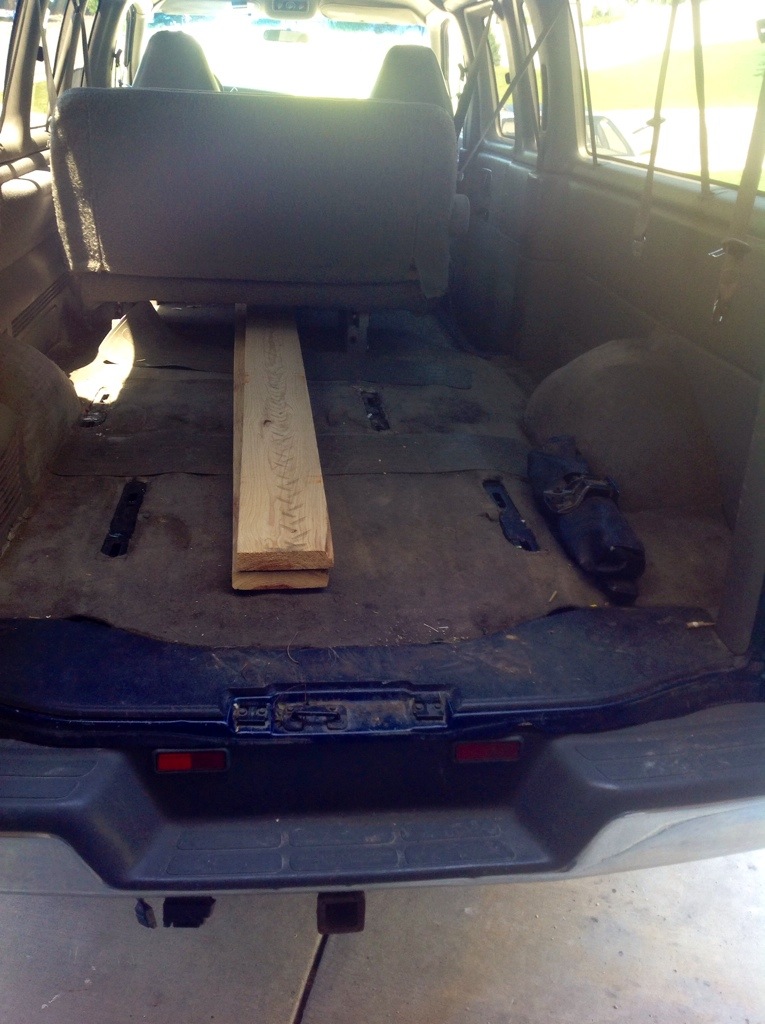
Like I said, there’s plenty of room. You might have noticed the jack that is in the lower right hand portion of the picture. THAT is the problem.
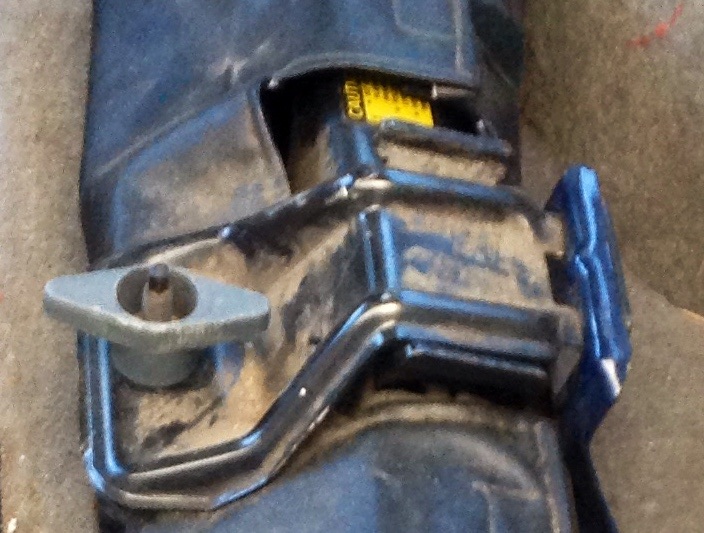
The jack comes out of course. But, the brace for the jack is welded, WELDED, to the frame. As you can see from the earlier picture, the jack is in that 4×8 space. To move sheetrock we had to find a board to place over the jack and then pile the sheetrock at an odd angle.
Why would they do that? Why would they go to the trouble of giving a nice 4×8 bed and place an obstruction right in the middle? Personally, I think it’s similar to what happened to Apollo 13. Probably the guy deciding where to place the jack didn’t talk to the engineers who designed the bed.
What does this have to do with business? Anyone who’s worked with software development or engineering teams probably got it right away.
People occasionally ask me what a Project Manager does. See that immovable jack stand in the middle of the van bed? We do that. Well, if we do our jobs well, we prevent that from happening. Many of my projects involve multiple teams. My current project involves
Desktop Engineering
Telecom Engineering
Networking
Account Management
Workforce Management
Quality Assurance
Operations
Senior Management (The hardest group to work with at times)
In addition, I need to work with our client’s engineering teams.
Project and Program Managers are the guys who are supposed to look across the engineering silos and realize that Team A needs to make a change so that Team B will later be able to take advantage of their work.
It’s humbling in a way. I cannot do what the engineers do. In terms of actual work, I don’t DO very much. But, the one thing I CAN do is talk. I talk to the client and get their requirements. I talk to the engineering teams and make sure they have the specifications and the resources to build the solution. I talk to Operations and make sure they are prepared to take over ownership of the product when it’s ready.
Daddy, what do you do at work?
I talk to people.
That seems like an easy job.
Sometimes Sweety. But, not often enough.
The Project Managers are the ones who respond to “We have a problem here.”
Rodney M Bliss is an author, columnist and IT Consultant. He lives in Pleasant Grove, UT with his lovely wife and thirteen children and one grandchild.
Follow him on
Twitter (@rodneymbliss)
Facebook (www.facebook.com/rbliss)
LinkedIn (www.LinkedIn.com/in/rbliss)
or email him at rbliss at msn dot com
Tell your friends about this!


I love reading, especially science fiction, but also westerns, techno thrillers and a fair amount of non-fiction. So, you would think these book reviews are a natural for me.
The problem, in my opinion is when authors attempt to mix genre’s. I’ve read Louis L’Amore’s detective stories. They aren’t as good as his westerns. But, the worst is when a writer attempts to use storytelling to teach business concepts. It’s painful. The dialogue is stilted. The plot is paper thin. The characters are a flat as a sheet of paper.
The Traveler’s Gift was slightly better than most in this respect, but that’s not high praise.
The story involves a man named David. He’s 46 years old and recently lost his job. And he’s not sure what to do so he attempts to commit suicide. We are then taken on a journey through time as he meets with various figures throughout history and they give him important lessons or decisions he must make to be successful.
First Harry Truman tells him, “The buck stops here.” in other words, own your decisions and stop being a victim.
Second he is transported to ancient Jerusalem where King Solomon teaches him “I will seek wisdom.”
Third he’s off to the battle of Gettysburg where “Joshua Chamberlain of the Twentieth Maine” gives him the third decision for success: “I am a person of action.”
His fourth visit is to the crows nest on the Santa Maria where Christopher Columbus explains he must have “a decided hearth.”
His fifth visit is to a hidden room in Amsterdam during the Nazi occupation. Anne Frank teaches him “Today I will choose to be happy.”
His final earthly teacher is Abraham Lincoln, again at the battlefield in Gettysburg. Lincoln teaches him “I will greet this day with a forgiving heart.”
I say his final earthly teacher, because his seventh visit is to a way-station between earth and heaven where he meets a slightly bookish Angel Gabriel. The angel explains “I will persist without exception.”
David is then shown a vision of his future where he’s a huge commercial, financial, personal and in all other ways success.
There’s nothing terrible about the lessons the author Andy Andrews offers. They are all good messages. But, I was put off by the manner he choose to explain them. I had three main problems with his technique.
First was his view of history is slightly skewed. For example, his Lincoln is very 20th Century. Lincoln certainly freed the slaves, but he was also in favor of moving them “back” to Africa. Andrews’ Truman hates nuclear weapons and agonizes over the decision to drop the bomb. It’s not a historically accurate description. Even his Columbus is too humble. Columbus insisted on a title of “Admiral of the Ocean Seas.” Andrews characterization of him was generous to a fault.
The second problem I have with Andrews’ approach is the idea that it takes literally the greatest men in history to convey these lessons. Is the message to take responsibility for your actions more powerful because President Truman delivers it? From a literary standpoint it feels like Andrews is compensating for a weak message by finding powerful messengers.
Finally, I have a problem with the main character’s motivation. We find a character who is so weak that he decides to abandon his wife, his family and take a coward’s way out. Does he think his family will be better after he’s dead? Not really. He simply knows that he won’t have to be responsible anymore.
Maybe it’s because I was in David’s position. I was out of work, hugely in debt, had no health insurance, two cars that the bank was going to repossess, and 12 children at home. I had been exactly where David was. The idea of simply giving up always seemed like a cowardly course.
It was hard for me to really care about David’s journey through history knowing that the author had to arrange for him to get advice from some of the greatest men in history to convince him to do what he should have done anyway.
And at the end of the book we are shown what “success” looks like: world famous and abundantly rich.
Really? THAT is the goal? How about a man who works his butt off to get out of debt, who pours everything he has into providing for his family. Maybe someone who at the end of his life has had a modest career but has done the hard things to care for his family and we get to meet his children and grandchildren and realize that success isn’t measured in money?
Again, “The Traveler’s Gift” isn’t a bad book. At 206 pages it’s an easy read. I also freely acknowledge that my less than stellar review is at odds with the accolades the book has garnered. It was a New York Times bestseller. And Andy Andrews has had much more success than my poor scribblings will probably ever garner me.
I just think he could have done such a better job sharing his seven points.
2.5 Stars
Rodney M Bliss is an author, columnist and IT Consultant. He lives in Pleasant Grove, UT with his lovely wife and thirteen children and one grandchild.
Follow him on
Twitter (@rodneymbliss)
Facebook (www.facebook.com/rbliss)
LinkedIn (www.LinkedIn.com/in/rbliss)
or email him at rbliss at msn dot com
Tell your friends about this!

Don’t leave money on the table.
The first person to give a number loses.
Always say no to their first offer.
If you’ve ever taken a negotiating class or training, no doubt you’ve heard those slogans and advice.
It’s all wrong.
Well, I guess it depends on your purpose.
That’s crazy, Rodney. Your purpose is to pay the least possible.
Is it? Is it really?
Did you buy your wife the least expensive engagement ring possible?
Did you argue with the kid down the block to get the lowest price possible for mowing your lawn?
Did you argue with the WalMart checker to try to get the milk at a lower price?
Probably not.
Don’t get me wrong. I’m not saying there is anything noble about paying more than you need to for something. What I am saying is that when negotiating, you are not trying to pay the absolute least possible. You are actually trying to get a price that is between what you are willing to pay and what you are willing to give up.
In other words, you look at something you want to buy. You figure out how much you are willing to pay for that thing, and you figure out what you are willing to accept. If you get one or the other, you stop. You’re done negotiating.
Let me show you how it works in practice. You want to buy a new car. You decide you can spend $3000 for the car. You find a car you like. The seller says it’s $3500. What do you do? It’s more than you are willing to spend. You answer very simply,
I can’t go higher than $3000.
If the person you are talking to is “classically” trained in negotiating, they will respond with,
I might be able to go as low as $3400.
They now expect you to come up a little. But, remember that we are approaching this from a new perspective.
I can’t go higher than $3000.
You are being honest, now watch what happens. The person you are talking to will either drop the price to $3000, or they will say,
I can’t go any lower than $3350.
Now what? You’re done. You walk away. No awkward hemming and hawing. If the seller really can’t go lower, and you really can’t go higher, you’re done.
So, you go look for another car. You find one you like and the seller says,
It’s $2800.
What do you do? If you’re classically trained, you’ll go with a
Well, would you take $2500?
But, I’m saying don’t do that. Instead respond with
Well then, we have a deal!
Look what happened. You feel good because you had a budget for $3000 and you spent less than that. The seller feels good because they got their asking price. That’s the definition of win/win.
But. . .but. . .couldn’t you have gotten it for less?
Yes, you could. But, at what cost? This way, you don’t have to stress about that awkward negotiating dance. You also have a good relationship with the seller than you can build on.
Decide what you want and what you’re willing to accept. When you get one or the other, STOP!
A win/win guide to negotiating.
Rodney M Bliss is an author, columnist and IT Consultant. He lives in Pleasant Grove, UT with his lovely wife and thirteen children.
Follow him on
Twitter (@rodneymbliss)
Facebook (www.facebook.com/rbliss)
LinkedIn (www.LinkedIn.com/in/rbliss)
or email him at rbliss at msn dot com
Tell your friends about this!

You throw like a girl!
One of the worst insults a 5th grade boy could say to another boy. No one wanted to throw like a girl. Not even the girls wanted to throw like girls.
Something happened between those days so many years ago and my life today. I had daughters. And while they are beautiful and talented young women, they play like girls! (And that’s a great thing!)
Rodney, can you come talk to a customer?
Okay. . .but why aren’t your operators taking calls?
Oh they are, but Kerri has a customer who refused to speak to a woman. He doesn’t think we are technical enough.
Seriously? Wow.
. . .
Hi, this is Rodney, how can I help you?
Hey thanks for taking my call. I’m sure the girls are nice enough, but it’s been my experience that girls just don’t “get” computers like us guys do. Don’t you agree?
How can I help you?
Kerri was fuming. I didn’t know the product line so Kerri had to coach me all the way through the call. My mother founded two multi-million dollar businesses. My wife was a computer consultant for many years. My sister never married and went on to a successful career in management. No way was I going to buy into the mysoginistic customer attitude.
In my field of IT, there are typically few women. There are even less in the programing and engineering fields. But, some of the best programmers I’ve ever worked with were women. If you are a woman in a technical field, you typically have to be that much better than your peers to be taken seriously.
My two oldest children are daughters. They grew up with the normal “girl” stuff, prom and piano lessons (not that boys can’t take piano lessons,) barbies and a typical American girl upbringing. But, they also at times, stepped out of the traditional female roles.
When my oldest daughter was 16 she stated going with me to play pickup basketball games, and she was good.
If a girl shows up to a pickup game, you want her on your team. She wouldn’t be there if she wasn’t really good.
I bought my daughter a shirt that said,
Remember when “You play like a girl” used to be an insult?
I also discovered that I couldn’t guard my daughter. She could drive on me every time. “Dad-mode” trumped “basketball-mode.”
My second oldest daughter played baseball (Not softball, baseball!) When she was 18, she joined the Army Reserves. She’s now in the ROTC program at Utah State. She enjoys the physical aspects of being a soldier.

I haven’t heard the phrase “You throw like a girl” in years. Partly it could be that I’m not hanging around 5th graders anymore. But, I’d like to think that it’s also because, like my daughters, women and girls are more excepted into traditionally male dominated careers and sports.
I’m very proud every time I have the chance to say,
My baby girl wears combat boots.
Rodney M Bliss is an author, columnist and IT Consultant. He lives in Pleasant Grove, UT with his lovely wife and thirteen children.
Follow him on
Twitter (@rodneymbliss)
Facebook (www.facebook.com/rbliss)
LinkedIn (www.LinkedIn.com/in/rbliss)
or email him at rbliss at msn dot com
Tell your friends about this!

Hey Rodney, do you want to play in the corporate basketball league?
What kind of league?
It’s just the IT groups. We divide up into 4 man teams and play 3 on 3.
Sure.
I haven’t played basketball in 3 years. And I’ll be 50 this year. Most of the people I work with are in their 20’s and 30’s. Plus, I’m very conscious of what I wear to work. (Your Company Has A Uniform Even If It Doesn’t Have A Dress Code.) And our building has no shower. So, if I play a basketball game, I have to spend the rest of the day in workout clothes, not exactly the image that I’ve been projecting at my new job for the past two months.
Why would I volunteer? Trying to recapture some lost glory? Trying to show the young kids that the old man’s still got it?
Nope. I did it for a much more important and personal reason: To get my projects done quicker. My basketball team includes the PM that sits next to me, a lead from another IT group and a database engineer. (We got thrown together as a group of free agents so our team is more diverse.)
There are some people who think that corporate basketball leagues shouldn’t be allowed. Why? They are sexist. Typically it’s only men that go play. And while they are stumbling around in the heat, they are bonding. They are establishing relationships that are separate from the typical corporate interaction and as a result the backchannel communication channels get strengthened.
Yesterday morning we played the “Systems” team. These guys maintain our Exchange Email System and file share systems. (We lost 21 to 18 in a game that really wasn’t that close.) Yesterday afternoon I went to see the systems guys.
Mark, I have a favor to ask.
No, we aren’t going to replay the game!
Well, you guys made it look too easy. If we hadn’t had Brian come late as our sub, it wouldn’t have been even that close.
What’s up?
I need some network shares created by Thursday. I know that typically you need two weeks for a change, but I only found out yesterday that I needed you guys to do this. I put a ticket in, but we’ve promised it to the client by Thursday.
Well, we have a lot of tickets right now and I don’t remember seeing that one. But, it’s only three shares? That actually is a very quick task. Send me the ticket number in email and we’ll get it done. But, you owe us one.
Are you kidding? I think I’m already into the double digits on what I owe you guys, Telecom and Networks. Thanks. I appreciate it.
Would Mark have rushed my change through if we hadn’t just played basketball for 30 minutes? Probably. Is he happier about doing it now than he would have been otherwise? Definitely.
As a Project Manager, I can’t really DO anything. PM’s are pretty useless when it comes to actually doing work like configuring computers, or creating network shares, or troubleshooting firewall issues. So, if I’m going to be successful as a PM, I need help from the engineering teams. . . a LOT of help.
Every company has a process for different groups to work together. The process typically involves some sort of database where you enter a ticket and it eventually gets looked at by the appropriate engineering team. If they have questions it comes back to you. The process is designed to make sure nothing slips through the cracks. However to do that it’s long on process and typically not quick.
If you want to short circuit the process, it cost you. You have to spend political capital to get someone to work outside the process. One of the ways you build political capital is when you do favors for others. But, another way is to become friends with people. Friends do things for their friends.
This is a two way street of course. If you “become friends” with the Desktop team simply for what they can do for you and you never give back, you’ll quickly burn through your political capital and they will find reasons that “I’m sorry I can’t help right now.”
We’ve lost every game so far this year. And every game has been a huge success. The score at the during the game is a lot less important than the bridges it builds going forward.
Rodney M Bliss is an author, columnist and IT Consultant. He lives in Pleasant Grove, UT with his lovely wife and thirteen children.
Follow him on
Twitter (@rodneymbliss)
Facebook (www.facebook.com/rbliss)
LinkedIn (www.LinkedIn.com/in/rbliss)
or email him at rbliss at msn dot com
Tell your friends about this!
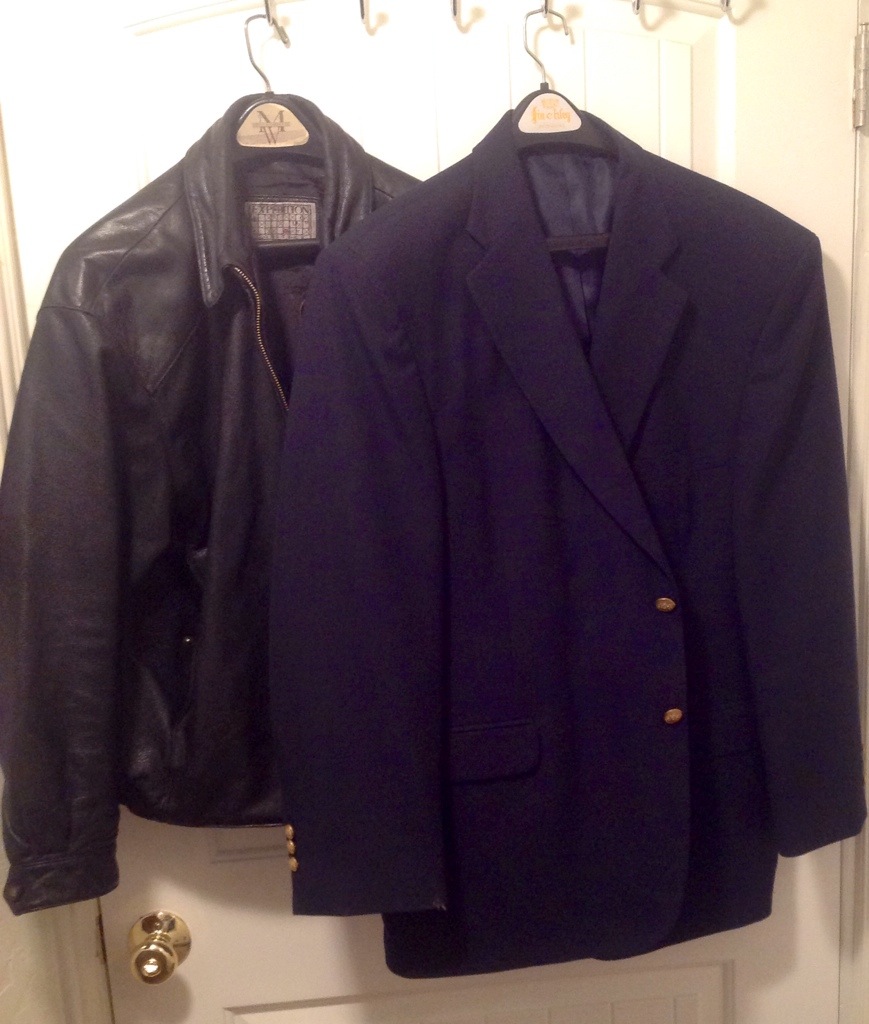
Lee bought a new sport coat while we were here and it doesn’t fit him. Do you want it?
Sure, Mom. Thanks.
My mother and my step father were in town for the blessing of my granddaughter. My step father is a big guy. He towers over my 6′ frame and easily outweighs me by 50 or 60 lbs. So, naturally the coat didn’t fit. That wasn’t the surprising part. The surprising part was that I expected it to fit.
I wear about a 40R and this coat is a 48R. However, since typical office attire at my office is shorts or jeans and t-shirts, I doubt anyone will notice if my sport coat fits a little loose.
But, why had I assumed that a coat from a man who wears 10 sizes larger than me, would fit?
Because it has in the past. Well, not from Lee, my step day, but from Lloyd Bliss, my father. Before my dad passed away, it was not unusual for him to say something like,
I got a new leather coat today, but it doesn’t fit right. Would you like it?
My dad was not a big guy. He was several inches shorter than I am and about 40-50 lbs lighter. And yet, every time I tried on his “new coat” it fit me perfectly. It became so common that I started to think my dad bought his clothes sight unseen. Maybe he mailed away for them. Surely, if he tried them on in the store there was no way they even came close.
After he passed away, us kids had the bittersweet task of helping my mother clean out his closet. My dad had great taste in clothes. He ordered his shirts custom made. They didn’t have a top button. He didn’t wear them with a tie and he didn’t like the way they looked with the lonely button at the top.
And that’s when it hit me. I guess I’d really known all along, but I was pretending to myself. Of course he didn’t buy a coat that was the wrong size. He bought a coat in the exact size he wanted. . .mine.
Not a single piece of clothing from my dad’s closet fit me. Not even close. He had a problem at times giving gifts. This was his way of getting the benefit of giving a gift without having to deal with the emotional aspects of someone thanking him for buying them a gift. It’s a weird way to approach gift giving, but it worked for him.
My dad’s coat reminds me of the role that mentors play in our careers. I’ve had mentors at times who arranged for wonderful opportunities to come my way, but they preferred to stay in the background.
That’s great that you got the SWAT team position. You worked hard for it.
And I might have. But, they also worked hard behind the scenes. And like my dad’s closet full of custom tailored clothes, it’s often not until after we or the mentor has moved on that we realize just how influential they were in our success.
Somedays I miss him a lot more than other days.
Rodney M Bliss is an author, columnist and IT Consultant. He lives in Pleasant Grove, UT with his lovely wife and thirteen children.
Follow him on
Twitter (@rodneymbliss)
Facebook (www.facebook.com/rbliss)
LinkedIn (www.LinkedIn.com/in/rbliss)
or email him at rbliss at msn dot com
Tell your friends about this!

(Photo credit: Flickr.com)
The old piano had seen better days. The sustain pedal was missing. A casualty of a trunk someone had shoved too hard. The cabinet was battered, of course. You would expect that of a piano that was nearly 100 years old and had been owned by a family with 15 kids. Inside, several of the hammers had broken off over the years. Enterprising kids had then “moved” hammers from the lesser used upper and lower keys and glued them into the middle range.
My wife inherited the piano because none of her siblings wanted it. We already owned a small piano. It was the first major purchase we’d ever made. But, we had a large house and the idea of a second piano was attractive to a family that loved music and planned to force. . .I mean encourage all of our children to learn to play the piano.
At the time I worked for Microsoft corporation. The stock was going up. We were all getting rich and we had the money to invest in restoring the old piano.
I called a piano repair location out of the phone book. (Yes, this story is old enough that it involves and actual phone book.) We set an appointment time and I removed all of the external panels so that he could more easily assess the work that needed done.
John?
You called about a piano that needed a repair?
Yeah, thanks for coming it’s in here.
On the phone you didn’t say what exactly it. . . .
There it is. It’s been in my wife’s family for years.
Not at any price.
What do you mean?
I mean I’m not going to fix that piano. And no amount of money can get me to change my mind.
I had never encountered this scenario. He was a piano repair man. I had a piano desperately in need of repair and he was refusing the job.
Has you business ever taken a job that you really should have turned down? Maybe you do catering and someone begged you to do their kid’s birthday party, even though you told them you absolutely do NOT do kid events?
Maybe you agreed to try repair a computer, even though it was running Microsoft Millennium and the user refused to update?
Whatever the scenario, there are some situations where you know a job is going to cost more than it’s worth. Maybe it will tie up your best resources on a low paying job preventing you from using them elsewhere. Maybe it’s going to result in so many change requests that you know the project budget will balloon out of scope. Maybe it’s knowing the client is so picky that you will end up redoing the same sketch many times while only getting paid for one.
Sometimes you need to be willing to walk away from a sale, or a contract, or a gig. It may cost you money in the short run, but long term it will save you hours of headaches.
That was the case with my piano repair guy.
What do you mean?
Look, I can fix that piano. But, if I do, you’ll complain that it cost too much money.
No I won’t. I expect it to cost hundreds of dollars. Possibly as much as $800.
I’ve been doing this job a long time. You will not be happy paying me $800 to fix this piano. The real reason is that piano’s this old were tuned a half step lower than today’s pianos. So, if I fix it without tightening the strings, it will sound out of tune. If I tighten those 80 year old piano wires, they are going to break. A lot of them.
So, there’s nothing I can do?
My advice is go buy a new one. You can get a pretty nice piano for $800. Donate this one to a school that teaches piano repair. I can give you a number. They might fix it just to give their students something to practice on, but no professional piano repair firm is going to touch it.
And with that, he picked up his tool bag and returned to his car. It took me a long time to figure out why he turned down the job.
We kept the piano for many more years. Finally, we were moving and didn’t want to lug it across the country again. We offered it during a yard sale with a sign that said, “Make an offer.” Not a nibble. We would have taken anything. Finally, we updated the sign to “$50 – As Is.” It sold in 30 minutes.
Rodney M Bliss is an author, columnist and IT Consultant. He lives in Pleasant Grove, UT with his lovely wife and thirteen children.
Follow him on
Twitter (@rodneymbliss)
Facebook (www.facebook.com/rbliss)
LinkedIn (www.LinkedIn.com/in/rbliss)
or email him at rbliss at msn dot com
Tell your friends about this!
You know that bug I told you about?
The one that randomly printed people’s names in reverse?
Yeah. I fixed it.
Oh?
Well, I kept thinking the problem had to be in the data store, right? But why would the string field for person.name.last in the data store only screw up sometimes, you know? So, I started looking at my other classes and I realized that when I had to process a name that included a double byte character, I was calling the string parser, and you remember I had to rewrite my own parser because the included one couldn’t handle mixed double byte and standard ASCII chars? Well anyway, I wasn’t resetting that variable I passed it to tell it I had a doublebyte string. And when I passed it a second time, the value just happened to be large enough to force a record size check, which of course I did back to front since I had a pointer to the final char in the list, and could simply count backwards. So, a simple initialize statement before I call for input and the problem is solved! Isn’t that cool?
Huh? I kind of quit listening after you said “I fixed it.”
One of the most boring things in the world is to hear a programmer describe fixing a bug in a program you’ve never worked on. The weird thing is that to the programmer herself, it really is fascinating. You can spend hours combing through your code checking and rechecking your logic to try to find the source of an elusive bug. When you do finally find the error, it’s often something simple; a transposed number, or a simple typing mistake. To you, it’s the culmination of hours of hunting. To other people it’s really, really boring.
Incidentally, do you know why we call them bugs? It’s all because of one of the founders of Computer Science, Grace Hopper.

(Photo credit: Wikipedia)
Rear Admiral Hopper was a computer programmer back when computers took up an entire room and did less than your phone apps do today. The relays back then were electrical, and mechanical, not electronic. So, there were metal levers that opened and closed to make connections.
One day there was a problem with the program. It didn’t run correctly. Admiral Hopper opened up the big side panels and inside discovered that a moth had flown in between the contacts on one of the mechanical relays. She taped the moth into her log book and documented the first computer “bug.”
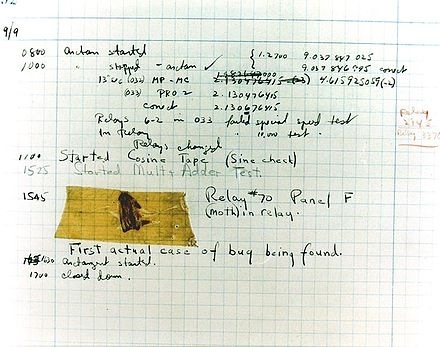
First computer “bug” (Photo Credit: Wikipedia)
See? Computer Scientists aren’t ALWAYS boring. But, most of the time they are. It’s strange too, because most programmers and engineers love to talk about systems and programs. It really is a foreign language. In fact, it’s multiple foreign languages, there is an entire lexicon of various computer languages, (C, C+, C#, Ruby, Python, BASIC, COBOL (written by Admiral Hopper in the 1950’s and still in use today.))
You might be tempted to look at today’s Management Rule That Makes No Sense title, “It’s Magic” and think it’s better to simply take the work programmers and engineers do as magic and not try to understand it.
That’s probably a reasonable approach, but it’s not what the rule actually means. If a technical person is giving an answer to a non-technical person, they will give their answer in one of two ways depending on their goal. If they want to actually explain what they’ve done, they will attempt to “translate” tech-speak into more intelligible language. They will most likely resort to analogies.
For example, you’ve probably heard of TCP/IP, but may not know what it refers to except that it has something to do with the internet. An IP address is kind of like your house number. Every house in your town has a unique address. Every computer on your network has a unique IP address. It’s how computers know how to keep track of each other. TCP refers to how the information is moved. Kind of like the idea that letters addressed to your house will be delivered by the postal worker. TCP describes how the computers route information back and forth.
That’s one way a techy person might explain technical terms if they trying to give you actual information. If the techy person simply wants you to go away and let them get back to playing with their shiny software toys, they will swamp you with jargon and then ignore you.
The IP protocol is a set of four octets that unique identify every device in a network. Octets support values of 0-255. Addresses are divided into class A, B and C addresses that correspond to each Octet. Routers route data packets based on the values in the octets.
They’ll keep going until you give up and leave in frustration, which is what they wanted in the first place. But, that’s not why this rule is called “It’s Magic.”
When explaining a technical solution to another technical person, sometimes the worst thing you can do is actual explain the technical details. You risk having the person you are explaining your solution to giving you completely unsolicited feedback.
Why not simply initialize the variable when you first load the program and then have the last command of each process reinitialize it?
Why? Because I choose to do it THIS way! You may not want to go through an architecture review simply so that you can give a status update to a coworker.
The other danger of giving a technical answer is more subtle. I was the email administrator for a large 30,000 user non-profit organization. I had discovered a clever way of calculating which users needed a larger mailbox. My algorithm, which I called the “Efficiency Index” looked at the how full a mailbox was, how much email had recently been deleted and how much new email the user got. I maintained it in an Excel spreadsheet and it took about 10 minutes for my laptop to churn through the calculations each morning.
I was explaining the Efficiency Index to the manager of our database team. There was no way for him to know what his EI number was on a daily basis. But, I explained the logic of it to him anyway. A couple weeks later I bumped into him again.
Rodney, can you tell me what my efficiency index is for the past week?
Why? You already have a large mailbox. If you need more space let me know and we can accommodate you. Your efficiency index won’t mean anything to you.
I know, I know. But, ever since you explained how you calculate it, I’ve been thinking about my mailbox, and I think I’ve figured out how to get a high efficiency index number. I know it doesn’t matter, but now I’m intrigued.
I just shook my head. It occurred to me that sometimes the best answer to a technical question is: It’s magic.
Rodney M Bliss is an author, columnist and IT Consultant. He lives in Pleasant Grove, UT with his lovely wife and thirteen children.
Follow him on
Twitter (@rodneymbliss)
Facebook (www.facebook.com/rbliss)
LinkedIn (www.LinkedIn.com/in/rbliss)
or email him at rbliss at msn dot com
Tell your friends about this!
When my mother got married the last time she decided to elope on a cruise up the Eastern seaboard. My friends at the time asked me,
If she decided to elope, how did you know about it?
I knew about it because my mother lacks the ability to respond privately to a message on facebook.
Yesterday I shared a story about how some people’s betrayals have affected me. (How Can You Forgive The Unforgivable.) In addition to some business examples, I shared some details of a very personal betrayal that happened in my own house.
A couple of readers reached out to me to express concern for the level of detail I was sharing. They were rightly concerned about the tendency that people have of oversharing online. It got me thinking about online privacy. Let me talk about my some different people’s approaches to online privacy and then I’ll explain exactly what I was doing yesterday.
In the early days of the internet, and pre-internet, no one worried too much about online privacy. I had an early CompuServe account in the 1980’s. You picked your own display name. Your “real” ID was a series of numbers. But, your profile existed only on CompuServe and even then, people tended to post to only a few forums. You got to know people. One of my best friends in the world Danita Zanre was known as an “email goddess.” She still is as the founder of www.Caledonia.net, where she expounds on GroupWise and several other non-Microsoft technologies.
In the mid-1990’s the Internet really started to take off. We all had to decide how we were going to appear to the rest of the world. From the beginning I wanted to be known by who I am. It’s an attitude I’ve continued through the years. There is a reason that this blog is called www.staging.rodneymbliss.com. Part of the purpose in starting it was to establish an online presence. I wanted any credibility I’ve built up over the years to be associated with the real me.
I have other friends who’ve been online as long as I have who took different routes. My friend Dave (www.heartmindcode.com) is @dbrady on Twitter. He’s Chalain on LiveJournal and Facebook. He picked Chalain in the 1990’s partly because “handles” were fashionable and partly because he thought he’d be able to hide behind a pseudonym. He’s now realized that all hope of anonymity is gone. His rule is to never say anything online in a semi-public area that he doesn’t want to be public. He continues to use the name Chalain because that’s what his friends know him as.
My brother, Richard is a brilliant internet marketer (www.blisspoint.us.) He has a real talent for looking down the road and seeing what’s coming. I asked him how he approaches online privacy.
I don’t. There is none.
You don’t have any filter on what you post?
Well, I try to not use my kids names. But, if there is a situation where I need to talk about my child I use the child’s name.
I’ve often talked about my friend Howard Tayler (www.schlockmercenary.com.) Howard’s business is built around having an online presence. He needs to get thousands of people he’s never met to come and read his comic, but also to buy books and merchandise. Howard’s approach from the very beginning was he gave his children pseudonyms. And he and his wife Sandra have been hyper diligent about only using their children’s pseudonyms online. Sandra says it is disconcerting at times because long time readers will approach her at a convention and talk about her children using their pseudonyms.
Their oldest child is now an adult and an accomplished artist. She is starting to make her own way through the digital forest. She’s widely known by her pseudonym thanks to 10 years of Howard talking about her and sharing her drawings over the years.
My lovely wife and I had to decide what we felt comfortable with as our children were growing up. We are some of the stricter parents, but we don’t drift into the paranoid state.
We almost never post pictures of our kids. Our children who are not adults do not have online accounts. No facebook or twitter or instagram until they get to be 18. We also never use their names. I recently wrote about my son saving another boy’s life (Sometimes It Really Is Life Or Death.) In that case, I used a pseudonym.
That brings me to yesterday’s post. There is a lot of personal information in that post. And one of readers was concerned that later in life the children involved might not appreciate the story being shared. I’m sensitive to that. To combat it, I did a few things specifically yesterday. First, I was intentionally vague about the number and the genders of my children in foster care. I have thirteen children. There are plenty to choose from. I also shared no information about the victims. I also hinted at the abuse, but wasn’t blatant. Although the hints were pretty broad.
Did I do enough? Would it be possible for someone to through the process of elimination figure out which children are involved? Possibly. But, unless I become a famous writer with paparazzi chasing me, I don’t think anyone will care to go to the trouble.
And that’s the heart of my online privacy strategy. I agree with my brother that if you are online you have no privacy. None. Don’t even pretend. Just accept it.
But, here’s where you can protect yourself and your kids. Hide behind a click. What I mean by that is that most people are lazy. I don’t have the statistics, but there are firms who track the effectiveness of websites and one way they do it is by calculating how many clicks a visitor has to go through to get to your content. You lose people on each click.
Did you know that there is a page two when you do a Google search? Well, sure you probably knew that, but have you ever gone to page two? Three? Probably not. We tend to graze when we consume information online. Each click is another step and most people won’t take it.
So, you can find out just about everything about my online presence. I have hobbies that I pursue online that I do not post to my blog, LInkedIn, or Twitter accounts. I’ve intentionally made them a click away from my business profiles. You can find them, but will you? Probably not. And most people are like you.
So, I was deeply touched by readers sharing concern for my online privacy, and even more for their thoughts to protect my children. It’s a valid concern. My current plan is hiding through obscurity. There are a few billion people online. The spiders who gather all information will get my stuff and the marketers will throw me into a demographic, but the casual person browsing online probably won’t make that extra click.
I’m content hiding in plain sight.
Rodney M Bliss is an author, columnist and IT Consultant. He lives in Pleasant Grove, UT with his lovely wife and thirteen children.
Follow him on
Twitter (@rodneymbliss)
Facebook (www.facebook.com/rbliss)
LinkedIn (www.LinkedIn.com/in/rbliss)
or email him at rbliss at msn dot com
Tell your friends about this!
It was almost too much to bear.
No. That’s not true. It was too much. I couldn’t breath. I couldn’t think. I couldn’t grasp what I was hearing. The details of the abuse that had been happening in my home were overwhelming. A huge part of my world came crashing down.
But, life goes on, even if I didn’t feel like I could.
I was talking to my mother who lived in Washington. Before the abuse was known she’d bought me a surprise gift of tickets to Billy Joel and Elton John’s “Face to Face” concert in Salt Lake City. I’d wanted to see the concert for literally over a decade. She was planning to fly to Salt Lake and we’d go together.
Unfortunately the concert was cancelled and she wasn’t going to be able to attend at the rescheduled time. She was trying to decide what to do with the tickets.
I don’t care, Mom. You bought them. Go ahead and get refunds if you want.
But, you’ve wanted to see this concert for years. Doesn’t it just break your heart?
Look, Mom. I just found out one of my kids will never again be able to set foot in my house. That breaks my heart. Not getting to see a couple of old guys sing on stage doesn’t really compare.
Yesterday I talked about dealing with people who are trying to redeem themselves. (Holding The Power Of Redemption.) Today I want to talk about being the person that is betrayed, whether that’s at work, or in your family, or in yourself.
The betrayal that I experienced in my own home was the worst experience of my life. Even now, years later, I’m only able to speak about in vague terms. But, it was horrific and it resulted in several of my children being removed and placed in foster care. They had to go through the legal system, but as children they really needed care not incarceration.
My wife and I had to make a decision at this point. Many parents in our situation “divorced” their child. They choose to focus on helping the victims heal and they either ignored or vilified the perpetrator.
That was a tempting route. It really was. The emotional scars were so big, ugly and raw that it was tempting to simply cauterize them. Shut off the emotions.
But, we soon realized something. Our kids in foster care were going to be sent along the path of least resistance. They’d be kept safe and kept from hurting others, but very little effort would be made at getting them the help and therapy that they needed to heal and get better.
Could we put aside our own grief, our own feelings of betrayal to become advocates for our kids? I wasn’t sure. But, I knew that if we didn’t, no one would.
Fortunately, not every betrayal is as personal or as painful as the one I went through with my kids. So, what do you do with an employee who has betrayed you? Yesterday I mentioned James (He Deserved To Be Fired.) James lied to me. And then he made a mistake. And then he ran away.
How do I get past that as his supervisor?
Sometimes you can’t. In some cases, you can never rebuild that trust. In that case, you owe it to the employee to let them go. Oh sure, that’s easy for me to say. “Let them go” sounds so benign. Almost like I’m doing them a favor by giving them freedom. But, that’s actually what it is. I have a good friend who is the son of a man who owns a large corporation. My friend had a good job for life. All he had to do with show up. But, my friend realized that he was never going to be anything except the boss’s son. So he left.
What’s that have to do with firing someone?
A lot. In both cases, you have someone who cannot possibly redeem their image. If you know you will never trust an employee again, why put both of you through the pain of keeping a relationship going that is not good for anyone?
One company I worked for found out that a mid level manager was getting kickbacks from a supplier in exchange for steering them business. He eventually got caught. The company didn’t want the bad press associated with charges and a trial. But, no one at that company was ever going to trust that person again, no matter if he changed or not. They did him a great favor by “letting him go.”
With James, I tried to focus on the good work he’d done in the years leading up to his mistake. I also thought I recognized why he was struggling. And finally, it was obvious that he wasn’t acting out of malicious intent.
Even with all of that, there was no guarantee he’d be able to recover. Fortunately he did, and we remain good friends to today.
So, what about my kids?
I couldn’t abandon them. Families built through adoption are unique in that parents get to choose their kids. I choose these kids and having once decided that I was going to love them, I couldn’t stop that. We had and continue to have a long road. Sometimes the kids are appreciative of the chances they’ve been given, other times, they are resentful. They are teenagers. Sometimes they just act crazy anyway.
I haven’t forgotten what they did. I’ll never forget that. It’s been seared into my soul with a white hot branding iron. But, I can separate what was done, from the individual doing it. I got just a glimpse of what the Bible means when it says “God loves everyone.” Really? Really? God loves Hitler? Stalin? The people who crucified His Son? The people who do horrible things to children? He loves THOSE people?
Does God really love the murderers?
Yes. But, I think it’s harder for Him to love the rapists.
Rodney M Bliss is an author, columnist and IT Consultant. He lives in Pleasant Grove, UT with his lovely wife and thirteen children.
Follow him on
Twitter (@rodneymbliss)
Facebook (www.facebook.com/rbliss)
LinkedIn (www.LinkedIn.com/in/rbliss)
or email him at rbliss at msn dot com