It was a dark and stormy night in the Catskill mountains, and a band of robbers sat around their daily spoils.
“Boys, let’s have a story,” the captain said. And this is the way the story went.
“It was a dark and stormy night in the Catskill mountains and a band of robbers sat around their daily spoils.”
“”Boys, let’s have a story,” the captain said. And this is the way the story went.”
“”It was a dark and stormy night in the Catskill mountains, and a band. . .””
That is my mother-in-law’s favorite joke. she can keep some of her younger grandkids strung along for 4 or 5 iterations before they figured out it is just the same story with the end tied into the beginning.
Stories are an important part of your business. People are going to tell stories regardless. You have the opportunity to define the story, if you choose to.
In marketing they call it “controlling the message.” I’m not in marketing. I call it “telling stories.” We had an intern one time who said to me,
Rodney, when people ask me what my boss is like, I tell them you’re the old guy who sits around telling ancient computer stories.
Well, maybe I am. But, I believe strongly in the power of story.

Last weekend, my family and I attended the 25th Annual Timpanogos Storytelling Festival. The point of the three day festival is simple: telling stories. We gathered at the Timpanogos Storytelling park in Provo Canyon. And under large white tents designed to keep off the rain or the sun, we sat for hours listening to stories.

There was Antonio from Brazil who took my kids to a magical animal party in the sky.
Douglas took us back to a one room schoolhouse in the West Virginia mountains where as a second grader he learned about paddling.
I’ll admit, to someone who’s never been, a Storytelling festival seems. . .odd. Maybe slightly eccentric, like a writer who insists on using a manual typewriter.
But, to those who attend, it’s a wonderful experience. My children don’t know they are witnessing an art form that predates the written word. All they know is that Bill Lepp is one funny guy.
Storytelling is important in business as well. We don’t call it that. We call it “lessons learned” or “best practices.” But each line in a best practices document is there because someone was doing something and they figured out a new way of doing part of it, and now they want to tell you about it.
Stories do another thing. They bind people together. Reliving our shared experiences draws a team closer together. Sharing personal stories is an even stronger bond.
In the movie “Saints and Soldiers,” five allied soldiers are trapped behind enemy lines and desperately trying to get back to their units. The British pilot suggests they share some personal information with each other so that they can feel more connected.
“The first time I kissed my wife was the day we were married,” offers one soldier. “I used a car engine vacuum tube to give myself hickies so people would think I had a girlfriend,” added another. Finally, they turn to the Brit and ask, “How about you? What’s your secret?”
“I couldn’t possibly share that with you fellas. I barely know you.”
Give your teams the opportunity to have shared experiences, but most importantly give them an opportunity to share stories.
Rodney M Bliss is an author, columnist and IT Consultant. He lives in Pleasant Grove, UT with his lovely wife, thirteen children and one grandchild.
Follow him on
Twitter (@rodneymbliss)
Facebook (www.facebook.com/rbliss)
LinkedIn (www.LinkedIn.com/in/rbliss)
or email him at rbliss at msn dot com
Tell your friends about this!

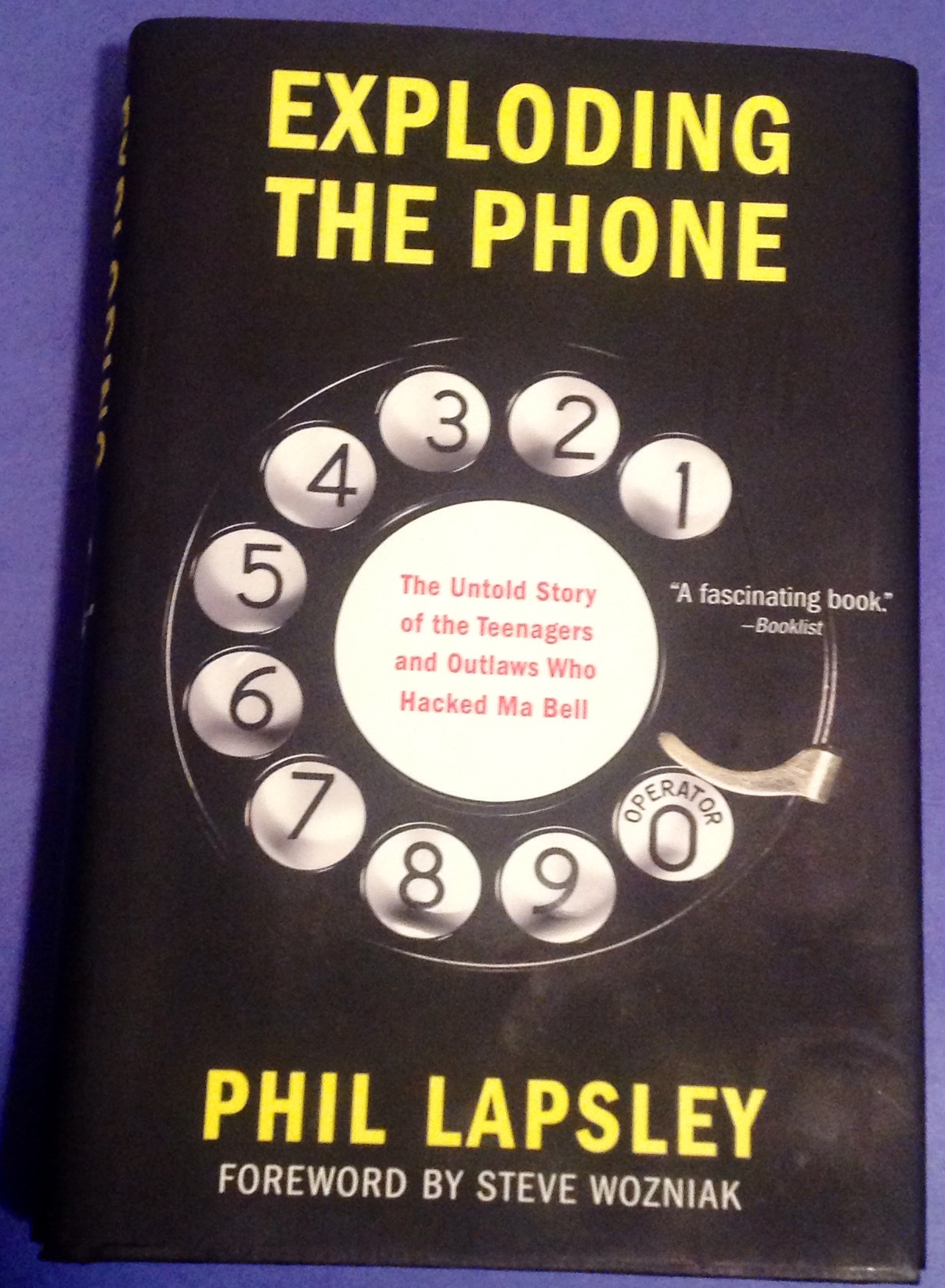
I remember breaking the law at my Great Aunt May’s house. We were standing in her basement, huddled around an old phone. This wasn’t the regular phone. This was the scandalous “extension.” In 1970 the phone company owned all of the equipment. You rented your equipment from AT&T. And they had “ways” of finding out if you had installed an extension. I didn’t know what the penalty was. Aunt May didn’t know what the penalty was. But, she knew if you only listened, didn’t talk, you were safe.
Exploding The Phone, by Phil Lapsley is a fascinating journey of exploration into the land of the world’s largest machine. Phil Lapsley takes the reader on a fascinating trip populated with blind teenagers, hippies, blind whistlers, future titans of industry, gamblers, and at the heart of it was the AT&T phone system and something called a blue box.
Exploding The Phone takes us through the cat and mouse game as phone phreaks matched wits with the engineers at the phone company, and law enforcement including the FBI. And to what end? Oh sure, there were a few people like Kenneth Hanna, a bookie who used a blue box to make free phone calls to his clients, but for the most part the people involved in hacking the phone system did it just because they could.
Exploding The Phone details the history not only of how AT&T built the worlds largest machine, but how a bunch of teenagers turned it into their own personal playground. At least, that is until the FBI showed up and spoiled everyone’s fun.
I knew a little of the history of Ma Bell before I picked up Exploding The Phone, but there were plenty of happy surprises for me. For example, “The Steves,” Jobs and Wozniak of Apple Computer fame started out as phone phreaks. Jobs was more interested in selling blue boxes than making them. Wozniak, as usual was the technical brains behind the operation. In an interesting connection that Lapsley didn’t pick upon, Woz’s work on blue boxes had something in common with his work on the Macintosh. Inside each phone hacking blue box he built he included a strip of paper that said,
He’s got the whole world in his hands.
Even Wozniak, who write the introduction for Exploding The Phone couldn’t really explain why he put the phrase there, except that if he was later asked to fix a blue box and it had the paper inside, he’d know it was one of his. . .and he’d fix it for free.
Years later when the Apple Macintosh came out, the Macintosh team included a message inside the box as well.
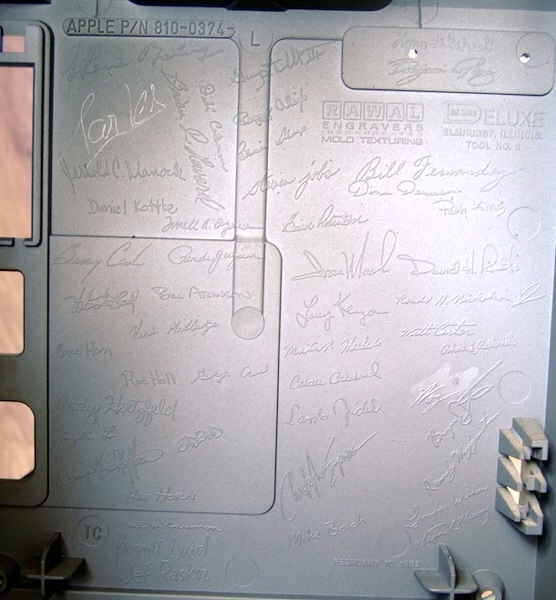
(Photo Credit: Cultofmac.com)
The development team signed their names and then Apple baked that into the manufacturing process and the inside of the case. So, just as he did years earlier, Wozniak added a note inside the Mac that said, “I made this.”
This book isn’t for everyone. But, even if your only exposure to phone phreaking was watching Matthew Brodrick make free phone calls in the 1983 movie WarGames, Lapsley has written his story in an engaging way that will take you along for the ride.
What I Liked
Lapsley tells a very interesting story. He includes enough of the details that an old wire monkey like me will find pieces that make me go squee. (It’s a technical term.) But, the technical details take a backseat to the dialogue and the fascinating cast of characters. He doesn’t bury the reader in the technically. Instead, it’s the people who drive the story.
What I didn’t
That cast of characters is part of my one issue with the book. The story lacks cohesion in many spots. When the major players do not have any actual connection to each other, Lapsley has to rely on the technology to transition from chapter to chapter. Especially the first few chapters, while well written in and of themselves, lacked a compelling arc to tie them together.
What it means to you
Exploding The Phone is a hefty tome. It weighs in at 431 pages including the appendix and index. That’s a lot of words to devote to a subject if you have only marginal interest. However, if you grew up taking phones apart and if your first job in college was installing a new telephone system on BYU campus (Pull It Now) Exploding The Phone is a wonderful diversion. I intend to gift my hardbound edition to the head of our telecom team at work. He’s just the kind of old phone phreak who would enjoy it, I think.
Rating
3 stars out of 5
Rodney M Bliss is an author, columnist and IT Consultant. His self titled blog posts every M-F at 7:00 AM Mountain Time. He lives in Pleasant Grove, UT with his lovely wife, thirteen children and one grandchild.
Follow him on
Twitter (@rodneymbliss)
Facebook (www.facebook.com/rbliss)
LinkedIn (www.LinkedIn.com/in/rbliss)
or email him at rbliss at msn dot com
Tell your friends about this!
Things should be made as simple as possible, but no simpler.
– Albert Einstein

Einstein was a genius but he never tried to transfer videos between smart phones.
Hey Rodney, you know that video you took getting water dumped on me from the 4th floor?
Yeah, I posted it to youtube.
Can you give me a copy?
It’s on my phone. It’s too big to send through email.
Here, I think if we just touch our phones, they should set up a bluetooth connection and we can transfer it.
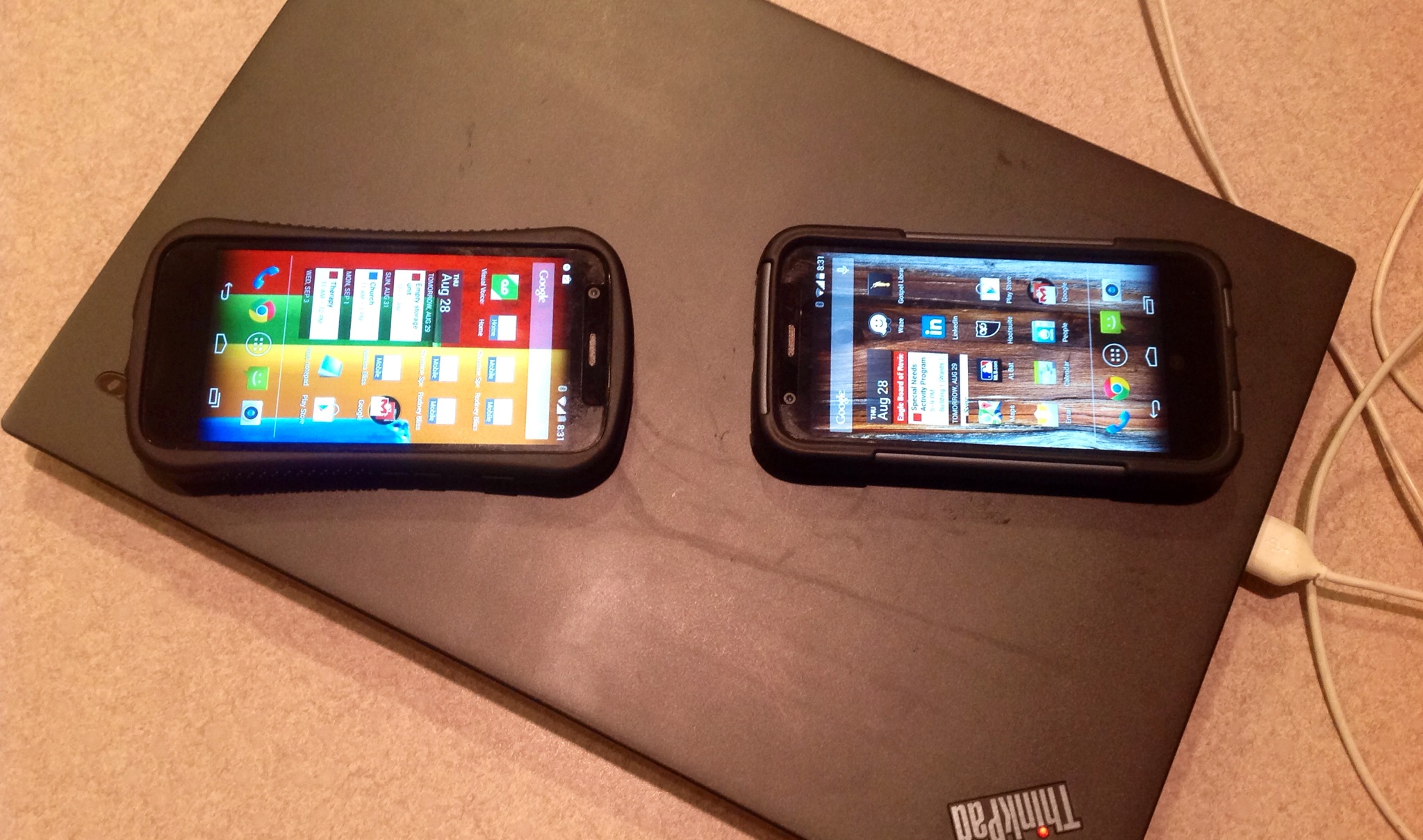
After smacking our phones together to no effect.
Maybe I can try texting it.
“File is too big to send as a text”
Try sending it to Google Drive.
Yeah, I could. Or I could install dropbox on my phone.
You’ve got an Android phone. It should already be set up with Google drive.
I’ll work on it and get back to you.
Between us, my boss and I have over 50 years of computer experience. (I’m old, him slightly less so.) You would think that between us we could figure out how to get a file from my phone to his computer.
He could have pulled the video off of youtube, but it would require a installing a program. We could use dropbox, but we’d have to install software. I could use Google Drive, except that I have never used it and I’m not sure if I have to set up credentials.
What we really needed was a simple way to move really big files back and forth between two devices. The answer turned out to be literally right in front of my face. And the solution would have made Einstein proud, although he would not have recognized the tool.
Guess what happens when you plug your phone into a computer to recharge?
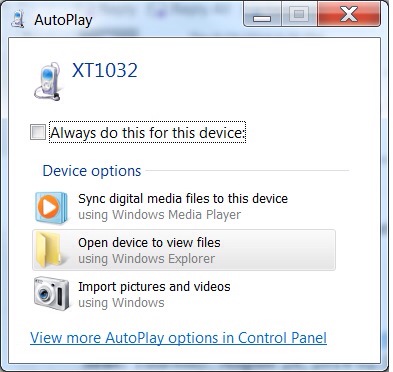
I decided I was not nearly smart enough for my tools. Or maybe I was too smart for my own good. I plugged in my phone and the computer was very happy to move a 56MB video file to my desktop in less than 10 seconds.
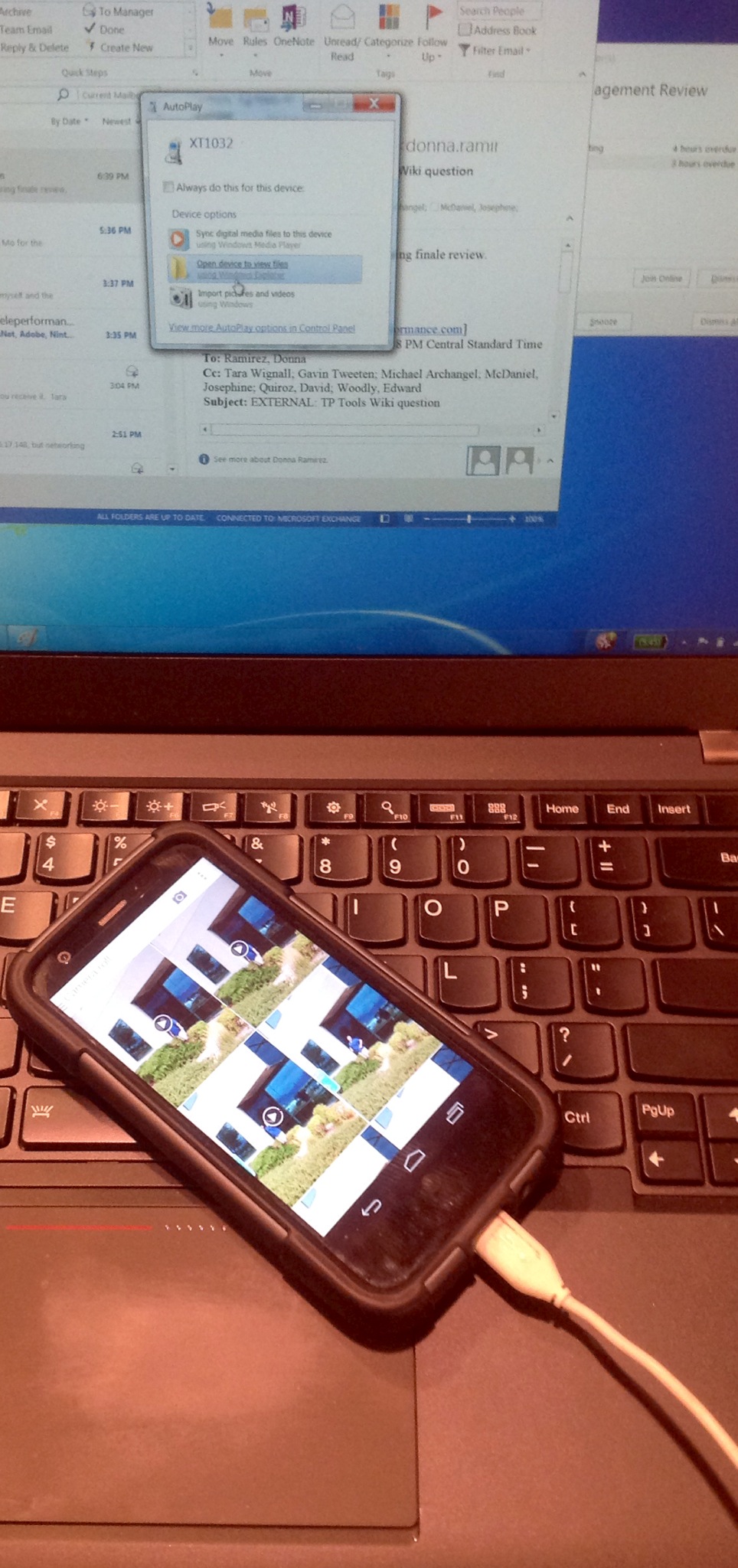
Add one very old school thumbdrive and wait for another 10 second transfer.
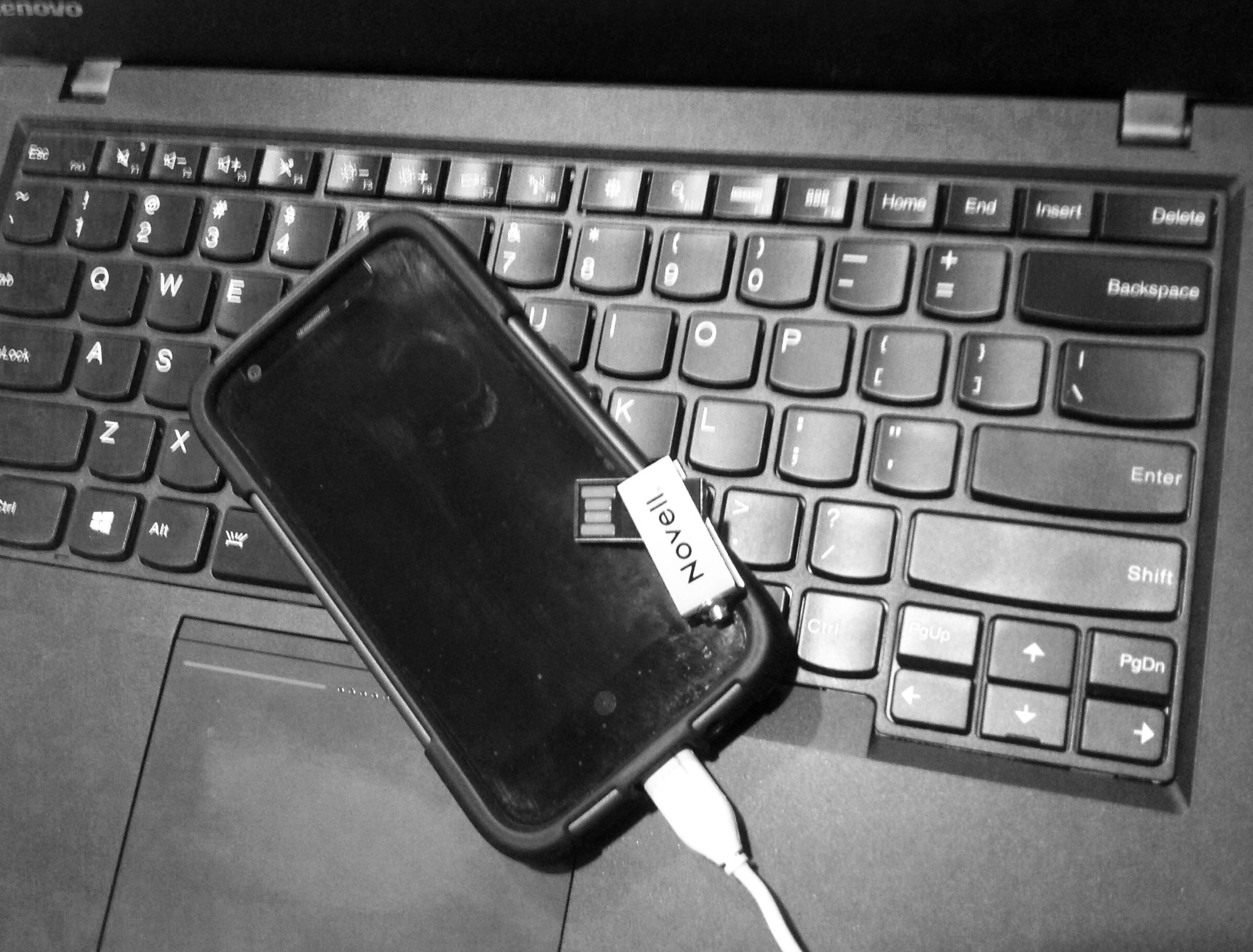
Sometimes the simplest solutions are the best.
My boss accepted the ALS ice bucket challenge. He had two buckets of ice water dumped on him from the top of our 4 story building. The sound in this video isn’t great, but the picture is pretty clear. Here’s the video.
Rodney M Bliss is an author, columnist and IT Consultant. He lives in Pleasant Grove, UT with his lovely wife, thirteen children and one grandchild.
Follow him on
Twitter (@rodneymbliss)
Facebook (www.facebook.com/rbliss)
LinkedIn (www.LinkedIn.com/in/rbliss)
or email him at rbliss at msn dot com
Tell your friends about this!
I’m not sure why it took me so long to notice. Maybe it was the long hours. Maybe it was the darkness. Today I “slept in” until 5:00AM. All week I’ve been getting up at 3:15AM to be at work at 4:30AM. I was back to The Brutal Schedule of Working Half Days. Today, I didn’t need to be in until 7:00AM.
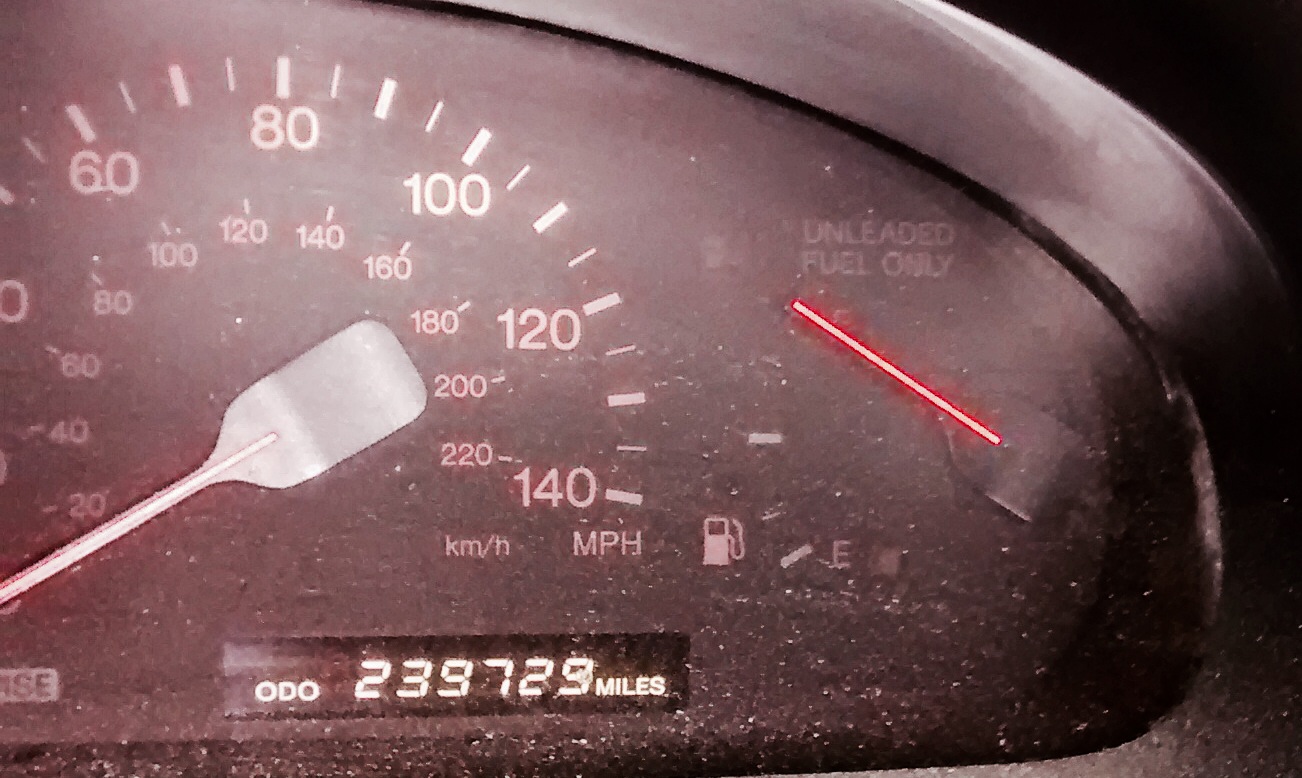
Whatever the reason, it wasn’t until I was on the freeway that I looked down at the dash and my heart fell. All of a sudden I remembered I was planning to buy gas first thing before heading to work.
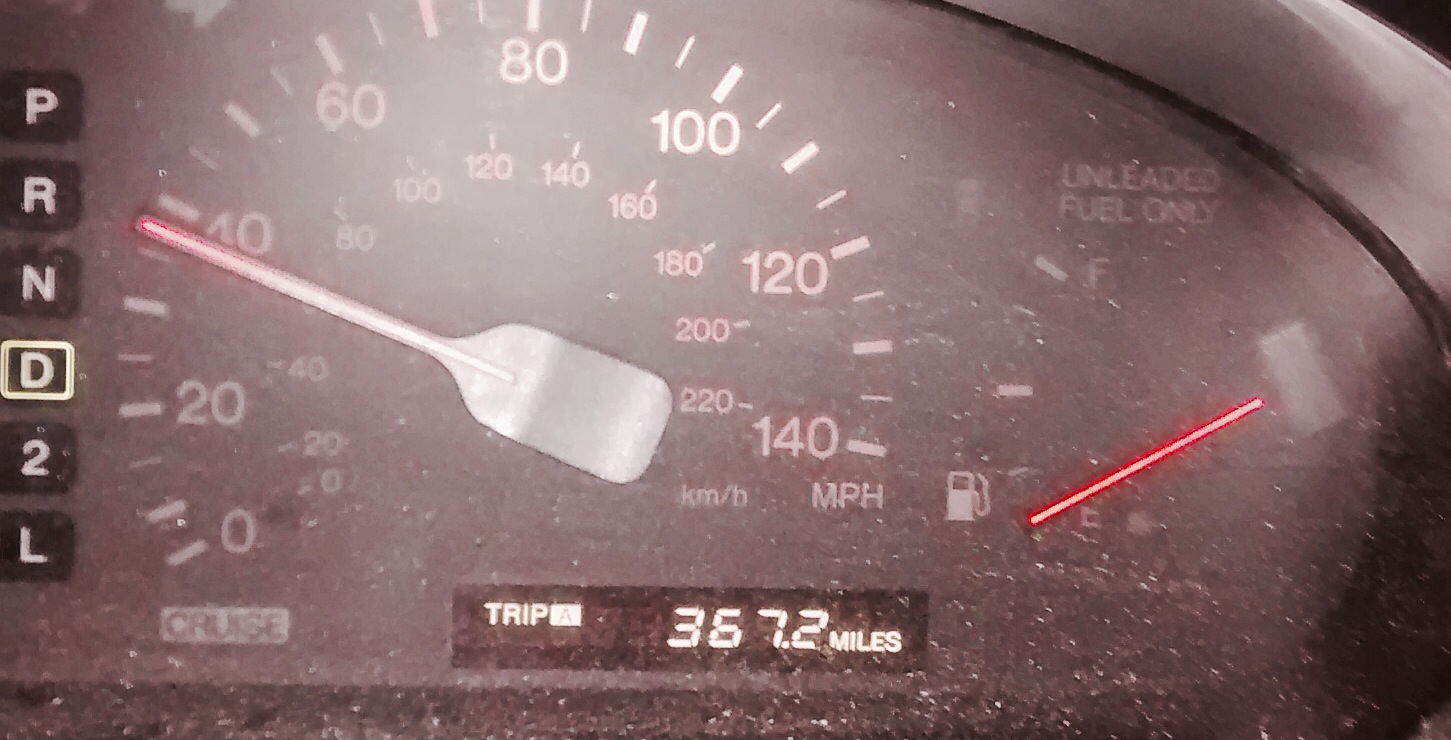
Not only did I forget, I’d let my car get lower than I ever had in the past. Panic set it. I’d gone from “being comfortably early” to work to “how late will running out of gas make me?”
My mind went into overdrive:
– Where is the next gas station?
– How many miles do I have left?
– Will my temperamental transmission complain if the engine dies at 70 – MPH?
– Will I have time to move to the shoulder when the engine dies?
– Which meetings will I miss if I’m a couple of hours later?
– Will I have to buy a gas can?
– Do cops stop and help stranded motorists?
– Should I stay with the car when it dies, or should I try walking to the gas station?
And a million more thoughts. My stress level went through the sun roof. And then, still miles from the nearest gas station, all of a sudden I quit worrying. I didn’t assume everything would be all right, but I did quit worrying. I turned the radio back up and enjoyed the Country station.
A project manager is a professional worrier. Seriously, I get paid to think about everything that could possibly go wrong with my project. We do an exercise called “Risk Analysis.” We look at the risk, for example, the possibility that I won’t be able to get fiber data circuits in time for my GO LIVE date. That’s an actual risk on my current project.
Once you’ve identified a risk, you have to put it on the Risk Registry and you decide what you can do to minimize the risk, or mitigate it. In my case, we realize it’s unlikely we will get the 50MB fiber circuits we need in time for GO LIVE. We know we won’t get them in time for my TRAINING date.
So, Plan B is to immediately order 12MB “copper” circuits in the interim. They take less time to get installed. Now, we go through the Risk Analysis process all over again. There is a chance the 12 MB circuits won’t be ready in time for my TRAINING date. Plan C might be some sort of cable modem or a DSL line. They have an even shorter install lead time. But, they are smaller than the 12MB circuits. We might not be able to run our training classes on a cable modem.
See? I worry about the backup to my backup plans. And Circuits are just one of about a dozen areas I have to track. Every area; Desktops, Network, Facilities, Security, Systems, Telecom, have their own risks and mitigations.
I’m really good at worrying. That’s why you might be surprised that I suddenly became so calm at the prospect of running out of gas on the freeway and being late to work.
The reason is that in addition to being really good at worrying, project managers are also really good at not worrying. In the circuit example above, I worried my way through three different possible plans. The guy in charge of ordering our circuits knew what the the various plans were, and more importantly, he knew what our preferred plan was. At that point, there is nothing else I can do. I can’t make the order process go any faster than it was already going. At this point, my plans are either going to work or they are not. And no amount of action, and especially no amount of worrying on my part will impact any of the outcomes.
Once you’ve done all you can, there is no point to further worry. This is different than fatalism. I will watch the developments carefully and be ready to change my plans if necessary. This is different than the post I wrote where I explained It’s Not That I Think We’ll Crash. I Just Don’t Care. In that case, I didn’t worry because there was nothing I could do if my plane was going to crash. In my current case, I don’t need to worry once I’ve done everything I can.
And that’s exactly why I quit worrying about running out of gas. No amount of worry was going to cause my car to go farther on fumes. No amount of knotted stomach pains would shorten the distance to the nearest gas station. In my head I plotted my route to that gas station and got into the right hand lane in case I had to coast to a stop.
At that point, I realized there was nothing more I could do. No sense worrying over something that might not even happen. Again, this applies to my work as a project manager. My circuits would either come in on time or they wouldn’t. If they didn’t, I had my backup plans. If I ran out of gas, my backup plan was to walk to the gas station.
It would be awful to end this column without finishing the story.

I made it to the gas station. Plus, I put more gas into my car than I ever have. In fact, more than I even thought it would hold.

With my project, I got word yesterday that the 12MB circuits would be installed in plenty of time to meet my training date, and my 50MB fiber circuits would be available 2 months earlier than expected.
Much of what we worry about never actually happens. Makes me glad I didn’t spent any additional time worrying about it.
Rodney M Bliss is an author, columnist and IT Consultant. He lives in Pleasant Grove, UT with his lovely wife, thirteen children and one grandchild.
Follow him on
Twitter (@rodneymbliss)
Facebook (www.facebook.com/rbliss)
LinkedIn (www.LinkedIn.com/in/rbliss)
or email him at rbliss at msn dot com
Tell your friends about this!

(Photo Credit: On Plan)
Have you ever seen someone physically accosted with nothing more than a voice? Have you seen them accosted from 35 feet away simply by words spoken?
It’s a pretty impressive sight.
The art of project management is getting people who owe you nothing to do things for you. In my current role, I have no one who reports to me directly. I have no technical processes or programs that I’m responsible for. I’m not sure I even have the skills to maintain technical programs if they were given to me. (The Day I Realized I Had No Skills.) And yet, if anything goes wrong at my current project. . .from a server crashing to the lights going out, I’m responsible.
In a lot of ways, I’m like a traffic cop. While a missionary in Chicago I occasionally encountered a traffic cop. And their role and their skills were not what I expected. However, their role reminds me a lot of a project manager.
The first misconception about traffic cops is that they are there to direct traffic, as in vehicular traffic. They are not. They are there to direct people traffic. During rush hour in a major city the streets get jammed with people. People who are in a hurry. People who are trying to catch a train, a bus, or grab a cab. People who just want to get home after a long day at work, or get to their dinner reservation before their table gets given away. Whatever is driving people, they are all in a hurry.
Have you ever jay walked? Me too. I’ve been known to cross against the light. But, if there is traffic, that’s a dangerous endeavor in my little town. However, in a big city, during rush hour, there are hundreds and thousands of people around me who are also willing to jay walk. When the light turns yellow, we hurry across, chasing those in front of us. And there are those behind us chasing us. When the light turns red, people will continue to stream across the street, because the people in front stopped the traffic. And behind the jay walkers, are hundreds more, and behind them additional thousands.
What to do?
A traffic cop. The traffic cop in a city like Chicago, or New York is not there to direct the cars. She is there to make people get back on the sidewalk. During my years in Chicago, I saw traffic cops physically push someone back on the sidewalk with her voice. . .and a whistle. The whistle is important.
Without the traffic cop, no cars would ever move. There are simply too many people.
Not every aspect of a traffic cop’s role translates to a project manager, but more than a few do. The PM’s role is not to actually maintain any of the systems, or stage any of the computers, or configure any firewall rules. But, the PM has to know about all of that. The PM plays traffic cop when he pushes Telecom to get additional phone circuits. When he makes a call to keep the network team from blowing the schedule because we missed counting switches.
The PM, like the traffic cop keeps everyone else moving smoothly, and coordinates the work of multiple teams so they deliver on time. It’s a role I relish, but recognize that like the traffic cop, I don’t have the ability to physically do much of anything. I don’t yell at people to get them to do what I need. But, my success is directly linked to my ability often to get people to move simply by persuading them.
Unfortunately, I don’t get a whistle. The traffic cop has me beat on that score.
Rodney M Bliss is an author, columnist and IT Consultant. He lives in Pleasant Grove, UT with his lovely wife, thirteen children and one grandchild.
Follow him on
Twitter (@rodneymbliss)
Facebook (www.facebook.com/rbliss)
LinkedIn (www.LinkedIn.com/in/rbliss)
or email him at rbliss at msn dot com
Tell your friends about this!
Hey guys, put them away.
What?
You’re phones. Give me your attention for a few minutes.
But, that’s what we were doing.
Come on. I was 17 once too. Let me see what’s on your phones.
Every year I tell my family I want a Dilbert desk calendar. Every year my kids fail to get me one for Christmas. Every year, I go and buy a Dilbert desk calendar for myself in January.
I like Dilbert because he talks about my world. I’ve been in the IT world for a long time. I consider myself one of the “in” crowd. I’ve built my own computer. I can analyze network traces just using a copy of notepad.exe. I can tell the baud rate of a modem just by listening to its handshake protocol.
And that is when I realized I wasn’t as hip as I thought. Most people entering the workforce today don’t care about building a computer. In fact, they don’t much care about the computer at all. If they need to look at network traces, products like Wireshark do all the heavy lifting. And no one uses modems. No one cares.
A Dilbert cartoon last week showed the young intern Asok asking the title character about the “Grandpa box.” Tablets and smartphones are much more the tools of the younger generation.
But, I have a smartphone. Nearly every blog post I’ve ever written, close to 400 of them, have been written on my iPad. Scott Adams wasn’t talking about me as one of those “granpa box” users. . .was he? Sure, I am a grandpa, but I’m a technology guy. I understand this stuff. I’m still relevant!
The teenage boys in my Sunday School class all turned their phones around. Each phone had a scripture app loaded and they were all following along with the lesson I was teaching.
At least they didn’t complain I was using a grandpa box.
Rodney M Bliss is an author, columnist and IT Consultant. He lives in Pleasant Grove, UT with his lovely wife, thirteen children and one grandchild.
Follow him on
Twitter (@rodneymbliss)
Facebook (www.facebook.com/rbliss)
LinkedIn (www.LinkedIn.com/in/rbliss)
or email him at rbliss at msn dot com
Tell your friends about this!

Hey Lloyd, there’s a problem with the order for table 3.
What do you need?
See, I thought they had ordered rum and coke, but it turns out the guy was just talking to his friend about other drinks they had here and he wasn’t actually. . .
What do you NEED!
Oh. . .ah. . .return on a rum and coke. Corona with lime.
In addition to being a professional gambler (Looking For The Answer In The Back Of The Book) my dad was also a bar tender at one point in his life. He’s been gone for 5 years, but I had a chance to talk to my mother about him this weekend. (I Never Again Had Friends Like When I Was Twelve…Does Anyone?)
At work, I get involved every time something breaks. Ironically I cannot fix it. But, I provide two important functions. First, I bring the right people together. Secondly, because I am familiar with all aspects of the customer installation, I often get involved in drive for a return to service.
I don’t remember anyone ever teaching me how to drive for resolution or results. But, I must have picked it up simply by growing up in my house. My brothers and I are really good at managing in a crisis.
I’m sure there’s a some official name for it. Personally I call it “Tank driving.” If you are in a tank, you don’t really have to worry about whats going on around you. You can point your tank at the objective and drive straight for your goal.
A good tank driver can boil a situation down to its essential elements. Like a couple of weeks ago when I had a problem with Baking Pans and Wiring Closets, I didn’t really care about the look. I just needed it to be functional.
However, there’s a problem with tank driving. You miss the niceties. You tend to be viewed as arrogant, or insensitive. And your arrogance factor is directly related to how fast your drive your tank. If you have the luxury of time, you can build consensus. This method hands down beats every other method of decision making. But, it takes a long time. Sometimes a REALLY long time.
I was part of a team that was rolling out Microsoft Lync. However, our telecom team really wanted to go with Cisco’s instant message product. As the engineering manager, I knew we were going to go with Lync. The project manager knew we were going to go with Lync. But, he refused to announce that as our decision. Instead, week after week we met with the telecom team, talking about their concerns and working toward a consensus opinion. It was maddening. However, after several months the telecom team was on board and the PM moved forward confident that he had turned telecom from a potential stumbling block to an ally.
It’s a skill I still struggle to master.
What does all of this have to do with my dad the bar tender? My mother related the above story to me. Typically during a rush a bar tender might be filling 300 per hour. That’s one order every 12 seconds. He doesn’t have time for a lengthy explanation about why the order was screwed up. Like Officer Joe Friday on Dragnet, he just wants “the facts.” The story can wait for a time when it’s not busy. In the middle of the rush he just needs enough information to pour the drinks.
Rodney M Bliss is an author, columnist and IT Consultant. He lives in Pleasant Grove, UT with his lovely wife, thirteen children and one grandchild.
Follow him on
Twitter (@rodneymbliss)
Facebook (www.facebook.com/rbliss)
LinkedIn (www.LinkedIn.com/in/rbliss)
or email him at rbliss at msn dot com
Tell your friends about this!
I didn’t even realize they had done it. I’m not sure they realized they had done it.
This is a picture of our “trophy shelves.”

It took me a while to realize the significance of the placement of the trophies.
Participation trophies are a controversial topic. Some people think that the “trophication” (Thanks to my friend Caleb for the word) of America is a big part of what’s wrong with our society.
When everyone’s special then no one is. – Dash
When everyone is super, no one will be – Buddy/Syndrome
If everyone gets a trophy then getting a trophy isn’t special, it’s boring. It’s expected. My kids have picked up a few participation trophies along the way. I still have a couple from when I played peewee football.
And yet, There’s something to be said for rewarding effort. Microsoft used to hand out trophies pretty freely. Here are a couple of my Microsoft Ship It! awards.
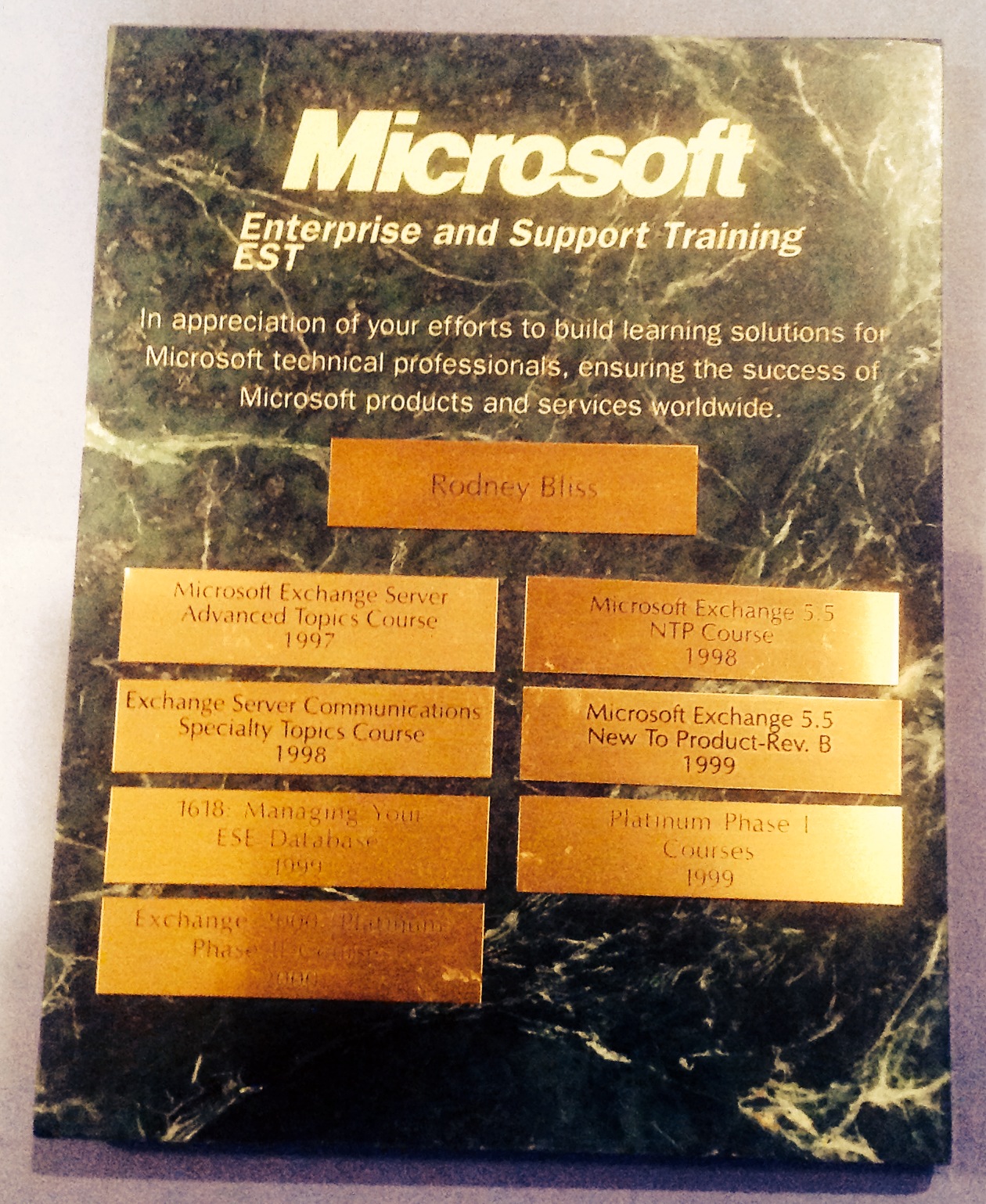
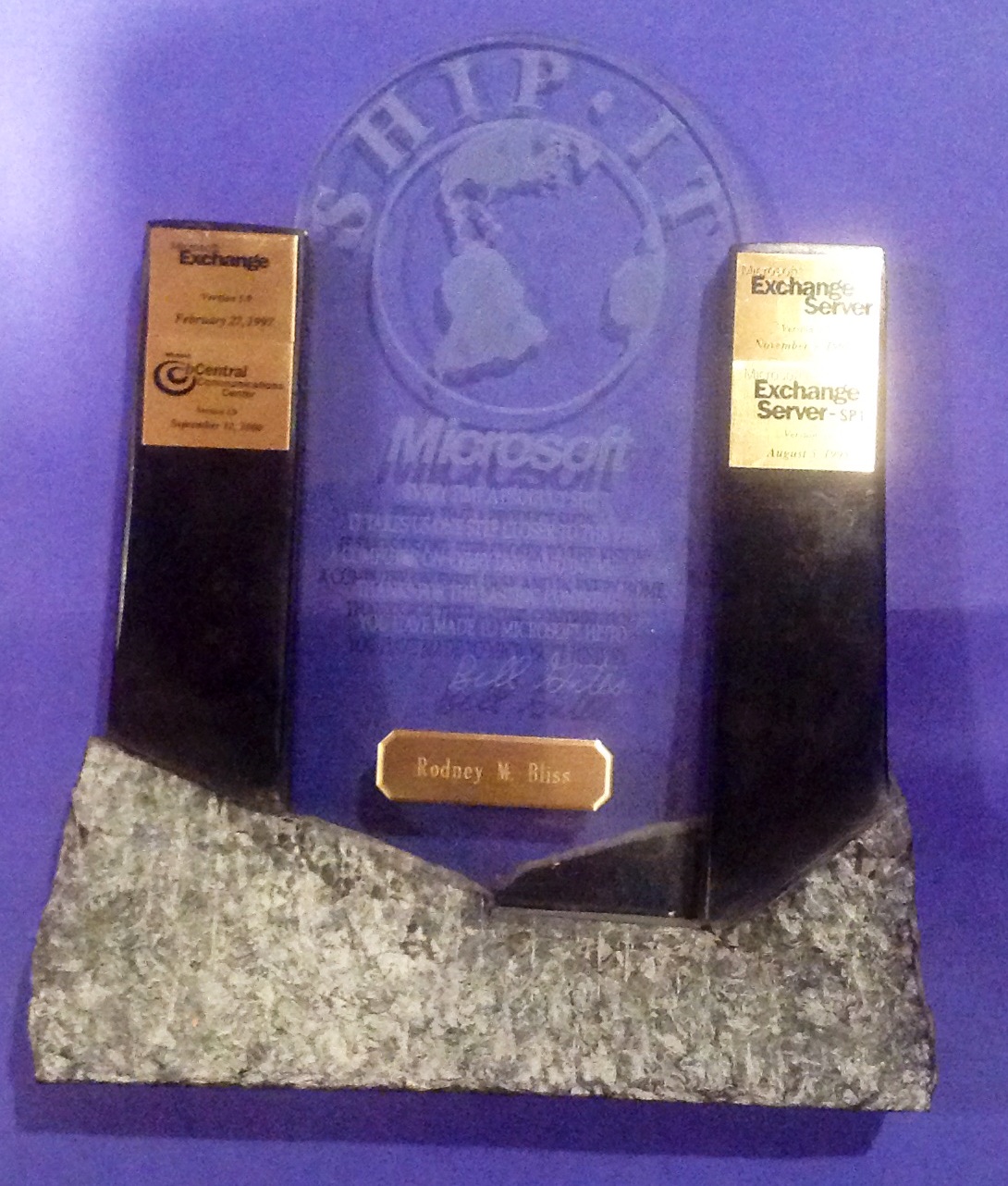
I worked my butt off for the EST awards, but the product Ship It awards? I got those because I sat in the Exchange building. True, I was writing courseware on Exchange, but I had a buddy down the hall who was writing Windows NT courseware. He got an Exchange Ship It award. He kept the trophy but didn’t stick on the Exchange sticker.
Other awards, no matter how cheesy, if they are personalized tend to mean more. My current boss awarded me this trophy.
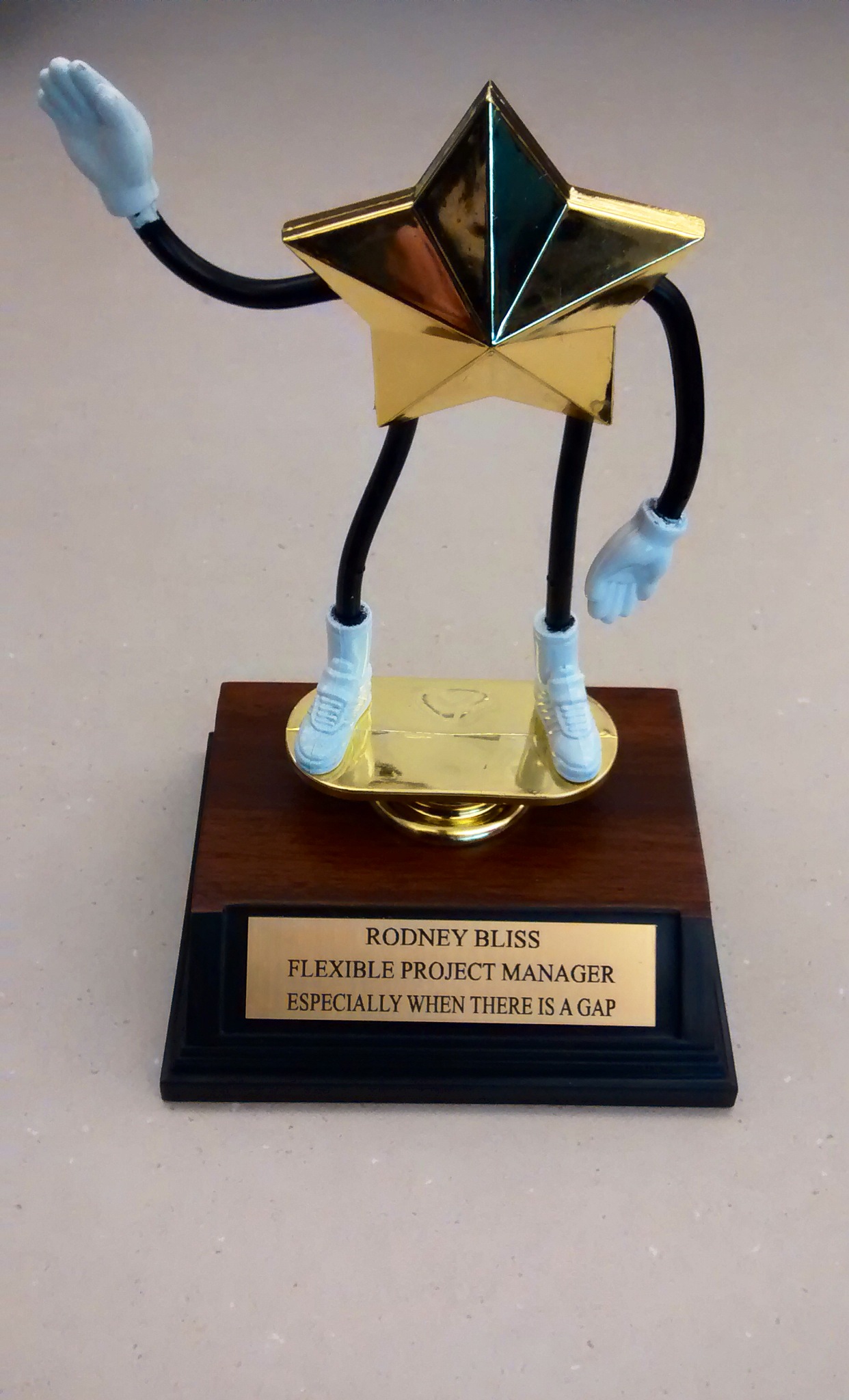
He gave it to me because we had a bet on whether I (or anyone, but I was the only one volunteering) could climb up through a gap in our turnstiles. A gap that is covered with spare ceiling tiles in this picture.
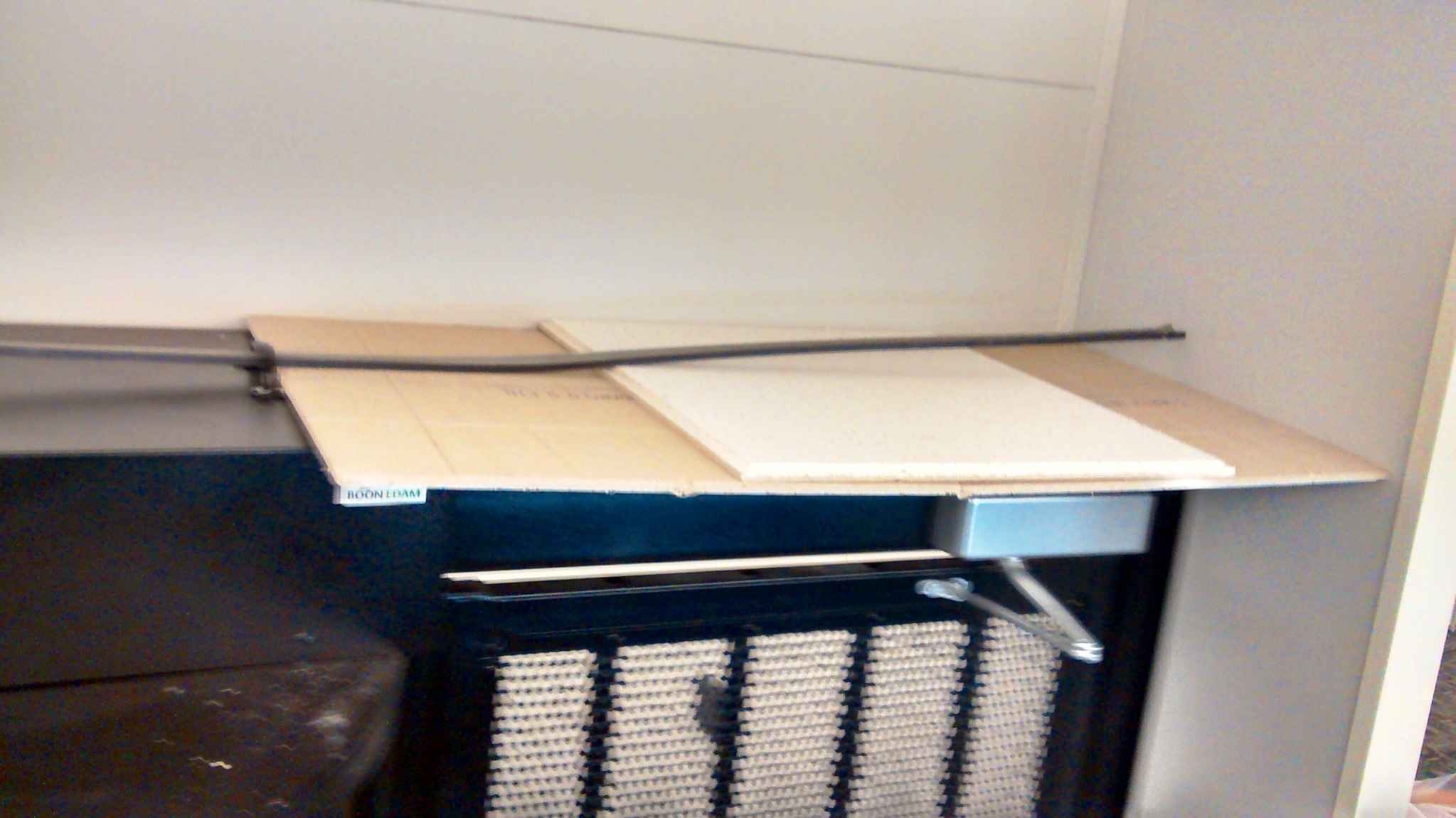
I’m not as small as I once was, (Up Through The Rabbit Hole) but, I was willing to venture $5 that I could make it. I did, he paid up and threw in a trophy to commemorate the event.
I’ll keep the trophy on my desk. But, the fact that it was for something that I did, something that he didn’t think I could do and then did anyway, means that it’s more important than a simple department wide trophy.
I’m not opposed to the Ship It award type rewards. I was part of a team. And, I really like team awards. In fact, I like them so well that I started awarding Ship It awards anonymously when my department at Microsoft decided to discontinue them. (They Switched To A Cash And Totally Blew It.)
But, I’m still concerned with the message that participation trophies send my kids. And then I realized what the trophy shelves were showing me. If you look at the top shelf of the above picture, the first trophy is 1st Place in Beginning Chess. Next to it is the 2nd Place in Beginning Chess trophy. (My sons were in a tournament and could beat everyone except each other.) The round trophy on the end is awarded when a kid reads 50 books in a summer. The two medals on ribbons say, 2nd Place Lindon Mini-Marathon 2012 and 3rd Place Grovecrest Mini-Marathon 2013. And the son who won them assures me that next year he’s going to take 1st.
The trophies on the third shelf? They are participation trophies.
My kids literally put the trophies they earned on the top shelf. While they may not even be able to articulate it, they see value in the top shelf trophies and don’t consider the participation trophies all that important.
I think they “get it.”
Rodney M Bliss is an author, columnist and IT Consultant. He lives in Pleasant Grove, UT with his lovely wife, thirteen children and one grandchild.
Follow him on
Twitter (@rodneymbliss)
Facebook (www.facebook.com/rbliss)
LinkedIn (www.LinkedIn.com/in/rbliss)
or email him at rbliss at msn dot com
Tell your friends about this!
Mind if I look at it?
Sure. Keep it pointed in a safe direction. . .Oh, and pull the slide back and verify there isn’t a bullet in the chamber.
That last bit wasn’t necessary, was it?
I have an uncle who turned 72 this week. I don’t see him as much as I’d like. Last week was an exception. (I Never Again Had Friends Like I Did When I Was 12. . .Does Anyone?) My uncle is retired. He was a dam builder, a highway patrolman, a sheriff and various other professions. Now he mostly hangs out at his house on Lake Coeur d’Alene and drives the bus for the Shriners.
He’s also a bit of a gun nut. His collection includes various handguns, shotguns and even a hunting rifle that he built. Over the weekend, he picked up a handgun at a yardsale. Here’s picture of the type he had, although his was in a hard plastic carrying case.

(Photo Credit: Impact Guns)
We’ll leave the morality, or wisdom of bringing a firearm to a family reunion with little kids to another day. I was thinking about his safety warning. He made the same warning to everyone who wanted to hold the gun.
Why? He KNEW the gun wasn’t loaded. In fact, we didn’t even have any 9mm ammunition available. And after the first person or two checked the chamber, why continually make people check?
Everytime something breaks at work, I have to get involved. And with software and users, something breaks a lot. One of the most important parts of my job is to determine who was responsible for the breakage; us or the client. It’s not always an easy choice. But, sometimes it is.
Two months ago, we had an outage that was our fault. All our agent phones went dead. They computers, the phones, everything. As you can imagine this is a major incident that gets high visibility. We traced the problem down to a piece of computer equipment that one of our engineers thought was a test device. They didn’t know we had any production calls going through it. But, messing up a production device wouldn’t have caused an outage if we hadn’t done some changes in the middle of the day.
We failed that day because the engineer failed to check to see if there was a bullet in the chamber.
A few weeks later there was another outage. Similar symptoms. The root cause of this second outage was one of our suppliers. They scheduled their maintenance, but neglected to tell us. In other words, they forgot to say, “Check to make sure there isn’t a round in the chamber.”
Either of these outages could have been easily avoided. And the amount of time it took to correct them was minimal. Still, I really strive for perfection in my job and these type of unforced errors make me go crazy.
It would have been easy for someone walking up to my uncle, especially if they had just seen someone else handle the pistol and check the barrel, to say, “I don’t need to check the barrel. I know it’s empty.” And they would be correct. But, far too many firearm deaths in this country are a result of someone getting shot with a gun that was unloaded. . .or at least the shooter thought it was unloaded.
My uncle made everyone check, because each of us when we picked up that firearm were responsible to handle it in a safe manner. That is not a responsibility that we could pass off to someone else, or trust someone else to complete.
In computers, especially complex systems that involve multiple departments, it is the responsibility of the engineer to check and double-check themselves to ensure that their changes won’t impact production.
For me, personally, my uncle didn’t need to warn me to check the chamber. I already had the slide pulled back and was checking it.
Safety is my responsibility.
Rodney M Bliss is an author, columnist and IT Consultant. He lives in Pleasant Grove, UT with his lovely wife, thirteen children and one grandchild.
Follow him on
Twitter (@rodneymbliss)
Facebook (www.facebook.com/rbliss)
LinkedIn (www.LinkedIn.com/in/rbliss)
or email him at rbliss at msn dot com
Tell your friends about this!

College campuses are generally beautiful places. Lots of brick buildings, picturesque views and large grassy expanses. All of those things take upkeep, of course.
My own alma mater, Brigham Young University is no different. It’s a gorgeous campus, nestled at the foot of the Wasatch mountain range. I enjoyed my time there for many reasons, not the least of which was that I dated and married my lovely wife while we were both students there.
Just because I loved my school doesn’t mean I think they were always the smartest administrators. Every year they had to replace large sections of the grass. Utah’s frigid winters and torrid summers take their toll, but 27,000 students walking on the grass will wear out the sod as well.

One year the school decided to address the issue by taking it straight to the students. At least in my case, their logic completely backfired.
Among my interests is studying Global Warming. It’s fascinating that we hare inside this big Petri dish and we are trying to figure out how it works from the inside. In computer science there is a concept that a computer system cannot check itself. In other words, you need to test software from a perspective outside the program. It’s part of the Turing Tests.
And yet with the earth, we are trying to do exactly that. But, I’m getting off track. If you’ve read about Global Warming at all you know that carbon dioxide is a big part of the equation. Scientists are concerned we are putting too much into the atmosphere.
This really isn’t a Global Warming post, except I have a question for you: What percentage of the earth’s atmosphere is carbon dioxide, also called CO2?
Sure, you don’t know, but just take a guess before you read on.
If you guessed that CO2 makes up somewhere between 25% and 33% of the atmosphere you would be right in line with the guesses my friends have suggested when I’ve asked them.
Okay, ready for the actual number?
400 ppm. . .that’s 400 parts per million. Put a different way, if you have 1,000,000 molecules from the atmosphere, 400 of them would be CO2. Let’s look at that ratio in a different way. If you had $1M, CO2 would be like $400 worth. That seems like a bunch. But, if you do the math, it works out to if you had $100, you would have $0.04 worth of carbon dioxide. Four cents on a hundred bucks.
So, what’s this have to do with the grass at BYU? When people find out that CO2 makes up just .0004% of the atmosphere, it changes their perception of the problem. A friend responded
Well, if it’s that low, I’m going to go start up my fireplace. What’s the big deal?
The big deal is the idea that knowledge can hurt your cause.
The year BYU attempted to get the students involved in reducing the landscaping costs they did it by sending out an announcement:
BYU spends $30,000 per year replacing worn sod. Put another way, each student has to contribute $1 just to replace grass.
They were trying to impress upon us the magnitude of the problem. They failed. I looked at that statistic and thought,
Okay. I’m willing to pay $1 per year to get to my classes a little quicker by walking across the grass.
What’s this have to do with business and computers?
Lots.
I’ve always been a manager who overshares. (Fortune Favors the Bold) And yet there are times where too much information simply creates more questions than it answer. Or worse yet, someone, after hearing your reasoning decides the reason for the decision isn’t valid. Just as I decided that $1/year to walk on the grass was well worth the cost to me.
There are time where you should simply tell people the way it will be and don’t go into detail. (Sometimes The Best Answer Is “It’s Magic.”)
Rodney M Bliss is an author, columnist and IT Consultant. He lives in Pleasant Grove, UT with his lovely wife, thirteen children and one grandchild.
Follow him on
Twitter (@rodneymbliss)
Facebook (www.facebook.com/rbliss)
LinkedIn (www.LinkedIn.com/in/rbliss)
or email him at rbliss at msn dot com
